Where Darkness Begins to Listen: Roy DeCarava in Los Angeles
Photography
At David Zwirner Los Angeles, more than 130 photographs from Roy DeCarava’s the sound i saw turn jazz, labor and street life into a score made from shadow, interval and attention.
Viacheslav Munister · 2026-09-30
Some photographs describe sound by showing its source: a trumpet lifted, a hand striking a drum, a mouth held close to a microphone. Roy DeCarava did something more difficult. He photographed the conditions in which sound becomes meaningful–the pause before a phrase, the body at work, the density of a room, the street that continues after the music has stopped.
At David Zwirner Los Angeles, the sound i saw gathers more than 130 images from a project DeCarava developed between the late 1940s and the 1960s. Curated by Ebony L. Haynes, it is the largest presentation of this body of work since its first exhibition at the Studio Museum in Harlem in 1983. An adjacent listening room, SIDE B: the sounds , extends the exhibition through records and programs shaped by the artist’s own musical life.
I · A book before an exhibition
the sound i saw began not as a commission or a documentary assignment but as a handmade artist’s book: a private sequence of roughly 300 photographs and text. This origin matters. The project does not behave like a catalogue of jazz history. Musicians appear beside children, workers, intersections and rooms because DeCarava was composing a lived environment rather than illustrating a genre.
When 125 photographs were shown at the Studio Museum in Harlem in 1983, curator C. Daniel Dawson described the work as a reflection on life made with jazz and photography as instruments. The distinction protects the pictures from a familiar reduction. DeCarava photographed Black musicians, but he refused to turn them into spectacle. He photographed Black life, but he refused the demand that every image perform as social evidence.
II · The street keeps time
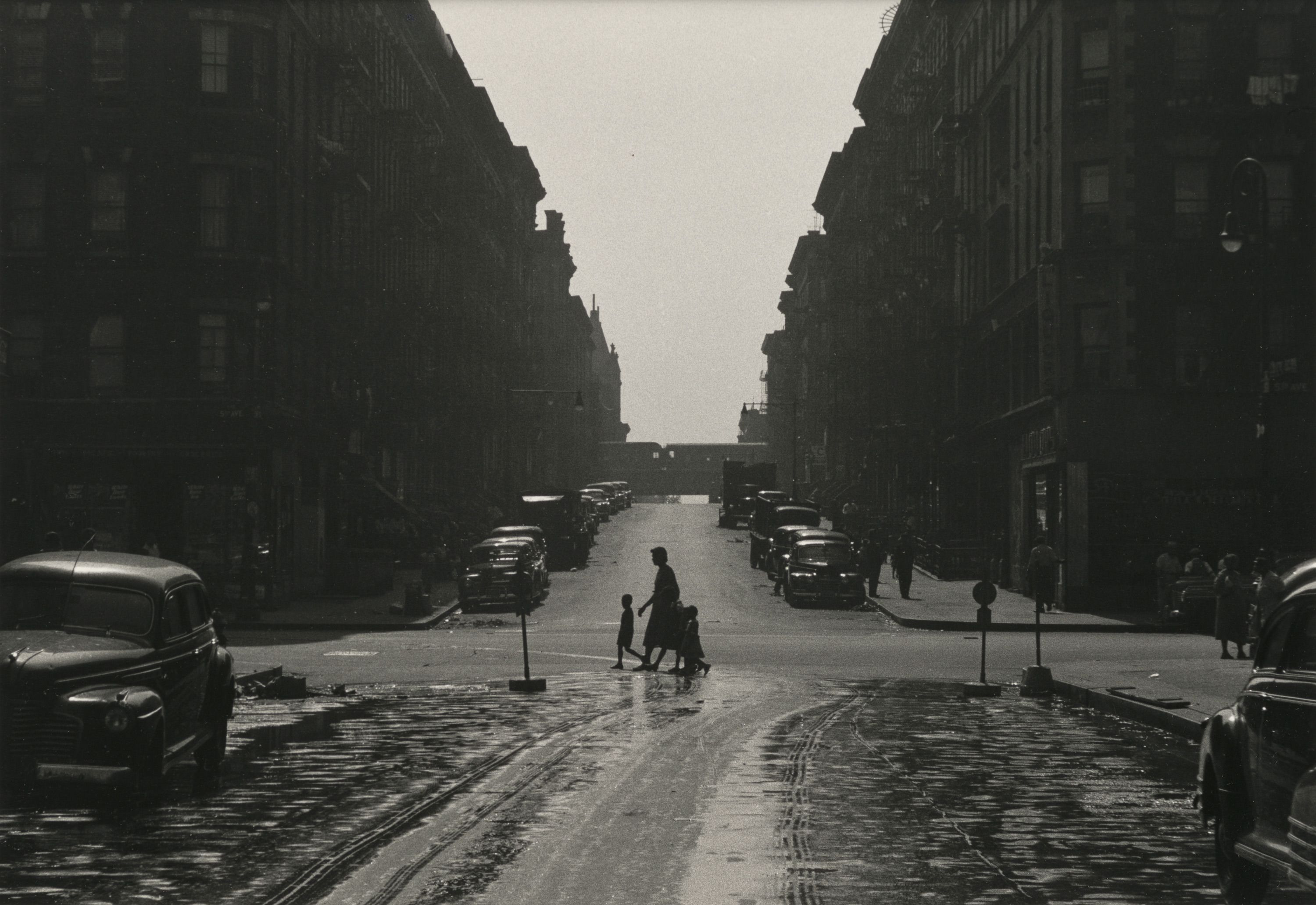
In Woman and children at intersection (1952), the city is divided by a bright wedge of winter sky and the dark walls of buildings. The figures are small, yet the crossing does not diminish them. Their movement activates the geometry. A photograph that might be called quiet contains several tempos at once: the pace of traffic, the careful step across snow, the duration of looking from a distance.
DeCarava worked with a handheld 35mm camera, moving through New York without the ceremony of a large apparatus. Mobility gave him proximity, but proximity was never permission to intrude. His pictures are intimate because they preserve the subject’s interiority. They do not explain people into submission.
III · Shadow is information
DeCarava’s darkness is often treated as a signature effect. It is better understood as an ethics of attention. In his prints, shadow does not conceal a lack of information; it changes the speed at which information arrives. The eye must adjust. A face, hand or doorway emerges gradually, and the viewer becomes conscious of the labor of seeing.
Blue Morocco (1955) turns a nightclub interior into a series of thresholds. Curtains frame a room whose occupants are visible but not offered up. The photograph holds back just enough to make atmosphere structural. Darkness becomes the architecture through which one enters.
IV · Music as relation
The portrait of bassist Percy Heath concentrates on an instrument, a hand and the partial presence of a face. DeCarava does not need the full performance. The photograph locates music in touch: the pressure of fingers against strings, the physical intelligence through which a note is made.
Art Blakey appears at a greater distance, isolated by the pool of light around his drums. The surrounding black is not empty. It measures the intensity of concentration. DeCarava said that he photographed musicians as people rather than as musicians, responding to the commitment they brought to life in a particular moment. The best of these images make work itself visible without turning labor into performance for the camera.
V · The break is part of the score
Ellington session break (1954) looks toward the interval that conventional music photography might discard. A coat rack occupies the centre; figures wait at the edges; ceiling lights repeat like notes above them. The session’s pause is not outside the music. It is where fatigue, preparation and ordinary time return.
This is DeCarava’s radical correction to the mythology of jazz photography. Billie Holiday, Miles Davis, John Coltrane and Count Basie appear across the larger project, but celebrity does not organize the sequence. The musician on stage and the deliveryman on the street share a world of skill, pressure, rest and attention.
VI · A politics without slogans
Force, New York (1963) records a Brooklyn protest against the destruction of residents’ homes for an expansion of Downstate Medical Center. Bodies press together in a frame where power is felt physically–in arms, shoulders, cloth and compression. DeCarava later described the deeper force in the image as the desire of people to reach sunlight.
The photograph’s politics are neither hidden nor converted into a slogan. Its argument comes from relation: the state acts upon bodies, and bodies answer through collective will. DeCarava understood that serenity could carry power without softening conflict.
VII · Dance and duration
In Dancers (Harlem) (1956), movement is dispersed across a dark floor. The image is not a single decisive instant so much as a field of rhythms. Figures advance, turn and recede; light catches the ground like a faint pulse. The photograph feels less like a frozen event than a duration briefly made visible.
That quality explains why the exhibition’s listening room is more than an accessory. DeCarava’s sequencing asks to be experienced musically: repetition produces difference, silence gives shape to sound, and the gap between images functions like an interval. The viewer does not merely identify subjects. The viewer learns a tempo.
DeCarava did not photograph jazz as an event. He photographed the world that made its intensity possible.
VIII · Verdict
the sound i saw is important because it refuses the false choice between formal beauty and social meaning. DeCarava’s tonal control is inseparable from the dignity he grants his subjects. His shadows ask for patience; his sequences resist extraction; his photographs make attention feel like a form of responsibility.
Seen in Los Angeles more than four decades after the project’s first public presentation, these pictures remain insistently contemporary. They answer an image culture built for brightness, speed and immediate recognition with a different proposition: look longer, accept partial knowledge, and let a photograph retain the right to be quiet.
Roy DeCarava: the sound i saw, curated by Ebony L. Haynes, is at David Zwirner, 606 N Western Avenue, Los Angeles, from 19 September to 31 October 2026. SIDE B: the sounds is presented at 616 N Western Avenue. This article was prepared from the gallery’s official exhibition materials and image captions; it does not claim an in-person visit. Images are reproduced for editorial review with credits supplied by David Zwirner.
Read next
- Where Wisdom Takes Form: Inside the New CCA Tashkent
- The Forms That Refuse a Name: Richard Pearson on Painting Other Worlds
- The World Is Not What It Says: Magritte’s Afterlife at Gagosian London
- The Ocean Is Not Blue: Torkwase Dyson and the Politics of Abstraction
- The Ordinary Life Is Not a Small Subject: Louis Fratino and the Painting of Intimacy
- The Painting Is Still Wet: Emma McIntyre and Art That Refuses to Finish