The World Is Not What It Says: Magritte’s Afterlife at Gagosian London
Exhibition
At Gagosian London, René Magritte is placed beside more than forty artists to test not who copied his motifs, but who inherited his deeper proposition: that an ordinary image can become unreliable without ceasing to look ordinary.
Viacheslav Munister · 2026-09-29
A pipe is useful until it becomes an image. Then it stops carrying smoke and begins carrying doubt. René Magritte understood that the smallest distance between a thing, its picture and its name could be made wide enough to contain an entire philosophy. At Gagosian’s Grosvenor Hill gallery, This Is Still Not a Pipe: The Afterlife of Magritte asks what happened after that distance entered visual culture and never closed again.
Organised with the Fondation Magritte and curated by Jasper Sharp and Bernard Lagrange, the exhibition brings paintings, works on paper and sculpture from across Magritte’s career into contact with more than forty artists. The important word is not influence but afterlife . This is less a family tree of quotations than a test of which of Magritte’s problems remain active: the unreliable word, the theatrical object, the scale that turns familiarity into menace, and the image that withholds exactly what it appears to show.
I · Not a retrospective, but a pressure test
The exhibition begins with a historical span that is unusually broad without becoming dutiful. Its earliest Magritte, Les Fleurs du voyage (1926), appeared in his first one-person exhibition in Brussels. Nearby works carry the painter through the Paris years, the cloud-filled sky of La Malédiction (1931), the word-image puzzles of the 1930s, the deliberately coarse vache period of 1948 and the late, polished paradoxes for which he became globally recognisable.
Placed alone, these works might describe the evolution of a career. Placed among objects and paintings made decades later, they behave differently. They become propositions waiting for replies. The gallery’s installation makes that argument spatially: Magritte is not given a sealed historical room. His pictures keep reappearing between Robert Gober, Vija Celmins, Maurizio Cattelan, Mona Hatoum, Sarah Lucas, Jeff Koons, Issy Wood, Victor Man and newly commissioned works.
II · The painting that behaves like evidence
L’Apparition (1928) demonstrates the structure beneath Magritte’s familiar imagery. A dark field holds forms that seem to have arrived from incompatible systems: fragments of landscape, bodily suggestion, diagram and object. The surface does not ask to be admired as brushwork. It asks to be inspected as if it were evidence from an event whose rules have not been disclosed.
That evidentiary flatness matters. In a conversation published by Gagosian Quarterly, Alex Da Corte distinguishes Magritte from painters whose thinking is visible in the movement of paint. Magritte often appears to have the image already decided and then executes it with the cool precision of an illustration or a distorted camera. The lack of painterly confession is not an absence of thought. It is what transfers the burden of thought to the viewer.
III · A sky becomes an object
La Malédiction (1931), the earliest single-panel canvas in which Magritte devoted the entire field to a cloud-filled sky, removes the ground without turning the painting into pure atmosphere. The sky becomes a thing: bordered, transportable, owned. Once framed, even infinity acquires edges.
This is one reason Magritte’s clouds survive so easily in advertising and design. They are both weather and graphic device, nature and ready-made backdrop. But the commercial afterlife can conceal the original disturbance. His sky is not freedom. It is a surface pretending to be depth.
IV · The artist as his own impossible object
La Lampe philosophique (1936) is often understood as a conceptual self-portrait. A face, a pipe and a candle are locked into a circuit of looking and consumption. The nose enters the pipe; the candle bends with an almost bodily exhaustion. Nothing in the scene is painted as a dream effect. Every component is materially plain, and the impossibility lies only in their relation.
Magritte repeatedly called ordinary objects “problems”: the problem of the window, the door, the mountain. The formulation remains useful because it denies symbolism an easy victory. A pipe does not need to stand for one stable idea. It becomes a problem because painting separates it from use while leaving its identity intact.
V · Day and night refuse to take turns
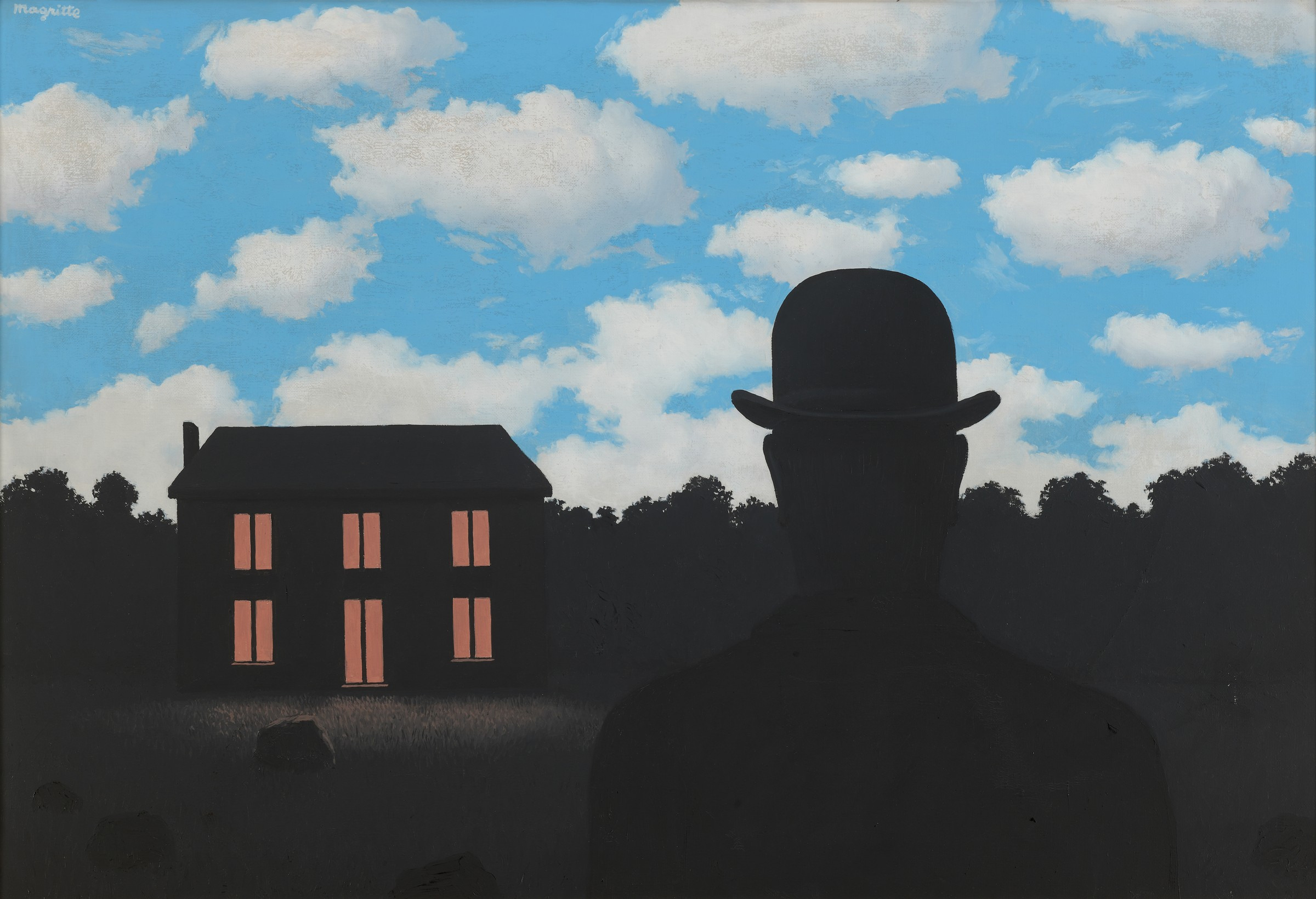
The late L’Empire des lumières (1961), loaned by the Heidi Horten Collection, is the final painting in Magritte’s celebrated sequence of landscapes where a bright daytime sky hangs above a nocturnal street. It is also the only one in the series to include a bowler-hatted figure silhouetted against the sky.
The device is famous because it is instantly legible. It is lasting because legibility does not resolve it. The sky and street are both convincing, and therefore their coexistence cannot be dismissed as fantasy. Magritte does not invent a new world; he forces two true descriptions of this one to occupy the same moment.
VI · What the descendants inherited
The strongest contemporary responses do not reproduce the apple, cloud or bowler hat. They inherit Magritte’s method of making an object betray its category. Vija Celmins’s Pink Pearl Eraser (1966–67) enlarges a disposable correction tool into a painted balsa-wood sculpture. It remains recognisably an eraser while becoming incapable of erasing. Use has been displaced by scale.
Dana Schutz’s new painting The Singer (2026) operates further from Magritte’s iconography but close to his theatrical logic. The figure and the picture plane seem to negotiate which one is permitted to contain the other. It is not a quotation; it is a continuation of the same distrust in stable pictorial space.
VII · Why Magritte now
Magritte’s relevance is often explained through ubiquity: his images anticipated advertising, music videos, fashion and the visual shorthand of the internet. That is true but insufficient. Ubiquity can make an artist harmless. What the exhibition restores is the friction beneath recognition.
Our contemporary image systems promise transparency while producing uncertainty. AI-generated pictures can be entirely plausible and entirely without a photographed event behind them. Interfaces label objects, faces and places with increasing confidence. Magritte’s old separation between word, image and thing no longer reads as a philosophical joke; it reads as basic media literacy.
Da Corte identifies something still more unfashionable in Magritte: opacity. These pictures do not reveal the artist’s inner process, supply a correct interpretation or reward the viewer with full access. They remain clear and withholding at once. In a culture organised around explanation, disclosure and instantly searchable context, that refusal feels newly contemporary.
Magritte’s pictures do not ask whether the world is real. They ask why an image should be trusted simply because it looks familiar.
VIII · Verdict
This Is Still Not a Pipe succeeds when it treats influence as a working problem rather than a resemblance game. With more than forty contemporary artists, the exhibition inevitably produces uneven lines of descent. Some works sit close to Magritte’s vocabulary; others require the curatorial premise to make the relationship visible. But that unevenness is productive. It shows that Magritte’s afterlife is not a style. It is a set of permissions: to let the ordinary become unstable, to make scale carry meaning, to allow an image to contradict its caption, and to leave the central mechanism unexplained.
The exhibition is therefore most useful not as a celebration of a canonical Surrealist, but as a manual for looking at images now. The pipe is still not a pipe. The more urgent discovery is that the photograph may not be evidence, the label may not be knowledge, and the familiar may be the least trustworthy category of all.
This Is Still Not a Pipe: The Afterlife of Magritte is at Gagosian, 20 Grosvenor Hill, London W1K 3QD, from 24 September to 12 December 2026. Tuesday–Saturday, 10am–6pm. Curated by Jasper Sharp and Bernard Lagrange in collaboration with the Fondation Magritte. This article was prepared from the exhibition materials and official installation photography; it does not claim an in-person visit. All artworks and photographs are reproduced for editorial review with the credits supplied by Gagosian.
Read next
- Where Wisdom Takes Form: Inside the New CCA Tashkent
- The Forms That Refuse a Name: Richard Pearson on Painting Other Worlds
- Where Darkness Begins to Listen: Roy DeCarava in Los Angeles
- The Ocean Is Not Blue: Torkwase Dyson and the Politics of Abstraction
- The Ordinary Life Is Not a Small Subject: Louis Fratino and the Painting of Intimacy
- The Painting Is Still Wet: Emma McIntyre and Art That Refuses to Finish