The Ocean Is Not Blue: Torkwase Dyson and the Politics of Abstraction
Contemporary Painting
In Seeing in Blue, Torkwase Dyson asks whether painting can hold the ocean as physics, memory, extraction and freedom at once–and whether abstraction can make climate crisis felt before it becomes an image.
Viacheslav Munister · 2026-09-30
The ocean is not blue. Water has no colour of its own; it borrows, scatters, absorbs and returns light. Blue is therefore not a property but an event–a relation between depth, distance, matter and an eye. This unstable fact is the beginning of Torkwase Dyson’s new paintings, and it prevents them from settling into the category that their beauty initially suggests.
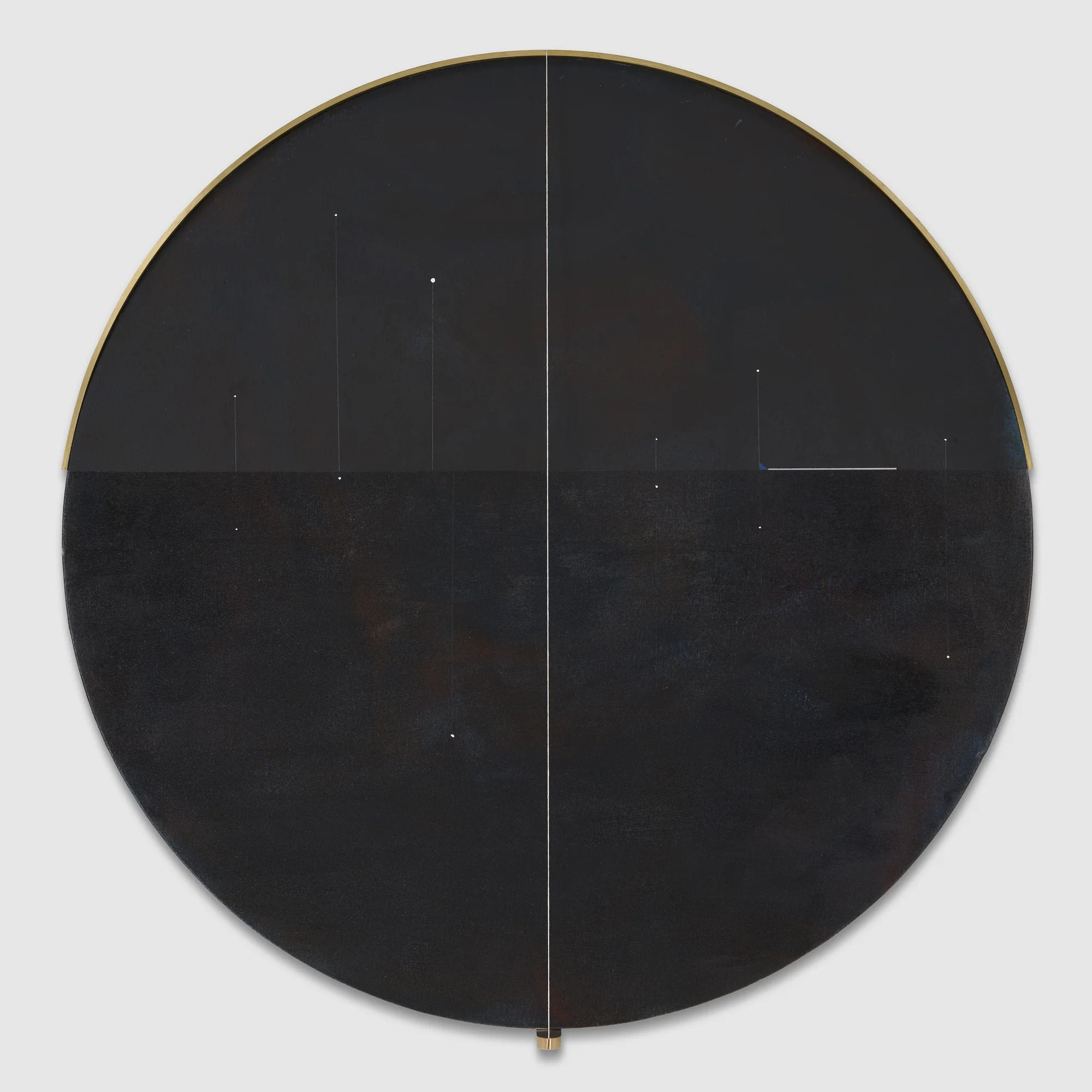
At Pace Gallery in New York, Seeing in Blue presents paintings informed by more than a decade of swimming and deep-sea diving. Their dark aquatic fields are crossed by arcs, strings, seams, brass bars and small apertures. They appear at once as maps, instruments, night skies and fragments of architecture. Yet they illustrate none of these things. Dyson’s question is more demanding: can painting carry the physical knowledge of water–and the political histories contained within it–without reducing either to an image?
I · Against the climate image
Contemporary culture has developed a stable visual language for ecological crisis. Aerial photographs show burning forests, retreating ice, poisoned rivers and coastlines seen from satellites. These images are necessary as evidence, but their repetition produces a paradox: the more completely catastrophe is pictured, the more easily it becomes scenery. The viewer is placed safely outside the event, looking down.
Dyson removes that distance. Her paintings do not show an ocean; they ask what it means to have a body inside one. Pressure replaces panorama. Buoyancy replaces horizon. Breath becomes a measure of time. Navigation is no longer a line drawn over a map but the continuous negotiation between density, darkness and movement.
II · Physics and memory
Dyson describes working with water as moving “between physics and memory.” The phrase resists the division between objective environment and subjective experience. Water obeys pressure, gravity and temperature; it also stores histories of transport, extraction, labor, migration and death. To enter it is to meet both systems at once.
Her studio process repeats this double movement. She begins with canvases laid on the floor, allowing washes of diluted colour to spread, pool and escape complete control. She then answers that errancy with measured geometric construction. Flow is followed by structure; accident by decision. The painting becomes a negotiation between what matter does and what a body asks it to do.
III · Abstraction is the subject
Dyson has made an essential distinction: she does not describe herself simply as an abstract artist; she has chosen abstraction as a subject. The difference matters. Abstraction is not a style applied after the political content has been decided. It is itself a political operation: the process by which bodies, territories and resources are converted into categories, property lines, statistics and zones of control.
A map is an abstraction. So is a shipping route, a flood-risk boundary, a prison plan, a deed, an insurance district and the financial instrument that makes extraction profitable before anything has been removed from the ground. Abstraction can erase lived specificity. It can also allow a person to imagine space otherwise. Dyson works inside this conflict rather than pretending abstraction is innocent.
IV · Black geography is not a theme
For Dyson, ecology cannot be separated from Black spatial history. The Atlantic is a living system and a historical structure: a medium of forced movement, trade, colonial extraction and diaspora. Land is never only landscape when plantations, property and environmental exposure have determined which bodies may occupy it safely.
This is why “Black geography” in her work is not iconography to be located in a picture. It is a way of thinking about movement under unequal conditions. Her shapes draw from histories of self-emancipation and improvised shelter: how to hide, turn, pass, breathe, build and remain indeterminate inside systems designed to make a body legible and controllable.
V · Geometry after freedom
Dyson calls parts of her formal vocabulary “hypershapes.” Curves, wedges, apertures and compressed rooms are distilled from liberation strategies rather than from geometry as an autonomous language. Their sources include the spatial intelligence through which enslaved and fugitive people survived: the hull, the garret, the hidden route, the narrow opening and the architecture made usable against its intended purpose.
The forms do not decode into a single story. That refusal is crucial. A symbol becomes governable once its meaning is fixed. Dyson’s geometries remain available for movement; they can be read as enclosure and exit, pressure and protection, structure and breach. Freedom appears not as unlimited open space but as the ability to compose within constraint.
VI · A painting with an edge
Photographed frontally, these works can look restrained and almost immaterial. Seen obliquely, they disclose their objecthood. Cotton string stands away from the surface; brass and bronze interrupt the painted field; canvases possess substantial depth; circular and irregular supports reject the neutral rectangle.
The side view changes the argument. A line is not only drawn; it is tensioned across space. A bar is not only a colour; it has weight, conductivity and resistance. The work oscillates between diagram and construction. It does not depict architecture so much as make the viewer encounter painting architecturally–through distance, position and bodily scale.
VII · Blue without innocence
Dyson’s earlier paintings often approached blackness through layered mixtures rather than a single black pigment. In Seeing in Blue , aquatic colour comes forward, but the blue is equally impure. Titanium white can make it seem incandescent; green flickers below it; rust-red passages suggest oxidation, sediment or an atmosphere losing equilibrium.
The blue therefore refuses the cultural promise commonly attached to it: serenity, infinity, escape. Dyson rejects what she calls the merely “vacation beautiful.” Her oceanic beauty is prehistoric, vulnerable and terrifying. It includes artificial reefs and living ecologies, but also seafloor drilling, military posts, acoustic surveillance and the ruins of the built world.
VIII · Beauty as a method of staying
There is a temptation to treat beauty as politically suspect whenever the subject is disaster. The fear is understandable: beauty can aestheticize damage and make violence consumable. Dyson proposes another function. Beauty can hold attention where spectacle exhausts it. It can keep a viewer inside complexity long enough for relations to emerge.
Her surfaces do not reward a quick scan. Near-black passages require the eye to adjust; fine strings and graphite marks disappear and return; metallic interruptions alter with the viewer’s position. Looking becomes slow, physical and incomplete. That incompleteness is not evasive. It is a rehearsal for encountering an ecology that cannot be mastered from a single point of view.
IX · The scale of intimacy
Much of Dyson’s practice has moved across monumental painting, sculpture, architecture and collective study. These new works compress that research into a more intimate register. Their scale does not make the subject smaller. It changes the relation from public address to proximity.
Blue Worlding for Love pushes beyond the wall as a support. Its layered planes and brass member resemble a compact shelter, instrument or incomplete model. The title matters: “worlding” names the active construction of relations rather than the passive occupation of a given world. Love enters not as sentiment but as a spatial practice–the work of making conditions in which another body can live.
X · What the paintings cannot do
No abstract painting can explain climate science, repair an ecosystem or redistribute environmental risk. Dyson’s theoretical vocabulary is dense enough that the works can appear inaccessible without prior knowledge. The gallery context adds another contradiction: objects concerned with liberation and unequal space circulate through one of the most exclusive spatial economies in culture.
But demanding that a painting solve the crisis it addresses would repeat the instrumental logic the work opposes. Its function is different. Dyson makes visible the habits through which knowledge is organized: the preference for views from above, for clean boundaries, for catastrophe rendered as an image happening elsewhere. Her paintings shift knowledge back toward the body–not as pure feeling, but as a sensing instrument implicated in history.
Dyson does not paint the ocean as a place to look at. She paints what happens to knowledge when the body is already inside it.
XI · Verdict
Seeing in Blue succeeds because it refuses to make ecological painting legible through familiar signs of nature. There are no waves to admire, no horizon to lose oneself in and no ruined coastline to confirm what the viewer already knows. Instead, water becomes a method for rethinking painting: fluid and constructed, material and mnemonic, beautiful and compromised.
The deepest proposition is that abstraction does not move away from reality. It reveals how reality has already been abstracted–into territory, infrastructure, value and risk–and asks whether those systems can be recomposed. In Dyson’s hands, a line can be a route, a barrier, a breath or a relation. Blue can be light and depth, but never innocence.
Torkwase Dyson: Seeing in Blue is at Pace Gallery, 540 West 25th Street, New York, from 11 September to 24 October 2026. The exhibition presents new paintings informed by Dyson’s experiences as a swimmer and deep-sea diver. This article was prepared from the artist’s writings, interviews and official exhibition materials; it does not claim an in-person visit. Images are reproduced for editorial review with credits supplied by Pace Gallery.
Read next
- Where Wisdom Takes Form: Inside the New CCA Tashkent
- The Forms That Refuse a Name: Richard Pearson on Painting Other Worlds
- The World Is Not What It Says: Magritte’s Afterlife at Gagosian London
- Where Darkness Begins to Listen: Roy DeCarava in Los Angeles
- The Ordinary Life Is Not a Small Subject: Louis Fratino and the Painting of Intimacy
- The Painting Is Still Wet: Emma McIntyre and Art That Refuses to Finish