The Ordinary Life Is Not a Small Subject: Louis Fratino and the Painting of Intimacy
Contemporary Painting
In Prose, Louis Fratino paints lovers, relatives, baths, gardens and subway cars–and asks why an ordinary queer life, given the scale of history painting, can still feel radical.
Viacheslav Munister · 2026-10-01
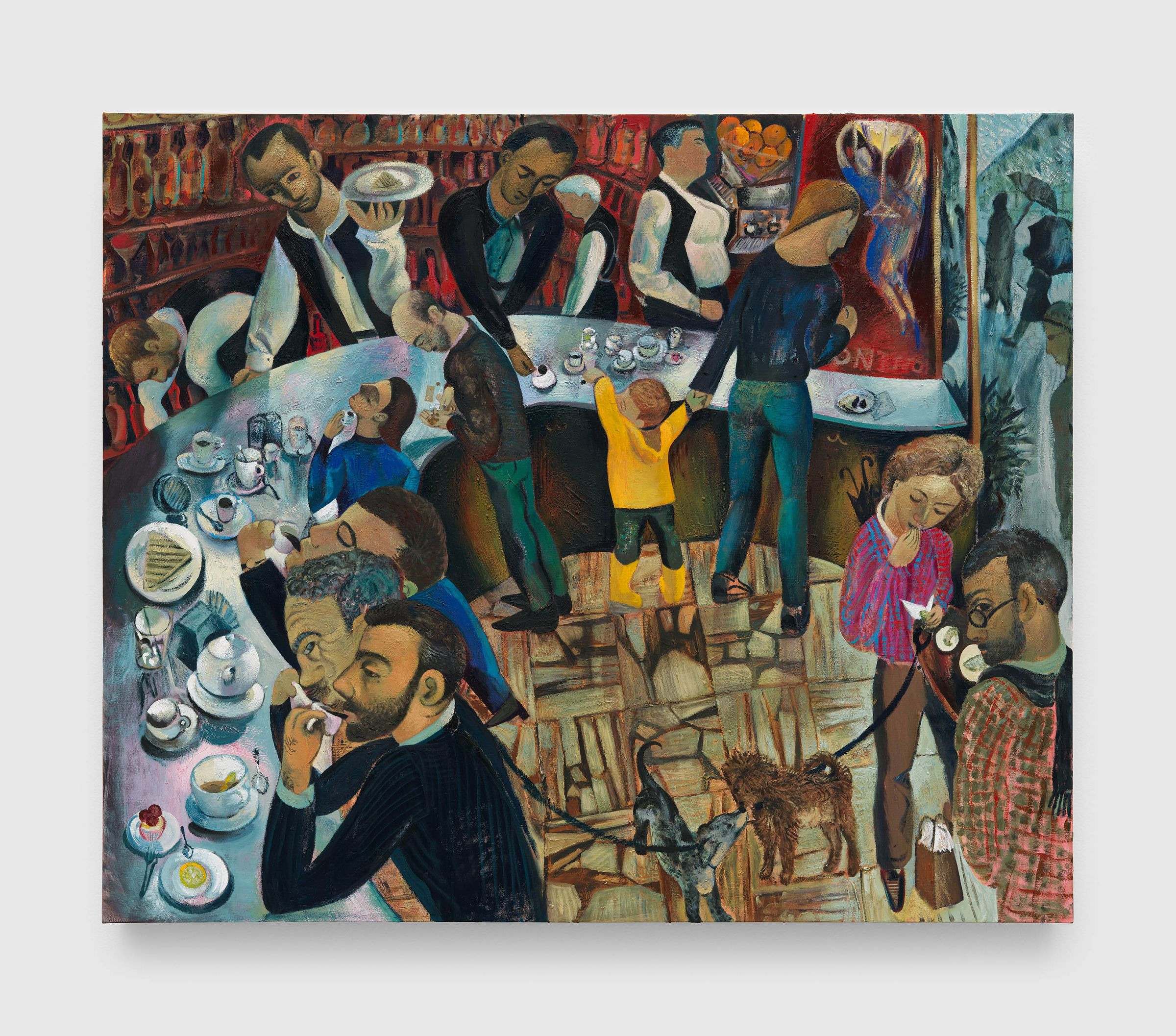
A life becomes visible in fragments: coffee cups on a crowded table, a lover turning in bed, a mother’s garden seen at the hour when colour begins to loosen, a naked body folded into bathwater, strangers packed into a subway car. None of these events announces itself as history. Louis Fratino paints them as if the distinction between a major and minor subject were no longer useful.
His new exhibition Prose , at David Zwirner in London, contains paintings, drawings and sculpture made from observation and memory. The title is exact. Prose is what carries most of a life: not the exceptional line preserved for quotation, but the continuous language between moments. Fratino’s paintings ask what happens when this ordinary continuity–especially the continuity of queer life–is granted the concentration once reserved for mythology, power and public catastrophe.
I · After visibility
Queer figurative painting has often been discussed through visibility: which bodies were absent from museums, which desires were concealed, and what political work is performed when they enter the frame. Fratino belongs to a generation for whom the problem has changed without disappearing. The male body can now be shown desiring another male body, but visibility alone no longer guarantees complexity.
The harder task is to paint queer life without requiring it to remain exemplary, transgressive or tragic. Fratino’s figures eat, wait, bathe, read, travel and become bored. Sex appears, but it belongs to a larger ecology of domestic life. The radical claim is not simply that these bodies deserve representation. It is that their uneventful time deserves form.
II · Memory is not an archive
Fratino paints from memory, even when observation begins the process. This does not mean retrieving an intact mental photograph. Memory edits scale, exaggerates colour, compresses rooms and brings emotionally adjacent moments into the same field. A body can become too large for the bed because its felt presence was larger than the room.
In Ale in his mom’s bedroom (after Corot) , the seated figure is held inside greens and muted reds that make the room feel remembered rather than measured. The parenthetical “after Corot” identifies an artistic ancestor while also admitting that influence reaches the present through private experience. Art history is not outside the bedroom. It is one of the things remembered there.
III · The crowded picture
Coffee is a social painting structured by objects. Cups, glasses, chairs and bodies compete for the same shallow space. The table does not organise the gathering so much as record its aftermath. Fratino’s compressed perspective allows every detail to insist on itself: the drink, the hand, the face partly hidden behind another person.
This density carries an ethical position. No figure becomes the sovereign subject around whom the scene is arranged. Intimacy is distributed. A gathering is made from simultaneous acts of attention and distraction, and the painting refuses to decide which one matters most.
IV · Pleasure without defence
Pleasure in contemporary art is frequently asked to provide its own alibi. It must be critical pleasure, wounded pleasure, pleasure made acceptable by an explanatory structure. Fratino resists this economy. He has said that he wants to remain vulnerable in the studio and to work without embarrassment–as if the private dialogue of painting should not begin by anticipating prosecution.
The sauna turns a communal interior into a field of orange and red bodies. Anatomy is elastic; limbs intersect; heat seems to deform the room. The painting is erotic, but its eroticism does not depend on a single exposed act. It comes from proximity, repetition and the temporary suspension of distance between bodies.
To paint pleasure without defence is not politically naïve. Queer culture has been made visible through histories of prohibition, medicalisation and loss. An image of ease can therefore carry historical pressure even when it refuses to illustrate suffering. The right to appear unafraid is not the absence of politics; it is one of politics’ unfinished outcomes.
V · The body as landscape
In The green bath , a body folds so completely into the vessel that figure and container begin to share a contour. The view from above abolishes a stable horizon. Knees, chest, water and enamel become a single knot of green volumes.
Fratino’s distortions are sometimes placed in a lineage running through Picasso, Matisse and Marsden Hartley. The references are real, but resemblance can become a lazy conclusion. What matters is how inherited distortion changes when the body being painted is not an anonymous model but a lover, friend or self. Formal freedom becomes inseparable from relational knowledge.
VI · Looking without possession
The reclining nude is among Western painting’s most burdened formats. It converts a body into an available surface and assigns the viewer a privileged position outside the scene. Fratino inherits this structure and makes it unstable. His nudes are often aware of being seen, yet they do not organise themselves for the viewer’s control.
In Nude with black hair , the figure’s horizontal body occupies almost the full canvas, but the face does not offer access. Flesh is painted with tenderness without becoming smooth. The image distinguishes intimacy from possession: familiarity allows the painter to remain close, not to claim total knowledge.
VII · Painting as a form of care
Fratino has described painting as an act of respect or care because it demands time, skill and a kind of abasement. The formulation is useful in an era when images are made and discarded with almost no friction. A painting holds someone in attention for longer than convenience requires.
Chrissie is small enough that the face must be approached rather than consumed at a distance. The surface remains worked and unresolved; likeness is constructed through accumulated decisions rather than photographic completeness. Care appears not as idealisation but as sustained looking.
VIII · The city enters the room
Domestic intimacy is not sealed off from public life. The subway car compresses strangers, reflections, advertisements and metal structure into a vertical chamber. The transit system becomes another interior–shared without being private, physically close without promising recognition.
The picture complicates the comforting idea that Fratino paints only a protected world of lovers and family. Urban queer life is shaped by public codes of looking: the glance that tests safety, the body that recognises another body, the practiced indifference of strangers. The subway car is a social composition in which everyone sees and avoids being seen.
IX · Art history at home
Fratino’s paintings openly converse with European and American modernism: Matisse’s decorative interiors, Corot’s figures, Picasso’s compressed bodies, Hartley’s masculine charge, Bonnard’s domestic colour and Alice Neel’s psychological line. The risk of such fluency is that citation can become a certificate of seriousness attached to private life.
His strongest works reverse that relation. They do not use art history to legitimise queer experience; they use queer experience to test what art history can still do. A modernist distortion that once signalled formal revolution is returned to the kitchen, bath and bed, where it must become emotionally specific again.
X · Why “prose” matters
Poetry is conventionally granted compression, intensity and transformation. Prose carries sequence: one sentence after another, one day following the previous day. By calling the exhibition Prose , Fratino chooses duration over climax. A life is not proven by its most dramatic image. It accumulates through repeated rooms, bodies and objects.
This is also a theory of painting. Each canvas is discrete, but the subjects age and return. A niece appears first as a baby and later as a child; partners and relatives occupy new rooms; the artist imagines painting himself when he is old. Autobiography becomes serial rather than confessional. The work’s meaning lies not only in disclosure but in continuity.
XI · The still life is never still
A bowl of fruit seems to suspend politics entirely. Yet still life has always been a record of access: what could be bought, stored, displayed and allowed to decay. Fratino’s apples and pears are compressed into a dark bowl on striped cloth, painted with the same bodily pressure as his nudes.
The equivalence is important. Fruit, flowers and flesh belong to one visual world because intimacy is not confined to interpersonal drama. It is a way of assigning attention. The ordinary object is not elevated out of ordinary life; ordinary life is revealed as already dense with form.
XII · The problem of the beautiful life
Fratino’s work is easy to love, and that ease creates suspicion. The paintings are colourful, sensual, art-historically literate and highly desirable within the market. The intimacy they depict can be converted into a style: the queer domestic interior as a recognisable and collectible genre.
The problem is not that the work is beautiful or commercially successful. It is whether vulnerability survives repetition. When the same compressed anatomy and saturated palette move from lover to flower to city scene, they risk becoming a guarantee of authorship rather than a fresh encounter. The paintings remain alive where the subject resists the painter’s known solution.
Fratino’s answer appears to be expansion rather than reinvention. The world of the paintings grows as his world grows: family, travel, public space, aging and new forms of attachment. This is a modest strategy, but modesty is the premise of the work. A style changes because a life does.
Fratino’s most consequential claim is not that queer intimacy belongs in art history, but that ordinary time is one of history’s primary materials.
XIII · Verdict
Prose matters because it refuses the hierarchy that makes public violence historically serious and private pleasure merely personal. Fratino does not deny conflict; he declines to let conflict monopolise the meaning of queer life. His paintings preserve affection, boredom, appetite, embarrassment and rest as forms of knowledge.
The ordinary life is not a small subject. It is where political victories and failures become inhabitable: in who can share a room, touch without fear, build a family, age visibly and expect another morning. Painting cannot secure those conditions. It can insist that they are worth the time required to see them.
Louis Fratino: Prose is at David Zwirner, 24 Grafton Street, London, from 18 September to 31 October 2026. The exhibition is the artist’s first solo presentation in London and his first with the gallery since representation was announced. This article was prepared from official exhibition materials and published interviews; it does not claim an in-person visit. Images are reproduced for editorial review with credits supplied by David Zwirner.
Read next
- Where Wisdom Takes Form: Inside the New CCA Tashkent
- The Forms That Refuse a Name: Richard Pearson on Painting Other Worlds
- The World Is Not What It Says: Magritte’s Afterlife at Gagosian London
- Where Darkness Begins to Listen: Roy DeCarava in Los Angeles
- The Ocean Is Not Blue: Torkwase Dyson and the Politics of Abstraction
- The Painting Is Still Wet: Emma McIntyre and Art That Refuses to Finish