The Painting Is Still Wet: Emma McIntyre and Art That Refuses to Finish
Contemporary Painting
Emma McIntyre paints with rust, oxidised copper, bone black, gravity and time–making works that continue to change after the artist has stopped touching them.
Viacheslav Munister · 2026-10-02
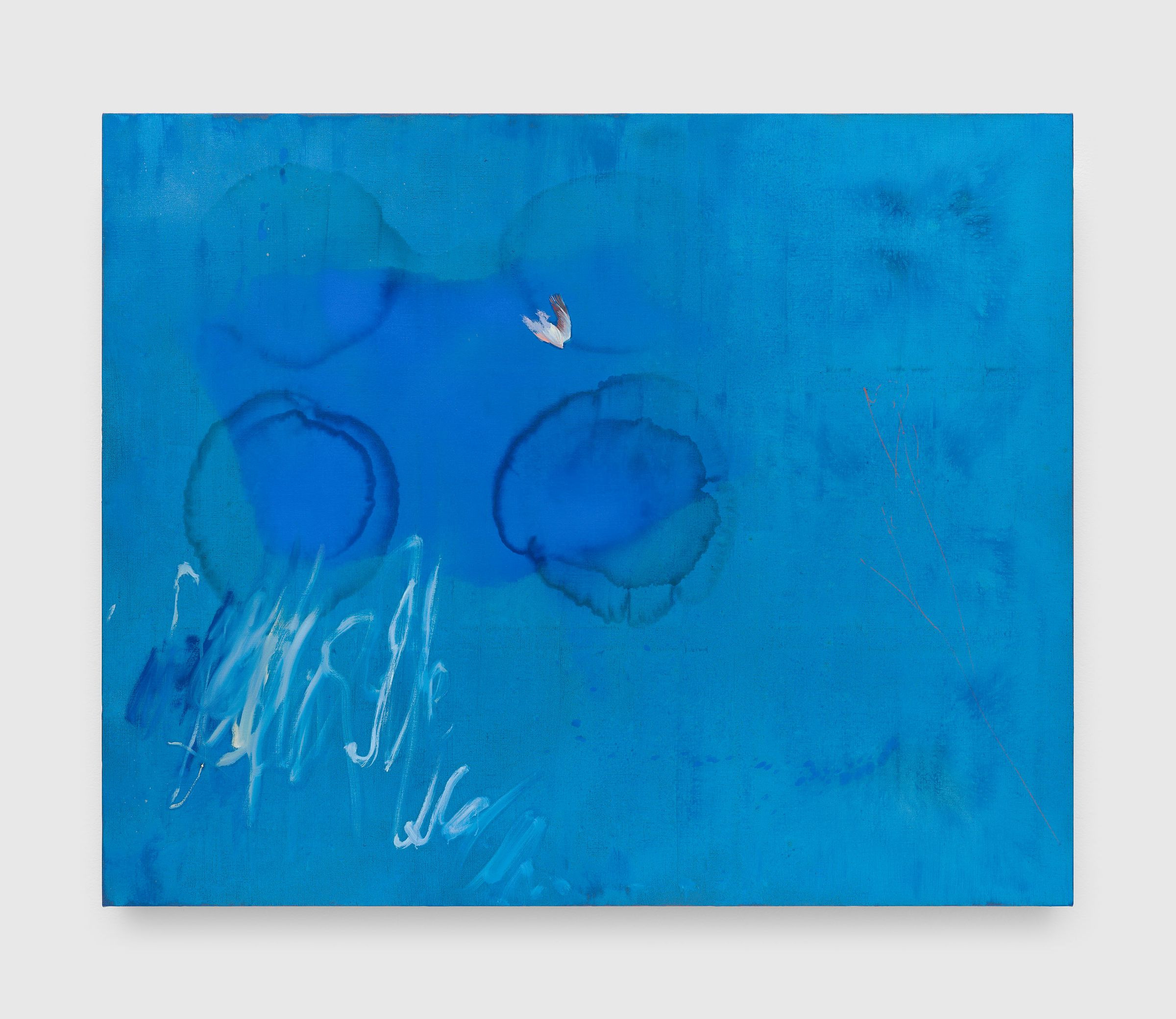
The fiction of a finished painting is useful. It gives the museum a date, the market a stable object and the art historian a boundary: before completion, the artist was deciding; after completion, the work began to mean. Emma McIntyre’s paintings disturb that sequence. Rust keeps blooming. Copper continues to oxidise. A surface changes after the hand has withdrawn.
In This body holds / swamp stuff , at David Zwirner’s 52 Walker in New York, McIntyre treats painting less as the execution of an image than as the temporary organisation of reactions. Oil, iron, copper, bone black, solvent, pressure, gravity and bodily contact meet on canvas. The artist initiates conditions, but matter retains the right to answer.
I · Who finishes the painting?
Western painting has long attached authority to the final touch. Completion confirms authorship: the painter has decided that no further mark is necessary. McIntyre replaces this sovereign model with collaboration. She pours and tilts, presses bubble wrap into wet pigment, oxidises metal-based paint and takes impressions from her own palette and body.
None of this means surrendering intention. Chance is prepared, watched and edited. The relevant distinction is not control versus accident, but complete control versus responsive control. McIntyre makes a move, observes what the material does, and composes the consequence.
II · Alchemy without mysticism
Solve et coagula names the alchemical instruction to dissolve and recombine. The phrase can sound mystical, but McIntyre’s process is stubbornly physical. Iron meets an oxidising solution and becomes rust. Copper produces blue-green compounds. Pigment thinned with solvent follows gravity across a horizontal support.
Alchemy here is not a fantasy of turning base matter into gold. It is a method for letting substances disclose behaviours that conventional studio technique tries to stabilise. Paint ceases to be colour carried by a neutral medium; it becomes an active chemistry with duration, incompatibility and risk.
III · Rust is a clock
Rust is usually understood as failure: evidence that a protected surface has been breached and time has entered. McIntyre makes that breach productive. Oxidation creates orange and brown blooms whose edges record the movement of liquid and air. The mark is not painted to resemble corrosion. It is corrosion.
This difference collapses representation into event. A landscape painter may depict weather; McIntyre allows atmosphere to participate chemically in the work. Each oxidised passage is a clock whose units are moisture, oxygen and exposure. The painting possesses a time that does not coincide exactly with the artist’s labour.
IV · A body made of swamp stuff
The exhibition title comes from Diane di Prima’s poem “Show Me Your Other Body”: “this body holds / swamp stuff / thick viscous / life-generating Mud.” The body imagined here is not a sealed figure separated from environment. It is porous, mineral, wet and generative.
McIntyre’s abstractions repeatedly move between bodily and geological scales. A stain can resemble bruised skin, a cloud system, pond water or a microscopic culture. None of those readings becomes definitive. The painting behaves like a body precisely because it cannot be reduced to anatomy: it absorbs, reacts, scars and changes state.
V · The body without a figure
Abstract expressionism made gesture into evidence of the artist’s body, but often converted that body into heroic signature. McIntyre uses bodily contact differently. Impressions, drags and pours appear alongside repeated industrial patterns and chemical reactions. Agency is distributed among hand, tool and substance.
In Bright medusas , a bubble-wrap grid crosses a vivid pink field. The humble packing material produces a cellular pattern that can read as skin, eggs, pixels or a protective membrane. Mechanical repetition and sensuous colour are not opposites. The painting’s body is built from their collision.
VI · Giotto enters through copper
Beautiful old lies turns oxidised copper into a saturated blue field. The colour invokes the prestige of lapis lazuli in Giotto’s Scrovegni Chapel while arriving through an entirely different material history. Medieval blue signified the expense of mineral pigment and the authority of the sacred image. McIntyre’s blue is produced by change, exposure and corrosion.
A semiabstract angel’s wing derived from Giotto enters the surface as a recognisable fragment. Figuration does not organise the painting; it alights briefly within a material weather system. The historical reference is therefore neither quotation nor homage. It tests whether the sacred can survive when its image and substance no longer guarantee permanence.
VII · Painting against the screen
A digital image promises consistency. The same file can appear on thousands of screens, varying in calibration but not in its underlying data. McIntyre’s paintings resist this form of identity. Their colour depends on reflected light; metallic and oxidised passages shift with angle; slow chemical change separates the object of tomorrow from the photograph taken today.
This does not make them pure or technologically innocent. They circulate online, through fairs and as market images. But the reproduction contains an honest failure: it cannot fully stabilise its subject. At a moment when synthetic images can imitate almost any pictorial style, material duration becomes more than craft. It becomes a form of difference.
VIII · Monochrome as weather
Several paintings lean toward monochrome without accepting its historical claim to purity. A McIntyre monochrome is crowded with temperature, stains, buried marks and competing densities. It does not remove the world from painting. It lets the world arrive as weather.
The atmospheric field changes as the viewer’s attention moves. A pale zone thickens into a body; a dark wash becomes space; a scratched line briefly reads as writing and dissolves again. Perception repeats the material process: forms coagulate and disperse.
IX · Bone black and the ethics of material
In Crackle and drag , white paint crosses a ground made with bone black–a pigment traditionally produced from charred animal bone. The name forces an awareness that colour is never merely optical. Pigments have bodies, sources, trade routes and residues.
Contemporary painting often speaks about materiality as tactile pleasure, but materials are also evidence of extraction and transformation. Copper must be mined; iron corrodes; bone becomes carbon. McIntyre does not turn every ingredient into an explicit moral argument. She keeps its prior life audible inside the painting.
X · The diptych as experiment
Violet for the temple veil began as two panels poured separately with blue-black paint before being joined. The resulting symmetry resembles a Rorschach test, an open book or a body split along a vertical axis. Yet the halves do not mirror one another perfectly. Material variance interrupts the desire for equivalence.
The diptych makes method visible. Joining is not the final concealment of difference but its display. Painting becomes comparative: two surfaces receive related conditions and produce distinct outcomes. The viewer looks not for a single image but for the interval between reactions.
XI · Paper remembers the palette
McIntyre’s works on paper are not preparatory illustrations for larger canvases. They often begin with leftover mixtures from earlier paintings or direct impressions of the palette itself. A by-product becomes a beginning. Waste becomes an archive of possible colour.
This cyclical studio economy complicates the fantasy of the isolated masterpiece. Each work shares matter and decisions with others. Paint travels between supports; motifs migrate; an ending leaves the residue from which another composition starts. The practice is rhizomatic because influence moves sideways rather than down a clean line from sketch to finished work.
XII · The romance of chance
Process-driven abstraction carries a familiar danger: chemical effects can become spectacle, and “letting materials speak” can disguise weak decisions. Rust, blooms, pours and imprints are visually persuasive before they are compositionally necessary. Accident is not automatically freedom.
McIntyre’s best paintings avoid this trap by making contingency answer to structure. A crisp figurative fragment cuts through a dispersed field; a hard edge halts a wash; an ugly colour prevents atmosphere from becoming tasteful. The work succeeds when material surprise is not the conclusion but the next problem.
XIII · What remains unfinished
No artwork literally escapes completion. At some point the painting leaves the studio, receives a title, enters an exhibition and becomes an object of ownership. Conservation may eventually work to slow the very transformations the artist invited. Institutional life rebuilds stability around unstable matter.
But McIntyre’s work retains a productive remainder. Completion becomes a negotiated threshold rather than a natural fact. The artist stops composing; the chemistry does not entirely stop. The collector acquires an object but not perfect control over its future appearance. Time is not damage arriving from outside. It is one of the materials already included.
McIntyre does not paint an image of change. She gives change a limited authorship inside the painting.
XIV · Verdict
This body holds / swamp stuff offers a compelling answer to a central problem in contemporary abstraction: how can a painting remain materially intelligent after the language of gesture, stain and chance has become familiar? McIntyre’s answer is to make those marks consequences of real reactions, bodily procedures and historical materials.
The paintings are not alive, but neither are they inert in the way their digital reproductions suggest. They oxidise, reflect, absorb and age. Their refusal to finish is modest rather than theatrical. It reminds us that every stable image is a temporary agreement between matter, time and the conditions under which someone is looking.
Emma McIntyre: This body holds / swamp stuff is at David Zwirner, 52 Walker Street, New York, from 18 September to 24 October 2026. All works in the exhibition were made in 2026. This article was prepared from official exhibition materials and published interviews; it does not claim an in-person visit. Images are reproduced for editorial review with credits supplied by David Zwirner.
Read next
- Where Wisdom Takes Form: Inside the New CCA Tashkent
- The Forms That Refuse a Name: Richard Pearson on Painting Other Worlds
- The World Is Not What It Says: Magritte’s Afterlife at Gagosian London
- Where Darkness Begins to Listen: Roy DeCarava in Los Angeles
- The Ocean Is Not Blue: Torkwase Dyson and the Politics of Abstraction
- The Ordinary Life Is Not a Small Subject: Louis Fratino and the Painting of Intimacy