Things That Disappear When Touched: Akiko Hirai and the Beauty of the Unfinished
Review
Moon jars that crack like river ice, cylinders with many centres, white slip over dark clay: the London potter Akiko Hirai’s new exhibition is a quiet manifesto for fragility – and one of the most thoughtful shows of the British autumn.
Viacheslav Munister · 2026-11-07
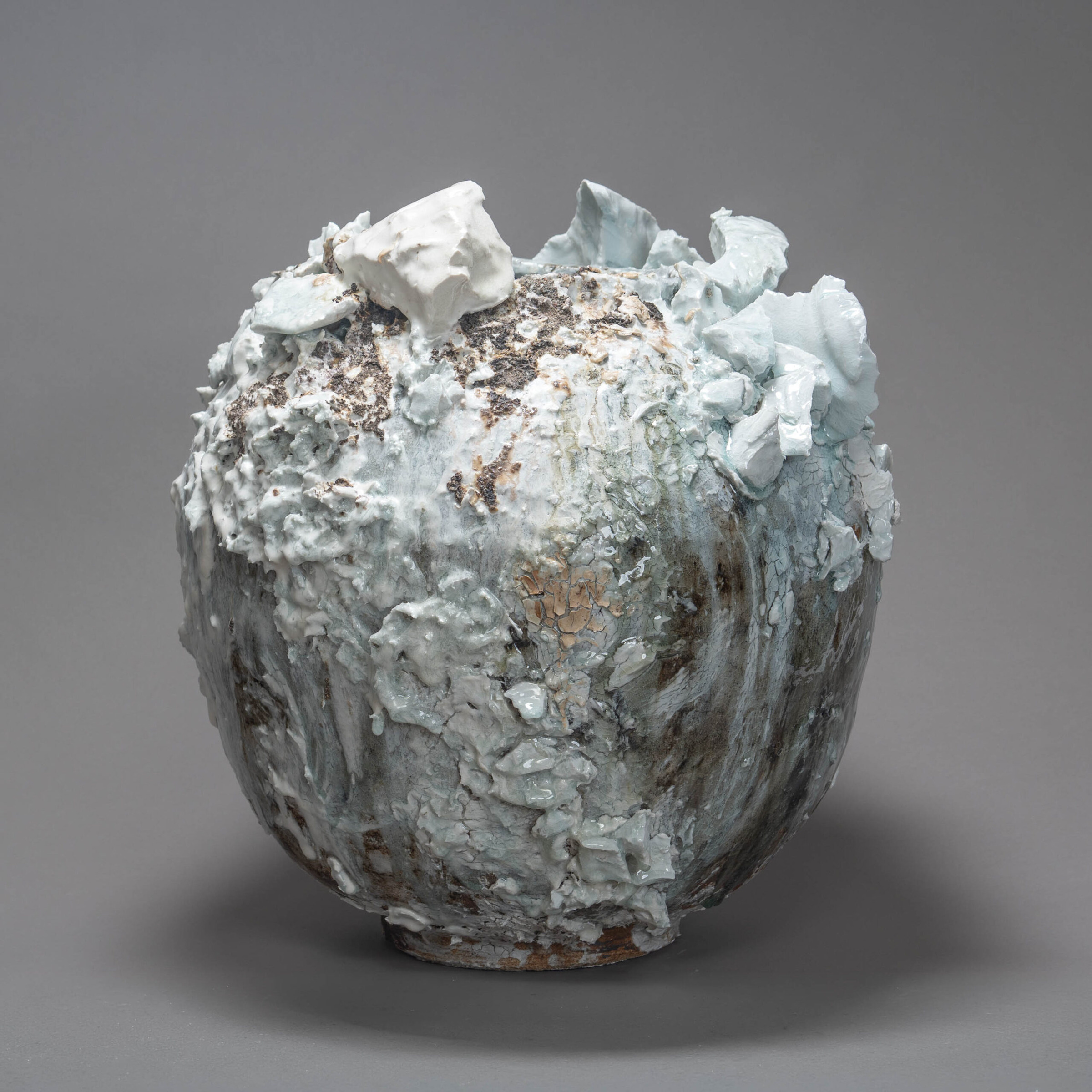
There is a jar in this exhibition that looks as if it has survived something. Its body is round and full, the classic shape of a Korean moon jar, but the surface has erupted: layers of white and pale blue glaze crack, curl and lift away like ice breaking on a river, and around the rim the clay rises in fragments. It is beautiful in the way a ruin is beautiful. It also looks as if it might fall apart if you touched it – which is exactly the point.
The jar is by Akiko Hirai, and the exhibition is called Things that disappear when touched. It closes today, 7 November, at Contemporary Ceramics, the London gallery of the Craft Potters Association, after three weeks in which it quietly made the case that some of the most serious art in Britain is being made on a potter’s wheel.
I · A potter between two islands
Hirai was born in Japan and has lived and worked in London for more than two decades. Her pots carry both places. The Japanese and Korean traditions – tea bowls, sake flasks, moon jars, white slip called kohiki – are the vocabulary. The attitude is that of contemporary British studio pottery, the tradition that runs from Bernard Leach and Lucie Rie to the present: the pot as a serious object, at once useful and sculptural. Her work is in the Victoria and Albert Museum, the Fitzwilliam Museum in Cambridge, the National Museum of Ireland and the Everson Museum of Art in Syracuse, New York.
The gallery describes her as making both practical and decorative ware, and the exhibition proves it. There are jugs and sake sets you could use at dinner tonight, and there are jars that belong in a museum case. What unites them is a single way of looking at clay.
II · The beauty of the odd
Hirai’s statement for the show is short and exact. The works, she writes, express a quiet equilibrium: fragile, shifting forms that exist in a state of delicate imbalance, whose stillness is easily disturbed, “as if the act of holding too tightly might cause something essential to disappear.” They resist perfection and remain slightly unresolved, unsettled, “and quietly alive.”
As if the act of holding too tightly might cause something essential to disappear.
Behind this lies a Japanese idea that has no good English equivalent: getemono, things considered odd, rough or even grotesque, which a trained eye learns to love. A tea bowl that leans, a vase whose glaze has run too far, a jar that cracked in the kiln – in this tradition such accidents are not defects but evidence of life. Hirai has made them her subject.
III · Many centres
For this exhibition Hirai worked in a lighter-coloured stoneware, fired in a reduction kiln. Her method is unusual. When she throws a tall form, the centre of the pot shifts as she works the top or the bottom, so a single vessel ends up with several centres rather than one. That is why her cylinders seem to sway slightly as you walk around them, and why her bottles lean like people listening.
The surfaces are built the same way, by letting things happen. As the clay dries, grog – fired clay ground into grit – is pushed to the surface and roughens it. Iron in the body comes through the white slip as speckles. Wood ash settles and melts into pale rivulets. The result is a skin that looks weathered rather than decorated, as if the pots had been dug up rather than made.
IV · White on white
The quietest works in the show are the kohiki pieces. Kohiki – literally ‘powder-coated’ – is a white slip over dark clay, a technique that came to Japan from Korea in the sixteenth century and was prized by tea masters for its soft, chalky glow. On Hirai’s cylinders the slip thins and breaks, letting the grey body show through like shadow under snow. On her jug and shallow bowl it becomes a surface you want to touch, though the title of the exhibition warns you not to.
V · The moon jar
The moon jar is the form Hirai is best known for, and it has a particular history in Britain. The original moon jars were made in Korea in the seventeenth and eighteenth centuries: large white porcelain jars thrown in two halves and joined at the middle, so that they are never perfectly round. In 1935 Bernard Leach bought one in Seoul and brought it to England, where it later passed to Lucie Rie and eventually to the British Museum. For British potters it became a kind of icon: the most famous imperfect object in the world.
Hirai’s moon jars take that imperfection much further. The smooth kohiki jar is close to the Korean ideal. The large blue-and-white and the ash-glazed jars are something else: the round form is still there, but the surface has been allowed to crack, flake and erupt, so that the jar seems to be in the middle of a geological event. They are among the most striking ceramic objects made in Britain today.
A moon jar in the middle of a geological event.
VI · Small rituals
Around the large works are the small ones: sake flasks (tokkuri) with their cups (choko), tea bowls, a set of three small wall pieces called Natsukusa Fuyumushi, after the Japanese name for a fungus that grows from an insect in winter and looks like a plant in summer. These pieces carry the same ideas at the scale of a hand. A cup is the thing we touch most often; it is also the thing that most clearly shows whether its maker understands touch.
VII · Why it matters
British art has always had an uneasy relationship with pottery. For most of the twentieth century it sat in a separate category called craft, shown in separate galleries and reviewed in separate magazines. That boundary has been dissolving for twenty years, as museums collect ceramics as sculpture and artists from Grayson Perry to Magdalene Odundo have shown how much a pot can say. Hirai’s exhibition belongs to that change. It is quiet, it is commercial – everything is for sale – and it is also one of the most thoughtful shows about fragility, time and attention that London has seen this autumn.
Things that disappear when touched is a perfect title for it. The works ask for the kind of looking that does not grab: slow, close, a little uncertain. In a city that moves as fast as London, that is a radical request.
See it
Akiko Hirai: Things that disappear when touched is at Contemporary Ceramics, 63 Great Russell Street, London, opposite the British Museum, until Saturday 7 November 2026. Admission is free. The works can also be seen on the gallery’s website.
The artist’s statement, collections and exhibition details are from Contemporary Ceramics. Descriptions of the clay, firing and throwing method follow published notes on the exhibition. Titles are the gallery’s. The history of the Leach moon jar is from the British Museum’s published account of the object. Photographs of the works courtesy Contemporary Ceramics.
Read next
- Where Wisdom Takes Form: Inside the New CCA Tashkent
- The Forms That Refuse a Name: Richard Pearson on Painting Other Worlds
- The World Is Not What It Says: Magritte’s Afterlife at Gagosian London
- Where Darkness Begins to Listen: Roy DeCarava in Los Angeles
- The Ocean Is Not Blue: Torkwase Dyson and the Politics of Abstraction
- The Ordinary Life Is Not a Small Subject: Louis Fratino and the Painting of Intimacy