The Sound of Data: Ryoji Ikeda, from Sine Waves to a Column of Light
Profile
Forty-nine searchlights over the Thames, barcodes laid across a floor, a trilogy built from NASA, CERN and the human genome: the Japanese artist Ryoji Ikeda, winner of the 2026 Nam June Paik Prize, turns data into light and sound.
Viacheslav Munister · 2026-11-09
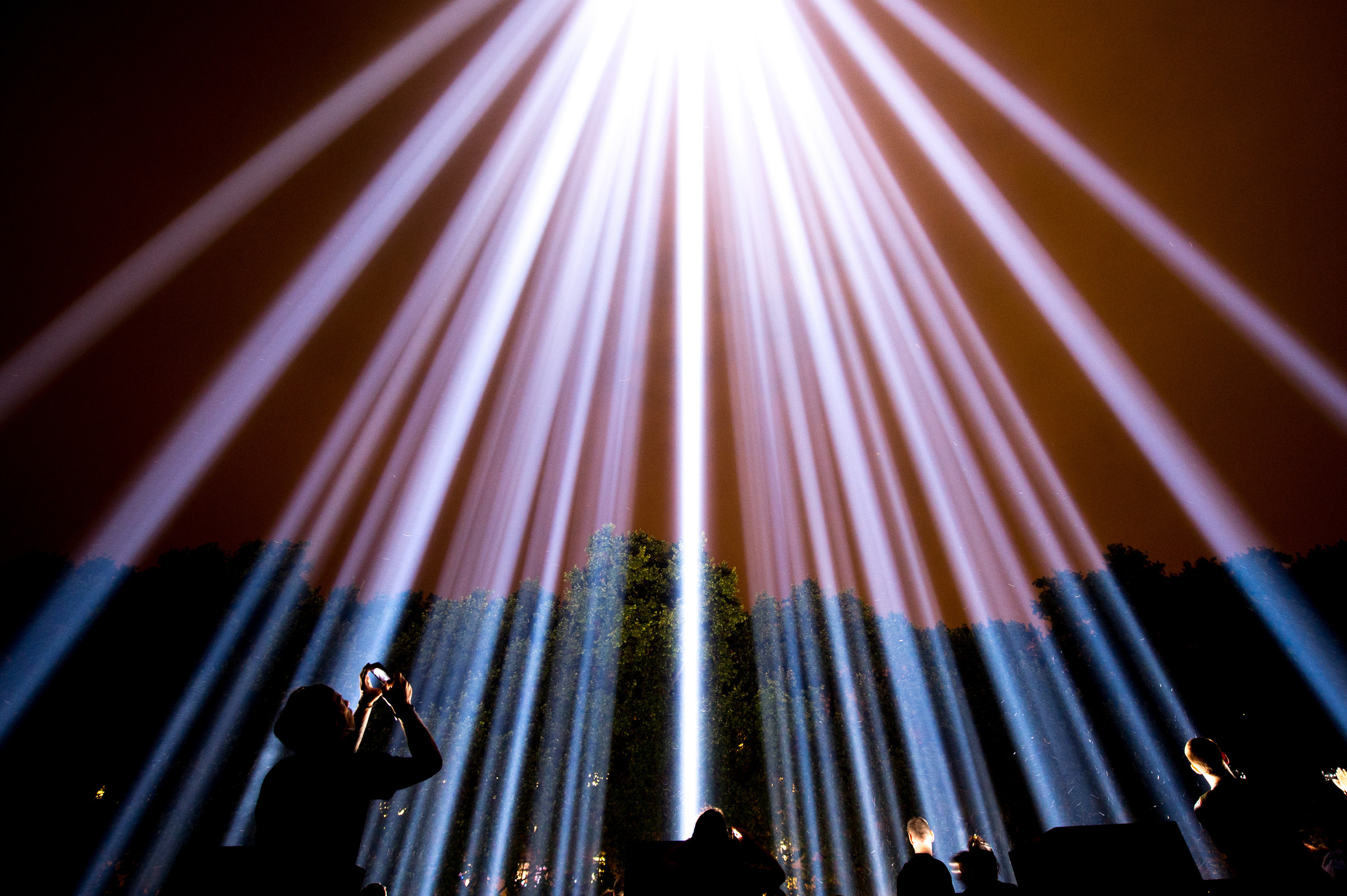
For seven nights in August 2014, a pillar of light stood over the Thames in London. It rose from Victoria Tower Gardens, beside the Houses of Parliament, and it was made of 49 searchlights set so close together that from a distance they read as one solid column. Visitors could walk in among the lamps. A soundtrack of pure sine waves, the plainest tones there are, played with it. The work was called spectra, it marked the centenary of the First World War, and its author was the Japanese artist Ryoji Ikeda.
Ikeda takes the smallest units of sound and light – a tone, a pixel, a bit – and builds them into environments the size of a hall or a night sky. This year the Nam June Paik Art Center in South Korea named him the winner of its 2026 Paik Prize, named after the pioneer of video art, and announced a solo exhibition for 2027. It is a good moment to see how he got here.
I · Between music and mathematics
Ikeda was born in 1966 in Gifu, Japan, and works between Paris and Kyoto. He began in sound, as a composer and performer who also worked with the Kyoto collective Dumb Type. His early records, among them +/- (1996) and matrix (2000), made music out of pure electronic tones and glitches, and matrix won the Golden Nica at the Prix Ars Electronica in 2001. With the German artist Carsten Nicolai he also recorded as Cyclo.
Over the next two decades the sound grew into light, projection and architecture, and the musician became an artist of data. Solo exhibitions followed at the Museum of Contemporary Art Tokyo, Park Avenue Armory in New York, the Centre Pompidou in Paris, the Taipei Fine Arts Museum and 180 Studios in London.
II · spectra: a column of light
spectra is 49 xenon searchlights, set in a grid and pointed straight up. The light is so strong and the beams so tight that they seem to form a single pillar rising out of the ground. The first version was shown in June 2013 at Dark Mofo, the winter festival of the MONA museum in Hobart, Tasmania, in front of the city’s Cenotaph. It came back to Hobart in 2018 and has stayed closely tied to MONA since.
The London version, in 2014, was produced by Artangel and co-commissioned by the Mayor of London and 14-18 NOW, the First World War centenary art programme. It ran from 4 to 11 August. A searchlight is a tool of war and of spectacle. Ikeda uses the same machine and turns it into a monument without a figure, a memorial made of nothing but light. In Hobart it stood by a real cenotaph. In London it stood by the Thames, and people walked in among the lamps, as if inside a weather system.
III · test pattern: data you can see
test pattern takes any kind of data – text, sound, photographs, film – and turns it into barcode-like patterns and strings of ones and zeros. In its 2013 version, test pattern [no.5], shown at Carriageworks in Sydney from 8 June to 1 July, five projectors laid the patterns across a floor 28 metres long and 8 metres wide, and visitors walked and sat on the stripes as they ran past, with sound. The artist’s own statement says the work tests the relation between the limits of a device and the threshold of human perception.
Another work of those years, data.tron, went through several versions, among them an 8K one shown at the transmediale festival in Berlin in 2010. In 2011 Park Avenue Armory in New York showed The Transfinite, three immersive audio-visual projects. The method is the same each time. A big, simple, very exact pattern, and a sound to match; no story and no image to hide behind.
IV · At CERN
In 2014 Ikeda won the Collide@CERN award of the Prix Ars Electronica, and spent a residency at CERN, the particle physics laboratory near Geneva, from July 2014 into 2015. It led to two works. supersymmetry was shown at YCAM in Japan, at Brewer Street Car Park in London in 2015 for the Vinyl Factory, and at KUMU in Tallinn. micro | macro was shown at ZKM in Karlsruhe in 2015 and at Carriageworks in Sydney in 2018. From then on data from physics, astronomy and biology was his raw material.
V · data-verse: from the genome to the galaxy
The largest of those works is data-verse, a trilogy of immersive light and sound installations made in 2019–20 and commissioned by Audemars Piguet Contemporary. Ikeda built it in three chapters, using open data from NASA, CERN and the Human Genome Project. He wrote his own programs to turn the data into images, then composed the pictures against an electronic score. The subject runs from the very small to the very large: the structure of the body, the structure of the universe, and the long chain of numbers between them.
data-verse was shown in 2024 at Almine Rech in Brussels. In 2025 the High Museum of Art in Atlanta gave it its first showing in the United States, from 7 March to 10 August, with projections running from floor to ceiling in the museum’s largest exhibition space, and with data.gram, a series of 18 monitors that take apart and recombine the information he gathered for the trilogy. Early in 2026 it was in Reykjavík, at BERG Contemporary, from 6 March to 4 July.
VI · Lying beneath the data
The newest large work is data-cosm [n°1], commissioned by 180 Studios in London. It ran from 15 October 2025 to 1 February 2026, after it was extended because of demand. Visitors lay on the floor beneath a vast LED ceiling, with sound all around, and watched data from nature unfold, from particle physics at the smallest scale to astrophysics at the largest. 180 Studios had been part of Ikeda’s story since supersymmetry in 2015, and in 2021 it hosted the largest exhibition of his work to that date.
VII · Why he matters
When the Paik Prize was announced at the end of August, the juror Sabine Himmelsbach, director of the House of Electronic Arts in Basel, said Ikeda had “fundamentally reshaped the aesthetic language of media art”, and that his work carries Paik’s experimental legacy “into the age of data and algorithmic culture”. The prize ceremony was set for 8 September at the Nam June Paik Art Center in Yongin, where the solo exhibition is planned for 2027.
Most art that uses data decorates it. Ikeda does the opposite. He strips a data set down to its simplest signal, a stripe, a dot, a tone, and makes it so large and so exact that you stand inside it. You do not learn what a particular pixel means. You learn how big a number can be, and where your eyes and ears give out. In an age that talks about data all the time and sees it almost never, that is a precise thing to offer.
See it
Ikeda’s next museum solo is at the Nam June Paik Art Center in Yongin, South Korea, in 2027; the dates have not been announced. data-verse has finished its 2026 run in Reykjavík, and data-cosm [n°1] in London.
The description of spectra follows Artangel’s and the Dark Mofo and MONA accounts of the installation; test pattern [no.5] follows the ISEA2013 and Carriageworks documentation; data-verse follows Almine Rech’s and the High Museum’s exhibition texts; data-cosm [n°1] follows 180 Studios and The Vinyl Factory; the Paik Prize follows ArtReview’s report of the announcement, including the quotations from the juror. Biographical facts and the list of works, awards and residencies follow published profiles. Where exhibition dates are not given in the sources, they are left out. All photographs are from Wikimedia Commons under the licences stated in the captions.
Read next
- Where Wisdom Takes Form: Inside the New CCA Tashkent
- The Forms That Refuse a Name: Richard Pearson on Painting Other Worlds
- The World Is Not What It Says: Magritte’s Afterlife at Gagosian London
- Where Darkness Begins to Listen: Roy DeCarava in Los Angeles
- The Ocean Is Not Blue: Torkwase Dyson and the Politics of Abstraction
- The Ordinary Life Is Not a Small Subject: Louis Fratino and the Painting of Intimacy