The Second Exposure: What Photography Does to Architecture, Sculpture and Painting
Photography & Visual Culture
From the measured neutrality of architectural typologies to Medardo Rosso’s dissolving sculpture and Ann Hamilton’s tactile scans, the camera does not merely reproduce art – it rebuilds it in light.
Viacheslav Munister · 2026-10-06
A photograph of an artwork is often introduced as evidence: proof that an object existed, that an exhibition happened, that a building looked a certain way before the weather, the public or the next installation altered it. Yet every serious photographer knows that evidence begins with a refusal. The camera excludes almost everything. It converts depth into a plane, duration into an instant, atmosphere into exposure and the wandering body into one fixed point of view. What we call documentation is therefore already an argument.
This argument has become more urgent as exhibitions are increasingly encountered first – and sometimes only – through images. Architecture travels as a frontal elevation emptied of people. Sculpture becomes a silhouette, a gleam, a dramatic shadow. Painting is detached from the wall, corrected into a perfect rectangle and made to emit the same light as the screen on which it appears. The camera does not stand after the work and report on it. It produces a second work: portable, repeatable, searchable and often more culturally powerful than the first.
The photograph is not the artwork’s shadow. It is a second object made of light, with its own scale, exclusions and authority.
The photograph is never after the work
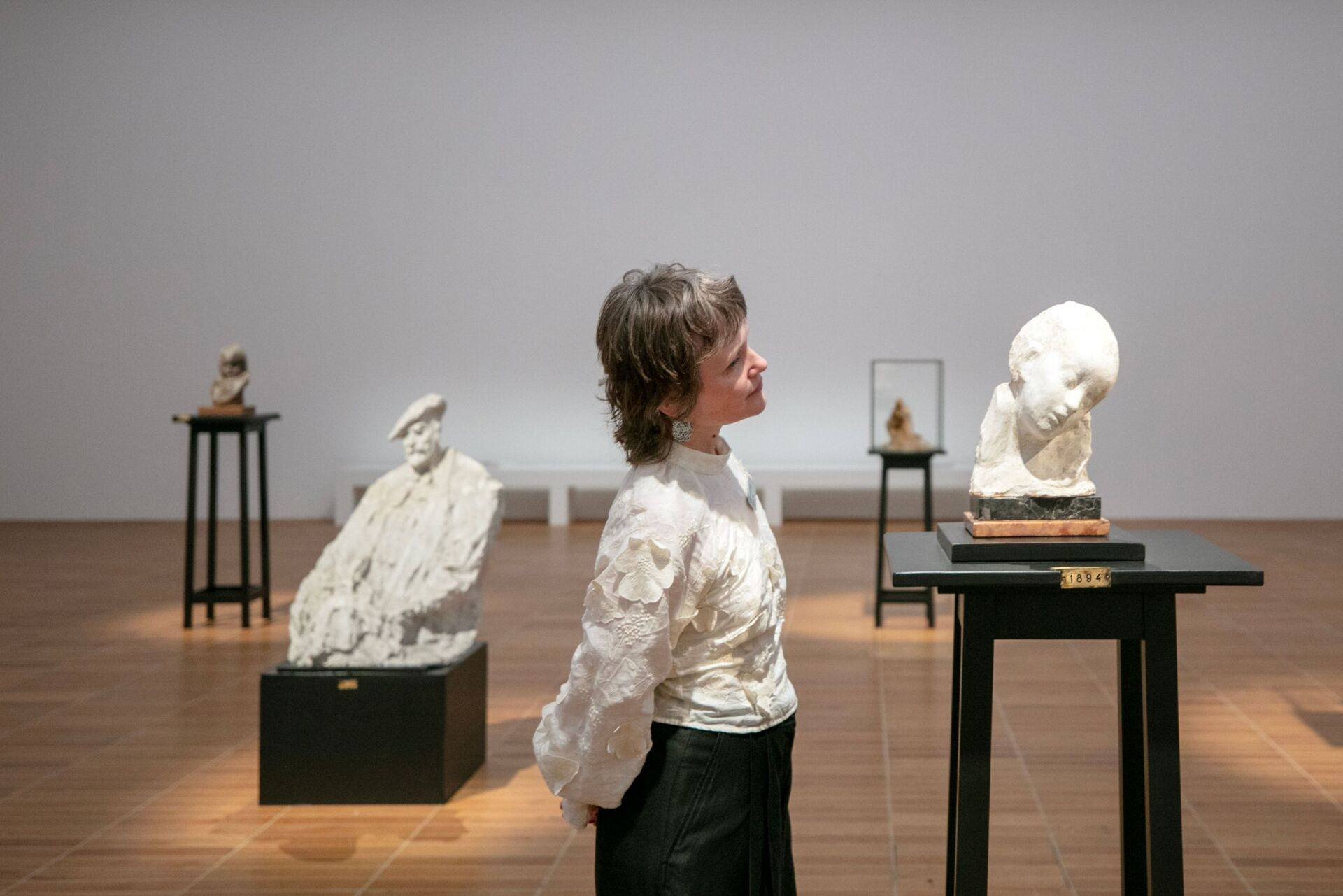
Three recent exhibitions make that second object unusually visible. Typologien: Photography in 20th-Century Germany , presented at Fondazione Prada in Milan from April to July 2025, assembled more than six hundred works by twenty-five artists. Its subject was not simply a national history of photography but the typological impulse: the desire to compare, order and stabilise the visible world. At Kunstmuseum Basel, Medardo Rosso: Inventing Modern Sculpture placed roughly fifty sculptures beside some 250 photographs and drawings, insisting that Rosso’s images were not secondary records but part of his sculptural thinking. In Cleveland, Ann Hamilton’s still and moving • the tactile image enlarged handheld scans of small historic figures until touch became architecture.
Together these exhibitions shift the question from whether a photograph is faithful to what stood before the lens to what kind of reality it builds. Typology claims knowledge through repetition. Rosso makes solidity unstable through light. Hamilton turns scanning – a procedure associated with administrative capture – into an intimate choreography of hand, object and delay. Each case exposes a different politics of looking.
Architecture and the fiction of neutral light
Architectural photography has long depended on a fiction of neutrality. The exemplary image is clear, vertical, spacious and apparently inevitable. It suppresses the inconvenience of use: open doors, moving bodies, temporary signs, cleaning equipment, the shifting colour of daylight. Perspective correction makes walls stand straighter than vision experiences them. A long exposure erases pedestrians or converts them into translucent traces. Weather is waited out. Furniture is moved by centimetres. The result can be precise in every measurable respect and false in every social one.
The German tradition gathered in Typologien complicates this fiction because its discipline is explicit. Bernd and Hilla Becher photographed industrial structures under flat skies, from consistent positions, with minimal theatrical incident. Their grids make comparison possible: water towers, blast furnaces and winding towers become families of form. The method appears objective, but the exhibition’s typological structure reveals the paradox. A type does not exist naturally in the world. It is produced by selection – by deciding which objects belong together, which differences matter and which context can be removed.
The Bechers’ influence on Candida Höfer, Thomas Struth, Andreas Gursky and Thomas Ruff did not create one style so much as a sustained argument about distance. Höfer’s empty libraries, theatres and museums are never merely empty. Their vacancy makes institutional order visible: furniture aligned for absent users, routes of circulation, ornament calibrated to authority. Struth’s museum pictures reverse the convention. Instead of isolating the painting, they include visitors looking, waiting, drifting and blocking one another’s view. The museum becomes an image-making machine in which the public is both audience and material.
Luisa Lambri takes another route. Her photographs of modernist interiors avoid the building’s iconic totality and move toward windows, corners, joints and the thin membrane where daylight meets a surface. Architecture is no longer a heroic object but a psychological aperture. The photograph measures what a room permits the body to sense. Light is not there to explain the building; it becomes the building’s most unstable material.
To photograph architecture responsibly is therefore not to eliminate interpretation but to make interpretation legible. A picture can acknowledge use, season, security, access and decay. It can preserve the difference between a room designed for contemplation and a room temporarily cleared for the camera. It can show that the polished image is a condition produced by labour. Neutrality is not the absence of style. It is a style whose choices have been made difficult to see.
When sculpture becomes weather
Sculpture creates an even sharper conflict. It occupies the same space as the viewer, yet the photograph must reduce that shared space to one surface. Scale becomes relative to the frame; weight becomes tonal contrast; the back of the work disappears. A camera can make plaster monumental and bronze weightless. It can detach a figure from its plinth, compress several objects into one silhouette or allow a cast shadow to become more active than the material that produced it.
Medardo Rosso understood this not as a limitation but as a medium. His wax, plaster and bronze figures appear to emerge from and return to their surrounding atmosphere. Faces are incomplete; shoulders merge with bases; surfaces catch illumination unevenly. In person, the object shifts as the viewer moves. In Rosso’s photographs, movement is replaced by another instability. He cropped, rephotographed, altered contrast and allowed light to veil the sculpture. The photograph does not clarify the object. It extends its refusal to become fully knowable.
The Basel exhibition was important because it resisted the familiar hierarchy in which sculpture is original and photography is supporting material. Rosso’s photographs stood as experiments in perception. The same figure could seem tender, spectral, damaged or almost abstract depending on angle and exposure. Repetition did not stabilise identity; it multiplied it. The work existed between states, and the camera was one of the instruments that kept it there.
Constantin Brâncuși later treated photography with comparable seriousness. He objected when professional photographers made his sculptures look like discrete, well-lit commodities. His own images accepted flare, shadow and spatial ambiguity because the relation among object, base and studio mattered more than descriptive completeness. The photograph became an extension of installation. It instructed the future not only what the sculpture looked like, but how it wished to be seen.
This is why contemporary sculpture photography so often fails when it is merely spectacular. The dramatic black background, hard spotlight and low angle may produce a powerful object while destroying the sculpture’s actual relation to gravity and room. A good image need not imitate ordinary eyesight, but it should understand what it transforms. The question is not whether the photograph beautifies the work. The question is whether its beauty discovers a condition already latent in the work or replaces the work with an advertising effect.
Touch without possession
Ann Hamilton’s Cleveland installation begins where conventional object photography is supposed to end: at the moment of contact. Using a handheld scanner, Hamilton moved across small ceramic and crèche figures from the museum’s collection, many rarely displayed. The scanner does not observe from a distance. It requires proximity, a paced movement and a narrow band of attention. What it records is not a single instant but the duration of a hand travelling over an object.
Enlarged from hand-sized objects to floor-to-ceiling images, the scans produce a strange reversal. The historic figure is no longer a miniature to be mastered by the gaze. It exceeds the viewer. Seams, abrasions and distortions become landscape. The scanner’s failures – drag, doubling, temporal discontinuity – are not defects to be corrected. They register the negotiation between a moving hand and a resistant form.
Hamilton calls the result tactile because sight is made to remember touch. Yet the installation also preserves distance. The visitor cannot handle the collection object; conservation protocols and museum authority remain. The enlarged image mediates that denied contact. It offers intimacy without possession and magnification without pretending that scale is unchanged. In this sense the work is an ethics of reproduction: it makes the transformation visible rather than hiding it beneath seamless technical competence.
Painting under surveillance
Painting appears to be the easiest art to photograph because both painting and photograph are flat. That resemblance is deceptive. Paint reflects light; screens emit it. Varnish produces glare, impasto casts shadows, matte passages absorb illumination and metallic pigments change with position. A single exposure may render the colours plausibly while cancelling the physical decisions that made them. The perfect digital rectangle is often a very incomplete painting.
Museum documentation usually removes the frame, corrects perspective and balances colour against a calibration target. These procedures are indispensable for scholarship, conservation and access. But they also produce a peculiar image: the painting as if seen from nowhere, under light that belongs to no hour, without the wall or body that establishes its scale. Such an image is less a view than a data model. Its authority comes from suppressing the conditions of looking.
Thomas Struth’s museum photographs restore those conditions by placing paintings inside crowded acts of attention. The viewers’ backs, clothes, gestures and hesitations become part of the image. Scale returns through bodies. So does conflict: one person’s contemplation is another’s obstruction. The painting is neither autonomous icon nor passive backdrop; it is a social event continuously reorganised by those who stand before it.
This social dimension matters in the age of the installation shot. Exhibitions are routinely photographed before opening, when every label is aligned and every surface untouched. These images are useful and often beautiful, but they portray an institution without friction. The public later enters a room already imagined as empty. Photography establishes the ideal state, and lived experience arrives as a disturbance.
Exposure has three meanings
The word exposure joins the problems at the centre of these exhibitions. In photography it names the quantity of light that reaches a sensitive surface. In display it means making something available to view. In ordinary speech it also means vulnerability: exposure to weather, judgment, danger or loss. Every reproduction of an artwork operates across all three meanings.
To expose a sculpture is to illuminate it, to place it before a public and to make it vulnerable to a framing it cannot control. To expose architecture is to transform occupied space into a claim about order. To expose a painting is to move colour from reflected light into a reproducible system. The technical decision is inseparable from the institutional one. What receives light receives attention; what remains outside the frame risks remaining outside history.
Typologien demonstrates how seriality can become knowledge, but also how knowledge becomes power. A grid persuades because it appears to treat every image equally. Yet the equal format intensifies the curator’s decisions: these are the examples chosen to represent a category; these are the differences the viewer is invited to compare. Typology is never innocent. It can preserve threatened forms, reveal industrial histories and discover affinities. It can also turn singular places into specimens.
Rosso uses repetition against that stability. His sequences do not define a type; they dissolve certainty. Hamilton, meanwhile, turns the capturing device back into a bodily instrument. Together they suggest that responsible photographic practice does not renounce ordering, framing or transformation. It makes those operations available to thought.
The ethics of the perfect image
The contemporary image economy rewards immediate legibility. An exhibition photograph must function at the scale of a phone, survive cropping, leave space for text and announce its subject before the next swipe. Architecture is pushed toward symmetry; sculpture toward silhouette; painting toward saturated colour. The most distributable image becomes the exhibition’s unofficial cover, regardless of whether it represents the experience of the work.
There is nothing inherently dishonest about seduction. Art has always required invitations, and photography can make inaccessible collections available across distance. The ethical problem begins when the image conceals the degree of its invention. Extreme tonal editing is presented as natural light. An empty room is presented as ordinary access. A temporary viewpoint is presented as the building’s essence. The camera’s rhetoric disappears behind the word documentation .
A more exact practice begins with captions. Who made the photograph? When was it taken – during installation, at opening, after conservation? Is the pictured state permanent? Has the image been cropped or composited? What does the credit line call the object: work, installation view, detail, rendering, archival photograph? Such language is not bureaucratic decoration. It tells the reader what kind of evidence is being offered.
Exactness also requires plurality. One frontal image can describe proportion but not movement. A detail can explain material but not scale. A crowded view can reveal social use while obscuring the work. The answer is not a mythical perfect photograph but a sequence in which the limits of one image are corrected by another. The serious visual essay is therefore closer to an exhibition than to an icon: it constructs relations across difference.
A second object made of light
The most consequential photographs of art do not disappear in service to their subjects. They establish a productive distance. Höfer makes institutional space visible by withholding its users. Struth makes looking visible by including them. Lambri fragments architecture until light and enclosure become psychological. Rosso photographs sculpture until material becomes weather. Hamilton scans touch until a small object becomes an environment.
None of these practices offers neutrality. Each offers a position clear enough to be examined. This is the distinction between interpretation and distortion. Distortion pretends that its transformation is the world. Interpretation reveals a way of moving through the world and permits another viewer to disagree.
The camera is often described as preserving what time will destroy. It does preserve, but never without building something new. A building becomes a plane of decisions. A sculpture becomes an event of illumination. A painting becomes a proposition about colour under controlled conditions. An exhibition becomes an archive before it has finished happening.
The task is not to force the photograph back into obedience. It is to demand more intelligence from the second object: enough formal precision to deserve attention, enough historical context to resist spectacle, enough transparency to disclose its choices and enough imagination to show what ordinary looking misses. The artwork does not survive in the image unchanged. It survives as a renewed problem – exposed again.
A responsible photograph does not say: this is how the work was. It says: this is the encounter I have constructed, and these are the conditions under which you may judge it.
Essay by Viacheslav Munister for EPRIS Journal. The text draws on official exhibition materials for Typologien: Photography in 20th-Century Germany (Fondazione Prada, Milan, 3 April–14 July 2025), Medardo Rosso: Inventing Modern Sculpture (Kunstmuseum Basel, 29 March–10 August 2025), and Ann Hamilton’s still and moving • the tactile image (Cleveland Museum of Art, 14 December 2025–19 April 2026). It does not claim in-person attendance. Images are reproduced for editorial and critical discussion and remain credited to their institutions and authors.
Read next
- Where Wisdom Takes Form: Inside the New CCA Tashkent
- The Forms That Refuse a Name: Richard Pearson on Painting Other Worlds
- The World Is Not What It Says: Magritte’s Afterlife at Gagosian London
- Where Darkness Begins to Listen: Roy DeCarava in Los Angeles
- The Ocean Is Not Blue: Torkwase Dyson and the Politics of Abstraction
- The Ordinary Life Is Not a Small Subject: Louis Fratino and the Painting of Intimacy