The Architect of Air: Tomás Saraceno, from Cloud Cities to a Pool of Salt
Essay
A balloon that flew 272 metres on sunlight and earned 32 world records, a museum whose toilets save a million litres of water a year, a sanctuary of salt in the Andes: the Argentine artist Tomás Saraceno, an architect who stopped building on the ground, makes proposals that can be measured.
Viacheslav Munister · 2026-11-08
Most utopias cannot be tested. Tomás Saraceno’s can be put on a scale. In January 2020 a black balloon rose 272 metres above a salt flat in Argentina, lifted by nothing but the warmth of the sun, and a year later the world body of aviation confirmed 32 world records for the flight. In Munich, the museum that now shows his work flushes its toilets with water from the hand basins and expects to save a million litres a year. These are numbers, which is not what one expects from an artist whose work began with spiders’ webs and clouds you can walk inside.
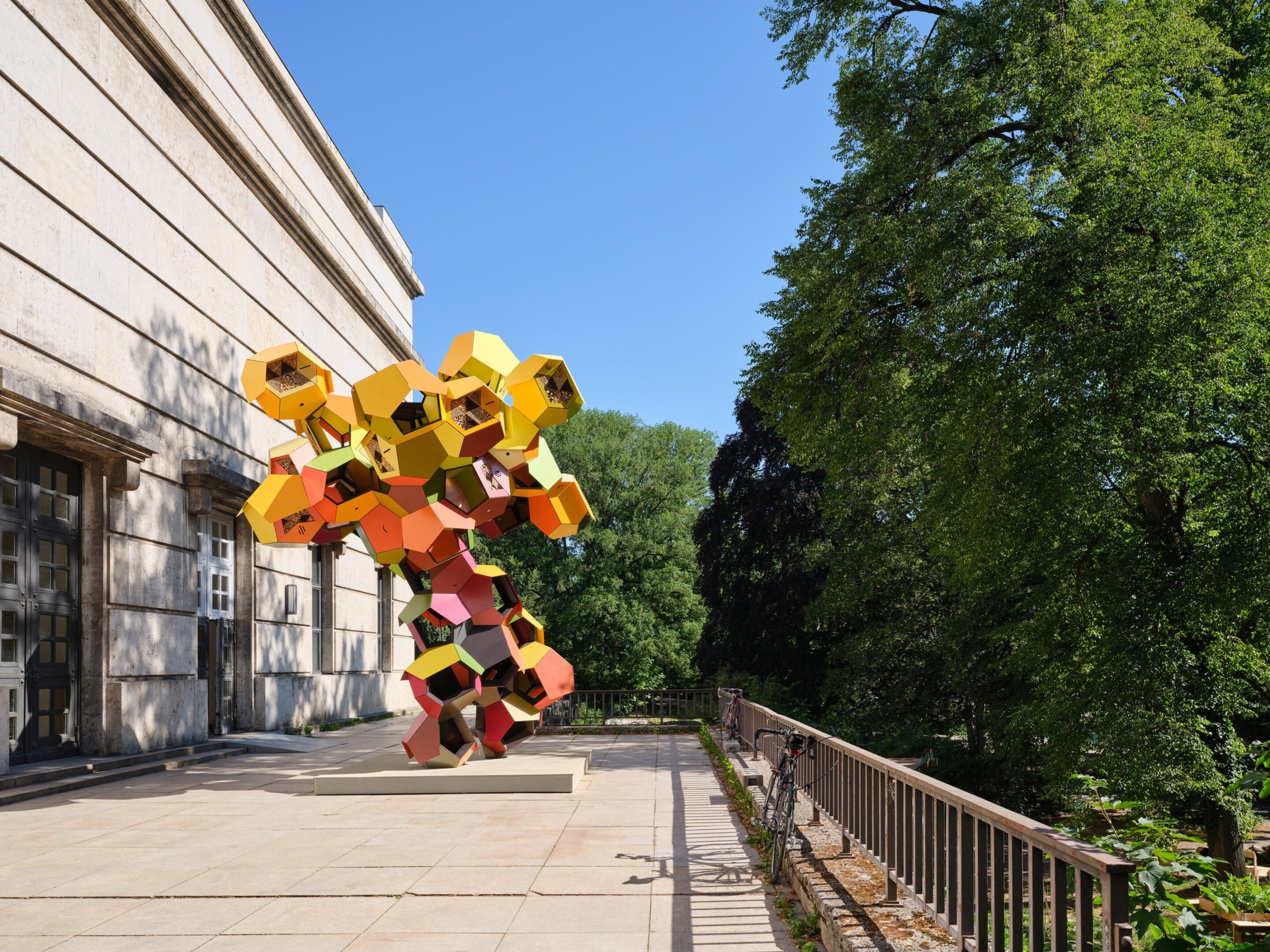
That is the thread through Tomás Saraceno in Collaboration: Ancestral Futures, which opened at the Haus der Kunst in Munich on 17 July and runs until 7 February 2027, the largest exhibition of his work ever shown in Germany. The museum was put up in 1937 to show the art of the Nazi state. Now spiders spin in its galleries, a sculpture sewn from reused plastic bags drifts overhead, and twelve cloud-shaped chambers on the east terrace are homes for birds, insects and spiders. This essay follows the work from the first idea to the proof: how a strange proposal, step by step, became something a museum, a community or an aviation federation can check and use.
I · An architect who stopped building on the ground
Saraceno was born in 1973 in San Miguel de Tucumán, in the north of Argentina, and studied architecture in Buenos Aires. He went on to study art and architecture in Frankfurt, at the Städelschule, and in 2003–04 took a course in Venice taught by Hans Ulrich Obrist and Olafur Eliasson. He opened his studio in Frankfurt in 2005 and has worked from Berlin since 2012. He has never really stopped designing buildings. He has changed what a building is for: something that does not sit heavily on the ground, does not burn anything and does not belong only to people.
The first work that made this visible was shown at the 2009 Venice Biennale, where he also won the Calder Prize. It filled a room of the main pavilion with a net of black cords, and its title says what it is about: Galaxies Forming along Filaments, like Droplets along the Strands of a Spider’s Web. The universe and a spider’s web, he suggested, are held together by the same kind of tension. After that the web never left his work.
II · Standing inside a cloud
From 2002 he made his Cloud Cities, habitable structures whose forms come from clouds, soap bubbles and foam. In 2012 the largest of them was set on the roof of the Metropolitan Museum of Art in New York: sixteen linked modules, about 16.5 metres long and 8.5 high, of steel frames with transparent and reflective panels. Visitors climbed a stair and walked inside, and the modules moved a little under their weight. The city went on all around, in the reflective panels, and for a summer the roof held a piece of sky that had come down to rest.
That same autumn, at HangarBicocca in Milan, he hung layers of transparent membrane about twenty metres above the floor and let people walk onto them. On Space Time Foam, free to enter from 26 October 2012 to 3 February 2013, stretched and sank under the visitors’ weight much as the heaviest bodies in the universe bend space-time. You did not look at an idea of gravity. You stood on it.
III · Eight legs, many minds
The spiders became a research programme. Saraceno founded Arachnophilia, a community of scientists, artists, spiders and webs that studies how spiders build, feel and communicate through their silk. With researchers at TU Darmstadt he helped develop a way to scan a web in three dimensions. Webs, for him, are architecture and instrument at once: a house, a trap and an ear.
At the Palais de Tokyo in Paris in 2018, in the show ON AIR, about 450 spiders lived in the building and spun their webs on some ninety frames, and nobody was allowed to kill one. Composers, among them Alvin Lucier, made music with the spiders; Saraceno called these evenings “cosmic jam sessions”. In 2023 the Serpentine in London let local spiders keep weaving in the gallery through the summer. For it Saraceno changed the building’s ventilation and electrics to suit the animals. His aim, he has said, is to “diversify the dialogue” with other species, because people are wrong to think of themselves as the most successful of them.
IV · Flying on sunlight
The other half of the work is about air. In 2007 Saraceno began Museo Aero Solar, a flying museum sewn from reused plastic bags brought by people on six continents. It is lifted by warm air, it is open-source, and it grows with every showing. It is the version of his ideas that anyone can take part in, made from what people would otherwise throw away.
From there came Aerocene, a foundation set up in 2015 to explore flight with no fuel and no electric power. At White Sands in New Mexico, on 8 November 2015, a registered balloon heated only by the sun lifted a person into the air. In January 2020, in the Salinas Grandes salt flat in Argentina, at about 3,400 metres, the balloon Aerocene Pacha, piloted by Leticia Marques, rose 272 metres. It has a dark fabric skin whose air the sun warms, and it was inflated with a pedal-powered fan. In 2021 the world body of aviation, the FAI, confirmed 32 world records for the flight, the first ever entered for free balloons heated by the sun alone.
A sceptic can fairly say that a balloon that rose 272 metres will not replace the aeroplane. The project describes itself as “an achievable utopia”: a proof that another kind of movement is possible, and a challenge to everyone else to take it up.
V · Salt and water
The flight carried a message. It came from the Indigenous communities of Salinas Grandes and Laguna de Guayatayoc, who say that water and life are worth more than lithium. Lithium goes into the batteries of electric cars, and getting it out of the salt flats takes large amounts of groundwater, in a dry region. The communities have opposed mining there since exploration began in 2010. Haus der Kunst’s own wall text puts the cost at about two million litres of groundwater for one tonne of lithium.
Saraceno first came to Salinas Grandes in 2006 and has been going back for two decades. The communities asked him for something permanent, a sculpture that could bring visitors and income to the region on their own terms. The result is The Sanctuary of Water, conceived by Saraceno with the eleven communities of the Red Atacama network and still being built as the Munich show opened. It is laid out around a circular pool of water, 81 metres across, that reflects the sky. Around it rise salt mountains in the form of apachetas, the stone offerings of the Andes, up to twelve metres high, climbed by stairs of some 11,900 hand-cut salt bricks. When it is finished it will be owned and run by the communities themselves.
In Munich this appears as an environment called Towards the Sanctuary of Water, with photographs taken since that first visit. The show takes its guiding thought from the Brazilian Indigenous thinker Ailton Krenak: the future is not something waiting ahead of us but already here, woven into the land. That is the meaning of the title. Ancestral futures are not a return to the past. They are the old knowledge of how to live with a place, put to work on a problem the new technologies have created.
VI · Why he matters
It is easy to take Saraceno for a poet of the sky. The works are beautiful: a net of black cords, a cloud you can climb into, a balloon on a white plain. But follow them in order and they read less like poems than like a series of tests. Each starts as a proposal and then goes looking for evidence: a web scanned in three dimensions, a balloon that has to stay up, a toilet that has to flush, a sanctuary that has to be built with the people who will look after it.
No gallery will solve the climate, and the best of these works do not pretend to. What they offer is a different standard. Instead of asking whether an idea is beautiful or radical enough, Saraceno asks whether it flies, whether it saves anything, whether the people who live there want it. A balloon is measured in metres, a flush in litres, a sanctuary in whether the eleven communities who asked for it will keep it. It is a fair test for an architect who gave up on the usual kind of building.
See it
Tomás Saraceno in Collaboration: Ancestral Futures is at Haus der Kunst, Prinzregentenstraße 1, Munich, until 7 February 2027. It is curated by Sarah Johanna Theurer and Andrea Lissoni.
The description of the Munich show, its works and dates follow Haus der Kunst’s exhibition texts and the wall text on The Sanctuary of Water, including the figures for the sculpture, the lithium claim and the estimated water saving. The histories of the Met roof commission, On Space Time Foam, ON AIR, Web(s) of Life, Museo Aero Solar and Aerocene follow the museums’ and the studio’s published accounts and press coverage; the FAI records and flight details follow reports of the 2020 flight. Biographical facts follow published profiles. Sources differ on some figures (the height of On Space Time Foam, the flight’s distance), so those are given in round terms. Installation views by Agostino Osio, © Haus der Kunst München; other images © Studio Tomás Saraceno, all from the Haus der Kunst press materials.
Read next
- Where Wisdom Takes Form: Inside the New CCA Tashkent
- The Forms That Refuse a Name: Richard Pearson on Painting Other Worlds
- The World Is Not What It Says: Magritte’s Afterlife at Gagosian London
- Where Darkness Begins to Listen: Roy DeCarava in Los Angeles
- The Ocean Is Not Blue: Torkwase Dyson and the Politics of Abstraction
- The Ordinary Life Is Not a Small Subject: Louis Fratino and the Painting of Intimacy