“Still Under Construction”: Solo Exhibition by Alexander Brodsky
Feature
“Still under construction” - solo exhibition of Russian contemporary artist and architect Alexander Brodsky, taking place in MAAB + Nina Due gallery in Milan from 6 October to 20 November.
Maria Ivanova · 2026-10-22
It’s not the most conventional description of an exhibition you have probably encountered. Every review takes root in personal experience, but in this particular case, I have no intention of covering it up completely.
Today I take you back with me to a warm Milanese evening vernissage, generous enough to gift the warmest feelings to those who open their souls. The artist was playing ping pong while I was observing a bronze sculpture of a dog, trying hard to keep my smile within my heart.
There is a shadow of vagueness in emotion-centered texts, art and the exhibition may seem auxiliary there, but give me the benefit of the doubt. Art is the core and the lighthouse of feelings at the same time, engendering and guiding the kind of introspective journey you can enter only if you listen carefully to what remains silent.
“Still Under Construction” is a solo exhibition of Russian contemporary artist and architect Alexander Brodsky, taking place at MAAB + Nina Due gallery in Milan from 6 October to 20 November.
Visiting it was a deeply reverent experience for me. I have only a passing acquaintance with Milan, but I had a warming feeling of belonging through a shared Russian soul with the artist.
If you look at artworks without prior knowledge of the artist, you see their independence. But once your subjective perception of the artist's personality is enriched by quotes, interviews, and a deeper understanding of what they do and why - a completely different picture emerges.
Some artists tend to distance themselves from their work, and some art lovers happily separate the creator from the creation. Yet I have to confess my curiosity about the kind of music playing in the artist's soul. For me, art is not only about visual discovery, but also about the intricate relationship between the persona and the final piece. Sometimes, though, this curiosity doesn't work in my favor.
Alexander Brodsky
Alexander Brodsky was born in 1955 in Moscow. In childhood, he attended Moscow Art School and considered becoming a painter, but on his father's advice, he enrolled at the Moscow Architectural Institute.
Later, he became known as a key member of the Soviet Paper Architecture movement of the 1980s. It took root at the university, where Brodsky and his fellow students Ilya Utkin and Egor Solopov designed their first project for the international student competition “Theatre of the Future”.
The term Paper Architecture was coined in 1984 by Yuriy Avvakumov and refers to the ultimately unbuilt nature of the projects: they would rather remain unseen or be sent to foreign architectural competitions.
Compared to the conventional practice of a recently graduated architect in Soviet times, Alexander Brodsky and Ilya Utkin carried a certain degree of freedom, which came not by any means of luck, but through intention multiplied by enjoyment. The last component is my assumption, but forgive me for such liberties.
In an interview with Blueprint in 2018, Brodsky was asked if he was upset about missing his first opportunity to visit the FRG, and the beginning of his answer won me over with its sincerity and unfeigned simplicity: “It was a little disappointing, but honestly, we couldn’t have cared less. We were having fun anyway.”
For Alexander Brodsky, switching from architect to contemporary artist was rather seamless and organic. In 1988, the works he and Utkin produced were published in a newspaper, where they caught the eye of the Storefront gallery in New York. The Soviet artists sent their etchings to the US, wrapping them around a broken ski pole.
But beyond Paper Architecture, Alexander Brodsky is well known for his installations, which resemble poetry through the ephemeral nature of the fragile emotions they evoke.
Every temporary structure made out of used materials or objects often takes root in memories, which the artist can brilliantly articulate and transform into tangible form. The discernible narrative is coded in the interrelations of light, scale, visibility, the presence of time and spirit: the spirit of the place it inhabits, the memory and dreams it conveys, or the unrepeatable author's intent.
The genius of his work lies in the emotional resonance with intimate mundanity known to the Russian soul, which, through the means of atmosphere, becomes accessible to everyone. Alexander Brodsky is an internationally acclaimed artist whose works are in the collections of the Russian Museum, MoMA and Tate Modern.
Entering the Exhibition
MAAB Gallery is located close to Piazza Cordusio, from where narrow streets lead you to Via Nerino 3.
In front of the entrance, I was welcomed by one of the wall sculptures. The showcased collection consists of seven wall-hung sculptures, one Dog sculpture made after a drawing from the 1980s, and Archipelagus Aequitatis Universalis.
Sculpture can be perceived differently. Sometimes we find form in it, the framing of the surrounding space, a story, a statement, material experimentation. But rarely does sculpture become a state and embrace you so boundlessly that you have no desire to escape.
That’s what happens from the first encounter with the sculptures in the exhibition “Still Under Construction”.
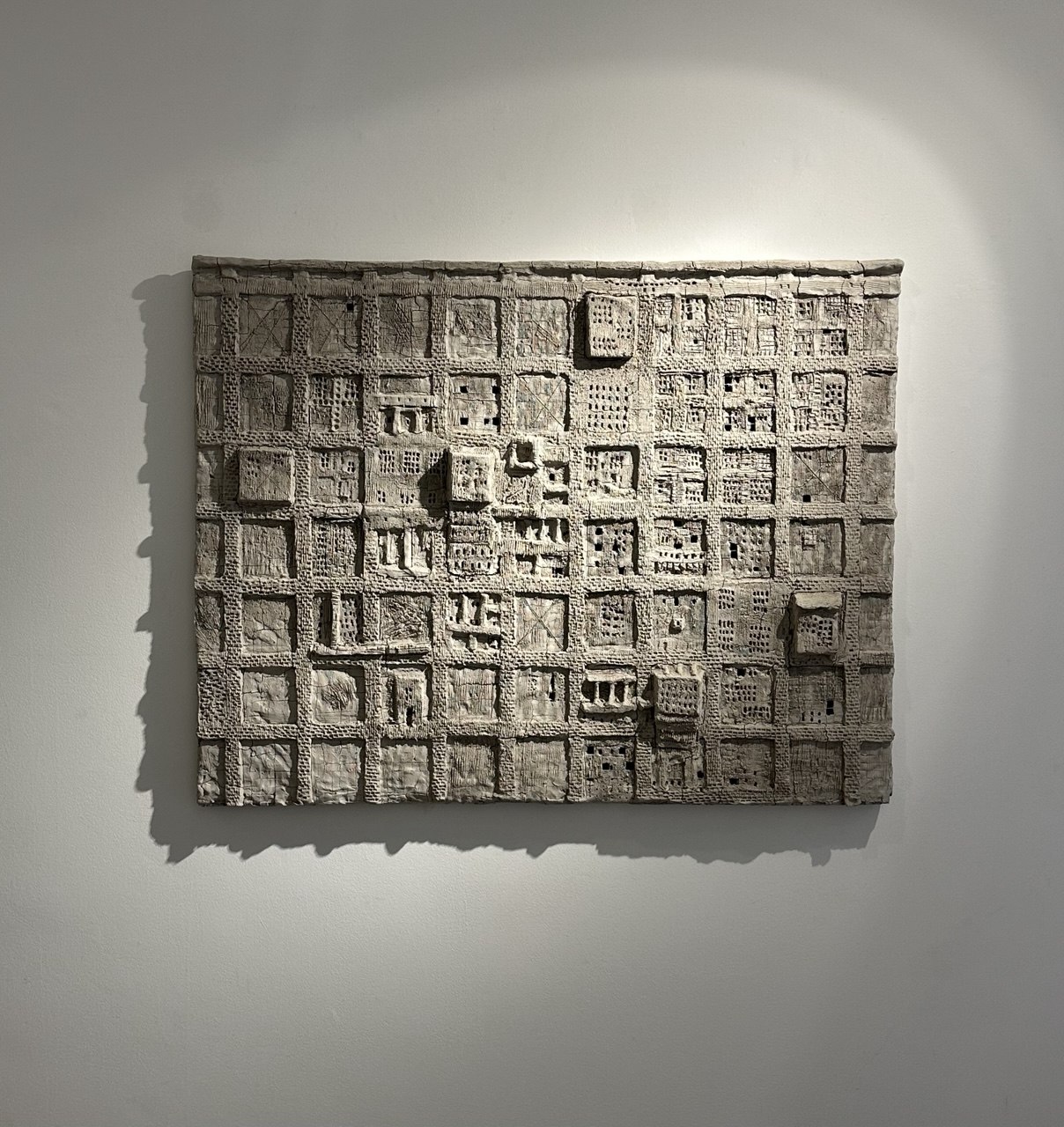
Within the framework of sculpture, Brodsky changes the rules of the game too: at the exhibition, we can see hanging sculptures, which in their form resemble paintings.
Enriched with texture and rhythm of details, executed in unfired clay, they certainly draw attention at first glance. An irresistible desire to come closer and study them carefully reveals the minute patterns of counter-relief, structure and order that keep the objects within the framework of recognizable images, without naming anything precisely.
Every sculpture undeniably evokes architecture, but everyone will find something of their own in it: someone will recall a facade of typical residential housing, others will see an abandoned or imaginary city.
Someone will be immersed in melancholy, while someone else will recall a long-forgotten feeling of childhood curiosity, evoked by mystery, ambiguity and scale, where it is impossible to find the truth. As if behind every improvised window and every column, people are hiding with bated breath, holding threads in their hands, binding them to other keepers of secrets.
The raw material leaves the sculptures unfinished – they organically change with the passage of time, gaining new wrinkles. It is fascinating how tolerant we are of aging in art; it doesn't simply represent age, but elaborates the context and adds charm, which can only be gained through the test of time.
Archipelagus Aequitatis Universalis
I don't recommend reading this part if you are planning to visit the exhibition. If you don't picture yourself in the space anytime soon, you are more than welcome to read the short essay below.
While exploring the gallery, you'll find a thick, light-proof curtain in front of the staircase. At first glance, it doesn't look like something inviting visitors in.
But once you step into the space, the open, welcoming white cube immediately gives way to enveloping darkness. As if coming in from bright sunlight, for a second you try to search for the meaning of the room – then it unfolds right in front of you.
Your gaze is gently caught by an elongated rectangular window at eye level. At first, you may perceive it as a painting, but with every step closer, you discover the depth of the space behind the glass, which hosts the central focus of the dark room – an installation, Archipelagus Aequitatis Universalis, first created for the Cascais Water Biennale under the curatorship of Demetrio Paparoni.
It is an imaginary submerged planet with the remains of identical autonomous islands. The sculpture is located in a mirrored box that optically erases the boundaries of the environment and immerses us in an infinite abandoned world. The name translates from Latin as Archipelago of Universal Equity.
The core of the project is a worldwide competition for water, one of the most sought-after resources on our planet. The artist's utopian solution is to demolish everything man-made and naturally created above ocean level and sink all the debris into underwater cavities to raise the water level. This drastic change would result in the ocean covering the entire surface of the Earth.
For equal access to water, the surface would then be divided into a grid of 1 km² parcels, every node hosting a square tower 20–30 meters high, accommodating a family, a company or a hermit.
Dwellers would sustain themselves with seafood, all the necessary infrastructure would be hidden underwater, and every other tower would be accessible by boat or swimming.
In Archipelagus Aequitatis Universalis, the most sought-after resource on Earth is available to everyone without limitation, eliminating its status as a reason for fights and conflicts.
I would recommend visiting this part of the exhibition at the end, after examining all the other objects.
The solitude, abandonment, overlapping eternity and absurdity of global conflicts are brilliantly expressed through sculpture and space, leaving you no chance to remain only slightly or imperceptibly affected.
Neither a gallery nor an exhibition needs to be particularly extensive: the depth of resonance depends on quality, not quantity, unless quantity itself is intended to amplify the experience.
If you are still unsure whether you should visit the exhibitions, my humble advice is to let yourself be vulnerable to whatever happens when you encounter a piece of contemporary art. Don't defend yourself, don't try to question or figure everything out at first glance. Otherwise, you might miss the essence in the chaos of your own thoughts and their complexities. Let it happen to you.
Read next
- Where Wisdom Takes Form: Inside the New CCA Tashkent
- The Forms That Refuse a Name: Richard Pearson on Painting Other Worlds
- The World Is Not What It Says: Magritte’s Afterlife at Gagosian London
- Where Darkness Begins to Listen: Roy DeCarava in Los Angeles
- The Ocean Is Not Blue: Torkwase Dyson and the Politics of Abstraction
- The Ordinary Life Is Not a Small Subject: Louis Fratino and the Painting of Intimacy