So, you like hyperreallism?
Feature
Defined by extraordinary attention to detail and an almost tangible sense of reality, hyperrealism invites us to look closer. Yet technical precision is only one part of the story. Behind familiar objects, faces and carefully constructed scenes lie personal memories, hidden narratives and emotional associations.
Maria Ivanova · 2026-11-23
This question often arises, accompanied by a smirk and a sense of bewilderment. And it is not just in my head, it is in the air, surrounded by contradictory preconceptions about paintings that reproduce familiar reality with surprising precision.
The emergence of photography in 1839 dramatically changed the status quo of visual arts. Perhaps something similar is happening right now with artificial intelligence. Although AI does not yet possess the prerequisites to replace or equal traditional painting, it might eventually strengthen its position as an independent medium. With the gradual integration of technology into our everyday lives, we find ourselves, sometimes desperately, searching for evidence of human presence. Everything immediate and seemingly perfected can frighten us with its soullessness, or disappoint us through the absence of creative input. The art world can tolerate many things, including abjection, but it rarely forgives superficiality, the imitation of effort or artistic pretence.
The latter is precisely what is sometimes attributed to hyperrealism. I am always surprised by how condensed our perception of the world can be. Abstraction is criticised for its lack of a recognisable connection to reality, as well as for complex imagery that can border on the incomprehensible. Hyperrealism, on the other hand, is often considered too direct, too accessible, as if its apparent clarity leaves nothing to investigate. There is an assumption that an artist is obliged to reinterpret and transform reality, imposing a personal perspective onto the canvas; otherwise, there is supposedly nothing left for the viewer to discover.
But how superficial is it to consider hyperrealism an open book?
Painting goes far beyond pictorial language. It is, in a way, an artist's self-portrait, concealing information about the choice of subject matter, personal reflections and the ideas communicated through the familiar. Precise representation becomes a direct channel for conveying memory, desire, idealisation and emotion, rather than the final destination of the artistic process. It is the whipped cream concealing the filling. Sometimes it is a sour cherry, sometimes a bitter lemon, or perhaps a refreshing blueberry that brings back a childhood memory.
It is also essential to distinguish hyperrealism from photorealism, even though both can demonstrate an extraordinary level of technical precision. While photorealism historically developed around the close reproduction of photographic images, hyperrealism goes beyond the photographic reference, often amplifying details, scale, atmosphere and emotional associations. The subject is not simply reproduced but transformed through the artist's interpretation. The question is not how convincingly reality can be copied, but what can be communicated through its precision.
I have always been curious about how the contemporary art scene will be represented and remembered hundreds of years from now. We are living through an extraordinary diversity of artistic visions, with an abundance of galleries promoting individual perspectives and seemingly no fixed restrictions or boundaries defining what art should be. What remains is the courage, curiosity, resources and willingness to discover. I am convinced that hyperrealism occupies a significant place within this landscape, so let me introduce you to a selection of artists who explore its possibilities in remarkably different ways.
Antonio Ovejero
Antonio Ovejero is a Spain-born artist who received a classical education, earning a Bachelor's degree in Fine Arts and a Master's degree in Artistic Production. Coming from an artistic family, with both his father and brother being artists, Antonio was immersed in the atmosphere of the painting studio from childhood. After the loss of his father at the age of eight, he felt an innate connection to his family's artistic legacy and dedicated himself entirely to painting.
Despite being professionally shaped by the male side of his family, the major influences on his paintings come from his grandmother, mother and aunts. Growing up surrounded by a matriarchal atmosphere interwoven with care and support gave him an understanding of how empowerment can be expressed through jewellery, hairstyles and elegance. His grandmother, in particular, who worked as a seamstress, revealed to him how aesthetics, beauty and ornamentation can become forms of resistance against time and hardship. Her work with textiles also influenced his sensibility towards garments, which remain present throughout much of his practice.
The objects in Ovejero's paintings are never chosen as mere decoration. They are deliberate signs and totems belonging to an emotional archive, assembled through observation and personal experience and reconstructed into imaginative scenes enriched with identity and inherited stories.
His immersive, vivid and warm representations, combined with carefully constructed narratives, become portals into a world of nostalgia. Porcelain, pottery, bags, shoes, jewellery and decorative elements embody the silent power carried by women who choose to celebrate life every day, carrying their hardships and experiences alongside them.
Thérèse Mulgrew
Thérèse Mulgrew is an American artist born in 1991 just outside Dubuque, Iowa, whose practice focuses on large-scale oil portraits and nostalgic still lifes. Growing up in an artistic family, she was influenced by her mother's surrealist paintings and grandmother's impressionist still lifes, while her father, a gallery owner and art patron, introduced her to the wider art world. Despite this environment, Mulgrew initially pursued English literature at the University of Iowa, graduating in 2013, before moving to New York, where she worked in fashion photography and attended classes at the Art Students League and New York Studio School. Her encounter with painting in 2019 became a turning point, eventually leading her to leave the fashion industry and dedicate herself entirely to her artistic practice.
A strong sense of nostalgia is central to Mulgrew's visual language. Old films, vintage photographs and collected objects become sources of inspiration, alongside memories of family gatherings and dinner parties from her childhood. Candlelight, wine, cigarettes, beautiful food and books created an atmosphere where conversations and personal connections unfolded naturally. These domestic rituals became an important reference for her still lifes, where ordinary objects are transformed into signs of intimacy and shared experience.
Mulgrew develops photographic narratives before translating selected images into large-scale oil paintings. Her artworks combine cinematic composition, carefully constructed lighting and meticulous layering of paint, creating images that resemble hyperrealist fragments of a film rather than conventional portraits.
Her paintings are not simply representations of staged moments, but reflections on the emotional associations we attach to familiar objects, gestures and surroundings. Much like fragments of a film or recollections of a past experience, they preserve an atmosphere rather than a complete story, leaving the viewer to reconstruct what remains beyond the frame.
Gottfried Helnwein
Gottfried Helnwein is an Austrian-Irish artist whose multidisciplinary practice combines painting, photography and installation. Having studied at the Academy of Fine Arts in Vienna, he developed a visual language centred on the psychological and social dimensions of human experience. His large-scale portraits, particularly those depicting children, explore vulnerability, innocence, violence and the consequences of historical trauma.
The almost unsettling precision of his figures creates a contrast between the familiar appearance of reality and the disturbing narratives behind it. Often drawing upon historical imagery and popular culture, Helnwein transforms the human face into a medium for confronting collective anxieties and uncomfortable memories. His paintings demonstrate how hyperrealism can move beyond visual accuracy, becoming an instrument for questioning the relationship between innocence, power and violence.
Robin Eley
Robin Eley is an Australian hyperrealist painter born in London in 1978. His practice is primarily concerned with the human body, identity and the relationship between physical and psychological boundaries. Recognised for his large-scale oil paintings, Eley frequently incorporates transparent plastic and reflective materials, creating complex interactions between the figure and its surroundings.
The wrapping and confinement of the human body become recurring visual elements, suggesting themes of isolation, vulnerability and contemporary identity. Through extraordinary technical precision and carefully constructed compositions, he creates an almost sculptural understanding of the painted surface. His figures appear caught between exposure and protection, transforming the familiar human form into a reflection on the fragility of individual existence.
Eloy Morales
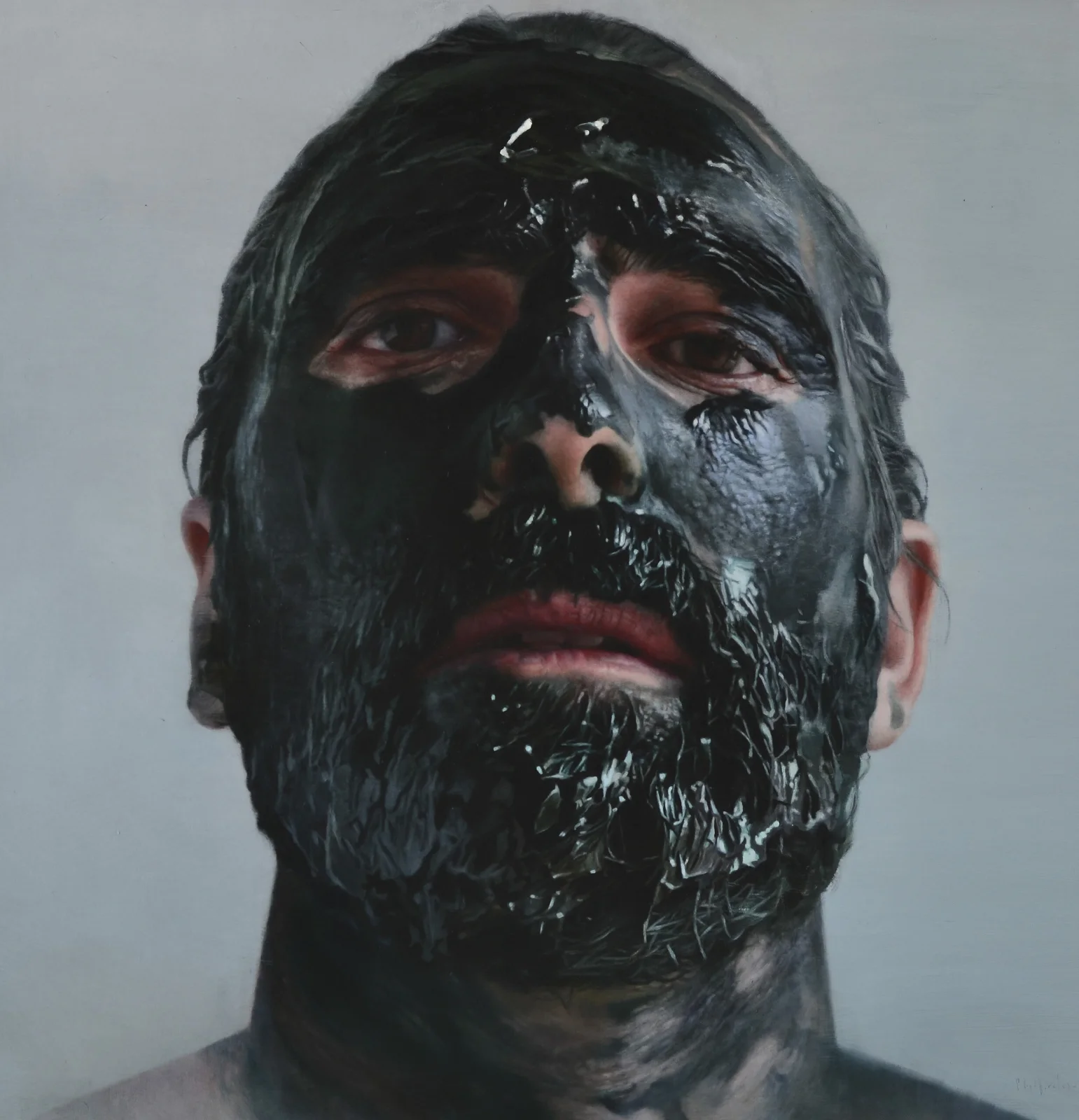
Eloy Morales is a Spanish painter born in Madrid in 1973, known for his large-scale hyperrealist portraits and exploration of the relationship between painting and representation. After graduating in Fine Arts from the Complutense University of Madrid, he developed a distinctive approach to portraiture, particularly through his self-portraits featuring his face covered with layers of colourful paint.
The contrast between the natural features of the human face and the expressive physicality of paint becomes a reflection on the artist's relationship with his own medium. His paintings combine meticulous observation with a strong psychological dimension, where the face becomes both a subject and a surface for artistic experimentation. By allowing the material of painting to interfere with the image itself, Morales challenges the boundaries between representation and abstraction.
Ron Mueck
Ron Mueck is an Australian sculptor whose work has become one of the most recognisable interpretations of contemporary hyperrealism. Having initially worked in film and television, creating puppets and special effects, he transferred his technical knowledge into the world of fine art. His sculptures reproduce the human body with extraordinary attention to detail, using materials such as silicone, resin and synthetic hair.
However, it is the manipulation of scale that gives his works their distinctive character. Figures can appear either miniature or monumental, disrupting the viewer's perception of the human body. Through representations of birth, ageing, intimacy and mortality, Mueck explores the vulnerability of human existence and the physical reality of life. His sculptures are not simply convincing imitations of human figures; they confront us with an amplified sense of physical presence, making even the most ordinary gestures feel unfamiliar.
Perhaps the most interesting aspect of hyperrealism is that it refuses to be reduced to a single visual formula. It can preserve the intimacy of a family memory, magnify the significance of an ordinary object, confront the viewer with uncomfortable realities or reconstruct the human body on an unfamiliar scale. The precision of representation might be shared, but the intentions behind it are remarkably different.
And this is where the answer to the initial question lies. Liking hyperrealism does not necessarily mean being fascinated by the ability to paint something that looks real. It means being curious about what an artist chooses to reveal through reality, and, more importantly, what remains hidden behind it.
Read next
- Where Wisdom Takes Form: Inside the New CCA Tashkent
- The Forms That Refuse a Name: Richard Pearson on Painting Other Worlds
- The World Is Not What It Says: Magritte’s Afterlife at Gagosian London
- Where Darkness Begins to Listen: Roy DeCarava in Los Angeles
- The Ocean Is Not Blue: Torkwase Dyson and the Politics of Abstraction
- The Ordinary Life Is Not a Small Subject: Louis Fratino and the Painting of Intimacy