One Dot Among a Million Stars: Yayoi Kusama, 1929–2026
Essay
Yayoi Kusama died on 14 August at 97. From the infinity nets to the pumpkin on Naoshima, how one dot filled rooms, streets and a whole career, as her last retrospective arrives in Amsterdam.
Viacheslav Munister · 2026-11-10
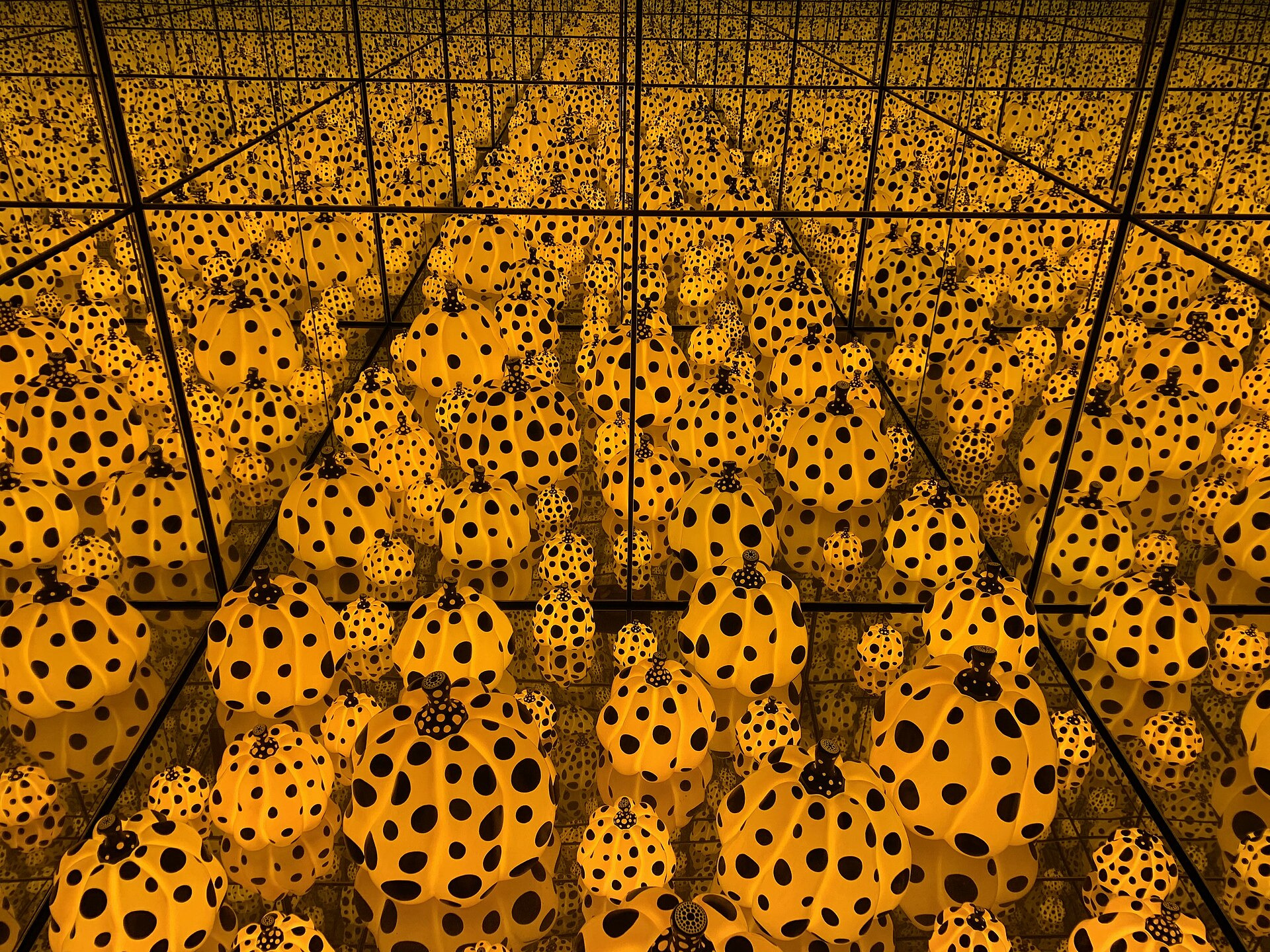
Step into the room and the floor seems to disappear. The walls are mirrors, and in every reflection, a yellow pumpkin covered in black dots multiplies until you lose count - of the pumpkins, and of yourself. The door closes behind you, and for a moment, you become one dot among thousands. This is the world of Yayoi Kusama, an artist who has spent decades turning repetition into infinity.
Kusama died on 14 August 2026 in a Tokyo hospital. She was 97. Her company announced it on 27 August and said she never put down her paintbrush. She once wrote that “our earth is only one polka dot among a million stars in the cosmos”, and she spent her life making that sentence into rooms.
I · A girl and a field of flowers
She was born in 1929 in Matsumoto, in the Japanese Alps, into a family that ran plant nurseries. As a child she had hallucinations: flowers seemed to swarm around her, patterns spread over the walls and the sky, and she drew what she saw. At thirteen, in the war, she was put to work making fabric for army parachutes. She studied the traditional painting style nihonga in Kyoto and found it too small. In 1958 she moved to New York and began to paint.
What she painted there were Infinity Nets: huge canvases covered in tiny looping brushstrokes that go on until they leave the edge. In 1962 she sold one to Frank Stella and Donald Judd for $75. In 2022 an Infinity Net from 1959 sold for $10.5 million.
II · Boats, balls, and a lot of stuffed forms
The paintings were only the start. In 1963 she began her soft sculptures, sewn and stuffed forms that crept over chairs, tables and walls. Aggregation: One Thousand Boats Show of the same year, a rowing boat covered in white plaster casts, with a pair of women’s shoes and posters, is now in the Stedelijk’s own collection, a gift from the artist. Two years later came Infinity Mirror Room: Phalli’s Field, her first mirrored room, in which the soft forms went on forever.
In 1966, at the Venice Biennale, she laid out Narcissus Garden: a “lake” of 1,500 mirrored balls on the ground. She sold the balls to visitors for $2 each, until the Biennale moved to stop her.
III · The room that fills up
Her rooms got larger. The Obliteration Room was commissioned by the Queensland Art Gallery in 2002 as a children’s project: a white room set like an ordinary flat, with white furniture, a white table, white walls. Visitors are handed sheets of coloured stickers and put them anywhere they like. By the end the room has disappeared under dots.
The mirrored rooms did the same thing without the stickers. Infinity Mirrored Room – The Souls of Millions of Light Years Away was shown at David Zwirner in 2013, and in 2025 she made a new one for her last retrospective, Illusion Inside the Heart, a mirrored cube of 300 centimetres a side. Her giant inflatable forms in pink and black do it by volume.
IV · Pumpkin
The pumpkin is her best-known creature, and it is easy to like: heavy, humble, a thing that sits. She has made it in yellow with black spots, in mirror-polished steel with red dots, in steel with holes cut through its skin, and, in 1993, as a mirrored room filled with pumpkin sculptures in the Japanese pavilion at the Venice Biennale.
The most famous of them sits on a pier on the island of Naoshima, in the Seto Inland Sea, where a yellow pumpkin stood from 1994. In August 2021 a typhoon swept it into the sea, and it broke in three. In October 2022 a new pumpkin was put back in the same place, with a hook set into its stem so that it can be dragged to safety if another storm comes.
V · Out in the street
Kusama’s work does not stay in museums. It turns up in city squares, on pavements and in the branches of street trees, and each time it makes the same offer: dot the world.
In London there is a grove of mirror-polished steel spheres at Liverpool Street. In Brisbane, eyes, in black and white, were laid across a pavement. In Lille, two huge tulips. In Matsumoto, her home town, dotted Coca-Cola cans are on sale in a vending machine.
VI · The hospital and the studio
She came back to Japan in 1973. In 1977 she checked herself into a psychiatric hospital in Tokyo, where she stayed for the rest of her life. Every day she was driven to a studio nearby. In the 1980s she published novels. In 2016 she received Japan’s Order of Culture. The hallucinations did not stop. “I still see hallucinations even now,” she told reporters in 2017.
VII · The last retrospective
Her last big retrospective opened in Basel, at the Fondation Beyeler, on 12 October 2025, and ran there until 25 January 2026. It then went to Museum Ludwig in Cologne and now stands in Amsterdam, at the Stedelijk, from 11 September 2026 to 17 January 2027, curated by Leontine Coelewij. The show covers more than seventy years of her work and includes historic pieces never shown in Europe before; in Basel it had more than 300 works. Her own museum in Tokyo opened its 18th show on 8 October, The Light Spreads Out, and Glittering Things Start Appearing All Around Me, which runs until 31 January 2027.
The numbers are large. A net painting sold for $10.5 million in 2022, her exhibition in Australia in 2024 was the most visited in that country’s history, and the Hirshhorn’s 2017 show was temporarily closed after a work was damaged in a selfie attempt. But the numbers are the least interesting part. A retrospective puts her life in order, from the nets to the pumpkins. Her rooms put you in the middle of it.
Why she matters
Kusama made the most repeatable picture in the art world, and it never wore out. A dot is the smallest mark there is, and she let it grow until it took the room, the street, and the viewer. Her best work does not ask you to look at an infinity. It asks you to stand in it for a minute, small and multiplied, and notice that it is not frightening.
See it
The retrospective Yayoi Kusama is on at the Stedelijk Museum Amsterdam until 17 January 2027. The Yayoi Kusama Museum in Tokyo has its current show until 31 January 2027.
Biography and career follow the obituaries in Al Jazeera and The Irish Times (27 August 2026); the Stedelijk retrospective and its tour follow the Stedelijk Museum and the Fondation Beyeler press kit; the Obliteration Room follows the Queensland Art Gallery; the Naoshima pumpkin follows ArtReview and CNN. Images: all via Wikimedia Commons, credited under each photograph (CC0, CC BY, CC BY-SA); the Kusama works are © Yayoi Kusama.
Read next
- Where Wisdom Takes Form: Inside the New CCA Tashkent
- The Forms That Refuse a Name: Richard Pearson on Painting Other Worlds
- The World Is Not What It Says: Magritte’s Afterlife at Gagosian London
- Where Darkness Begins to Listen: Roy DeCarava in Los Angeles
- The Ocean Is Not Blue: Torkwase Dyson and the Politics of Abstraction
- The Ordinary Life Is Not a Small Subject: Louis Fratino and the Painting of Intimacy