Nothing but Everything: Yaroslav Seleznev on Abstraction Without a Name
Interview
Painter Yaroslav Seleznev on moving from academic realism to abstraction, why a title can get in the way, where minimalism turns into emptiness, and what is left of a painting when the artist is gone.
Viacheslav Munister & Yaroslav Seleznev · 2026-10-14
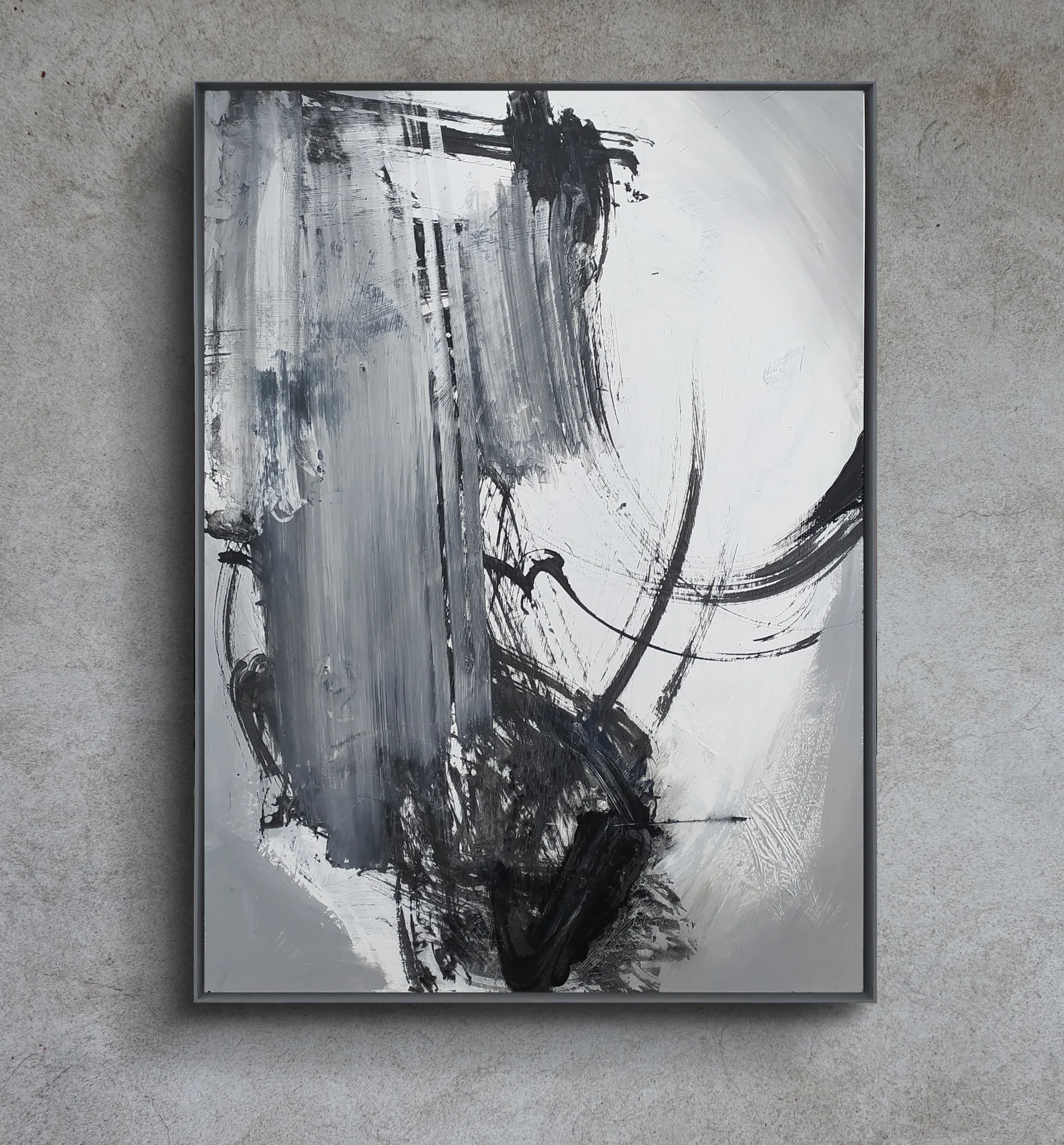
“It’s nothing but everything…” That is the line in Yaroslav Seleznev’s Instagram, and the three dots at the end say as much as the words. It is a joke, a programme and a paradox you cannot finish in one evening. His paintings speak the same way: one broad stroke, a thin graphic line, grey air around them, and then suddenly red, blue or orange, like a flash no one expected.
He did not come to this language in a straight line. First an art school inside the academic system. Then, at thirty-two, a master’s studio linked to the Academy of Arts: academic realism of the eighteenth and nineteenth centuries, broad tasks, no drilling. And then a deliberate break with recognisable subjects. He calls it “the destruction of my idea of being able to draw, and the building of a language from zero.” His solo exhibition at the Art-Liga gallery was called Composition No. , a number sign that any number could follow. The title pushes that refusal as far as it will go.
Today his work is shown in Paris, at Deux Paris (2025) and at the Art3f fair (2026), and at the exhibition Garden (2025). Beside canvas and paper there are now ceramics and copper: the same broad gesture moves onto a dish and into an object.
We wrote Yaroslav long and sometimes uncomfortable questions: about the academic eye and the title, about price and the screen, about parasitism, and about what is left of a painting without its author. He answered briefly and exactly. Few words here could be cut, and none are excuses. Seleznev speaks of beauty as an absolute and does not hide behind irony, though he has plenty of it.
01 · The Eye, the Nothing and the Name
We begin with what a person trained in academic realism carries into abstraction, with the line between “everything” and “nothing”, and with a title that sometimes gets in the painting’s way.
Viacheslav Munister [VM]: You studied in a master’s studio linked to the Academy of Arts, where the eye learns to see form, weight, light and tone. Is abstraction for you a radical version of that training, or a betrayal of it? Could it be just a better hidden academism, where what you recognise is your own “handwriting”?
Yaroslav Seleznev [YS]: I finished an art school that was part of the academic system, but I came to the master’s studio late, at thirty-two, and by choice. There was no drilling and no canon forced on us. The tasks were broad. We were aiming not at post-Cézannism or Soviet social realism, but at the academic realism of the eighteenth and nineteenth centuries. So the move to abstraction was not easy, but I always had room for other interests. When I was building my own language, I wanted something radically different. I wanted to make work that was new and of its time, to say what was truly mine, and to find myself in it. It was a break, a step into the unknown, into freedom, onto another level. You could say I destroyed my idea of being able to draw and built a language from zero. At some point you start to see the whole, the relation of the patches, and you stop caring about objects. I don’t think this is a new academism. It is a different way of looking. The values stay the same: balance in the composition, harmony, taste, and, as a result, a “strange”, “new” beauty.
VM: Was there a moment when you saw that your precise hand was the main obstacle?
YS: Style is both an obstacle and not. At some point I found mine, as a personal artistic truth, and that truth has not changed. But you can’t do the same thing for ever. You feel routine and a kind of emptiness. That is why the unintended, the mistake, chance, renew it and give me exceptional sensations. A precise hand is an obstacle. Too much control is lifeless, but no order at all is chaos. So balance matters: it should look as if it was not made by hand, yet the author is there.
VM: “It’s nothing but everything…” What separates your painting from emptiness and from chaos? What keeps “everything” from dissolving into “nothing”? And why exactly three dots?
YS: You are remarkably perceptive). It is nothing, but it is everything. It is nothing other than everything, and so on. For me abstraction is a degree of generalisation, a distance from meanings and from the concrete. It works on the level of emotion and intuition. To formulate an idea is to be pinned down by it. A work organises space so that a message appears about personal beauty, about artistic truth. That truth rests on feeling, values and faith. The boundary is the author’s own sense that the work is finished and enough, but not too much. The viewer’s opinion belongs entirely to the viewer. The ellipsis is there because the system is open, the concepts are general, and everyone will see their own.
VM: Your exhibition at Art-Liga was called Composition No. Is refusing a title the most honest gesture, or a way of hiding from responsibility for the content?
YS: Both: an honest gesture and a game of hide-and-seek. A title immediately makes an abstraction concrete. “Composition No.” is the most honest name for such a work. But it also lets you hide, not so much a lack of skill or substance as any single meaning, and it protects you from being devalued. Today words are often tied to marketing, and nothing is less compatible with real value than personal interest. It can creep into titles. At the same time a title is a conversation with the viewer in a language they understand. If you give only a number, you risk more than being misunderstood: you may be refused communication from the start. Titles get in my way. They call up associations or memories that are too literal. If I can stay at the level of form, the value is kept.
02 · The Hand, the Refusal, the World
Next: restraint, the hand and chance, and whether a painting without a subject can be a witness.
VM: Your work is often called colour minimalism. But isn’t restraint a kind of privilege? Where does “less” stop being purity and become emptiness? Were there works where you allowed yourself excess?
YS: Yes, I made works with detail, texture and a wide palette. But I felt that clarity gets lost in abundance, and the form slides into decoration. The boundary is a matter of feeling. Emptiness is a phrase left unfinished. Too much self-limitation quickly turns into boredom, a feeling of losing touch with my own language, and hopelessness.
VM: Who is the author of a painting: you, the material, chance, or the viewer? Can chance be depicted? How do you tell a living movement of your hand from a rehearsed one?
YS: Chance and the hand live together. The work is made by nature, yet the author is present in it. The artist organises chance. The viewer joins in when the work is already finished. You can depict chance for a viewer, but the author knows it is not chance, and then the interest and value are gone for him. A gesture can wear out. Then something new helps: another tool, a different material or paint, a change of movement. In my view the question is not the image itself but the purpose and the personal investment. A still life can be a student exercise, done under pressure, or it can carry the author’s values and life: energy, a firm hand, taste, a feeling for colour. Yes, abstraction has no criterion. That gives freedom, but it also means that anyone can make abstraction, and value becomes hard to define. There is no test and no special person to ask. What is needed is some surprise, some chance, and no sign of labour or contrivance.
VM: Can a painting without a subject be a witness? If your work does not depend on what happens in the world, does it bear no responsibility for it?
YS: Exactly! Not to accuse, not to justify, not to devalue. A distance from agendas. An attempt to find universal values that stay the same through any upheaval. The author is always in dialogue with reality, with the past, with art history. It depends on your point of view. Some say that the harsher the times, the more abstract the art. On the other hand, I know that when I was looking for my language, I started from specific wishes and positions. Great art stands outside politics, at a distance from agendas. It is not about being liked. It stays outside the subjects and meanings that pin you down and show your personal limits. It was also a reaction against abundance, against the overproduction of images and information.
03 · Heritage, Host, Wall
Then the legacy of the avant-garde, the communities an artist chooses or refuses, and the wall where a painting becomes part of someone else’s composition.
VM: Malevich, Rodchenko and Kandinsky believed that form can change life. What do you believe in? And what do professional associations mean to you?
YS: I believe in beauty as such, as an absolute, and a particular work is evidence of contact with it, or is not. The associations, including the Union of Abstractionists of Russia and the Union of Artists of Russia, were an attempt to find like-minded people and my place in the professional community. I did not have to join. Or I did, in order to define myself by contrast. In my view abstraction gives freedom to look for your own language. It is the only direction today that is tied to tradition and still leaves room for something new. Abstraction is not one thing. American minimalism of the last century is not the same as the contemporary kind. Post-war abstract expressionism in the US differs from the Japanese, and so on. A personal language lets you express yourself and realise yourself. Individuality cannot be reproduced and does not repeat in history.
VM: Your Instagram has collections called “Parazit” and “Borey”. Whom or what do you “feed”, and what do you feed on? Can an artist be free while depending on those who buy and exhibit?
YS: It is more down to earth. “Parazit” is a community that inherits Leningrad nonconformism and arte povera. It is the opposite of an artists’ union. You could say its members’ works lie on the far side of beauty, or that it is a different beauty, with something marginal and underground in it. This takes nothing away from the value of the authors individually, or from the kindness of people. An artist should be alone, because a community levels individuality. Humour in art doesn’t attract me. Attempts to make people laugh or to devalue things sometimes look like a screen and a hopeless search for invulnerability. Perhaps a parasite changes its host’s behaviour. But in art, parasitism mainly means opposing the official, the conventional, the commercially successful. Without a host, only marginality and plain rebellion are left. I want substance beyond that. An artist asserts his own values. I think it is important to stay autonomous and keep your own kitchen separate from the market.
VM: Who do you work for: the seconds viewers actually give, or the years nobody will give? And how far will you let an exhibition, a curator or a wall take authorship of your painting?
YS: I think abstraction is accepted by a viewer who wants or is ready to accept it. Time doesn’t matter. It can be long, if there is something to sink into, or it can be seconds. We read another person unconsciously in an instant, and in effect decide whether we like them and whether to talk. At Art-Liga we hung the works together, by agreement. A clean space matters to me, its ability to be a background. I am not ready to leave this to curators, and another person’s eye is usually foreign. At an exhibition a work opens up more fully, a cycle comes to an end, and one gaze meets another.
04 · Price, Copy, Screen
The fourth part is about the fair, the price and the phone screen, and about noticing that a style has died before the market says so.
VM: An abstract painting is almost the perfect commodity. How do you avoid becoming decorative? Does the market change you, when you show at fairs such as Art3f Paris?
YS: Fairs are always inspiring: lively contact, many new viewers, attention, one more chance to make a first impression. I think the line of the decorative is fairly clear. It is about wanting to please. It shows in polish, gloss, abundance, ostentatious friendliness. If you keep your own purpose and stay within the limits of taste, you can avoid decor. The market does change me. For several years I have heard that colour is needed, that monochrome is boring, dreary, funereal, gloomy. So I move into colour carefully. But honestly, as Tarkovsky said, colour gets in the way of a focused message.
VM: Thousands of people see your painting in a feed, and only dozens see the original. Which of these meetings is “the work”? Did a painting change when you thought about how it would look on screen?
YS: In the studio I do what I think is right for the work in person. I don’t look over my shoulder at the media space. Some works look less expressive on screen, so I try to publish the ones that make an impression. I think the context and the dimension of perception change, but the work itself does not. I see social media as a necessity for self-presentation. But post-production and publishing are a duty. They are work, not pleasure.
VM: What is the sign of a dead style, and how will you know that yours has died? What would make you stop?
YS: What is alive in a style is (n+1)׿, where the last term is chance, the unintended, the unpredictable. A style is dead when the author is dead and can no longer share his aims and values in living conversation. Yet art historians, researchers and dealers embalm works very successfully and keep them in circulation for centuries. I have also repeated my own works, and made work close to what was expected, but that was on commission and I saw it as commercial. In the studio I follow only my own preferences. There are failures, but they mostly come from walking along the edge of the aesthetic. Some say frustration is the road to subjectivity. In the long run that is probably true, but any failure may be the last. I can’t imagine a situation where it is no longer possible to go on. On principle, yes: if I saw that a technique had been overused and turned into kitsch, not as an artistic method. Abundance, when there is no reason to work, could probably stop me. It could certainly change my inner intention. But I assume I will keep working for myself, for the drawer.
05 · Words, Time, What Remains
And at the end, words that are better left unsaid, and what remains when the author is gone.
VM: Abstraction is usually written about either emptily or with too much explanation. What single word or phrase would you let us place next to your painting?
YS: Honestly, it would be better without words. But “Nothing but everything” will do). The critic and the viewer exist on another plane. For me abstraction is direct perception and a degree of generalisation. Interpretations and associations are necessary for communication and for the art world to exist. I think any work can be interpreted, and not in only one way. It is a tool of cultural marketing.
VM: What will remain of your work when you, your explanations and your name are gone? If you could keep only one work, which one? And what unanswered question would you leave to our readers?
YS: What will remain is the composition, craft and taste, what is left unsaid, and the inner energy. If anyone wants to see it. Stories and legends are more entertaining). I would keep Ugly beauty , from 2023. “Terribly beautiful”, or “ugly beauty”). In that work I stated my aim: to speak about the maximum with the simplest means. And here is my question. Is there still a place for the word “beauty” in art today, or has “artistic truth” replaced it? Can beauty exist as such, as an ideal?
The artist organises chance.
Yaroslav handed the last question back to us: can beauty still exist in art today, or has “artistic truth” replaced it? We will not answer for him. We leave it with our readers.
Interview by Viacheslav Munister. Answers by Yaroslav Seleznev, lightly edited for clarity and punctuation. Questions have been shortened. All artworks and photographs courtesy of the artist.
Read next
- Where Wisdom Takes Form: Inside the New CCA Tashkent
- The Forms That Refuse a Name: Richard Pearson on Painting Other Worlds
- The World Is Not What It Says: Magritte’s Afterlife at Gagosian London
- Where Darkness Begins to Listen: Roy DeCarava in Los Angeles
- The Ocean Is Not Blue: Torkwase Dyson and the Politics of Abstraction
- The Ordinary Life Is Not a Small Subject: Louis Fratino and the Painting of Intimacy