Miguel Ángel Romero: Sculpting the Ineffable
Feature
Barcelona-born sculptor Miguel Ángel Romero on childhood memories, the language of sculpture, human relationships, and the experiences that shape his artistic practice.
Maria Ivanova · 2026-11-19
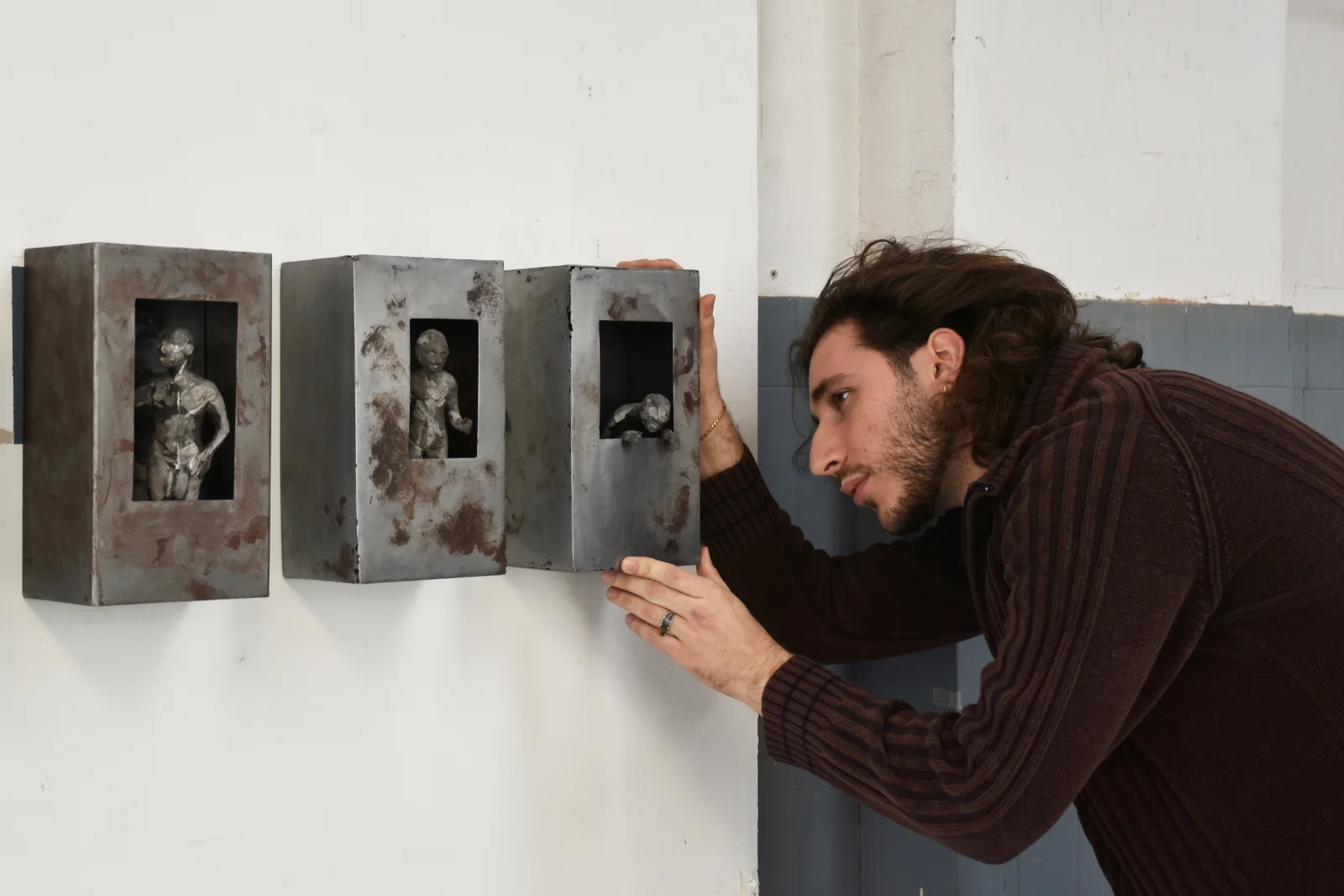
For Barcelona-born artist Miguel Ángel Romero (b. 2001), sculpture offers a way of approaching things that are difficult to put into words. His works often seem to exist somewhere between the familiar and the unfamiliar, quietly drawing our attention to moments and feelings we might otherwise overlook. Childhood holds a particular place in his practice, not simply as a memory of the past, but as a way of understanding the world that we gradually lose as we grow older. There is something tender, and at times unsettling, in his figures, which seem to carry a knowledge they are not quite ready to share.
Born in 2001, he studied Fine Arts at the University of Barcelona before specializing in sculptural techniques at Escola Massana. In 2025, he worked as an apprentice and production assistant in the studio of sculptor Samuel Salcedo, while his artistic practice has also taken shape during stays in South America and the Caribbean.
Whether exploring the delicate moment between the desire to act and the action itself, or the silence that exists between people, his sculptures leave space for uncertainty. They do not necessarily offer answers, but invite us to linger a little longer with the questions. In our conversation, we return to his childhood, the beginnings of his relationship with sculpture, and the experiences that continue to shape the way he sees and creates.
1. Artistic beginnings and influences
When did art first become part of your life? What initially drew you to it?
When I think back to my childhood, I remember how much I loved spending time with my grandfather, who was a cabinetmaker. I have a very vivid memory of that time. Once, I told him that I wanted a bow and arrows. He went to his workshop, and a few days later, he showed up at our house with a gift. He hadn't bought me a bow; he had made me a wooden crossbow himself, with handmade arrows as well. My parents would go crazy when they saw me playing with that crossbow around the house.
I loved going to his workshop and watching him work. As a child, it seemed like a mystery to me how he could give shape to something that hadn't existed before. I started making my own toys and inventing stories with them.
Through play, I learned that I could give shape to almost anything I imagined, and that brought me immense joy.
How did your relationship with sculpture begin? Was there a particular moment when you realised it was the medium you wanted to work with?
When I entered the Faculty of Fine Arts, I wanted to be a painter. My first years of study were complicated by the pandemic, and I spent almost two years without setting foot in the faculty's workshops. My relationship with sculpture began rather unexpectedly, towards the end of my degree, when I started working with clay in modeling classes. From there, I began exploring different materials, depending on what each piece required. I discovered that I could play with materials in a very different way from how I did in painting, and that this opened up other possibilities for conveying an idea.
I also had professors who supported me throughout this discovery. I liked the collaborative atmosphere of the sculpture workshop. Sometimes I had to trust others to move forward with a piece; otherwise, I would get stuck, and that helped me grow. Sculpture required more time and a different kind of learning, one that developed gradually. I suppose I realized how much it meant to me as my desire to spend time in the workshop kept growing.
2. Sculpture, painting and storytelling
You work with both painting and sculpture. How do you feel these two mediums communicate differently with the viewer?
When you take something out of the two-dimensional plane, the relationship the viewer establishes with the piece changes completely. I have always been drawn to touch, to how a material can be understood through it. In painting, representation itself usually requires fixing a point of view that is difficult to move beyond. In sculpture, however, all points of view coexist simultaneously, and the viewer discovers them as they move around, which is what the piece requires in order to be understood. And through that movement, a very direct, almost personal relationship with the work is established.
I like to say that it is the viewer's eye that completes the work.
A painting allows for many interpretations. In sculpture, moreover, those interpretations change depending on where you choose to look from. Sometimes I feel that this physical relationship makes it easier to approach a sculpture, no matter where you come from. Ultimately, for me, they are two sides of the same coin, two equally valid languages for representing ideas that also complement each other.
You often explore an idea through a series of sculptures, as in The Ages of Aran. What draws you to working in series?
The idea of repetition has always fascinated me. In the case of *Las edades de Aran*, it emerged from experimenting with the mold. I wanted to push it to its limits, and that's how the series began. When I start a piece, I don't usually think about whether it will be unique or part of a series. I just keep working, and ideas begin to connect with one another in that small universe of consciousness that forms around my work. Sometimes, while I'm finishing one piece, I'm already starting another, and I might finish the second before the first, or even the third.
What I like is that, as I continue developing an idea, the pieces begin to communicate with one another. When that idea changes direction drastically, that may be where the series ends, although the question that gave rise to it stays with me and may reappear later in another form. I make art in an attempt to understand what lies beyond my comprehension. Sometimes that answer takes the form of a series, and other times it fits within a single piece.
3. El trampolín and the idea of transition
In 2025, you created a series of works featuring diving boards. What first inspired your interest in diving boards and swimming pools as artistic subjects?
It all started with an empty head, separated from its body, that needed some kind of device to activate it. The image of a diving board began to emerge almost without me realizing it. At that moment, I was trying to represent something difficult to capture, that very delicate point between the will to act and the action itself.
I imagined a head on the edge of an abyss, and the abyss ended up taking the form of a diving board. At the same time, a staircase emerged that one seems able to climb, along with a platform one can move forward along, until it comes to an end.
In this series, you describe each diving board as a place of transition, somewhere between the intention to act and the action itself. I find this idea particularly fascinating. Could you tell me a little more about what the diving board represents to you?
For me, the diving board represents a perpetual journey, waiting for a jump that may never happen.
One seems to fear it and, at the same time, wishes it would never happen. It is a place that leads us to another, even if that other place has no recognizable form. In this series, the staircase seems to offer a path. However, if one tried to follow it to the last step, one would encounter an iron plate that prevents access to the diving board.
I like that whoever approaches the piece can experience something of that doubt, the risk, and the excitement of the jump, even if it never happens.
Every time I see those diving boards, I recognize myself in them; I see something that has to do with my life. As an emerging artist, I think about everything I have learned and everything I still have left to learn. I feel that I am at a point from which I could jump somewhere. At the same time, I don't know where that jump might take me.
But ultimately, it is something that happens to us as human beings:
we live in that constant tension between desire, action, and their consequences.
4. Una caja de milagros and theatre
In Una caja de milagros [A Box of Miracles], you describe theatre as a box of wonders, a place where entire worlds can be discovered through a single opening. What inspired this idea?
I am interested in how theater can exaggerate a situation to make visible something that is barely perceptible in everyday life. In these boxes, the scale is small, and the figures share an ambiguous situation. You don't know whether they want to get out or remain hidden inside. For me, they function as a silent theater. I am interested in what can be sensed in that space, the possibility of communicating with someone, and also the difficulty of doing so.
Populated by theatrical gestures, they create a break in the midst of the world, a window through which they can observe and be observed. These settings function as a silent theater, focusing on what cannot be seen but can be sensed: spaces where human existence is suggested through presence and, paradoxically, through absence. These figures share an ambiguous situation; it is unclear whether they want to go outside or remain hidden within. There is a certain strangeness, something that can be sensed but not explained. I am interested in representing communication – or its impossibility – and human relationships as a space for reflection on the individual and the collective in a society where identity and individuality seem to dissolve.
I am not so much interested in showing people as in revealing the questions they leave behind: what happens between them, what remains unsaid, what is left suspended in the air, that silence. A place for transition, a fragment of a world that does not entirely exist, but that refers to experiences already lived or yet to be lived.
5. Childhood and El niño que ya no juega
Childhood seems to be a recurring theme in your sculptures. What draws you to exploring this stage of life through your work?
It has always been said that children are innocent, but within that supposed innocence there is a wisdom that becomes difficult to access as one grows up and becomes an adult, and that we all try to return to at some point. Doesn't that seem like a great contradiction to you? Perhaps that is why elderly people and children have always understood each other so well. I am sure that the stages of life they are going through are closer than we think.
A child gets to know the world through play. A toy car is enough for them to imagine and pretend they are driving, and perhaps discover something that will continue to interest them when they grow up. Sometimes I wonder at what point we stopped playing the way we used to, and what changed then.
Through play and the desire to play, we were able to give shape to something that seemed impossible. I think that is partly where my insistence on returning to childhood and trying to represent it comes from.
One of your sculptures is titled El niño que ya no juega (The Boy Who No Longer Plays). What inspired this work, and what does the idea of losing our sense of play mean to you?
It all began with an experience I had with the child who would become the model for the piece. I was deeply struck by the way he behaved and acted, as if his age did not really belong to him. I remember that I was able to communicate with him through play; it was the way he expressed his knowledge of the world. I always tried to play with him, and he taught me many things I didn't know. That made me think a lot, and then the idea for this piece emerged, in which the protagonist seems to have assimilated that transition into adulthood despite his young age.
For me, losing the sense of play has to do with losing a way of understanding the world.
The boy in this sculpture has such an intriguing facial expression. What kind of emotion or state of mind were you hoping to convey through it?
I was interested in finding a state of introspection. He has a fragile appearance, a relaxed posture, and partially closed eyes. Perhaps he holds some hidden knowledge within himself that I cannot access.
I like to think that this child, while looking at you, is also looking at himself. He narrows his eyes as if he needs to look inward, although he is fully aware that someone is standing in front of him. There is something protective about that gesture. The outside world is still there, and for a moment, he can withdraw into himself.
Perhaps he hides the truth within himself, a knowledge he acquired through play, and he is aware that he will never return to it again.
6. The creative process
You’ve written about how mistakes and accidents can become something beautiful, even when they are difficult to accept. Has an unexpected moment ever completely changed the direction of a work?
Of course, in fact, it happens to me constantly. As I work, I make decisions, and problems arise that force me to improvise. Sometimes I have a pretty clear idea of how I'm going to proceed, and one of those decisions ends up taking me in another direction.
I've gradually learned that this chain of mistakes and accidents can work in favor of the piece when I accept that there is a part of the process I cannot control.
Finding a certain order in that chaos is part of what I do. I let myself be guided a little by accidents. They are great companions in the solitude of the creative process.
7. Barcelona and a final thought
What are some of your favourite places in Barcelona? Are there any particular spots that inspire you or that you find yourself returning to?
I always like returning to Montjuïc mountain. I find it a very curious and strange place within the city itself. There are several museums and gardens there that are always worth revisiting. Besides, it comforts me to know that I can walk to the farthest point of the mountain and know that the sea will always be there. The Mediterranean light at sunset, with the sea in the background, reminds me of where I come from.
I am also inspired by life in its streets, the bar culture, that ease of sitting down at a little outdoor terrace and having people around you at any hour and at any moment. However, if I had to choose just one place to return to, I would end up returning to the sea.