Emily Kraus: Rhythm of the Moment
Feature
Inside the Canvas Cube, Emily Kraus Paints the Rhythm of the Present Moment
Maria Ivanova · 2026-07-30
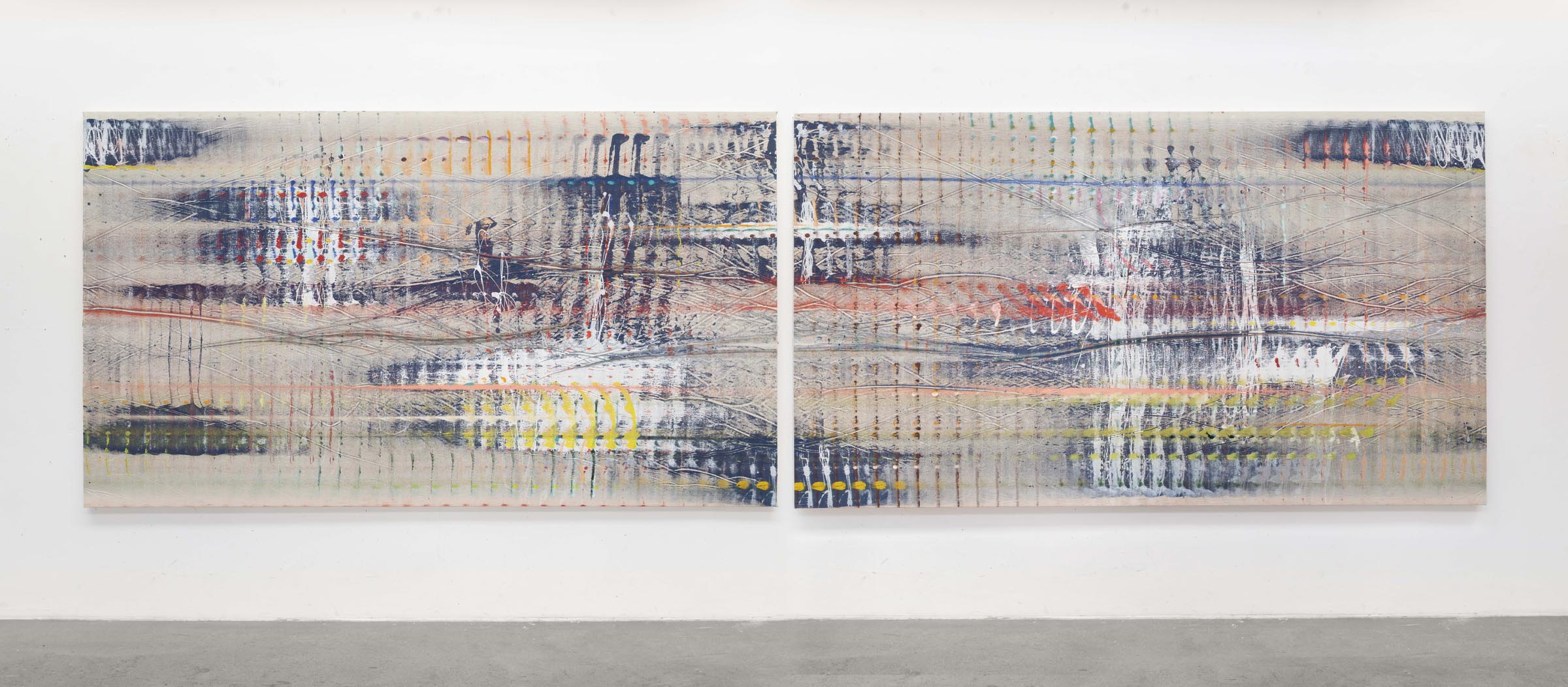
Emily Kraus's (New York, 1995) works left me unbothered by anything externally existing. I am frozen, trapped and stunned by the unidentified. It's almost like falling in love – you were not prepared, you didn't ask for it, yet it's one of the best feelings that can happen to the human being.
When the art is a part of the artist's mind, body and soul – you can feel it from the innermost dedication to the practice. That form of connection can be compared to the billions of invisible thinnest threads that remain unbroken between the artist and the artwork, even when they are far apart. They are mutually nourishing and will never be independent again.
When you look at the painting and can almost physically feel the presence of the author - that's when the purest form of revelation is unfolding in front of you.
The first glance was not followed by the question "How?". I was too occupied dealing with jitters. The second one brought me back to consciousness, ready to be curious about how it was achieved.
Lack of immediate curiosity about technique corresponds to the artist's belief that the work should live on its own – the communication with the viewer relies on an individual reflection as the clearest translator of visuals.
Emily Kraus works in tandem with a self-invented structure, made of a scaffold with planks and rotating poles, on which the canvas is stretched. This approach gives a unique opportunity to rotate the surface and at the same time creates a cube-like enclosed space. From inside, the artist is applying the oil paints, and then rotates the canvas before the paint dries – as it moves through the poles, the paint gets smudged. The repeated steps result in the glitchy signature visual code.
As the canvas is geometrically structured, the result of the whole image is unknown until the end of the work, which takes approximately one month.
There is a beauty in the uncontrollable. The nature of each painting is not in the pursuit of visual appeal, but in a momentary decision, whether the following gesture belongs to this emerging artwork or not. Through this profound significance of the process, based purely on the artist's feelings, the painting accumulates a powerful, spiritual memory.
This mechanism was influenced by the time when Kraus was studying in her second year at the Royal College of Art, which coincided with COVID-19 and the lockdown. She was assigned a cube studio 2.5 by 2.5 metres. The limited area of the room hampered Kraus's intention to paint with large gestures, experimenting with her body and space. To expand the possibilities of her practice in existing conditions, she stretched the canvas along all the walls using shower poles and wooden brackets. The canvas could be rotated, erasing the boundaries of the contained space.
The concept of confinement as part of a wider perception of space was on the artist's agenda before. Emily Kraus explored the boundaries of objects, places, and the relations between them. Moreover, she practiced meditation, which ultimately reconfigures the whole existing world, making it seamlessly broad and possible to totally fit in one's mind at the same time. Accumulating reflections along with a small studio space prompts a question about how one can find freedom when physically confined and how space cannot free us from the mind's cage.
As Lucian Freud stated – "Everything is a self-portrait". These words can't be more accurate when talking about art. The sublime essence of Emily Kraus's oeuvre is definitive, rather than chaotically formed – she holds a BA in Religious Studies from Kenyon College. The choice was influenced by Kraus's self-questioning of the meaning of life.
The profound influence of Emily Kraus on the contemporary art world is reinforced through the recognition by major institutions: as one of the Artsy Vanguard 2026, recipient of the Hopper Prize, and shortlisted for both the Hopper Prize and the John Moores Painting Prize, she continues to make discoveries through every new work, establishing her strong path.