Luciano Fabro: A Retrospective You Can Walk Into
Exhibition
A room made of paper, a bed of marble and a cube of mirrors: the first Italian museum retrospective of Luciano Fabro since 2007 turns the Navate of Pirelli HangarBicocca into a place to inhabit.
Viacheslav Munister · 2026-11-19
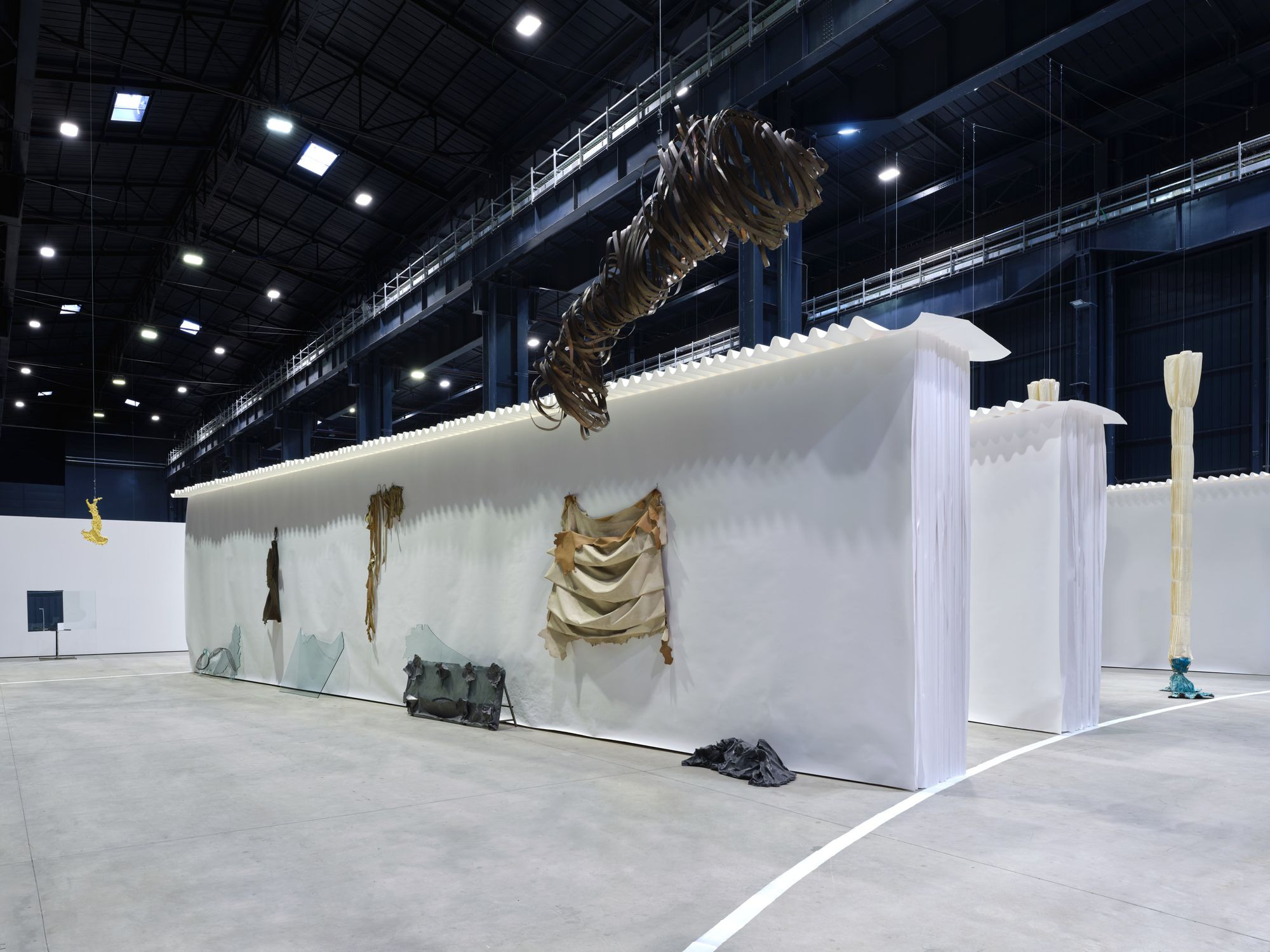
In the Navate of Pirelli HangarBicocca in Milan, a former locomotive factory, a long white wall made of paper now runs through the nave. About twenty sculptures hang on it and stand around it, and the whole structure is a reconstruction of something Luciano Fabro built in Rotterdam in 1981. Luciano Fabro: Abitare lo spazio. Inhabiting Space runs from 8 October 2026 to 21 February 2027. It is the first museum retrospective of Fabro in Italy since his death in 2007, and it brings together around fifty sculptures and installations from the whole of his career. Admission is free.
Fabro was born in Turin in 1936 and died in Milan in 2007. He was one of the leading artists of Arte Povera, and he kept an independent, nonconformist line within it. What the museum puts at the centre of his work is a verb in the title: to inhabit. He understood space as a dynamic field of action, and he looked, with unusual stubbornness, at the act of looking: at the relation between the viewer, the work and the room.
I · A word with two roots
The word that holds the show together is habitat. Fabro began to use it only in the 1980s, although the museum traces the idea back to the 1960s. It has two Latin roots: habito, to inhabit or to dwell, and habitus, outward appearance, bodily form, even clothing. A habitat, in his sense, is an ideal environment, either self-contained or built into an existing space, made to house and activate his works. Many are made of paper and light. They question the neutrality of the white cube, and the museum says they recall the welcoming atmosphere of a Baroque piazza.
Fabro was precise about what he did not want. He said that installations do not interest him, because they build a false construction in a false situation, while a habitat is real: the light is real and a wall is a wall. It belongs to a situation in which one is present, and if nobody is there, in his words, it is not a habitat. The exhibition takes him at his word. Single works alternate with large environments made of several pieces, and some of the habitats have been rebuilt in the Navate after his death, on the basis of his plans and instructions.
II · A cube of mirrors
The story starts with mirrors. The museum says Fabro followed the perceptual and spatial research he began in the 1960s from his first experiments with reflective surfaces to ever more complex architectural structures. The early reference points are Lucio Fontana's Ambienti spaziali and the conceptual inquiries of Piero Manzoni. Among the works is In cubo of 1966, conceived, according to Gaiaitalia, from the dimensions of the human body. The photograph from the invitation to his 1967 show in Turin shows Fabro himself inside the white cube, arms stretched out to its walls.
Allestimento teatrale, 1967 to 1975, takes the idea to its extreme. Mirrors cover every surface of a room and lines of light multiply into the distance, so that whoever sits inside is repeated and fragmented without end. The photograph below is a performance view from the Bagno Borbonico in Pescara in 1975. The press kit shows the work again as Cubo di specchi at the Centre Pompidou in Paris, in the exhibition Habitat of 1997. The museum adds that the reflective surfaces of the Baroque, with their play between presence and absence, run through the whole of Fabro's work.
III · Glass feet, a marble bed
Fabro changed materials freely. The museum lists marble, glass and bronze among the traditional ones and silk and lead among the unconventional, each chosen for its sensory and evocative qualities. He described painting as vision and sculpture as revelation. Two works from the late 1960s show what that means in practice.
Piedi, Feet, hangs fabric against glass: pure silk shantung ends in feet of Murano glass. It was shown at the 36th Venice Biennale in 1972, in a photograph by Fabro himself. The other work is Io rappresento l'ingombro dell'oggetto nella vanità dell'ideologia, "Lo spirato", of 1968 to 1973. A reviewer in Gaiaitalia describes it as a marble resting place in which the absence of a body becomes a perceptible presence. Seen from a few metres it is a bed under a heavy sheet, with the folds of stone fabric falling exactly as cloth does. In the Milan show it is lent by the Castello di Rivoli, from a private collection.
IV · A room made of paper
The centre of the show is the Habitat di Rotterdam, which Fabro conceived for his retrospective at the Museum Boijmans Van Beuningen in 1981. It has been rebuilt in the Navate by Silvia Fabro and the Archivio Luciano e Carla Fabro, from the artist's plans and instructions, at dimensions close to the original, according to Gaiaitalia's account. About twenty works sit inside it, among them some of the celebrated Italie. The walls are paper, and they are cut with openings, passages and viewpoints that organise how visitors meet the works.
The choice of paper is the point. A material that looks fragile and temporary lets him build a place that changes the experience of the visitor by a wall, an opening or a carefully judged view, without the weight of a monument. The two photographs here show the same idea forty-five years apart: the first at Rotterdam in 1981, the second in Milan in 2026. In both, tall wrapped columns stand in a white space that someone has taken care to make.
V · A web, an eclipse
Not everything is built from paper. In La Dialettica, 1985, a marble sculpture from the Museum of Modern Art in New York stands in the dark of the hall, and a web of cord rises from it toward the roof. In the museum's credit the earrings and the cobweb belong to a private collection. Eclissi di cielo, dated 2006, balances a green stone sphere between two heavy dark cylinders. And È la vita è la storia è la morale, first shown at the 1997 Venice Biennale, has been placed in the Cubo of the HangarBicocca, a tall hall with a spiral stair against its concrete wall.
VI · A Milanese
Fabro spent his childhood in Friuli and moved to Milan in 1959. The city is a theme of the retrospective, which comes more than a decade after his last major international exhibition, at the Reina Sofía in Madrid in 2014. In the late 1970s and early 1980s he founded the Casa degli Artisti with the artist Hidetoshi Nagasawa and the critic Jole De Sanna, a centre meant to bring younger artists into dialogue with each other, and from 1983 to 2002 he taught at the Brera Academy. Alongside the work he wrote a great deal, and the catalogue, published by Marsilio Arte, collects essays on 1968, the Baroque and the habitat, including contributions from Frances Morris, Margit Rowell and Catherine Grenier. It also prints his 1983 conversation with Bruno Corà, which the museum calls a seminal text for the theory of the habitat.
See it
Luciano Fabro: Abitare lo spazio. Inhabiting Space is at Pirelli HangarBicocca, Via Chiese 2, Milan, from 8 October 2026 to 21 February 2027, Thursday to Sunday, 10.30 to 20.30. Admission is free, and booking online is recommended for priority entry. A walking lecture with Liliana Moro and Gianni Caravaggio takes place on 3 December at 19.00. The exhibition is curated by Fiammetta Griccioli, Roberta Tenconi and Vicente Todolí, in collaboration with Silvia Fabro of the Archivio Luciano e Carla Fabro.
Facts follow the Pirelli HangarBicocca press release and press kit, the e-flux announcement of the exhibition, Finestre sull'Arte and a review by Fabio Galli for Gaiaitalia (17 October 2026). Descriptions of the works are of the photographs shown. The historical photographs come from the museum's press kit and are credited as the museum gives them; the installation views are by Agostino Osio, courtesy of Pirelli HangarBicocca.
Read next
- Where Wisdom Takes Form: Inside the New CCA Tashkent
- The Forms That Refuse a Name: Richard Pearson on Painting Other Worlds
- The World Is Not What It Says: Magritte’s Afterlife at Gagosian London
- Where Darkness Begins to Listen: Roy DeCarava in Los Angeles
- The Ocean Is Not Blue: Torkwase Dyson and the Politics of Abstraction
- The Ordinary Life Is Not a Small Subject: Louis Fratino and the Painting of Intimacy