How to Stand in an Unstable World: Mona Hatoum at Fondazione Prada
Sculpture & Objects
Three rooms, more than thirty thousand glass spheres and a metal tower that repeatedly loses its balance: Mona Hatoum turns sculpture into an instrument for measuring instability.
Viacheslav Munister · 2026-10-04
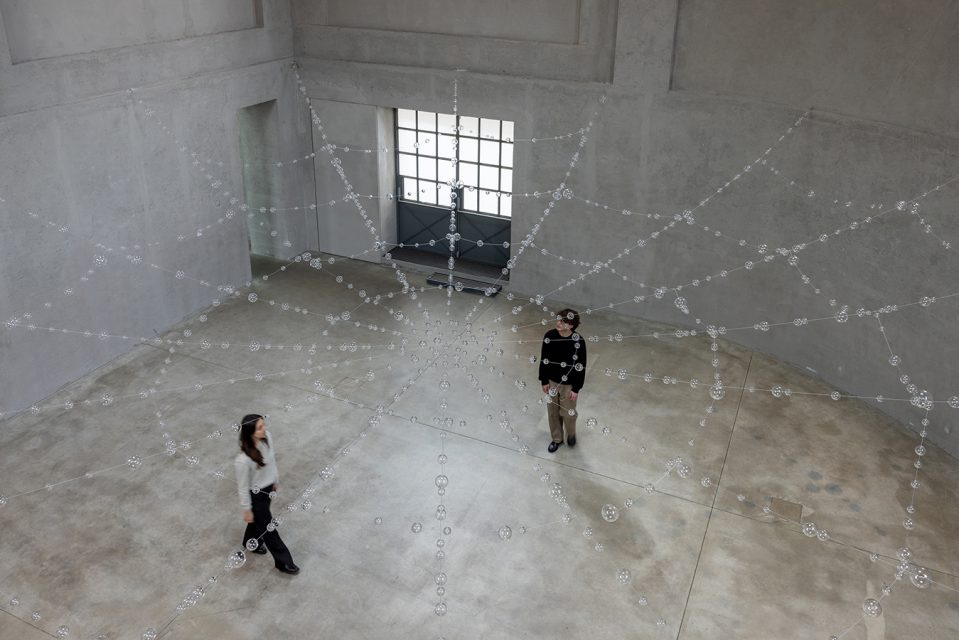
Mona Hatoum’s new installation at Fondazione Prada begins with a simple correction to the way exhibitions are usually seen. The visitor does not stand outside the work and interpret it from a stable position. The floor may be clear, the walls may be still, but the body is already implicated: looking upward through a suspended web, circling a world map that could scatter underfoot, listening to a nine-storey metal frame strain against its own collapse. “Over, under and in between” is less a sequence of objects than a set of physical propositions about how it feels to occupy a world whose structures remain visible while their promises have become unreliable.
Installed in the three rooms of the Cisterna, the project brings together two new works made for Milan, Web and Map (red), with all of a quiver from 2022. The economy is severe: glass, cable, aluminium, hinges, a motor; transparency, geometry, repetition. Yet this restraint does not produce calm. Hatoum takes the inherited language of Minimalism – the grid, the module, the industrial surface – and returns to it everything the modernist ideal attempted to exclude: the vulnerable body, the unstable border, the possibility of rupture, the noise of fear.
Independent editorial review by Viacheslav Munister. “Mona Hatoum. Over, under and in between” is on view at Fondazione Prada, Milan, from 29 January to 9 November 2026. Factual details and work specifications are based on the institution’s official exhibition materials.
A building that remembers containment
The Cisterna was built in 1909 to contain three storage tanks for the former distillery. Its conversion into exhibition space did not erase that history. Each tall concrete chamber still feels like a vessel: enclosed, vertical, slightly disproportionate to the person entering it. Hatoum’s decision to give one installation to each room turns the architecture into more than a backdrop. The visitor moves through three distinct conditions of containment – caught beneath a network, held at the edge of a diagram, and confronted by a structure that cannot keep its composure.
This matters because Hatoum has never treated space as neutral. Since moving from performance and video toward installation and sculpture in the early 1990s, she has made familiar forms behave strangely: domestic objects become threatening, maps refuse political certainty, grids become cages or nervous systems. Born in Beirut in 1952 to a Palestinian family and based in London since the Lebanese Civil War made her return impossible in 1975, she works from a biography marked by displacement without reducing every object to autobiography. The political force of her art lies precisely in this refusal of illustration. History enters as pressure, scale, temperature and distance.
Web: beauty becomes a condition of capture
Web spans the first chamber overhead. Clear hand-blown spheres, irregular in size, are threaded along stainless-steel cable into a network that appears both precise and improvised. From the doorway it can resemble a constellation or a molecular model. Walking beneath it changes the register. The sparkling points become droplets under tension; the geometry lowers itself into the visitor’s field of movement. What looked celestial begins to feel adhesive.
The work succeeds because its seduction is not incidental to its menace. A web is simultaneously a home and a trap, an image of connection and a technology of capture. Hatoum does not choose between these meanings. Nor does she allow transparency to stand for innocence. Every glass sphere receives light, but every sphere also marks a node in a structure that holds. The room is visually open and psychologically occupied.
There is a risk, in work about precarity, that fragility becomes an elegant effect – danger made beautiful enough for institutional display. Hatoum acknowledges that risk and folds it into the piece. The blown glass is genuinely vulnerable, yet the web is engineered and taut. Its beauty does not soften the contradiction; it makes the viewer remain inside it. One looks longer because the object is beautiful, and that prolonged attention is exactly when beauty reveals its disciplinary edge.
Map (red): no border is the same as no violence
In the second room, more than thirty thousand loose red glass balls form a world map directly on the floor. There are no national borders. The projection is Gall–Peters, which preserves the relative area of landmasses more accurately than the familiar Mercator projection and therefore refuses one of cartography’s most persistent hierarchies: the visual inflation of Europe and North America at the expense of regions closer to the equator.
At first, Map (red) seems to offer a repaired image of the world – borderless and proportionally corrected. But Hatoum does not confuse correction with resolution. The continents are made of identical units that are not fixed to one another or to the floor. A careless step, a vibration or a small displacement could deform a coastline. Geography appears legible only because the room is temporarily calm.
The red is crucial. It can suggest warning, blood, heat, ideology or emergency, but the balls remain translucent; light moves through them. The colour does not assign a single message. Instead, it denies the map the cool authority of information. This is not a neutral diagram seen from nowhere. It is a world at the viewer’s feet, vulnerable to proximity and power.
Hatoum has returned to maps across decades because they compress political decisions into apparently natural shapes. Here she removes borders but leaves the problem of territory intact. The work’s most difficult insight is that a world without drawn boundaries is not automatically a world without domination. Scale can be corrected while movement remains unequal; a border can disappear from an image while becoming harder in lived experience. The installation does not illustrate this argument. It gives the argument a material condition: one beautiful arrangement, maintained only by collective restraint.
The map is most political at the point where it stops pretending to be permanent.
all of a quiver: the grid develops a nervous system
The final chamber contains the exhibition’s loudest and most explicitly animated work. all of a quiver is a nine-level frame made from aluminium square tubes connected by steel hinges. At full height it resembles scaffolding, a skeletal tower or the diagram of a building stripped of everything but its claim to order. Then a motor and cable initiate its transformation. Levels fold, the frame lowers and the geometry gives way with a metallic creak before the structure is drawn upright again.
Nothing literally falls. That distinction is essential. The sculpture performs collapse while remaining held inside a system designed to repeat it. Disaster is not a single event but a cycle: tension, failure, suspension, reconstruction. Watching the work, one begins to notice how much confidence is usually invested in the right angle. The grid has long signified rationality, repeatability and control. Hatoum leaves its logic visible but makes every joint articulate. The abstract frame becomes bodily – it braces, buckles, groans and rises.
Of the three installations, this is the most theatrical, yet it is also the most exact. Its drama comes from engineering rather than illusion. The mechanism never permits complete catastrophe, and that limit makes the work more disturbing rather than less. It recalls infrastructures maintained just above failure, institutions that survive by rehearsing crisis, and bodies asked to recover without being allowed to change the conditions that exhausted them.
Minimalism after certainty
Hatoum’s relation to Minimalism is often described through resemblance: modular structures, industrial materials, repeated units, the removal of expressive gesture. But resemblance is not allegiance. Historical Minimalism frequently offered the object as a self-contained fact and the gallery as a field for phenomenological encounter. Hatoum keeps the encounter and removes the security. Her modules can scatter, her grid can fail, her transparent surface can ensnare. The supposedly universal viewing body becomes a particular body aware of risk.
This is why the exhibition feels current without chasing topicality. Its materials do not name a war, a migration route, a border regime or a collapsing institution, yet they sharpen the sensorium through which those realities are experienced. Uncertainty is not represented as fog. It is given structure. There are clear lines, measurable spheres, visible joints and identifiable mechanisms. Everything can be described, and still nothing feels secure.
The show is also a corrective to the idea that political art must deliver a readable position at first glance. Hatoum’s politics are spatial before they are declarative. The visitor discovers them through posture: the neck tilted upward, the feet held back from the glass map, the body waiting for the tower’s next movement. Interpretation follows sensation rather than replacing it.
The body as a measuring instrument
Across the three rooms, the body repeatedly becomes an instrument for measuring what cannot be trusted. Under Web, height is felt as exposure. Beside Map (red), distance becomes an ethical decision not to disturb. Before all of a quiver, time is counted through expectation: when will the structure move, how far will it give way, will it return? The works do not immerse the viewer through spectacle. They make perception responsible.
That responsibility distinguishes Hatoum’s use of fragility from a broader contemporary taste for ruins, broken grids and precarious materials. Here instability is never merely a look. It governs the viewer’s behaviour and the object’s survival. The installations remain austere enough to resist narrative illustration, yet sensuous enough to prevent detachment. Glass catches light; metal produces sound; scale works on the lungs before language has settled.
How to stand
“Over, under and in between” does not offer resilience as a comforting conclusion. The tower rises again because a cable pulls it. The map remains intact because people keep their distance. The web is beautiful because its tension holds. Every equilibrium is conditional, supported by labour, restraint or force that the work makes visible.
What Hatoum finally asks is not whether the world is stable. It plainly is not. The more difficult question is how to stand inside instability without mistaking survival for safety or order for justice. In the Cisterna, sculpture becomes a rehearsal for that position: alert but not paralysed, implicated but still capable of attention. The exhibition’s deepest achievement is to make precarity neither abstract nor spectacular. It becomes the space between the object and the body – the interval in which looking turns into responsibility.
Image credits: installation views of “Mona Hatoum. Over, under and in between”, Fondazione Prada, Milan, 2026. Photos by Roberto Marossi. Courtesy Fondazione Prada. Images reproduced from official institutional materials for independent editorial review; rights remain with the artist, photographer and institution.
Read next
- Where Wisdom Takes Form: Inside the New CCA Tashkent
- The Forms That Refuse a Name: Richard Pearson on Painting Other Worlds
- The World Is Not What It Says: Magritte’s Afterlife at Gagosian London
- Where Darkness Begins to Listen: Roy DeCarava in Los Angeles
- The Ocean Is Not Blue: Torkwase Dyson and the Politics of Abstraction
- The Ordinary Life Is Not a Small Subject: Louis Fratino and the Painting of Intimacy