Heavy Things Pretending: The Sculptures of Zhanna Kadyrova
Essay
Dresses made of tiles, jam made of ceramic, light cast in cement, bread cut from river stone: Zhanna Kadyrova makes the heaviest materials pretend to be weightless, and her concrete deer now hangs from a crane in Venice.
Viacheslav Munister · 2026-11-13
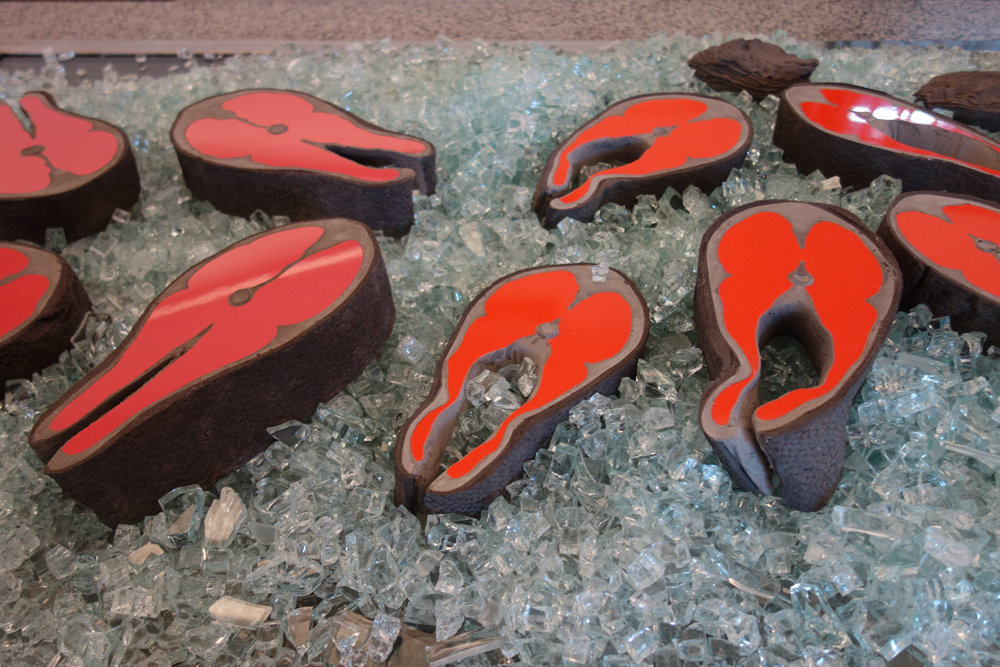
Pick up a loaf of bread in a Zhanna Kadyrova show and you will need both hands. It is a river stone. The jam in the pot is a disc of glazed tile, the dress on the wall is cut from the wall itself, and the beam of light lying across the floor is poured cement. Nothing she makes is what it looks like, and you only find out when you touch it.
Kadyrova was born in 1981 and has worked with tiles since 2004. Her method fits in one sentence: take the heaviest materials there are, tile, cement, concrete and stone, and make them pose as things that are light, soft, liquid or invisible. Clothes, fruit, fish on ice, a ray of light, a paper deer. This month the deer hangs from a crane at the Venice Biennale, where it stays until 22 November. Here are the works that got it there, from the first tile dress to the last stone loaf.
I · The tile wardrobe
Second Hand, begun in 2014, is the work that made the method visible. Kadyrova takes tiles from buildings that are being emptied or taken apart and cuts them into garments in the shapes of 1960s and 70s fashion: A-line dresses, square-shouldered jackets, T-shirts, scarves, even briefs. The clothes hang from hangers, nails and clotheslines in rooms like the ones the tiles came from, so that a dress made of a wall hangs on a wall.
In 2019 a new chapter of the series was made at the 58th Venice Biennale, on the spot, from Venetian materials, as part of the main exhibition in the Central Pavilion in the Giardini. The tile garments were shown outside the building, so that you saw them through a window of the pavilion and from the street, like washed clothes hung to dry on a line, an everyday sight in Venice.
II · Pots of paint that are really tile
Fillings (2006–2016) turns the trick inside out. Here the tile is not the garment but the contents. Kadyrova cuts layers of coloured tile to the diameter of enamel kitchenware, saucepans, mugs, basins and jugs, and fits them in, and under a gallery light the glossy tile looks exactly like the mirror film on the surface of a liquid.
The colours are chosen to unsettle. Red could be jam and white could be milk, but what are bright blue and green doing in a cooking pot, and why is a black film like fuel oil in a mug? The viewer starts to guess what they are looking at, and then to think about what they drink and what they fill their own bodies with. For the Paris version, in 2012, the kitchenware was bought at antique stalls on the edge of the city, so that each installation carries the enamel of the place it was made in.
III · Prices by the gram
Market, first shown at ART Monte Carlo in April 2017, is a market stall built of heavy things. There are mechanical scales, vegetable crates, a plastic chair, a lamp inside a metal frame under a blue tent, and goods that every street seller has: watermelons, zucchini, eggplants, eggs, hams and sausages, all made of tile, cement, concrete and natural stone. The goods were sold by weight, at one gram for one euro, and in later editions for one unit of whatever currency the host country used.
The stall travelled to Venice in 2019, to Miami in 2018 and to the Armory Show in New York in 2020. A fish edition, commissioned by the Biennial of Graphic Arts in Ljubljana, was shown in a gallery that had once been the fish department of the central market: salmon and white fish steaks, oyster shells and sheets of transparent glass for ice.
IV · Fruit
The same logic, at the scale of a room, gave Fruit (2021): a halved apple, a sliced pear and their pieces, large enough to walk around, faced in tile. The cut surfaces show pale tiled flesh and dark seeds, and the skins, in faceted red and yellow, look like a computer's idea of a fruit.
V · Light you can hit your head on
Invisible Forms (2010–2015) gives physical shape to what has none: rays of light and shadow, poured in cement. The lamps, video cameras, headlights, security cameras, sockets and switches whose light and shadow we hardly notice are turned into solid cement shapes, made inside the exhibition space. For the show at Le Moulin outside Paris she used the narrow passages of an old factory, so that the beams were in the way of anyone walking through. It was shown at the 55th Venice Biennale in 2013.
VI · Crowds, maps, fractures
Other works use the same weight for other kinds of looking. In Crowd she collected newspapers from around the world, cut out every person on the page, and rebuilt them into a single crowd, sorted from large to small to make a perspective. The mastheads, prices and dates of the originals stay, so that each collage keeps its country and day. Each is pressed between two panes of glass. It was shown at the 56th Venice Biennale in 2015, on the waterfront.
In Maps (2009–2024) the cracks in porcelain tile become the streets, rivers and boundaries of a city. In Shots, Fractures she covered panels and cubes with tile of a single colour and hit them with heavy tools, or shot them with a shotgun, so that destruction draws the picture.
VII · Weightless
Not everything is heavy. Volatility was made in March 2019 at the Fantazery festival on Mount Dragobrat in the Carpathians: several dozen white helium balloons of different sizes, each tied by an invisible fishing line to a weight at the bottom of a mountain lake. As the wind moves, every balloon swings like an inverted pendulum, at a frequency set by the length of its thread, and their reflections tremble in the water.
VIII · Apartment block
Zhylmassyv (2016) is built of transparent acrylic bricks with photographs of real interiors and exteriors on their opposite sides. She took some of the pictures herself and received others from people in towns and villages who answered her call. Stacked into walls and towers, the bricks let you look into other people’s flats and doubt how thick the line is between a home and a street.
IX · Bread, crane, deer
Her best-known recent work is made of stone. Palianytsia (2022) is named after the round wheat loaf. Kadyrova collected river stones from mountain streams in the Carpathians, where the fast water polishes them smooth, chose the ones that already looked like loaves, and cut and carved them until they were bread: whole, sliced and stacked, laid on tables set as for a banquet. In 2023 it was part of her first retrospective, Daily Bread, at the Kunstverein Hannover.
Her Origami series applies the same kind of translation to paper. The first work, a crane two metres high in reinforced concrete, was installed in a flooded clay pit in Ivano-Frankivsk, which locals now call Swan Lake. The second, a deer designed as a 3D model and cast in concrete, borrows from the tradition of putting a deer in a park, and from the paper folding that anyone can follow step by step.
The deer is now at the 61st Venice Biennale, which runs until 22 November 2026. It hangs in a harness from a crane at the entrance to the Giardini, while the pavilion in the Arsenale shows archive material and a multi-channel video. A concrete deer, of all things, has been made to float.
X · A career in a few lines
Kadyrova finished the sculpture department of the Taras Shevchenko art school in Kyiv in 1999 and was a member of the group R.E.P. She won the PinchukArtCentre’s special prize in 2011, the Kazimir Malevich award in 2012 and the PinchukArtCentre’s main prize in 2013. She has shown at the Venice Biennale in 2013, 2015, 2019 and 2026, with solo shows at the PinchukArtCentre (Flying Trajectories, 2023–24) and the Galerie Rudolfinum in Prague (Unexpected, 2024), and she shows with Galleria Continua.
Why she matters
Most sculpture asks to be looked at. Kadyrova’s asks to be tested: lifted, touched, weighed. A tile dress is hard, a bowl of paint is a disc of ceramic, a beam of light is cement. Each time she shows that the eye is lazy and the hand is not, and that the weight of a thing tells you what it really is.
A good sculpture, on that account, is a lie that holds from a distance. Hers hold until you come close, and then they get better.
See it
Origami Deer is part of Kadyrova’s project at the 61st Venice Biennale until 22 November 2026. The artist’s website, kadyrova.com, has a page for each of her projects.
Descriptions of the works follow the artist’s own project texts on kadyrova.com and the PinchukArtCentre’s Flying Trajectories texts; Origami Deer’s display in Venice follows Hyperallergic and The Art Newspaper; the career and prizes follow Galleria Continua’s biography. Images: courtesy of the artist (kadyrova.com); the portrait by Jindřich Nosek (CC BY 4.0), via Wikimedia Commons.
Read next
- Where Wisdom Takes Form: Inside the New CCA Tashkent
- The Forms That Refuse a Name: Richard Pearson on Painting Other Worlds
- The World Is Not What It Says: Magritte’s Afterlife at Gagosian London
- Where Darkness Begins to Listen: Roy DeCarava in Los Angeles
- The Ocean Is Not Blue: Torkwase Dyson and the Politics of Abstraction
- The Ordinary Life Is Not a Small Subject: Louis Fratino and the Painting of Intimacy