Controcorrente: Solo Exhibition by Uwe Wittwer at Monica De Cardenas Gallery
Feature
A focused opening paragraph for a new editorial story.
Maria Ivanova · 2026-11-27
Today, we’re visiting "Controcorrente", Swiss artist Uwe Wittwer’s first solo exhibition in Italy, presented at Galleria Monica De Cardenas in Milan. Bringing together paintings and works on paper, the exhibition explores the artist’s dialogue with art history, memory and the transformation of familiar images.
The exhibition runs from 24 September 2026 to 21 November 2026. Join us on a video tour and immerse yourself in the exhibition, then read the article below to discover more about Wittwer’s practice.
Uwe Wittwer was born in Zurich in 1954, where he continues to live and work. His early artistic practice was rooted in non-figurative painting, influenced by American Abstract Expressionism. In 1989, however, his artistic direction took a significant turn. During a scholarship in London, Wittwer encountered the works of David Hockney and Francis Bacon, whose figurative approaches became an important influence on his practice. Their ability to convey the complexities of contemporary life through recognisable imagery resonated with the artist. From that point onwards, Wittwer began to move away from abstraction towards figuration, exploring subjects such as warships and ruins.
Subjects are influenced by the artist’s family background. His father intended to pursue an artistic career, but the war disrupted his plans. He fled Berlin on a Swiss passport, keeping the memories of the devastation and disempowerment of wartime. Growing up close to this family history encouraged Wittwer to explore collective experiences shaped by major historical events and their lasting impact on individuals and society.
The historical substantial motifs bear dialectics of having a significant emotional effect spanning over generations with the intricate web of plotlines, actions, and consequences. For Uwe Witter its essential to consider both sides of human consciousness, depicting the events not only to arouse emotions in the beholder, but also to catalyze analysis and critical review of the themes. Perhaps this intention makes the viewers to stand in front of the canvases for more than expected, being trapped by the interplay of strong complex feelings and tangles search for the truth and justice. Despite being deeply connected with political events, Uwe Witter doesn’t regard himself as a political artist - the meaning of his works lies in ontological questions and contemplation.
The majority of the works is executed in subdued tones - a muted palette constructs the intangible presence of painful intimacy that you live through for a time.
Uwe Witter works closely with photography. He examines and studies archives such as the Pitt Rivers Photographic Collection and records from the Basel Mission. This photographic heritage preserves traces of missionary endeavours and colonial expansion, while implicitly demonstrating how different cultures across the Americas, southern China, Africa and India were presented. Through his painterly practice, the artist questions the objectivity and reliability of archival materials, challenging the presumed truthfulness of photographs and their ability to capture the authenticity of the people portrayed, rather than merely reflecting the perspective through which they were seen.
To work with drastic political themes is to inevitably encounter the contradiction between severe reality and aesthetically appealing imagery. According to Witters, “painting is always an act of aesthetics” (&unconsorten). Visual arts are powerful instruments for conveying, reinterpreting, and transforming the invisible connections within the disturbing subject matter into the sensibily disticntive elements, that otherwise might be overlooked, even though it is debated whether the aesthetic masks and understates the importance of the event. Uwe Witters artistic language is balanced in a way that it does not drown out the vulnerability present in the subject depicted. Abstract element with unfinished touches; strong gestures; a combination of weights and distribution of volumes on the canvas itself represent the powerfull absurdity of the plight.
The exhibition title Controcorrente (Upstream) directly refers to the historical role of major water elements in colonial countries, which led the expeditions from the coast to deeper parts of the territory, enabling faster exploration, establishment, and expansion. At the same time, Controcorrente obliquely indicates the artist’s approach of tracing the photographic archives, revealing their origin and how our perception of the past is deconstructed by the preconceived circumstances.
Apart from the medium of photography, Wittwer refers to the great italian masters, specifically to Caravaggio’s Basket of Fruit and The Last Supper by Paolo Veronese. Both paintings are located in Milan, in Pinaciteca Ambrosiana and Pinacoteca di Brera respctfully. Another significant historical reference is Willem van de Velde's drawings, which inspired the body of watercolor works. The Dutch mariner depicted 17th-century merchant ships, which prompted the progression in European colonialism by transporting traders, military personnel, explorers, and missionaries. Ships connect the exploration of photographic archives with the broader historical context of expansion.
What continues to draw me to Uwe Wittwer’s work is the duality of his approach discussed above. Each canvas carries a distinct sense of gesture and movement, accompanied by vivid colours that rarely seek to imitate reality.
Red "Night Sky", presented twice in adjoining gallery spaces, intensifies the emotional associations we attach to a star-filled sky. The unconventional use of colour heightens these impressions, evoking contrasting feelings: loneliness, serenity, inevitability and acceptance, or, alternatively, a sense of danger and foreboding. The immersive quality of the paintings engages the senses, while their discernible silhouettes invite the viewer to search for connections and meanings within the image.
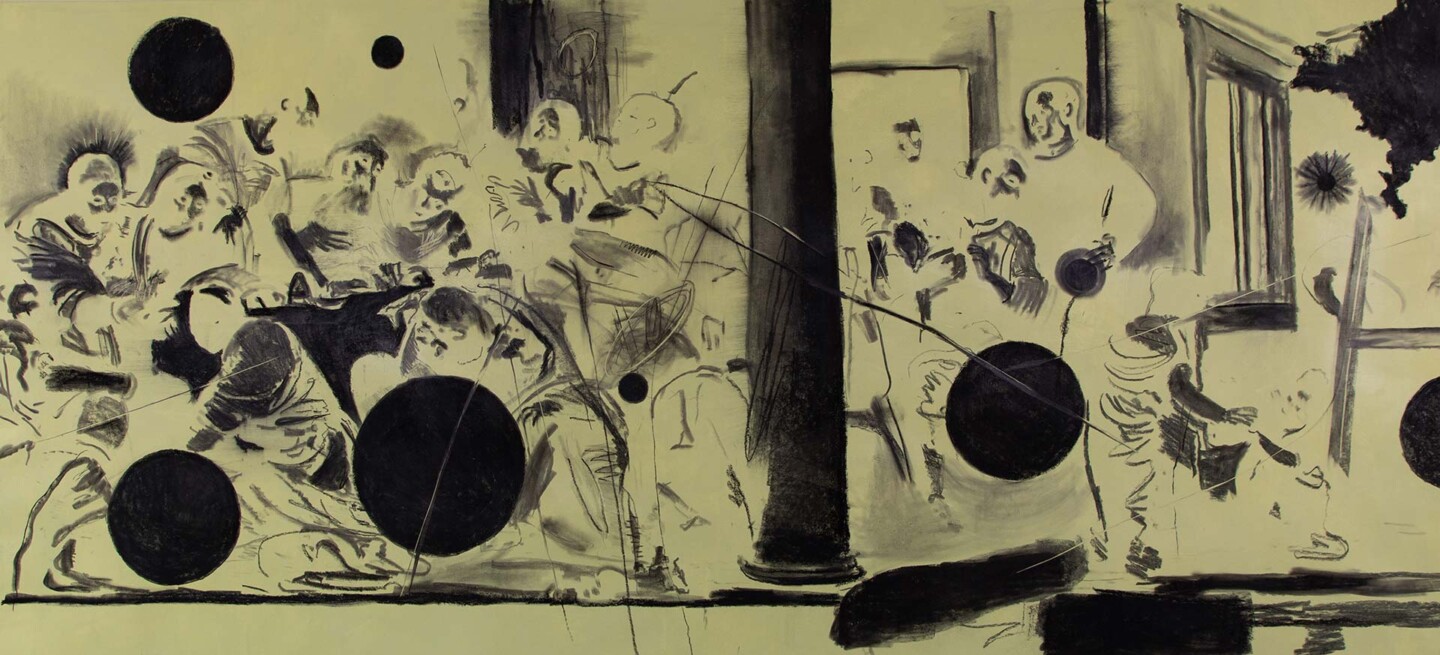
After every exhibition, we find ourselves returning to the artwork that left us speechless, the one that stays with us and becomes a lasting image in our minds. As someone enchanted by stars, "Red Night Sky" became a personal highlight of the exhibition. Yet I was equally captivated by "The Last Supper after Veronese", a charcoal-on-paper work that left me completely stunned.
Drawing on Paolo Veronese’s "The Last Supper", Uwe Wittwer reinterprets the historical composition through a fragmented and expressive visual language. Familiar figures and architectural elements emerge through gestural brushstrokes, seemingly suspended between appearance and disappearance. Large black circles interrupt the composition, exerting an almost hypnotic pull that makes it difficult to look away. Their striking contrast with the loose charcoal strokes and delicate tonal variations creates a visual tension that is both unsettling and captivating.
Perhaps the beauty of this dialogue lies in the temporal distance between the two paintings - a passage of time that one can almost physically feel. By deconstructing Veronese’s composition, Wittwer makes visible how artistic language, perception, and cultural sensibilities transform across centuries. What was once a coherent and elaborate scene becomes fragmented, reflecting the distance between two different moments in history. Time itself becomes an integral part of the artistic dialogue, allowing the original image to acquire an entirely new meaning.
Read next
- Where Wisdom Takes Form: Inside the New CCA Tashkent
- The Forms That Refuse a Name: Richard Pearson on Painting Other Worlds
- The World Is Not What It Says: Magritte’s Afterlife at Gagosian London
- Where Darkness Begins to Listen: Roy DeCarava in Los Angeles
- The Ocean Is Not Blue: Torkwase Dyson and the Politics of Abstraction
- The Ordinary Life Is Not a Small Subject: Louis Fratino and the Painting of Intimacy