Cathy de Monchaux: The Poise of Wounds
Sculpture & Objects
At the Palais de Tokyo, Cathy de Monchaux turned metal, velvet, dust and fragile armatures into a sculptural language of desire, danger and extraordinary beauty.
Viacheslav Munister · 2026-10-03
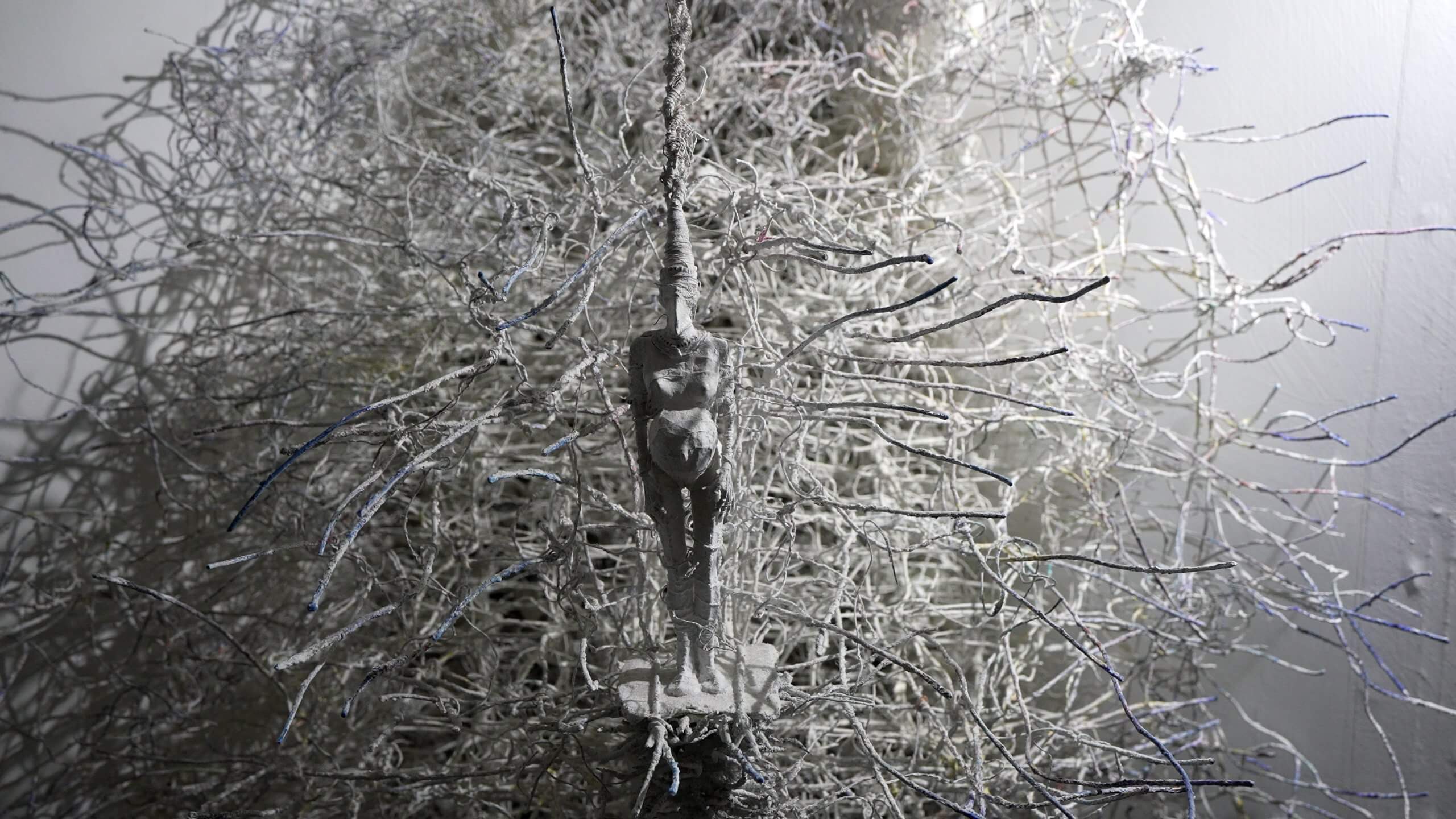
Some exhibitions make sculpture look monumental. Cathy de Monchaux’s first major retrospective at the Palais de Tokyo made it look alive. Across roughly fifty works dating from 1984 to the present, metal, velvet, dust, tracing paper, straps, rivets and delicate armatures formed an unsettled ecology of bodies. Nothing simply stood still. Even the most rigid structure seemed to be breathing, bracing itself or remembering an injury.
Studio, wounds and battles, desire is the reiteration of hope closed on 13 September 2026, but its images remain unusually difficult to put away. The exhibition was beautiful in the way a thorn, a relic or a half-remembered dream can be beautiful: not because it reassures, but because it gives form to the contradiction between vulnerability and force.
Independent editorial review by Viacheslav Munister. Exhibition dates, descriptions and image credits are based on official Palais de Tokyo materials. Images are reproduced from the institution’s press visuals; rights remain with Cathy de Monchaux, ADAGP and the credited photographers.
The sculpture that refuses a clean edge
De Monchaux’s objects are never satisfied with a single category. They can be sculpture, reliquary, anatomical fragment, stage set, machine, shell or weapon. They often occupy the wall like a drawing that has thickened into matter, or the floor like a body that has not decided whether to crawl, stand or disappear.
This refusal of a clean edge is central to the exhibition’s sensuality. A surface may appear soft until the eye notices its armour. A metal structure may look severe until it begins to resemble a rib cage, a flower or a nest. The works are made from transitions. They live in the moment when one material becomes another kind of image.
An intimacy made from metal
The most striking quality of de Monchaux’s work is not its darkness but its intimacy. The sculptures seem to know the scale of the body. They bend, clasp, fold and open like gestures that have been enlarged without losing their private origin. Even the more spectacular installations retain the feeling of something handled, repaired or protected.
Her vocabulary is full of structures that support and restrain at the same time. Straps can hold a form together, but they can also bind it. Ribs can protect, but they can also become a cage. The work does not decide which reading is correct. It makes the viewer feel the pressure between them.
That pressure is why the sculptures never become decorative, even when they are extraordinarily refined. Beauty is not a surface applied to difficult material. It is the exactness with which difficulty has been given a body.
The forest inside the gallery
In the gallery, pale branches and clustered forms project from the wall like a forest translated into nerves. The effect is both natural and artificial. It recalls roots, antlers, coral, lace and the architecture of an inner organ, yet every part remains visibly made. The eye moves from the overall silhouette to the individual joint, then back again, as if the work were asking to be read at two speeds.
De Monchaux’s sculptures often create this double scale. From a distance, they become landscapes or battle scenes. Up close, they reveal minute acts of construction: a rivet, a fold, a seam, a rough edge. Grandeur is built from attention. The monumental is not the opposite of the intimate; it is the intimate carried carefully to another register.
Desire is never innocent
The exhibition’s title places desire beside wounds and battles, and the pairing is exact. De Monchaux’s work is sensual, but never passive. Its surfaces invite the eye and then make the eye cautious. The viewer is drawn toward velvet, cavities, polished metal and soft-looking forms, only to discover a hidden threat: a spine, a point, a hard seam, an opening that refuses to explain itself.
This is not the eroticism of smooth surfaces. It is an eroticism of hesitation. The body recognises something in the work, but cannot immediately decide whether that recognition means attraction, fear, memory or all three at once. De Monchaux makes sculpture out of the delay between these responses.
The archive of the damaged
The retrospective included technical drawings and archives of destroyed works, and this widened the exhibition’s emotional range. The finished sculptures were not presented as isolated miracles. They were surrounded by evidence of trial, failure, disappearance and reconstruction. A destroyed work still has a body in the archive. Its absence becomes another material.
This matters because de Monchaux’s work is fundamentally about what holds. An armature holds a form; a memory holds an event; a title holds an image open; a museum holds a fragile object long enough for strangers to encounter it. But every support can fail. The exhibition never hides that fact. It gives failure a quiet dignity.
A sculpture of the almost-human
The works often hover near the human figure without becoming figurative in any conventional sense. A vertical structure suggests a torso. A cluster becomes a group of bodies. A protrusion feels like a limb, a horn or an architectural brace. This almost-human quality is where the sculptures become most psychologically intense.
The viewer begins to project a story onto the object, then the object withdraws. It refuses to become a character in a simple narrative. It remains matter, and that refusal is liberating. The sculpture does not have to represent a person in order to carry the pressure of a person’s life.
Against the straight line
The Palais de Tokyo presentation was also a quiet critique of the straight line: the straight line of the pedestal, the clean line of progress, the hard line of authority. De Monchaux bends, tangles and interrupts those lines. Her forms make room for asymmetry, softness and the intelligence of the detour.
The effect is not chaos. It is a different order. The sculptures are carefully composed, but their order is organic rather than administrative. It grows by repetition, pressure and response. One shape touches another; one material changes the temperature of the next. The gallery becomes a field of relations rather than a sequence of isolated objects.
The elegance of resistance
There is a particularly British severity to de Monchaux’s sensibility: a willingness to let elegance coexist with discomfort, and to let humour appear at the edge of the grotesque. But the exhibition’s emotional geography is wider than national style. These works speak to the body under pressure, to the architectures that protect and confine it, and to the strange optimism of continuing to make something delicate after damage.
The beauty of Cathy de Monchaux is never innocent. It is beauty that has learned how to brace itself.
That is why the exhibition stayed with me after its closing date. Not as a catalogue of forms, but as a physical intelligence: the knowledge that fragility can be engineered, that a wound can become an aperture, and that a sculpture can be both warning and shelter.
Studio, wounds and battles did not ask to be admired from a safe distance. It made the distance unstable. The closer one looked, the more the works changed register – from ornament to anatomy, from relic to threat, from private memory to collective image. Their beauty was not an escape from the world. It was a way of remaining awake inside it.
Image credits: Cathy de Monchaux installation views, Palais de Tokyo, 2026. Photos by Antoine Aphesbero, Aurélien Mole and Quentin Chevrier. © Adagp, Paris, 2026. Images reproduced from official institutional press materials for editorial purposes; rights remain with the respective copyright holders.
Read next
- Where Wisdom Takes Form: Inside the New CCA Tashkent
- The Forms That Refuse a Name: Richard Pearson on Painting Other Worlds
- The World Is Not What It Says: Magritte’s Afterlife at Gagosian London
- Where Darkness Begins to Listen: Roy DeCarava in Los Angeles
- The Ocean Is Not Blue: Torkwase Dyson and the Politics of Abstraction
- The Ordinary Life Is Not a Small Subject: Louis Fratino and the Painting of Intimacy