Nikolai Astrup: One Valley, Every Weather
Exhibition
A Norwegian painter who hardly left one valley and printed the same hill again and again, in every season. The first Astrup retrospective in Japan opens at Tokyo Station Gallery on 21 November.
Viacheslav Munister · 2026-11-26
On 21 November 2026 the Tokyo Station Gallery opens Nikolai Astrup: Garden of Growth, the first retrospective of the Norwegian painter in Japan. It brings about 130 works, oil paintings, woodblock prints that were shaped by the example of the ukiyo-e masters, and textile designs he made with his mother. It will move on to Nagoya in 2027 and then to Hayama. Astrup died in 1928, aged forty-seven, and after a few years of study abroad he spent his life in one valley. He looked at it so hard, and in so many kinds of weather, that it became a country.
I · The priest's eldest son
Astrup was born in 1880 in Kalvåg, on the west coast of Norway, the eldest of eleven children. His father, Christian Astrup, was the parish priest of Jølster, a long valley with a lake and steep mountains behind it. His father wanted him to become a priest, and he failed his Latin exam at the cathedral school in Trondheim because he preferred to draw. He studied in Kristiania at the painting school of Harriet Backer, spent 1901 and 1902 in Paris at the Académie Julian and, under Christian Krohg, at the Académie Colarossi, and travelled in Germany. In 1911 he studied in Berlin under Lovis Corinth.
By 1902 he was back in Jølster, and he stayed. The museum in Oslo, which owns some of his best-known works, describes him as a smallholder, a painter and a printmaker at the same time, and notes something that is easy to miss: he was not himself a member of the peasantry. He looked at the lives of his neighbours from the outside, with an attention that is visible in every field and festival.
II · The fire on the hill
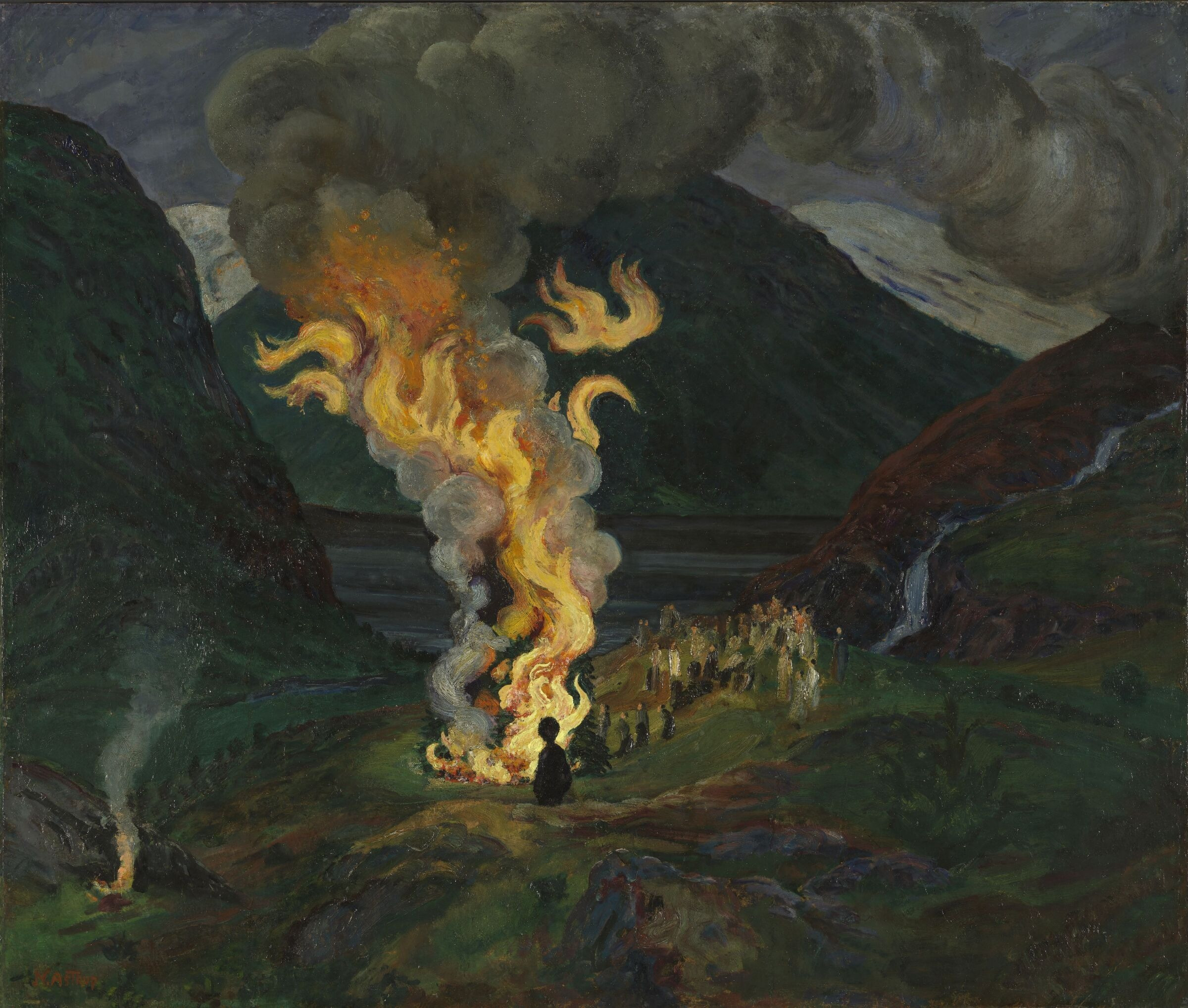
The subject he returned to most often is midsummer night. In Jølster the custom of lighting bonfires on the eve of midsummer, and gathering round them to play and dance, was a living tradition. The Oslo museum notes that Astrup was interested in the interdependence of people and nature, and that the rituals, with their fires, dances and picking of wild flowers, were meant both to protect and to invoke. In the painting above the bonfire is the centre of the composition. A dark silhouette sits in front of the flames, a lone figure, while the other villagers have gathered on the slope across the fire, talking and flirting. Behind them the hillcrest of Kollen fills the valley.
The museum's date for this painting is 1912 and 1926. Astrup liked to reuse images that fascinated him, and he painted the festival in several versions, as well as in black-and-white and colour woodcuts. The Tokyo list includes several pictures of the festival and the nights around it: a study from 1902 to 1905, Ålhus Church, Midsummer from about 1904, a painting of the preparations from 1908 and the finished Midsummer Eve Bonfire of 1915. What interested him was not the subject. It was how many different pictures one place and one night could hold.
III · A block you can change
This is where the prints matter. In colour woodcuts, according to the museum, Astrup found a medium that was ideal for keeping parts of an image and changing others. He combined prints from one fixed plate with prints from plates in which he had altered parts of the picture and the colours, and so could show different moods of what was largely the same landscape. The usual method in colour printing is one plate for each colour. Astrup often painted several colours on a single plate, and he frequently painted directly on the finished print. The vibrancy of tone that resulted, the museum says, gives his woodcuts the quality of painting.
The clearest example is Bird on a Stone. All of Astrup's variants of it are spring pictures, and the differences between them are largely aesthetic, although he once wrote in a letter that he saw one version as an evening or daytime mood and another as a spring night. With its decorative elements and light, lyrical tone, this became one of his most popular woodcuts. The habit of printing one composition again and again with a different mood is one that Japanese printmakers also knew, and Time Out Tokyo describes his woodcuts as shaped by ukiyo-e.
Two prints show the range. In A Night in June in the Garden the round hill is green and the grass is full of yellow flowers. In Spring Night and Sallow a bent willow in black silhouette stands in front of a lake that has been cut into a pattern of ripples. Both are small, a little larger than a sheet of letter paper, and in both the ground is shaped less by perspective than by pattern, which is one reason the Japanese comparison does not seem forced.
IV · Garden of growth
In 1907 Astrup married Engel Sunde, and they had eight children. In 1913 he moved the family to Sandalstrand, on the shore of the lake Jølstravatnet, a place now called Astruptunet. His health was poor, tuberculosis and worsening asthma, and farming was a part of the work, not a break from it. The show's English title is Garden of Growth, and its Japanese title translates as Creating a Garden. Both fit a painter whose late pictures treat a vegetable bed and a farm with the same attention as a mountain.
The late paintings show how far the observation went. In the Oslo picture of about 1925, the point of view is high, as if one were looking down from a terrace: a brown bed with big leaves in the foreground, a birch trunk, trees in pink blossom, the roofs of the farm and a strip of water. The Tokyo list also includes Goose and Rhubarb, painted around 1925 and 1926, and Hayrack, an early picture on cardboard from 1901 to 1905. A single exhibition covers the span from a young man's study of a hayrack to the vegetable garden of the last years, and it is the same eye.
V · Three exhibitions in a lifetime
The recognition came late and slowly. During his lifetime Astrup had three major exhibitions, two in Kristiania, in 1905 and 1911, and one in Bergen, in 1908. He died of pneumonia in Førde on 21 January 1928 and is buried in the cemetery at Ålhus in Jølster. In Norway the late reputation grew until KODE in Bergen gave him a wing. Outside Norway the first exhibition of his work was at the Dulwich Picture Gallery in London in 2016, and the Clark Art Institute in Massachusetts followed with Visions of Norway in 2021. People have compared him to Edvard Munch, but his style is much brighter.
In Tokyo the viewer comes to him with a good deal of context. Japanese paper, wood blocks, tonal printing and the idea of one view seen in many seasons are all part of the visual culture of the country where the show is held, and the Large Self Portrait here is itself printed on Japanese paper. It is a rare case where a Norwegian painter, whose woodcuts were shaped by ukiyo-e, comes to show Japan what he did with the lesson.
See it
Nikolai Astrup: Garden of Growth is at the Tokyo Station Gallery, directly connected to the Marunouchi North ticket gate of JR Tokyo Station, from 21 November 2026 to 31 January 2027. It is open from 10 to 18, until 20 on Fridays, and closed on Mondays except 23 November, 11 January and 25 January. It is also closed on 24 November, 12 January and from 28 December to 2 January. Tickets on the day are 1,800 yen. The show then travels to Nagoya, from June to September 2027, and to Hayama, from October to December 2027.
Facts follow the Tokyo Station Gallery listings (Time Out Tokyo, Tokyo Art Beat, the official Astrup catalogue site) and the Nasjonalmuseet collection texts; the biography follows Wikipedia. The catalogue site names about twenty of the works in the exhibition; the text refers to those. The pictures are collection photos from Nasjonalmuseet, not necessarily the works lent to Tokyo.
Read next
- Where Wisdom Takes Form: Inside the New CCA Tashkent
- The Forms That Refuse a Name: Richard Pearson on Painting Other Worlds
- The World Is Not What It Says: Magritte’s Afterlife at Gagosian London
- Where Darkness Begins to Listen: Roy DeCarava in Los Angeles
- The Ocean Is Not Blue: Torkwase Dyson and the Politics of Abstraction
- The Ordinary Life Is Not a Small Subject: Louis Fratino and the Painting of Intimacy