Sheila Hicks: Sixty Years of the Same Thread
Exhibition
PAC Milan opens the first Italian retrospective of Sheila Hicks on 17 November: from tiny hand-woven pieces to heaps of torn blouses and rooms made of wool, an artist who refuses to choose between art, craft and architecture.
Viacheslav Munister · 2026-11-24
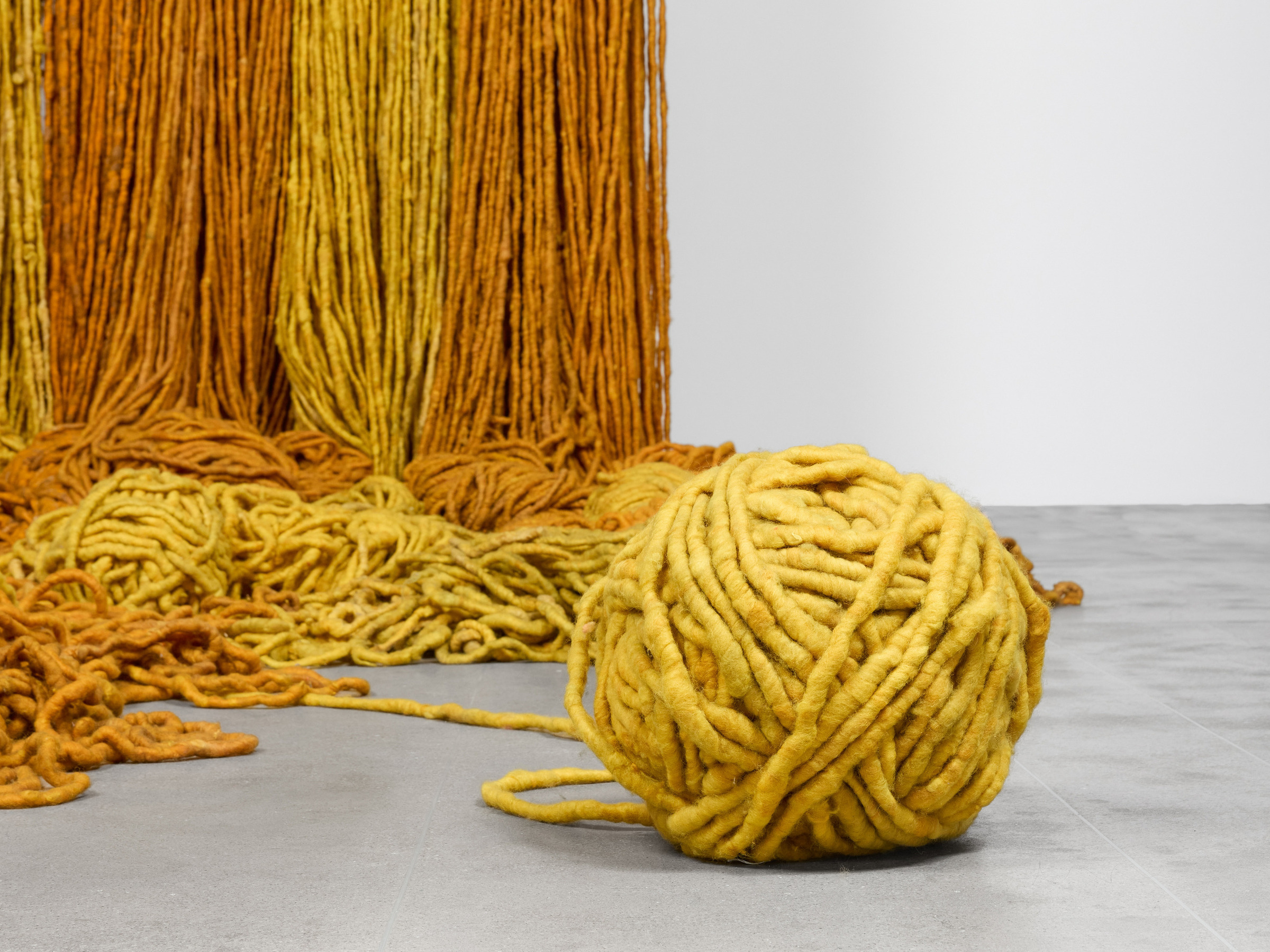
A huge ball of yellow wool sits on a grey gallery floor. Behind it, thick yellow cords come down from the ceiling and pool on the concrete, the way rope does on a quay. Nothing is hidden: a thread is a thread, and it is wound, pulled and let fall. This is how Sheila Hicks has worked for almost seventy years, and on 17 November 2026 the PAC in Milan opens In the thread of love, the first Italian retrospective of an artist who was born in Nebraska in 1934, has lived in Paris since 1964 and has done more than almost anyone to show that thread can be sculpture.
The Milan show is curated by Diego Sileo. PAC, the Padiglione d'Arte Contemporanea, says it brings together more than a hundred works from collections that include MoMA in New York, the Philadelphia Museum of Art, the Pérez Art Museum Miami, the Stedelijk Museum in Amsterdam, the Josef Albers Museum Quadrat, the Museum of Decorative Arts in Prague and the National Museum in Oslo. It follows more than six decades of research, from the experiments of the 1960s between Latin America and Morocco to monumental installations made in dialogue with the architecture of Ignazio Gardella, the building that houses the PAC. Some of the works have never been shown, and there is a new piece for the museum's outdoor spaces.
I · A language, not a craft
Hicks has said it in a single sentence for years: textiles are a universal language, and in all cultures around the world they play an essential and crucial role. She claims the word Freedom as her middle name. The sentence matters because it explains the order of her career. She never moved from craft to art. She refused the distinction, and the textile traditions she took as a starting point were mostly not European ones.
She studied at the Yale School of Art from 1954 to 1959, where her teachers included Josef Albers, Louis Kahn and George Kubler, and where an interest in pre-Hispanic art and architecture became an interest in thread. Her thesis was on pre-Incaic Andean textiles. A Fulbright grant took her to Chile in 1957 and 1958, and she lived in Mexico from 1959 to 1964, teaching at the national university at the invitation of Mathias Goeritz. In 1964 she moved to Paris and began to travel through Morocco, India and beyond, working with local weavers and craftspeople. Her black-and-white photographs from trips to South America between 1954 and 1961, including Chile with the Magnum photographer Sergio Larrain, are a quieter part of her story. She has said she used the camera's positions for looking, not always for taking pictures.
II · The smallest works
The way into Hicks is through her minimes, small woven pieces that she began making on an improvised hand-held frame and that now number more than a thousand. They record the places where she made them: the United States, Latin America, India, Morocco, the Middle East, Japan, France. She has said that she found her voice in them. At the Hepworth Wakefield in 2022, the curators scattered them among larger works instead of grouping them, so that a visitor could see the vocabulary of the large works already present in the small ones.
A single piece shows how this worked. Badagara Yellow, from 1966, was made in Kerala, in India, and its ribbed surface echoes a corrugated shutter in a photograph she took in Santiago in 1957. The weaving and the photograph are the same observation in two media. It is the kind of connection that is easy to miss in a gallery of fibre, and that makes a retrospective useful: it lets one follow a single way of looking across sixty years.
III · Bundles, blouses and ponytails
At the other end of the scale are the soft columns and heaps that made her name. In the Hepworth show, newer works echoed earlier ones, such as the wrapped linen cords of the Lianes and the stacked textiles of the Banisteriopsis and Evolving Tapestry series. Banisteriopsis II, from 1965 to 1966 and remade in 2010, is a tangle of wrapped linen strands that look like ponytails. Wow Bush, also called Turmoil in Full Bloom, made between 1977 and 1987, uses about three thousand nurses' blouses, torn into strips, dyed in a washing machine and left to spill across the floor. One reviewer of the Hepworth show found the found-material works of the 1970s, made from surgeons' smocks, military uniforms and nurses' blouses, the most affecting, because they shift the attention to the people and institutions that wore such clothes.
This is where the language of PAC's text, which speaks of marginalisation, identity, syncretism and the emancipation of women, becomes concrete. Hicks has always worked with materials that carry a trace of use: the cloth of work, the thread of a village, the fibre that societies assign to women and then call minor. She does not argue the point. She gives it a scale where it cannot be overlooked.
IV · Rooms made for rooms
She has been working for architecture from the start. Her commissions include the Ford Foundation headquarters in New York, a Paris bank, the offices of CBS and the interior of an Air France Boeing 747. La Mer, from 1976, began as a wall frieze for a corporate headquarters in Paris, and in 2022 it was shown as a column of blue waves falling from ceiling to floor. For the Hepworth Wakefield in 2022 she worked remotely from Paris with a scale model of David Chipperfield's galleries in her studio, and visited the building for the first time for the opening.
Outdoors she does the same. In the garden of the Hepworth that year stood Gabriel Reaching for Heaven, a five-metre column of cascading ribbons that answered the landscape by Tom Stuart-Smith, the Chipperfield building and the neighbouring mill, and that summer an outdoor installation commissioned by the King's Cross Estate opened at Coal Drops Yard, made in response to its Victorian architecture. The new piece for the outdoor spaces of the PAC belongs to this line. The Milan show promises the same conversation with Gardella's building, which is a good test. A work by Hicks does not sit in a room. It changes the room's temperature, light and sound, and it is shaped by the room in return. In 2026 the pattern has repeated in more than one city. In São Paulo, at the Instituto Tomie Ohtake, her show What is that? ran from 28 August to 25 October. In Lille, at the Palais des Beaux-Arts, Sheila Hicks: Beyond opened on 8 October with a site-specific work for the atrium, made to answer the volumes, the light and the architecture of the building and the textile history of Lille and northern France.
V · Sixty years of the same thread
Hicks is ninety-two, and the last few years have been the busiest of her career. In 2014 her eighteen-foot column Pillar of Inquiry/Supple Column hung at the Whitney Biennial, and in 2017 she was in the Venice Biennale. In 2018 the Centre Pompidou gave her the solo show Life Lines, with more than a hundred works. In 2024 and 2025 a survey of over 250 works from 1955 to 2024 was shown at the Kunsthalle Düsseldorf and the Josef Albers Museum, and in 2025 SFMOMA gave her her first solo exhibition. At the Musée du quai Branly in Paris, The Travelling Thread, which closed in March, celebrated sixty years of friendship between Hicks and Monique Lévi-Strauss, a historian of non-Western textiles, with about thirty works by Hicks next to nearly twenty textiles from the museum's collection.
The Quai Branly show gives the key to the whole project. Hicks's work, as the museum describes it, reinterprets the gestures that transform a textile material: knotting, weaving, braiding, twisting, wrapping and tying. These are not styles but verbs. They belong to nobody and have been done by everyone, in the Andes, in Morocco, in Kerala, in Nebraska. A retrospective in Milan, a city of fashion and design, is a good place to be reminded of that.
See it
Sheila Hicks: In the thread of love is at PAC Padiglione d'Arte Contemporanea, via Palestro 14, Milan, from 17 November 2026 to 14 February 2027. It is curated by Diego Sileo, promoted by the City of Milan's culture department and produced by PAC with Silvana Editoriale. In Lille, Sheila Hicks: Beyond runs at the Palais des Beaux-Arts until 8 March 2027.
Facts follow the PAC Milano exhibition page and the Alison Jacques gallery news pages (Milan, Lille, São Paulo, Quai Branly), with background from Wikipedia and from the reviews of Off Grid (Hepworth Wakefield, 2022) in Wallpaper and Studio International. The number of works at PAC is given as 'more than 100' by PAC and the gallery, and as 'more than 200' by one listing; the text follows PAC. The image of torn fabric strips is the one PAC uses for the show; its title is not given, and the caption does not name it.
Read next
- Where Wisdom Takes Form: Inside the New CCA Tashkent
- The Forms That Refuse a Name: Richard Pearson on Painting Other Worlds
- The World Is Not What It Says: Magritte’s Afterlife at Gagosian London
- Where Darkness Begins to Listen: Roy DeCarava in Los Angeles
- The Ocean Is Not Blue: Torkwase Dyson and the Politics of Abstraction
- The Ordinary Life Is Not a Small Subject: Louis Fratino and the Painting of Intimacy