Where We Meet Ourselves - interview with Keisuke Azuma
Feature
Artist Keisuke Azuma on washing paint back off the canvas, the Japanese aesthetics of shadow and emptiness behind his work, and why art has no right to be exclusive.
Maria Ivanova & Keisuke Azuma · 2026-08-21
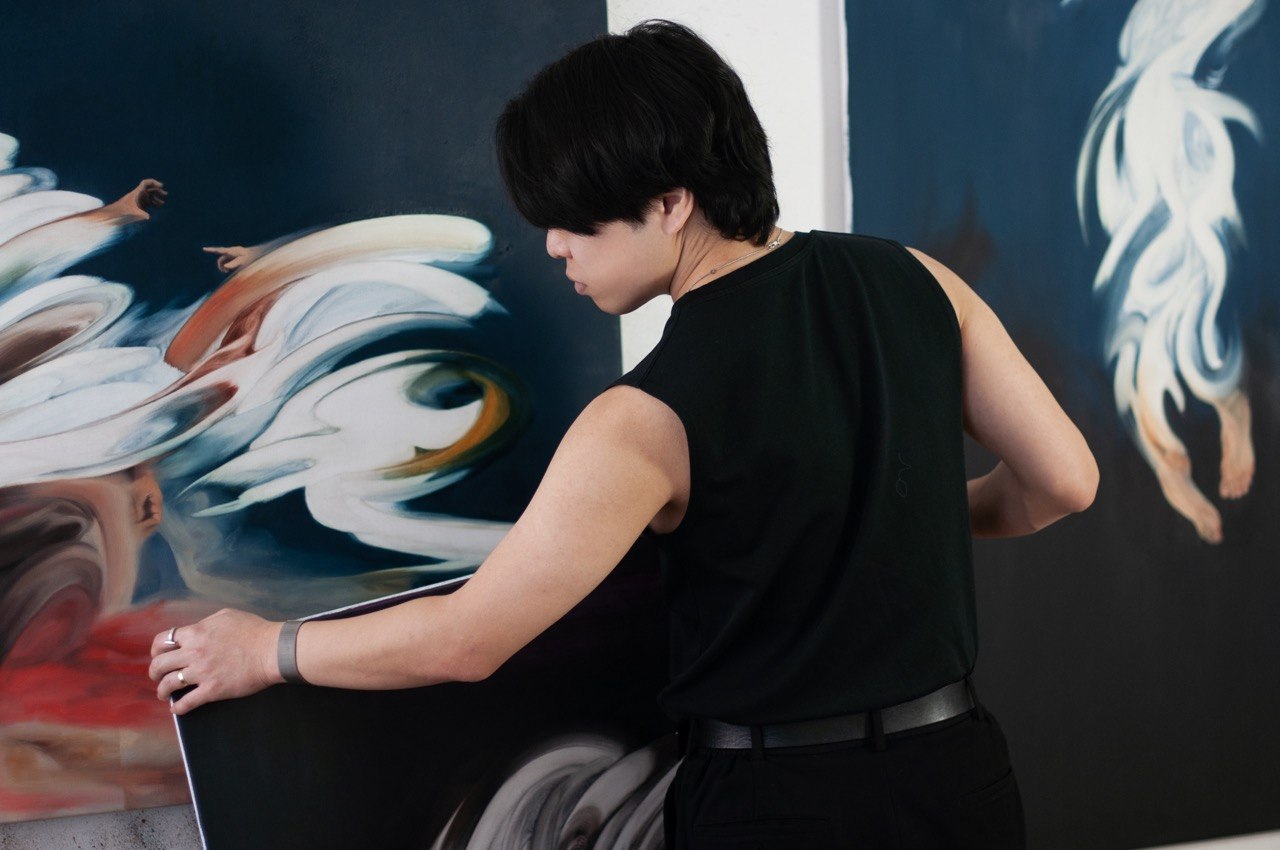
Born in Japan, trained in London, and now based in Lithuania, Keisuke Azuma builds his canvases by taking away rather than adding – washing pigment back, dissolving the body until only a hand, a foot, or a fragment of gesture survives against raw, unfinished canvas. His recent series, currently on show in KIAF Seoul, and exhibited recently in solo shows in New York and Paris, strips the human figure down to its most universal parts, leaving the rest as an invitation: a blank the viewer fills with their own reflection.
Epris met Azuma over a video call from his studio in Vilnius, where he lives with his wife and their dog and cat. Below you can find our conversation on the Japanese aesthetics of deduction that shaped his method and why he thinks art has no right to be exclusive.
01 · Becoming a painter
Maria Ivanova [MA]: What was the starting point for you to become an artist – were you immersed in art from childhood, or did the desire come later?
Keisuke Azuma [KA]: It's always a funny story, because I never actually wanted to be an artist. I loved art, obviously – I read a lot about artists from the Baroque period, and it always said they were poor. There were exceptions, but in general it looked like such a difficult profession. Still, I loved it, even though I was pretty much alone in that in my community. No one else in my family cared about art.
I was doing marketing work in a shop, and someone asked if I could do an illustration. I saw how customers reacted, and I was fascinated by that power art has to deliver a concept. I was into film too, so for a while I thought I'd combine the two through illustration. That's why I chose art school in the first place. During my studies I found this other love – expressing my own words, my own sense of identity. So it was a gradual thing. I kept trying to make excuses not to be a painter, and I kept coming back to it anyway.
Eventually I started showing in London while I was still studying, and having a gallery or two consign my work convinced me it might actually be possible. My wife's support mattered enormously too – she married me knowing I wanted to be an artist. That's how I built myself into one.
I kept trying to make excuses not to be a painter, and I kept coming back to it anyway.
MI: Do you think that pull toward art is something innate, or something your surroundings gave you?
KA: It feels a bit cheeky to just say “I was born this way,” but – my mother is an architect. My sister collages, just for her own journaling. My father doesn't do anything art-related, and neither does anyone else in the family, really. So I'd say it's more innate than not, with maybe a small hint of it in the bloodline. I actually tried hard not to go this way. In high school an art teacher personally called me to join his club, and I told him I wanted to do music instead. There was always a little sign pointing at it, even when I wasn't looking for one.
02 · Method
MI: You were born and raised in Japan, then moved to London to study. You've said your work is rooted in Japanese culture – how does that show up in your practice?
KA: There's a book, In Praise of Shadows – about how traditional Japanese houses use light and shadow, with a strong emphasis on negative space. A single shelf holding flowers becomes the whole focal point of a room precisely because everything around it is empty. Even a living space gets treated like a complete art expression. I was already interested in the contrast of light and shadow – I used to take a lot of photographs – and at some point that merged with my painting.
I take classical paintings as a reference, most of the time, and I manipulate them. In the process I try to eliminate elements so I can focus on what actually matters, what I want to deliver. All of my paintings have white space – that's the raw canvas itself. I wash the paint off. It's not perfectly clean; you can still see lines underneath. I do it because I love the physical act of taking the colour back out. In Japanese Zen culture, what matters is minimalist expression, and I wanted an immersive, physical process for myself.
All of my paintings have white space – that's the raw canvas itself. I wash the paint off.
MI: When I first saw your paintings I immediately felt that Japanese influence – that emphasis on essence over material, on how a space makes you feel rather than what's placed in it.
KA: You're right. I once visited a Tadao Ando church – a concrete box with two thin lines of glass standing in for a cross. Walking in, I felt completely safe, precisely because there was nothing there. That kind of minimalist emptiness matters because it's one of the few places left to actually see who we are – we spend so much of our lives on our phones, immersed in content instead. I keep a monotone background in most of my paintings for the same reason: when you wash off paint there are traces everywhere, and every one of them matters. And I still love how Baroque paintings use darkness – not as absence, but as a presence in the frame.
03 · Metamorphosis
MI: Your recent body of work, Human Metaphors , showed in Paris – it deals with vulnerability, identity, and change. Is it a response to the pressure of constant self-presentation we live under now?
KA: I think so. This series is a statement against that kind of validation-chasing. In London I felt I had to fit a certain format – what's trendy, what's popular, what's seemingly correct. Living in Lithuania changed that. I barely see anyone – my wife, our dog, our cat. Lithuanians, and Slavic people generally in my experience, are very true to themselves. They don't even say hello to me half the time, which I actually find refreshing – there's no pretending. People chase influence and money, and it matters, but at the end of the day you're the most important person in your own life, and it's easy to forget that. That's the question I'm trying to leave in the painting – which is also why I leave so much empty space. It has to become the viewer's own experience.
MI: Through the abstraction, but with hands and feet still present, are you gesturing at something like consciousness or soul – a self that can be detached from the body?
KA: Exactly. The title Human Metaphors was for the New York show; the Paris one was called Metamorphosis , which I love just as much. I erase the body because I think we've stopped paying attention to it as a physical scale – we live in our heads, on our phones, and the body becomes almost incidental next to the face, which carries the first impression. Hands and feet, though, are strangely universal. Bodies vary enormously, but a hand stays a hand. So I keep them as a kind of anchor – something everyone can recognise – and erase the rest so people can enter the painting without needing permission first.
Contemporary art has become elite-focused in places. Art should be accessible. When I see people say “I hate this painting,” it makes me a little sad, because it's still a human creation, even the ones I personally don't like. So the hands and feet are also an invitation – I don't want anyone standing in front of my work feeling like they don't belong there.
I don't want anyone standing in front of my work feeling like they don't belong there.
04 · On Eggs Series and A Journey to Abstraction
MI: You have an earlier series titled Eggs , more centre-oriented – something about transformation, maybe rebirth?
KA: Exactly that. After graduating in London I moved straight to Lithuania, into a basement studio, in winter, with nobody around – it felt like an art prison, just me and my art. That's was the moment when I made the Eggs series. Before that I was doing abstract landscape painting, which I loved, but I was following what people said was good without fully expressing myself.
I initially started making art through figurative compositions, working in realism. I wanted to combine this with my abstract expression, Japanese aesthetic, deduction. To do this, Eggs series was very important. In this work I tried to create something out of my landscapes - by folding them or experimenting with their physical form.
After Eggs series it tooks roughly eight months to reintroduce realistic elements - hand and feets. Eggs series was a transformation for myself.
MI: Do you think abstraction is the purest form of painting – more powerful because it forces self-reflection rather than reading a figure?
KA: I mostly agree. I remember a Monet retrospective in Kyoto – he's technically figurative, very pictorial, but there was one unfinished canvas from the Water Lilies series on show, barely any colour, just a few strokes. It affected me more than his finished work. That's one of the paintings that broke my resistance to abstraction.
Abstraction also has this democratic quality – it makes people feel like they could do it too, and I think that's valuable, even if it sounds naive. I still believe in the power of high realism, Caravaggio and that kind of work – we still go to the cinema for scale and craft – but abstraction fills a gap between the public and elite realism. It has its own contradictions – some abstract work is just as exclusionary – but at its best, it opens things up.
It has its own contradictions – some abstract work is just as exclusionary – but at its best, it opens things up.
05 · Why art should be for everyone
MI: You've said art should have a function. What function, in your view?
KA: Art has always had one, I think. Probably the earliest paintings – the Lascaux cave paintings in France, drawings of cattle – already had a narrative function: “this is what I saw today, this is where the hunting spot is”. We still use illustration that way, in guides and encyclopedias. I love Baroque painting particularly because it moved away from portraits of the powerful and started introducing ordinary civic life. It always have a function to talk about something beyond words. For example, Picasso's Guernica is the extreme version of that – painfully, brutally honest, and it makes me sad every time, it has a function to be against the world.
Art can deliver emotions beyond the skills to understand - books can be more efficient, but maybe some people don't know how to read - and painting can be more universal – it's even older than language itself.
MI: Do you think everyone has an innate capacity to understand art, or is it something learned?
KA: Both, I think, but I lean toward “learned.” I hated abstraction as a kid – I loved realism, and when I first saw work by a well-known abstract painter I genuinely didn't get it. Now I did cried in front of a Rothko.
I do believe everyone has a capacity to understand aesthetic and beauty in general - everyone can learn to recognise beauty in a face or in clothing – it doesn't have to be about painting specifically.
My own family still doesn't really understand my abstraction, but they're supportive. My wife's father, who has no art background, once looked at a painting and said, “Oh, he can draw hands and feet – he must be good.” [ laughs ] That was very important reaction as well - this connection with a work - even if it only lasts a second.
MI: What was your own first major encounter with a work of art – the moment you thought, this is it?
KA: Probably Rothko, in Tate Britain. I already knew his work, but seeing it in person, in a room that was much darker than the rest of the museum, was different. I felt something beyond humanity – like the painting had taken something out of me. One of the black-and-red canvases, almost like a gate to somewhere else. That's probably the painting that made me want to paint.
06 · In Artist’s Studio
MI: Do you paint daily, or wait for inspiration?
KA: Daily now – I have a lot of shows this year, so I don't have the luxury of waiting anymore. I work on an iPad first, manipulating a classical painting, then come to the studio around lunchtime to paint. I keep notes constantly, mostly title ideas – whenever something occurs to me, I write it down so it's there when I need it.
MI: So the starting point now is memory or emotion, recalled, rather than something you're seeing in the moment?
KA: Largely, yes. I still use classical paintings as inspiration when they can help carry a concept, but recently I've been trying to step slightly away from purely personal memory, toward something more generic – I've started making more explicitly political work lately, thinking about what's happening more broadly rather than only in my own life.
MI: Do you plan meticulously, or let the canvas decide in the moment?
KA: I'd say about half and half. Nothing ever repeats exactly – temperature, texture, everything shifts between the iPad sketch and the actual canvas. The painting I showed you earlier was originally dark blue; I didn't like it, went back to the iPad, mocked up something lighter, and ended up loving the mistake – you can still see the blue underneath. On the iPad everything looks matte and controlled; in reality it gets dirtier, more human. I like that.
MI: What's your biggest non-visual source of inspiration?
KA: Honestly, everything, but music and film especially. Even our dog – she has no capacity for overthinking, she's just happy, and there's something inspiring about that raw, unfiltered expression. In film I love things that confuse me – David Lynch, work that leaves a question instead of answering it. In music I listen mostly to instrumental or classical pieces, and to a Japanese band whose lyrics are deliberately mysterious – the mystery does more work than an explanation would .
07 · Favourite Places
MI: Do you have any hidden gems in London that you can share with us. Doesn't need to be art-related. A bar, a bench, a street.
KA: Not exactly hidden, but there's a bar in London, called Nickel Bar, inside a former bank building near Bank station, that they gutted and rebuilt – it looks a bit like Hogwarts inside. Very dark, very spacious, more like a grand hotel lounge than a typical bar, and dark enough that you can actually have a private conversation. I only found out about it near the end of my time in London, and I'd go back for that alone.
In Japan, I'd point people toward Nara – everyone goes for the deer and the giant Buddha, but if you climb further up the mountain behind the main temple, maybe twenty minutes past where most tourists stop, there's a much quieter temple with a view over the whole city. It feels like stepping back a few centuries. More generally: any small, minor temple you find on a map rather than a “best of” list – somewhere you're actually allowed to walk inside. Kyoto has thousands of them. If you can get matcha there afterward, even better.
08 · On life
MI: You mentioned earlier how much the move from Japan, through London, to Lithuania shaped you – can you say more about that?
KA: As Japanese, we're raised not to express ourselves too openly. Lithuanians, like a lot of Slavic people in my experience, hold onto their independence fiercely, and value both family and a very solid sense of self at the same time. London never really got under my skin that way – it's too much of a melting pot to leave a single mark. Lithuania taught me how to listen to myself. When I go back to Japan now, once a year, I notice how much self-suppression is baked into daily life there, and it feels strange in a way it didn't used to. I still love the culture deeply, but I needed the distance.
MI: And for someone young who wants to be an artist but is afraid to start?
KA: I believe anyone can be an artist, in principle – sustaining yourself entirely on it is a different, harder question. But it takes real guts and commitment, especially now, when the economics of it are unstable and art isn't something society treats as essential. Nobody hands you the opportunity – you make your own . From my first year at university I was applying to every open call I could find, because I was terrified of graduating with no show history. That network, built early, is what let me keep practicing once I moved abroad.
If art feels optional to you, it might not be the right path – it has to be closer to the centre of things than that. It doesn't matter if you're rich or poor going in. You just have to keep the spirit.
If art feels optional to you, it might not be the right path – it has to be closer to the centre of things than that. It doesn't matter if you're rich or poor going in. You just have to keep the spirit.
MI: If you had to give one piece of life advice, what would it be?
KA: Quit being a people-pleaser. I think a lot of people struggle with that, at different levels. It matters, because we only get one life, and I've heard the same thing from a lot of older people in interviews: just do what you actually want. Knowing your own voice, even in small daily decisions, is the whole thing.
…just do what you actually want. Knowing your own voice, even in small daily decisions, is the whole thing.
This interview has been edited and condensed for length and clarity.
Read next
- Sandra Kantanen: Beyond the Lens of Traditional Photography
- Art that makes you smile
- Where the Warmth Lives: How Two Traditions Measured the Turn from Summer to Autumn
- Where Wisdom Takes Form: Inside the New CCA Tashkent
- Who Needs a Museum? The Urban Design of Invitation
- Emily Kraus: Rhythm of the Moment