Two Ways of Looking at the Same Building - interview with Manuel Heywinkel
Feature
Architect and photographer Manuel Heywinkel on photographing a building he spent years supervising into existence, why colour and black-and-white were never separate chapters for him, and a black-and-white show on a raw construction site that had to be called off days before it opened.
Viacheslav Munister · 2026-09-24
Manuel Heywinkel was photographing buildings before he was trained to design them. There was no year when the camera turned professional and no clean break between the two – architecture school and, later, work as a construction-supervising architect simply sharpened a habit that was already there, teaching him to notice geometry, sightlines and proportion almost without deciding to. Colour came first, for the ordinary reason that it came before digital did; black-and-white arrived later, once post-processing and then Instagram gave it somewhere to live. He treats the two as equally valid today, decided case by case, image by image.
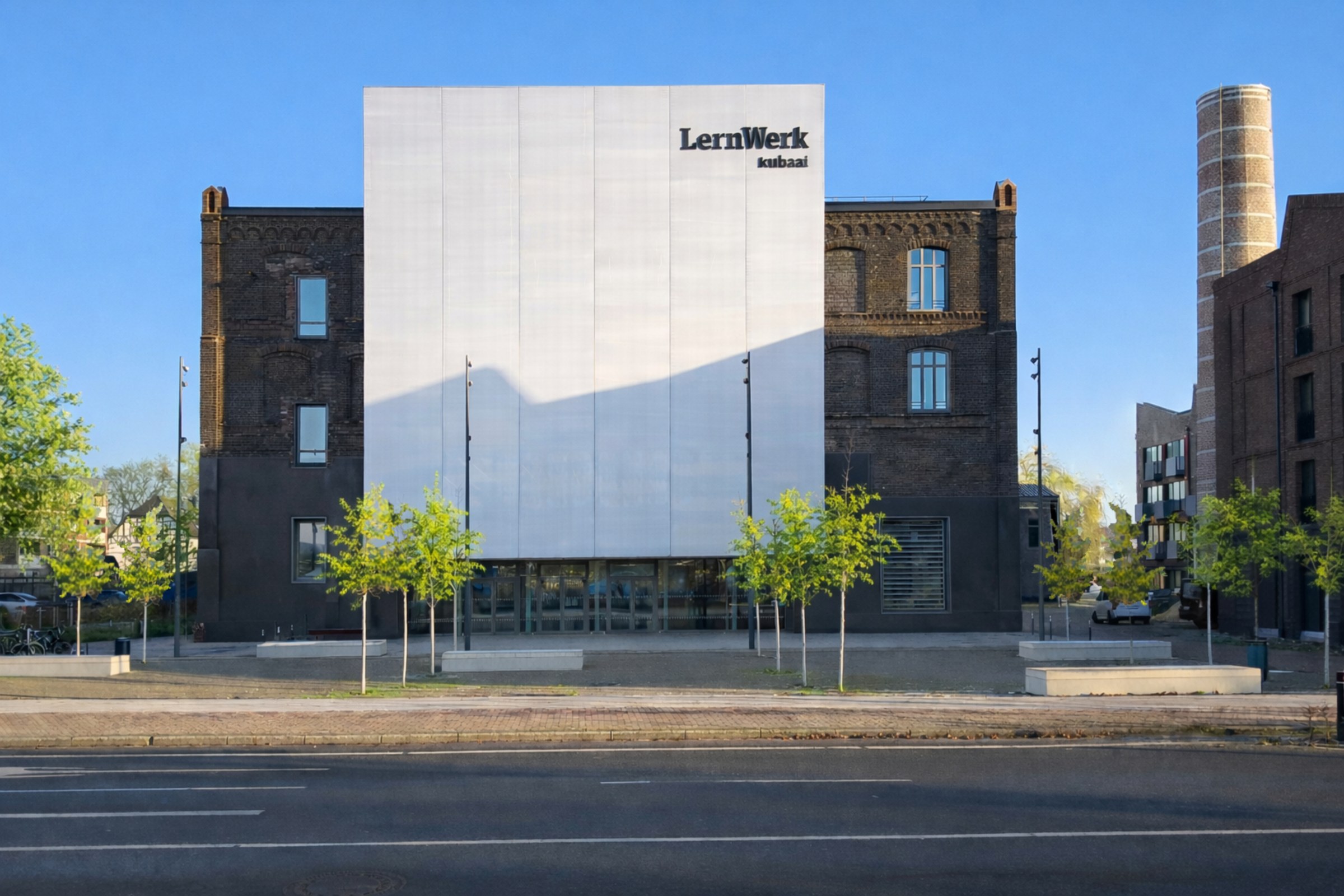
The clearest instance of both roles meeting in one place is the LernWerk in Bocholt – the conversion of the former Herding spinning mill, where Heywinkel spent years as project lead for ACMS and photographed the building throughout construction, not after it. Cast-iron columns from the original mill were kept and picked out in colour; a new, contemporary volume was inserted in a fibreglass-mesh cladding that quietly echoes the site's textile past. Old and new, as he puts it, stay legible as distinct layers of time and still stand in relation to each other.
His exhibition record runs in both registers too. FARBRAUM, running through 30 September at Galerie im Turm in Wuppertal with guest photographer Andreas Kretzschmar, extends colour photography into the room itself with passe-partouts and backing fabrics matched to each image – a deliberate answer to 2025's all-black-and-white show at the same venue. A third show, Black & White in Unfinished Core, was planned for a raw, unheated construction shell on Moltkestrasse in Essen – fine-art prints on acrylic glass staged inside bare concrete and unfinished masonry, admission by invitation only – and had to be called off at short notice, when days of bad weather made the site too risky for visitors. The idea itself, he says, is far from finished, and he hopes to find a suitable location for it one day. Two of his staircase images independently made the jury's Top 50 at the SPC competitions – Treppe im Kunstpalast Düsseldorf in Berlin, Treppe im Museum Küppersmühle in Duisburg in Cologne – while a third, of a ceiling light in his mother's living room, took fourth place in Cologne's public vote. Docu Magazine has run two issues of his work, and one image – Tiger & Turtle, the public sculpture in Duisburg – was shown at the Black & White International Photography Awards Exhibition at One Art Space, New York, in June 2026.
We spoke with Manuel about photographing a building he was also professionally responsible for, why staircases keep pulling him back, and what a jury looks for that a public vote doesn't.
01 · Two ways of seeing
Viacheslav Munister [VM]: You work on architecture both as an architect and, since long before that was your job, as a photographer. Has your eye for architecture changed in any way you can point to – and where do colour and black-and-white each come in?
Manuel Heywinkel [MH]: I've been photographing since I was very young, and architecture was one of my subjects almost from the start, so I can't name a moment when my eye for it changed fundamentally. When I was younger I also spent a good deal of time on film and video, making animated films among other things, before photography moved back to the centre.
Studying architecture, and later working as an architect, sharpened that eye considerably. You start paying much closer attention to geometry, line, vanishing points, proportion, spatial relationships – a lot of it happens automatically by now. Interestingly, before digital photography I shot almost exclusively in colour. Black-and-white came later, mainly once digital editing made it easier and then once I started posting on Instagram. Today the two are equal for me as forms of expression – I decide per image which one actually works for it.
VM: Was there a specific photograph or moment where documentation stopped being enough and it became a more deliberate, composed way of looking at architecture – or were the two always tied together for you?
MH: I can't name a specific moment – the more deliberate way of seeing developed continuously rather than arriving all at once. Today I notice details much more consciously, but also the sightlines between parts of a building, or between different buildings, and the urban context around them: how a building sits in its surroundings, how it responds to them, what perspectives that creates. It's exactly out of those relationships that interesting lines, vanishing points and perspectives tend to emerge for me – and years of close engagement with architecture have made that way of looking steadily more conscious.
02 · The LernWerk
VM: The LernWerk in Bocholt is a building you supervised as an architect over years and photographed throughout that same time, not after the fact. Does watching a building you're also professionally responsible for change what you see in it – do things show up that the strictly professional view might miss?
MH: It isn't always easy in the middle of a construction site. As the architect supervising the build, you're deeply embedded in the daily process – coordinating contractors, sorting out agreements, and above all quality-checking the work that's been done. That inevitably narrows your focus to individual details and immediate tasks a lot of the time.
Which is exactly why it matters to step back periodically and see the emerging building as a whole again. My photographic eye helps with that, I think – I keep trying to take a step back and not just see the detail or the current problem, but the space, the architecture, what's actually taking shape there. On a project you're following over a long stretch of time, it's easy to otherwise lose sight of how the building is developing as a whole.
VM: Is there one image in the series where the coexistence of the old mill and the new building reads most clearly to you?
MH: That depends a great deal on the design itself first. At the LernWerk, a central idea was developing the historic fabric for a new, contemporary use and reinforcing it technically without covering over the building's history. You can see that, for instance, in the original cast-iron columns – they were largely preserved and deliberately highlighted through their colour treatment. At the same time, the newly inserted cube introduces a clearly contemporary element into the existing fabric; its fibreglass-mesh cladding in turn references the building's original use as a spinning mill.
I find exactly that juxtaposition compelling: old and new stay legible as distinct layers of time, and still stand in relation to each other.
VM: How do the architect's eye and the photographer's eye actually divide the work on a project like this – are there moments where one has to consciously take the lead?
MH: In the daily rhythm of a construction site, the architect's view naturally comes first – checking completed work, coordinating the process, communicating with the client and the tradespeople, and at the LernWerk, eventually with the building's future users and to some extent the public. Part of the job is also thinking ahead rather than only at the current detail: what comes next, how does one decision affect other work, how does it all come together in the end?
The shift into photographing isn't that different, actually. There too I can focus very tightly on a detail, a line, a specific situation, and then deliberately let go of it again to take in the space or the building as a whole. The two ways of seeing complement each other well for me.
03 · Recurring motifs
VM: Staircases keep returning across your work – Schwerin Palace, Düsseldorf's Kunstpalast, the Museum Küppersmühle in Duisburg, the Ruhr Museum on the Zeche Zollverein site in Essen. What is it about a staircase that keeps pulling you back?
MH: A staircase is far more, for me, than a building component that connects a building's levels. Historically, staircases were often deliberately staged elements of representation – in palaces especially, they could be a direct expression of power, rank and importance.
Photographically I find them just as compelling. Their construction almost automatically offers interesting sightlines, vanishing points, repeating lines and perspectives – the same staircase can look completely different depending on where you stand. Maybe that's exactly the fascination: a staircase serves one unambiguous function and, at the same time, offers an almost unlimited number of ways to interpret it, architecturally and photographically.
VM: Your Zeche Zollverein images show a place that was once industry and is now a monument – a coking plant, reflections, machinery nobody operates anymore. How do you approach a site with that much history without the picture becoming a mere illustration of it?
MH: What strikes me first about old industrial sites is the sheer scale of the engineering achievement. Looking at Zeche Zollverein, or other large industrial complexes, it's worth remembering these complex structures were planned and built at a time with no computers, no CAD – much of it was still drawn by hand at the drafting table, something I learned to do myself as a trained architectural draughtsman.
Walking through a site like that today, I often find myself wondering what function a given building, machine, pipe or structure originally served. Now everything stands still. You can only imagine the working life that went on there, and probably only imagine, at that, the physical effort some of that work demanded. At the same time, these sites are photographically extraordinary – the sheer range of structures, materials, pipework, technical detail and large spatial relationships offers an enormous variety of motifs and perspectives. Zeche Zollverein is a very good example of that.
VM: What draws you to exploring different cities photographically, and what decides which motifs from a city become a series?
MH: Cities don't interest me only for their architecture. I'm also drawn to their history – why certain things emerged in a particular place, how a city became what it is today. With Frankfurt, for instance, I'm interested in how it grew into a major trade-fair city, but also its history as an imperial coronation city with its Kaiserdom. Other cities raise entirely different questions. Bielefeld is my hometown; Freiburg has a completely different character; Düsseldorf another again. Every city has its own charm, its own vibe.
So I'm interested not just in the historic building stock or the modern architecture, but in the life in between: how people use their city, move through it, engage with the spaces available to them. That's what I try to capture, alongside the architectural photography, through street photography as well.
04 · Black-and-white and colour
VM: After your black-and-white show at FotoForum Wuppertal in 2025, your current exhibition FARBRAUM deliberately shows colour work. What led to that decision, and what does colour open up for you as a photographic tool that black-and-white doesn't?
MH: For FARBRAUM, still on show now, I decided on colour photography quite deliberately from the start – partly as a counterpoint to last year's show, where I showed exclusively black-and-white work.
My basic idea was not to confine the colour to the image itself, but to carry it into the room. I did that with passe-partouts matched in colour to each photograph, and for individual works, matching fabric behind the image as well. That way the image's colour continues into the space around it and shapes how it's perceived and its mood at the same time.
Colour matters to me as a design tool in architecture too, for what it's worth. Architecture can of course work very deliberately with a reduced, white palette and achieve a completely different effect that way. But deliberately applied colour can emphasise spaces, surfaces and proportions and change how they're perceived – with lighting conditions playing an important role there as well. That interplay of image, colour and space is the whole premise of FARBRAUM.
VM: Why plan a black-and-white show for an unfinished space rather than a conventional white-walled gallery?
MH: The underlying idea for that show, too, was to connect architecture and photography directly. I wanted to present high-quality, precisely finished architectural photographs on acrylic glass inside a deliberately unfinished setting – a raw construction shell, exposed concrete, unplastered masonry, all the traces of an ongoing build.
That contrast was exactly what drew me: the finished image inside the unfinished room. The photographs show architecture in a resolved, completed form, while the exhibition space itself was still mid-process.
Unfortunately I had to cancel the show on short notice for safety reasons. Weather conditions in the days beforehand made the risk to visitors on an active construction site simply too high. The concept itself is by no means dead, though – it's still in the back of my mind, and since I deal with construction sites regularly through my work, I'm hoping to eventually find the right location to still make it happen.
VM: What did putting together l'une et l'autre – your Cologne show with Monika Geisler – teach you about your own work that you wouldn't have noticed alone?
MH: What I found especially interesting about the Cologne show was that we combined photographs with quite different styles and approaches, and still found surprisingly strong connections between many of the pieces – in content or in form.
So we deliberately paired images, placing works side by side that look very different at first glance but engage with similar motifs, shapes or structures. A good example: Monika Geisler's photograph of a snail next to my photograph of the spiral staircase inside Berlin's Siegessäule – two completely different subjects, and yet the similarity in form creates an immediate connection.
Putting the show together, I was genuinely surprised how many such relationships emerged between individual works. It was exactly those different photographic perspectives on related forms and themes that ended up being the particular appeal of the show, for me.
05 · Juries, print, a room in New York
VM: Two of your staircase images independently made the jury's Top 50 at the SPC competitions, while a third – of a ceiling light in your mother's living room – took fourth place in the public vote. What does that split tell you about the difference between what a jury looks for and what actually reaches an audience?
MH: I was of course very pleased that two of my staircase images were selected by the jury for the Top 50, even though neither placed in the actual competition. What I found even more interesting was that my image Unter der Decke – showing a ceiling light in my mother's living room – came fourth in the Cologne public vote.
A specialist jury engages with submitted work in a targeted, comparative way. Depending on the jurors' own photographic backgrounds, things like composition, technical execution, craft, or how a theme is handled can carry particular weight. With the public, the immediate personal or emotional response probably plays a stronger role – what speaks to me right away, what excites me about an image, does the motif remind me of something I've experienced or seen myself? That doesn't mean the public is blind to technical or formal qualities, of course. But a personal connection to an image can weigh more heavily in a public vote.
That's exactly why I find both forms of judgment interesting – they show how differently photographic work can be perceived.
VM: What changes about an image once you know it will be seen printed and bound, not just on a screen?
MH: I don't actually distinguish, while shooting, based on where or in what form an image will later be shown. Whether it ends up on Instagram, in a magazine, or in an exhibition is secondary at the moment of taking it – what has to work first is the subject, the composition, the way it's built.
When an image is later selected for a show or a publication, that's obviously very gratifying. I was especially pleased that my photograph of Tiger & Turtle was shown as part of an exhibition in New York – it meant something to present a piece of my own work in that kind of international setting. And I liked the thought that, with Tiger & Turtle, I was showing a motif from Duisburg – and with it, a piece of North Rhine-Westphalia and Germany.
06 · Looking forward
VM: Comparing today's work to your first architectural photographs – as both architect and photographer – what's changed the most in how you look? And what are you still looking for in either role that you haven't found yet?
MH: Today I seek out and look at architecture far more deliberately than I used to. Things I might once have photographed almost in passing, as a young photographer, I now go looking for quite consciously.
I research particular buildings and places in advance and think about what might interest me photographically there. Often that's museums, but just as often other publicly accessible buildings – and, naturally, places that aren't normally accessible hold a particular appeal. My professional work sometimes opens up the chance to photograph buildings during construction, or shortly before completion – before they go into use and become accessible to the public. Photographically that's very exciting, because you get to experience spaces in a state that won't exist again once they're in use.
Next up is a joint exhibition with Petra Baumgart and Andreas Kretzschmar at the IKIGAI-Raum in Cologne, and I'll be taking part in the SPC in Cologne again. What the new year brings beyond that, we'll see. Further PhotoWalks are being planned, among other places at Zeche Zollverein and in Berlin, but for now these really are plans rather than fixed dates.
Manuel Heywinkel’s photography can be seen at manuel-heywinkel.com , his work as an architect at acms-architekten.de , on Instagram at @manuel_242neo and on 1x at 1x.com/manuelheywinkel . Images © Manuel Heywinkel unless credited otherwise; published with permission.