The Seam That Isn't There: Anish Kapoor's Cloud Gate
Critical Essay
Anish Kapoor's Cloud Gate has no front, no seam and, its maker insists, no fixed subject beyond the skyline and the crowd currently caught in its surface. On the engineering problem that took two extra years and $23 million to solve, the omphalos underneath that turns the trick on the viewer, and why the solution still works two decades on.
Viacheslav Munister · 2026-09-07
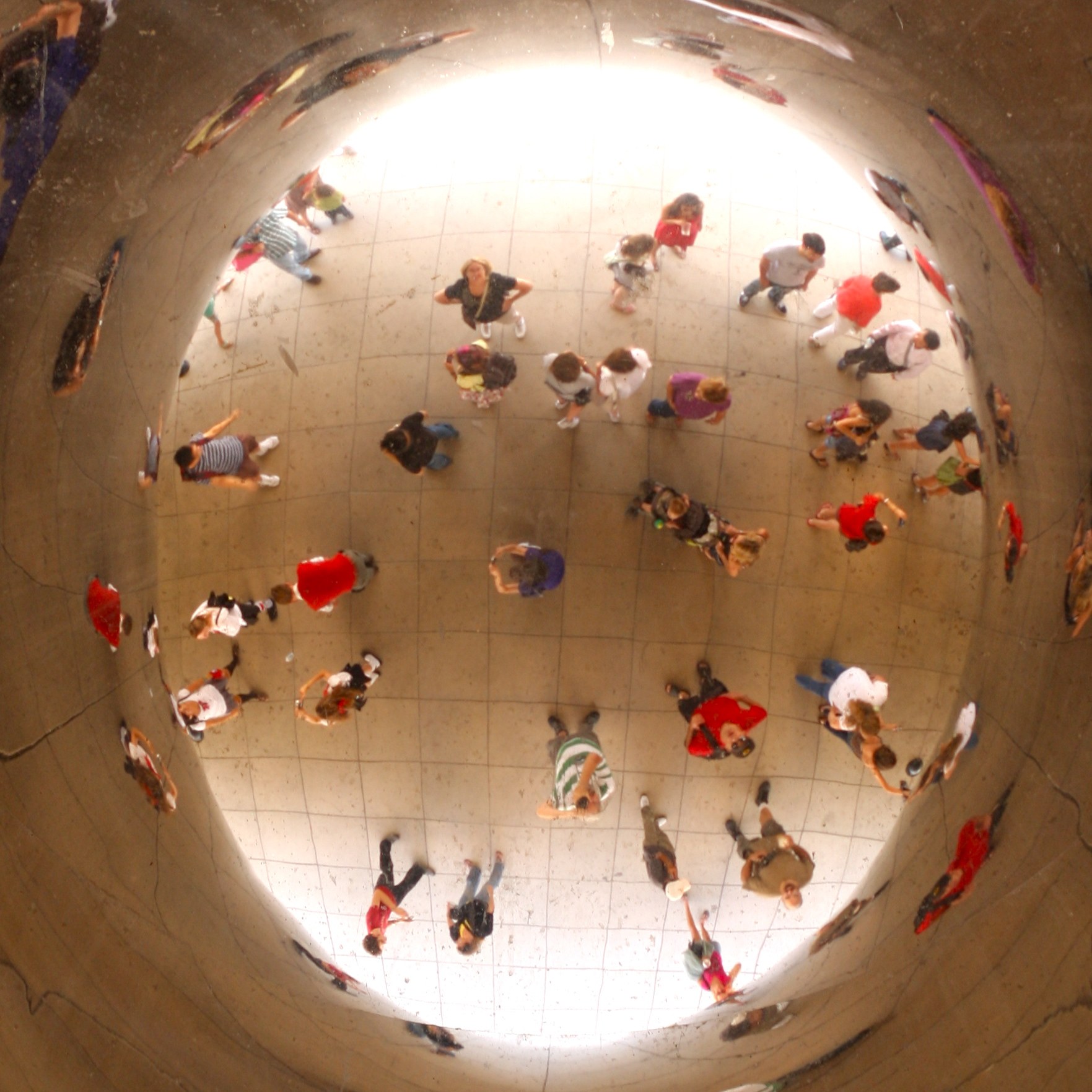
Cloud Gate has no front. Walk Millennium Park from any direction and the sculpture that Chicago calls the Bean turns to meet you: a continuous, gateless loop of polished steel, 20 metres long and 13 metres wide, sitting on the Michigan Avenue lawn like a drop of mercury caught mid-fall before it can spread. The city's public art program asked, in 1999, for a landmark for a new plaza on top of a rail yard. What it received, after a jury reviewed an international shortlist and Anish Kapoor's design was chosen over more conventional proposals, was his first permanent outdoor work built in the United States, and a piece of sculpture whose entire content is the city looking at itself, bent.
A surface with no seam to hide behind
The engineering problem was the whole project. Kapoor's design called for a mirror-polished skin with no visible joints anywhere on its surface, which meant 168 stainless steel plates had to be welded edge to edge and then ground and buffed by hand until the welds disappeared entirely. There is no trim, no gasket, no seam moulding to break the reflection and remind a viewer that the object in front of them was assembled rather than poured. Underneath that skin sits an independent steel frame engineered to breathe with Chicago's weather: the whole structure grows and shrinks by several centimetres between a July heat wave and a January cold snap, and the polished plates have to move with it without ever telegraphing a crease to the surface. Reaching that standard took two years longer than scheduled. Millennium Park opened in 2004; Cloud Gate, still hidden behind construction fencing, opened to the public in 2006, and the roughly $23 million the sculpture and its plaza eventually cost ran well past the original estimate, almost entirely on account of the polishing.
That decision is the piece's real subject. A seamed surface reads as construction: an object built by people, in time, out of parts. A seamless one reads as a phenomenon, less a sculpture of something than a hole cut in the world where a 110-tonne solid ought to be, through which the sky, the Aon Center and several thousand tourists a day pour continuously. Kapoor had spent much of the previous two decades chasing this effect at gallery scale, in the pigment-filled voids of the 1980s and the concave mirrored discs that followed, works where the viewer's own reflection curls back distorted rather than sitting flat on a surface. Cloud Gate is the moment that vocabulary met a civic budget and a skyline large enough to be worth swallowing, and it set the pattern for the mirrored public commissions Kapoor would go on to build elsewhere: Sky Mirror in London and New York, the C-Curve at Kensington Gardens, Turning the World Upside Down in Jerusalem. None of the later pieces attempt the same trick at the same scale.
Underneath, the plates curve inward to form what the artist calls the omphalos, an eight-metre concave chamber that gathers the reflections back on themselves and multiplies them into a compressed, curling vortex of tile, sky and crowd. It is the one part of the sculpture where the mirror stops behaving politely. Everywhere else, Cloud Gate flatters its surroundings, stretching the skyline into something taller and stranger than it actually is. Under the arch, the same surface turns on the viewer instead, folding dozens of people into a single circular frame with no horizon and no fixed vantage point to stand at and call correct.
Public sculpture as infrastructure
What makes Cloud Gate an unusually successful piece of public art, rather than merely a popular one, is how little it asks of anyone who did not come to look at sculpture. It has no plaque-length argument to absorb, no fixed reading distance, no correct time of day. A tourist photographing their own reflection and a critic tracing Kapoor's debt to Brancusi's polished bronzes and to the biomorphic abstraction of Jean Arp are using the same object for the same reason: because its surface changes with whoever is standing in front of it and never resolves into one fixed image to be checked off and left. That is a harder trick to engineer than the seamless steel. Most large civic commissions settle for legibility from a bus window; this one was built to reward the two minutes someone spends walking around it far more than the two seconds someone spends driving past, which is also why it survives being photographed several million times a year without wearing out as an experience the way a static monument would.
Two decades on, the sculpture has absorbed a nickname it was never given by its maker, appeared in more amateur photographs than almost any other work of contemporary art, and remained, underneath all of that circulation, a genuinely difficult object: a solid with the visual behaviour of a liquid, a monument with no fixed subject except the crowd currently caught in its surface. Cloud Gate did not need an anniversary or a retrospective to prove the seamless finish was worth the extra two years and the extra cost. Every clear afternoon in the plaza does that instead.