The Red Thread: Veronika Chernienko on Painting What Words Can't Reach
Interview
Ukrainian painter Veronika Chernienko, trained at the Kyiv academy and based on Cyprus since 2014, on why she calls herself a colourist before anything else, the recurring red thread that runs through her most personal work, and the biennial sketch about home and distance that she still can't look at without crying.
Viacheslav Munister & Veronika Chernienko · 2026-09-21
Veronika Chernienko paints the way she was trained to at the Kyiv academy she still calls home, and paints against it in the same breath. A colourist first, she says, before she is anything else – someone who works from the conviction that colour, not drawing, carries what she actually wants to say.
She left Ukraine for Cyprus in 2014, and for years her painting barely registered the move: the palette stayed hers, the subjects stayed the human figure. What changed the work was not geography but the war. Since 2022 she has painted more, and differently – not always about the war directly, but carrying its aftershock in every canvas: vulnerability, the need for shelter, a search for roots and for the people left behind. A recurring red thread, tied around a wrist or trailing into water, is not a fixed symbol for her so much as a nerve that different paintings touch for different reasons.
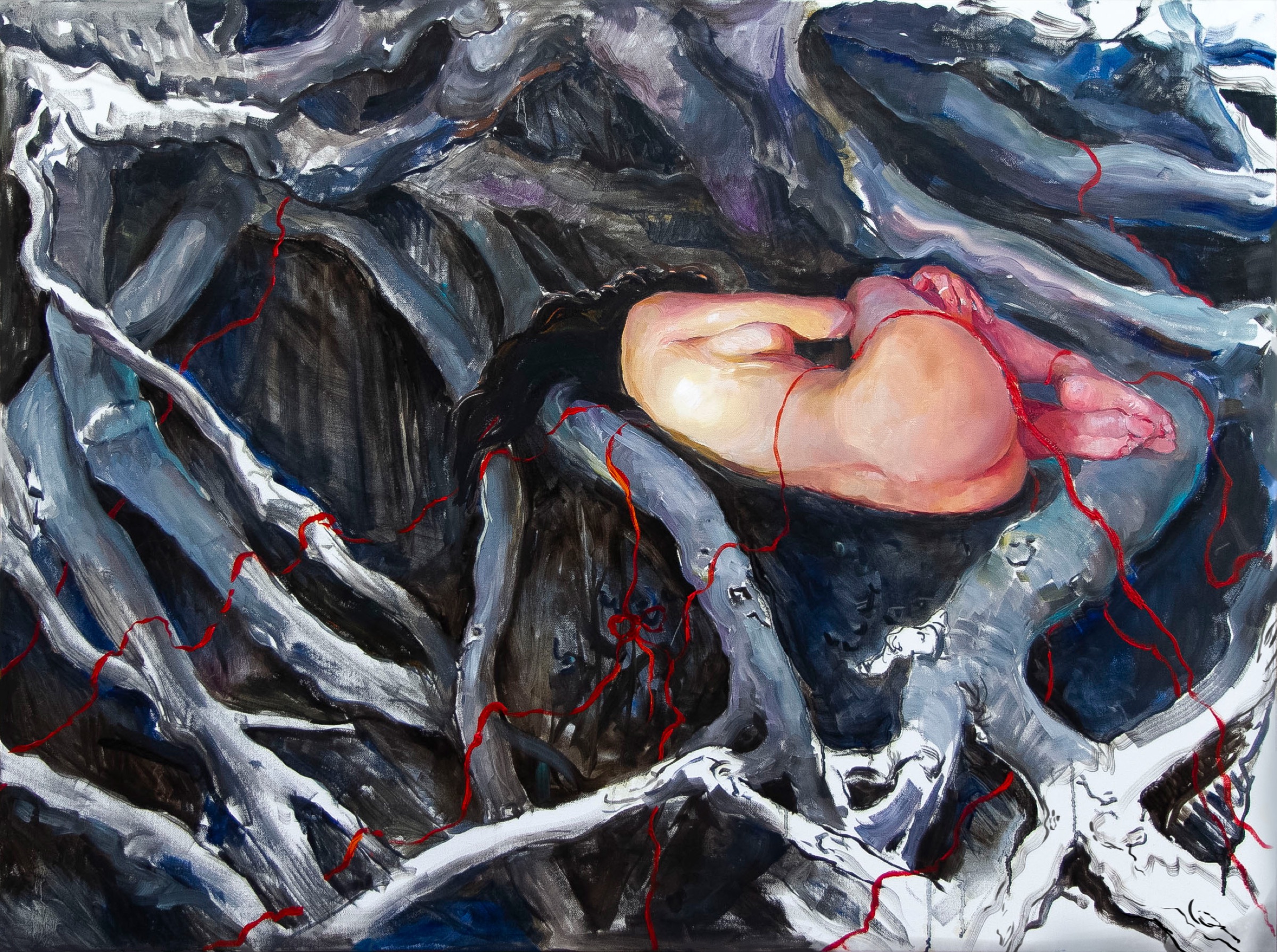
One of those paintings – a child curled in the exposed roots of a tree, a red thread running through the whole composition – was made for a 2023 biennial in Larnaca on the theme of a home far from home. It was not selected. She still cannot look at it without crying.
01 · Where the training came from
Viacheslav Munister [VM]: Could you introduce yourself and outline the path that brought you from your training to your practice today, based in Cyprus?
Veronika Chernienko [VC]: I've been painting since early childhood – it was always a natural part of my life. At twelve I entered an art boarding school in Kyiv, and later graduated from the National Academy of Fine Arts and Architecture with a master's in easel painting. Toward the end of my studies I joined the National Union of Artists of Ukraine and took part in Ukrainian and international exhibitions.
When my family and children came along, I focused for a while on painting for myself. In 2014 we moved to Cyprus, where I joined the local art community, painted portraits on commission, did wall murals, and taught children – including preparing them for entrance to art school. The circumstances and forms of the work kept changing, but the daily practice never left me. I always felt painting was my profession and my calling.
With the start of the full-scale war in Ukraine, I began painting especially intensively – painting helped me live through what I had no words for. Even when a work doesn't address the war directly, it carries an echo of what I've lived through: a sense of vulnerability, a need for protection, a search for support and for connection to my roots. Through the human body and its gestures, I speak about an inner pain that isn't always visible from outside.
It was on Cyprus, among artists from many countries, that I understood more deeply the distinctiveness of the Ukrainian school of painting that shaped me – I saw the richness of our palette and the boldness of our colour and imagery with new eyes. Today it matters to me to keep developing that inheritance in my own work and to pass it on to my students, to keep a living connection to the culture that raised me and that I carry with me.
VM: Could you place your training within a specific pedagogical tradition, and how much do you see your current work as a continuation of it, or a departure from it?
VC: My education belongs to the Ukrainian academic school of painting. I studied in the workshop of Oleksandr Lopukhov – our graduating class was, sadly, his last. Composition and the genre picture were the foundation there. At the same time we worked a great deal with Ihor Yulianovych Melnychuk, whose approach is marked by decorative sensibility and a bold, saturated palette. It was the combination of the two that formed how I see a painting.
Field practice mattered enormously. We spent long stretches in the Carpathians and in Transcarpathia, painting from life, studying the local culture and customs. Ukrainian motifs became part of my personal experience. Even in those student years, when many were looking for themselves outside the academic school, I was glad to belong to the Ukrainian tradition of realism and impressionism. The human being, and the theme of Ukraine, have stayed with me since.
At the same time, I feel today that I've moved away from academicism and from the need to follow rules. In a world that keeps changing, with so much creative freedom available, I've allowed myself to do what I want – to trust my own sense of colour and form, and to follow where the work itself leads. I rely on intuition more and more, but it's an intuition that grew out of deep training and years of practice. The school became an inner foundation that gives me the freedom to experiment. And the simple joy of the process itself matters enormously to me – I get real pleasure from what I do.
02 · A colourist's worldview
VM: How would you describe your practice as a whole to someone encountering it for the first time – what should they understand before anything else?
VC: My practice begins with an attentive, enamoured look at the world. I have a weakness for admiring everything alive – I love watching nature, the movement of light, reflections and colour echoes. Seeing the world through a painter's eyes feels natural to me: I'm constantly noticing combinations of colour and barely perceptible shifts that I want to carry onto canvas.
Above all, I feel myself to be a colourist. It's through colour, more than through form, that I convey my perception and what I'm living through. Even when the world holds so much pain, I'm captivated by how everything alive around us keeps changing without pause, and I want to carry that feeling into my painting.
I want to show the viewer what I see, and what they might otherwise pass by. To invite them to stop, look closer, and feel. What matters most to me is that the colour touches a person – that it calls up a memory of their own, a feeling, a new sense of something familiar.
03 · Cyprus and what geography did not change
VM: Displacement from Ukraine to Cyprus is a fact of your biography. Is it also a fact of your painting – does geography enter as subject, as light and palette, or does it stay outside the work itself?
VC: A different culture and landscape can certainly change how an artist works. But I can't say the move to Cyprus significantly changed my palette or my range of subjects. I keep painting what is close to me, drawing on a way of seeing that formed in Ukraine.
Even when I turn to the Cypriot landscape, I see it through my own experience, and render it in my own manner and colour relationships. What interests me is what image of this place can be born from that particular gaze – I feel it will differ from the Mediterranean painting I encounter here. It's precisely on Cyprus, among artists from different countries, that I notice most clearly the differences in our painterly approaches, and recognise what the Ukrainian school gave me.
Plein-air practice never really took root for me here, though I've tried more than once to return to it. I mostly work at home, and paint a great deal of figurative work. The human being and their inner world stay at the centre of my attention.
With the start of the full-scale war I joined volunteer work at the Ukrainian House in Cyprus, where I teach Ukrainian children. Together we keep our artistic tradition alive, turn to Ukrainian imagery, work with colour. It matters to me that children growing up abroad feel a living connection to their culture and can develop it in their own work. I see this, too, as a continuation of a path that began in Ukraine.
04 · Sources, and standing apart from lineage
VM: Beyond direct observation, what is your primary source of visual reference – art-historical precedent, photography, something else – and how consciously do you place your own work within a lineage of painters?
VC: My paintings are born from a combination of sources: studies, photographs, gestures I've seen, observation. Most often I turn to photography – it's convenient working material, and experience lets me reinterpret it freely. But working from life remains irreplaceable. Here on Cyprus, in our art community, we still work with a live model, and I value that greatly. When a photograph isn't enough, I go back to life, to look closer, to clarify, to feel what the image can't carry. Without that living experience, painting doesn't feel complete to me.
I often return to Ukrainian painters – Oleksandr Murashko, Viktor Zaretsky, Tetiana Holembievska, Tetiana Yablonska. My teachers had a great influence on me too. I also follow contemporary artists with interest, including those working alongside me on Cyprus. Everything I admire stays, to some degree, in my visual memory and shapes me.
At the same time, I don't place myself within any particular style, and I don't consciously try to follow a specific artist. While working I don't think about who my painting should resemble, or which tradition it continues. The knowledge, impressions and influences are already part of me – standing at the canvas, I trust my own sense of things and focus on what I want to convey.
05 · Still life and the figure – one language, not two
VM: Your still lifes pursue an almost hyperrealist finish, while the figurative work stays looser and more painterly. Are these two different languages for you, or one language used at different pressures?
VC: For me it's really one approach, in which the balance between precision and looseness shifts depending on what I want to convey. Academic training gives me an understanding of form, but photographic accuracy on its own isn't my goal. What captivates me is the chance to intensify what I've seen many times over – to sharpen colour, to underline the body's plasticity, to make felt what caught my attention.
Our everyday life is saturated with images, and I want to give the viewer a reason to let their eye linger. I take in the world through colour and plasticity, and I want to show what usually goes unnoticed. Sometimes that calls for careful modelling of form, sometimes for a large flat field of colour. The choice is often intuitive, made in the process of working.
The human figure remains an inexhaustible source of beauty and fascination for me. Through the body, its movement and gesture, I want to build an emotional connection with the viewer. At the same time, I'm captivated myself by painters who notice even finer nuances and show me things I hadn't seen before. That ongoing deepening of the eye is one of the greatest joys painting gives me.
06 · Wall and canvas
VM: Working across mural and easel painting means moving from a public, site-specific scale to an intimate one. How does your approach change?
VC: Monumental and easel painting call for different approaches to composition, scale and the organisation of space – they're separate specialisations, and the academy has a dedicated monumental painting workshop. But I approach a wall as an easel painter: I treat it as a large canvas and carry my own way of working onto it.
It isn't natural for me to build an image out of large generalised masses and flat fills. I work with brushes, keep the painterly stroke, and build form, transitions, a sense of air through it. Even in black-and-white murals, that liveliness of the stroke matters to me. There's a particular appeal in that approach, one my clients value.
Of course, on a large surface that kind of work takes far more time, and I always warn people about that in advance. But I enjoy the process itself – I love working with a brush, watching an image slowly come alive. The scale changes; the pleasure of painting and my own approach stay with me.
07 · A turning point
VM: Looking at your practice over time, is there a specific body of work you'd identify as a turning point?
VC: There was a period of deliberate experiment in my practice. During the pandemic I became absorbed in the work of American realist painters – their restrained, dark palette, complex colour nuance, the fine handling of the painted surface. I tried to change both my colour range and my technique. A number of darker, more delicately rendered works came out of that period.
Over time I felt that manner wasn't close to me. The work found less response from viewers, and I understood, more and more clearly, that in that search I was moving away from myself. Now I'm returning to what I loved since childhood, and what captivates me in Ukrainian painting: bold, exaggerated colour, a broad stroke, freedom.
What turned out to be the real turning point was realising how important it is to trust my own nature. This is a return to myself, but with different experience and greater confidence in my own language.
My most personal works are born from a deep inner feeling. Knowledge and experience support me, but every time, something happens at the canvas that I can't fully predict or explain. Sometimes I feel it as a connection to something larger than myself – to God, to the world, to the very energy of life. What matters to me is staying open to that state and letting it guide my hand.
08 · The red thread
VM: A recurring motif – a red thread bound around the wrist – punctuates an otherwise restrained body of work. What does it mean to you, and has its meaning shifted from painting to painting?
VC: I wouldn't call this motif a sign with one fixed meaning – it's born from the feeling behind each specific work.
I imagine you mean, first of all, the girl among the roots – the sketch for the 2023 Larnaca biennial on the theme 'a home far from home.' That painting still brings me to tears. In it, helplessness and a deep connection to home, to the people close to me, to Ukraine, come together. The red thread makes that invisible connection visible. Far from home it sometimes feels even stronger, even more painful – you can't embrace the people you love, but everything that happens to them passes through you. And at the same time, it's exactly that closeness that gathers us into a community, that helps us hold on to one another.
Sadly, the sketch wasn't selected. I don't know why. Perhaps the organisers didn't want to focus specifically on the Ukrainian experience of war and distance from home – but that's only my guess.
If you also mean the girl in the water, with a red ribbon in her hair – that painting is my reflection on the terrible violence in Bucha. Even now it's hard for me to talk about it: painting became a way to express a pain I had no words for.
So the meaning of the red accent shifts along with the painting itself. These images arose intuitively, from different experiences. What unites them is human vulnerability, and my own deep, personal response.
VM: Certain works – like the piece addressing children's bound hands – engage directly with violence and vulnerability. Does that content change how you paint, technically?
VC: You may be thinking of the painting with the girl embracing her own shoulders, a red ribbon from her hair trailing down into the water. That work arose as my reflection on the terrible violence in Bucha.
That content certainly affects how I paint, even though my painterly vision stays recognisable. I become especially attentive to human vulnerability, and try to render it as gently and tenderly as I can. Some fragments of the figure I render more carefully, lingering longer on a gesture, on subtle value shifts and colour transitions. Through that attentiveness to the body, I try to convey an inner pain.
These shifts arise from the feeling itself, intuitively. Colour, stroke, and how far I take a form are all subordinated to what I feel in front of the canvas. I think the viewer can sense that tenderness and pain before they even learn the story behind the painting.
09 · What she cannot look at without crying
VM: Is there a work you consider technically or conceptually significant beyond its public reception?
VC: For me, that work is the girl among the roots with the red thread, which I've already mentioned. That sketch for the Larnaca biennial became a very personal statement about home, distance, and a bond that cannot be broken. In it, a person's helplessness meets the strength of their belonging – to the people close to them, to their land, to their community. I still can't look at that painting without tears.
The sketch wasn't selected, and it's painful to me that it didn't get the chance to be heard in the context it was made for. I don't know the reasons for that decision and can't explain it with any certainty. A work's personal significance doesn't always match its outside recognition.
Its value for me hasn't changed: in it I managed to convey a feeling that's still hard to put into words. I'd like that work to still have the chance to meet its viewer.
10 · Knowing when to stop
VM: Your still-life practice pursues an almost hyperrealist finish, while the figurative work is much freer – how do you know when a painting is finished?
VC: For me a painting's completeness is decided by whether I've managed to convey what matters most. I often work alla prima, trying to capture the image at once, to keep the force of the first impression. Working fast matters to me. I used to see that impatience as something of a flaw, but over time it became a distinctive feature of my painterly language.
That's tied to my training too – we painted a great deal of studies en plein air, worked from live models outdoors, often in one or two layers. That practice taught me to focus on the essential. Long, many-layered work on a canvas isn't close to me, though commissioned still lifes, with their specific brief, sometimes demand more detail.
In my own work I stop when I feel I've said what I wanted to say. Areas of the canvas can stay unresolved, brushstrokes free, forms only suggested. For me those are spaces of the unsaid, where the viewer can feel and complete the image themselves. I don't want to overload the canvas – it matters to me that it breathes.
So what looks unfinished can, for me, be an entirely finished painting. I trust my own sense of that boundary, and I trust the viewer, too – not every detail needs explaining.
Veronika Chernienko's work can be followed on Instagram at @artveronika_painting.