Museo Nivola: A Museum, a Village and the Memory They Share
Interview
Costantino Nivola left a Sardinian village of masons for New York, worked with Le Corbusier, Sert and Saarinen, and never stopped coming back. The team of his museum, on the hill above Orani, on where a museum ends and a village begins, on the method he left behind, and on what a monographic museum can still become.
Viacheslav Munister & Museo Nivola · 2026-08-25
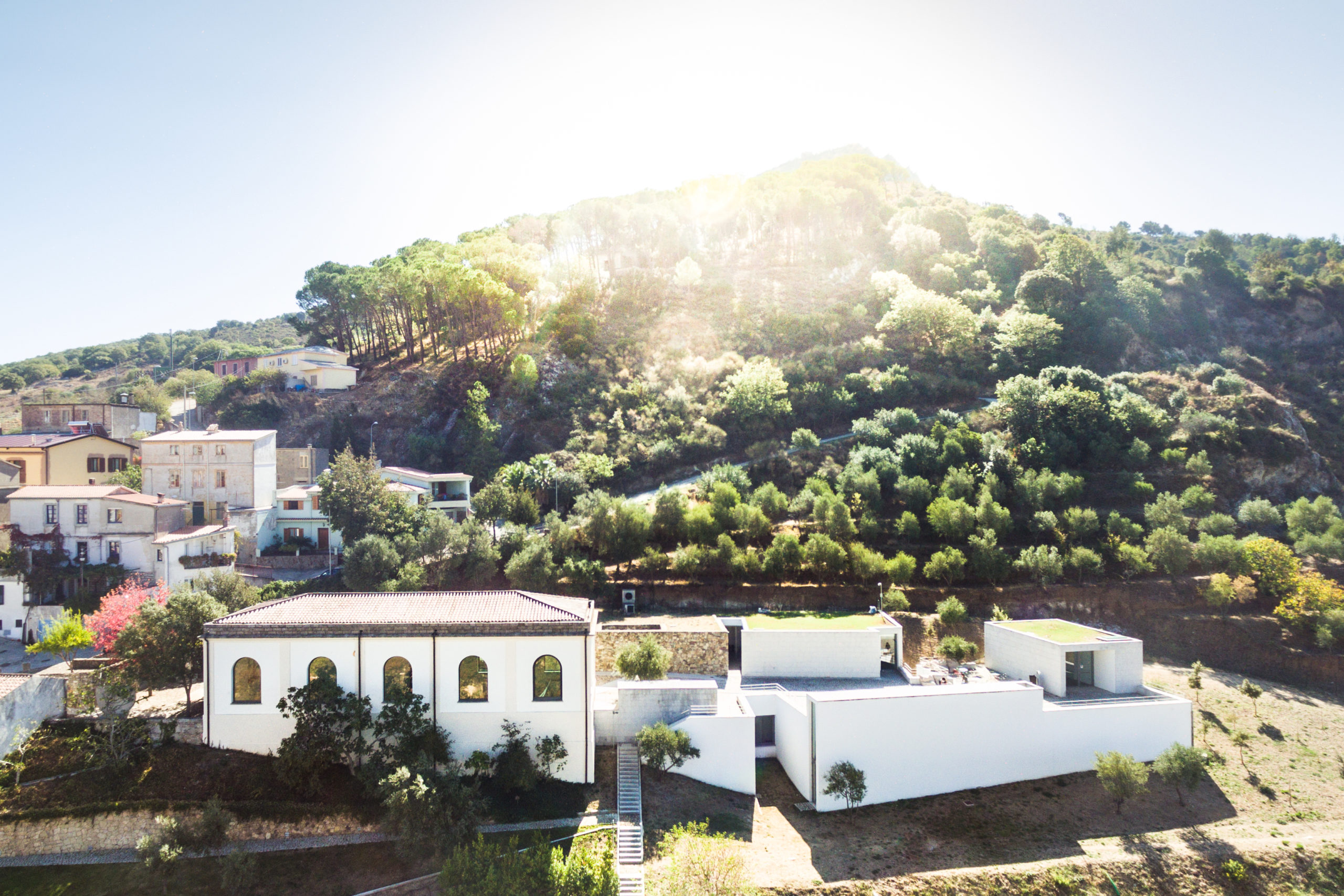
Orani is a village in the Barbagia, the mountainous heart of Sardinia. A road climbs up from the valley, the houses gather along the slope, and just above them, on the hillside, a low white building sits among olive trees and looks back down at the roofs. It is one of the most quietly beautiful small museums in Italy, and it belongs, in the fullest sense of the word, to the place it stands in.
Costantino Nivola was born here in 1911, the son of a mason, and learned the trade on his father’s building sites before the ISIA in Monza and a job as a graphic designer for Olivetti in Milan. In 1939 he left for New York. He met Le Corbusier in 1946, wrapped the wall of the Olivetti showroom on Fifth Avenue in a sand-cast relief in 1954, taught at the Harvard Graduate School of Design at the invitation of Josep Lluís Sert, and spent three years filling Eero Saarinen’s colleges at Yale with carved concrete. And he kept coming home. In 1953 he drew a plan to link every house in Orani with vine pergolas; in 1958 he covered the facade of the village church with a graffito and carried his sculptures out into the streets for three days, with the whole village taking part.
The museum that carries his name has inherited that generosity. It keeps its door open to the village, to contemporary artists, to schoolchildren and to researchers, and it does all of this with rare care and warmth. We are grateful to the team of the Museo Nivola for the time and thought they gave to our four questions: where the museum ends and Orani begins, what is still alive in Nivola’s belief in the union of art and architecture, what a museum in an artist’s birthplace can know, and what they hope the museum will become.
Where, in your view, does the Museo Nivola end and Orani begin? Can the village, its landscape and its inhabitants be considered a continuation of the museum space?
In a place like Orani, given its history and its nature, the border between museum and village is difficult to draw. The museum itself is born in a particular position: on the hill, immersed in the landscape and at the same time facing the slope up which the village climbs. Its architecture does not build a rupture with its context, but continually establishes relations with what surrounds it: the vegetation, the shape of the valley, the spring of Su Càntaru and, above all, the community.
This relation is deeper still if we think of Nivola’s own work, because Orani is a presence that runs through all of his research and is evident in the materials, in his childhood memories, in the experience of his father the mason, in his conception of public space and of the relationship with the social life of a place. In the 1953 project Pergola Village , Nivola imagined connecting the houses of the village, ideally and physically, through vine pergolas, turning the streets into shared social space. In 1958, returning to Orani, he made the graffito on the facade of the church of Nostra Signora d’Itria and brought his sculptures directly into the streets, involving the inhabitants in an experience that goes entirely beyond the traditional model of the exhibition.
This is why we like to think that the Museo Nivola does not end at the threshold of the building: the village is not an extension of the museum in the sense of a musealisation of the territory, but rather a living interlocutor.
The challenge is precisely to prevent Orani from becoming a backdrop, or a kind of diffuse museum crystallised in the past. We are interested in continuing to build a relationship in which the museum is part of the life of the village and the village keeps entering the museum, through people, through memory, through educational activities, projects in public space and new forms of cultural production.
Nivola called himself a sculptor for architecture, and the phrase was not a modest one. It meant that the sculpture would not arrive after the building, like a piece of furniture.
Nivola believed deeply in the integration of art and architecture. How current is that idea today, and what can it teach new generations of artists, architects and designers?
That is the great topicality of his thought. Today, perhaps, even more than when Nivola began working in this direction. For him, the integration of art and architecture did not simply mean placing a work inside a building or on its facade. It meant conceiving space, matter, function and the experience of whoever would inhabit that space all together. The famous total project.
Nivola worked with some of the great protagonists of modern architecture, trying to overcome the disciplinary separation between artist, architect and designer. His interest was directed at space as an overall experience. Sculpture could become wall, relief could become part of architecture, the courtyard a place of encounter. Even the urban plan was to be an instrument for strengthening social relations.
Behind the idea of integration between the arts there is something wider still: a conception of art as an instrument capable of affecting the quality of collective life.
Nivola invites us to step out of categories that are too rigid. He invites us to ask for whom a space is designed, who will use it, what relations it will produce. At a moment when architecture, art and design are called to confront environmental and social questions and new ways of inhabiting, his interdisciplinary approach appears surprisingly contemporary.
It is not, of course, a matter of merely reproducing his forms and languages, but of inheriting his method: working through dialogue between disciplines, keeping attention on materials and on context, and considering space as something that can orient behaviours, encounters and forms of community; not as a neutral container.
The collection in Orani is the largest anywhere, but the case for a museum in a village of a few thousand people was never an argument about inventory.
What can a museum located in his place of origin tell us about Costantino Nivola that a major international institution could not tell in the same way?
An international institution can tell Nivola within the dimension of global art history and twentieth-century architecture, reconstruct his relationships with New York, with the Harvard Graduate School of Design, with architects such as Le Corbusier, Josep Lluís Sert or Eero Saarinen, and give back the extraordinary cultural network in which he moved.
Orani can tell something different, showing the genesis of that gaze, its anthropological reasons.
Here some of the central questions in his work stop being merely art-historical themes and acquire a concrete dimension. His relationship with matter refers back to the geology of his land, as well as to family experience and his father’s trade. The attention to community, the theme of participation, take on a crucial meaning. A museum in the place of origin has access to a memory that is not only documentary. There is an oral, vernacular, everyday memory, made of people who remember him or who have gathered the memory of previous generations. There are the light, the silences, the movement of the landscape: elements difficult to restore inside an exhibition, and they require a language, a narration, a rooted and conscious approach.
This does not mean reading Nivola exclusively through Sardinia: that would be equally reductive, because his artistic identity is born precisely from the encounter between Orani and the world. The strength of the Museo Nivola lies, if anything, in the possibility of holding these two dimensions together. On one side, an artist fully part of the international culture of the twentieth century; on the other, a biography and an imaginary profoundly rooted in the island.
Perhaps what the Museo Nivola can offer in a unique way is exactly the possibility of understanding that these two dimensions are not in contradiction.
The last question is about what comes next, and the answer describes something closer to a workshop than to a shrine.
Could you tell us, as far as possible, about your plans for the future and for the development of the Museo Nivola? We were particularly struck by the way the museum goes beyond the traditional exhibition space, creating a dialogue between art, architecture, landscape and the village of Orani. How do you imagine the next phase of its evolution?
The direction we are following is to deepen precisely this hybrid identity of the Museo Nivola: a monographic museum as a research centre, as a place dedicated to the contemporary, to architecture, to landscape, to education and, once again, to community.
The new programme Nivola vis-à-vis arises from that need. After a series of exhibitions dedicated to contemporary artists, our vision returns to questioning Nivola directly, placing him in relation with the figures, experiences and questions of his time. It is not a matter of simply constructing formal comparisons, but of analysing Nivola’s work as a point of departure for themes that are still vital and necessary: space and the body, architecture and design, the interpenetration of art and environment. The exhibition Nivola, Colombo e lo spazio intorno , currently on view, reflects for example on space as physical and relational cognition. Around it orbit important reflections on what Nivola’s research continues to suggest to the present. Which aspects of his work still appear open, urgent and productive? Within international debate, it is fundamental to reactivate their design potential, bringing back to the centre of current discourse the questions Nivola posed more than seventy years ago about the relationship between art and society, between education and imagination, between the project and everyday life.
In the coming months, this work will continue through a rereading of the permanent collection. The temporary departure of some works for the exhibition dedicated to Nivola at the Triennale di Milano will become an occasion to rethink the display, to return to studying the storerooms, to present lesser-known works and to create other connections. We want scientific research to be able to speak with educational activity, every exhibition to be able to generate an experience within public space, the heritage to be continuously reread through the “sentiment of the present”, and the museum to continue to be perceived by the community as a belonging.
It is a dynamic that, in the end, already belonged to Nivola: crossing the world without losing the bond with the place one set out from. And this is perhaps the model of museum we are interested in continuing to build: not a closed place that preserves a legacy, but an organism capable of putting it back into circulation, continuously.
The exhibition Nivola, Colombo e lo spazio intorno is on view at the Museo Nivola in Orani, Sardinia. Works from the permanent collection will travel to the exhibition dedicated to Nivola at the Triennale di Milano, and the display in Orani will be rebuilt around their absence.