The Doors Are Opening: EPRIS Museum and Architectura, This October
Announcement
Every civilisation has announced itself through a door. This October EPRIS Journal opens two: EPRIS Museum, a museum without walls that never closes, and Architectura, an atlas and a school that teaches the three-thousand-year grammar in which Italy has been built.
Maria Ivanova & Viacheslav Munister · 2026-09-27
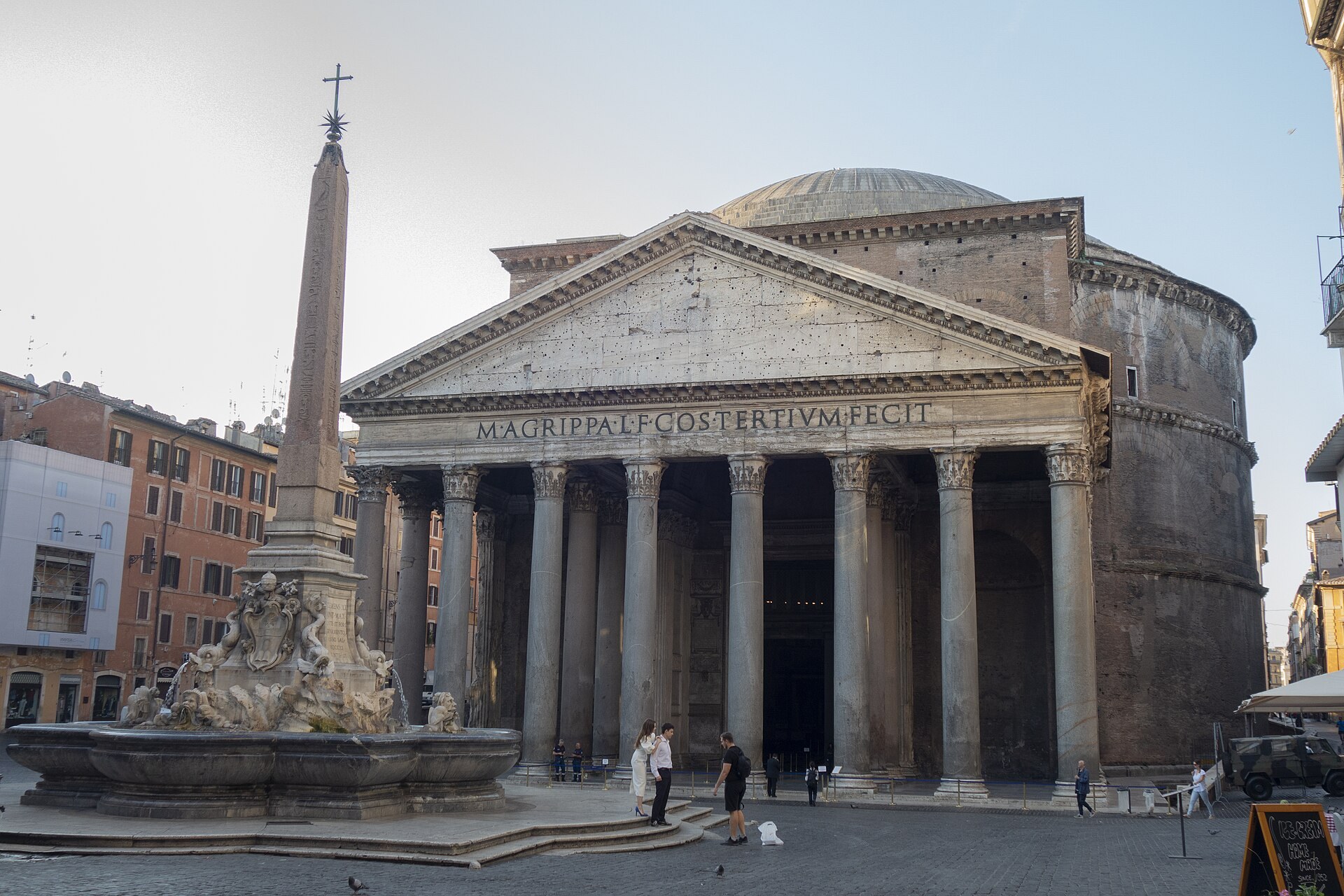
Nihil est tam populare quam bonitas. – There is nothing so much the people's as what is good. Cicero, Pro Ligario
Every civilisation has announced itself through a door. The bronze doors of the Pantheon have turned on their hinges for nineteen centuries; Ghiberti spent half his life on the doors that Michelangelo called worthy of Paradise. A door is a promise: that what lies beyond is kept, is cared for, and is meant to be entered. This October, EPRIS Journal opens two doors of its own. They are made not of bronze but of light and line, and they will not close at dusk.
The first is EPRIS Museum , a museum of painting, sculpture and photography with no walls, no ticket and no closing hour, at museum.eprisjournal.com. The second is Architectura , an atlas and a school for iPhone and iPad, which teaches the oldest grammar in Europe: the language in which Italy has been building for three thousand years. One is a place to walk through; the other a discipline to be learned. Both rest on a single conviction, which we hold as firmly as anything we publish: that beauty belongs to whoever is willing to look at it closely, and that looking closely can be taught.
I · Museum sine muris: the museum without walls
André Malraux dreamed of a musée imaginaire , a museum without walls assembled from every reproduction the century could make. EPRIS Museum is our answer to that dream. Today it holds forty-five halls, some six hundred and forty works and three hundred and seventy-five artists, from the marble of archaic Greece to photographs taken this very year. Nothing in it is borrowed on false terms: every work lies in the public domain or was given freely by its author under an open licence, and beneath every one we set down, as an act of honour, the artist, the date, the licence and the house where the original lives. The Art Institute of Chicago, the Cleveland Museum of Art and the National Gallery of Art in Washington opened their treasuries to the world; we have simply walked in and hung what they offered with the reverence it deserves.
A museum without walls must still have architecture, or it is only a list. And so the visitor is received, as the Romans were received, by the Pantheon. It is drawn in section from portico to apse, its heights lettered in metres as an architect of the Académie would have inscribed them. The disc of light that falls through its oculus is no ornament: it is the true sun over Rome, computed at the very moment the page is opened. At noon it rests upon the pavement; towards evening it climbs the coffers of the dome; and when night falls over the Campus Martius, the oculus fills with stars. Further on stands the Colosseum, half façade and half section, and every one of its arches is a gate into a hall.
A museum should be open at any hour, and it should always tell you where a work really lives.
Within, each hall is a hang of its own, introduced by a few lines that tell you what binds the works together and leave the feeling to you. Antiquity gathers eight centuries of Greek, Etruscan and Roman sculpture around the Cleveland Apollo. Built Light offers fourteen buildings photographed in the past twelve months by people who sign their work with their own names. The Room Itself turns to face the architecture of the museum as such. Stone and Memory and A Year of Looking Closely hang this year's international laureates of Wiki Loves Monuments and Wiki Loves Earth. Then the halls follow the procession of the centuries, and at last there is a wall on which every work is drawn at its true size, so that a Chardin no larger than a book may stand in dignity beside a Tintoretto two and a half metres wide.
And the museum is an invitation, standing and perpetual. Its open call welcomes photographers and artists from every country: to submit costs nothing, the work that is chosen is hung in a hall under its maker's name, and the author keeps the authorship entire. A modest curatorial fee of fifty cents per image is asked only after acceptance, and every term is published plainly for all to read. The halls of the future are not yet hung. Some of them are waiting for you.
II · Architectura: Italia, linea per linea
It was the drawings that held our readers longest. They lingered over the coffers of the Pantheon, counted the orders of the Colosseum and wrote to ask the names of the small arches crowning its attic. Curiosity of that kind is the beginning of every education, and it deserves more than a caption. Architectura is our answer: the measured line drawing, that ancient instrument of the architect, placed in your hands to be held, questioned and understood.
The atlas holds forty-seven plates, and not one region of Italy is left without its monument: from the Arch of Augustus at Aosta, beneath the Alps, to the golden cathedral of Monreale and the nuraghe of Barumini, raised in Sardinia before Rome was founded. Here are the buildings the whole world knows: the Pantheon, the Colosseum, Trajan's Column, the Tower of Pisa, Brunelleschi's dome, the Palace of the Doges. And here, with equal honour, are the quieter ones: the Cattolica of Stilo in Calabria, the nine-pointed star of Palmanova, the gate of Saepinum in the hills of Molise. Milan, the city in which EPRIS is edited, receives a chapter of its own, from the Roman columns of San Lorenzo to the Bosco Verticale, with a walk that carries you through two thousand years of the city on foot.
Open a plate, and it inks itself before your eyes, stroke after stroke, as a drawing grows beneath the hand of its maker. Then the reading begins. Five hundred and ninety-nine parts are marked across the atlas, and each is given its true name, the word an Italian guide would speak, a clear explanation and one fact worth carrying for the rest of your life. Touch the oculus, and you learn that it is nearly nine metres wide and has never once been glazed: the rain of Rome has fallen through it for nineteen hundred years. Touch the Torre del Mangia, and you meet the bell-ringer whose nickname the tower still bears. A narrator speaks every term first in Italian, for a word that has been heard is a word that is kept.
Architecture is a language before it is a style. Learn its words, and every city in the world becomes a book you can read.
We have written as the finest teachers speak before a building: never hiding behind jargon, never stooping to condescension. A frieze is a band of carving that runs along the head of a wall like a line of verse; an entablature is everything a column bears upon its shoulders. The facts are held to the same standard. Every date, height and name has been checked against published scholarship, and behind every plate stands a small library: its official Italian name, its place, its builders, its UNESCO inscription where it has one, and a list of books for those who would go further.
III · Schola: a school worthy of the name
To look is to begin; to understand requires a path. Schola , the heart of the app, is a true course of study, ordered as a university orders its reading. Seven courses stand open. Fundamenta teaches the grammar itself: how to read a drawing, the classical orders, the arch and the dome. Roma Aeterna walks the Eternal City. Italia crosses the peninsula. Ingenium honours the engineers. Magistri tells of the patrons, architects and writers who made the buildings possible. Peregrinatio is a pilgrimage through all twenty regions. And Mediolanum is Milan, in depth. Forty books, eighty-six lessons.
Every book closes with an examination, its questions drawn afresh each time: whose detail is this, when was it begun, how high does it rise, where does it stand. The student chooses the severity of the trial, from Tiro , the recruit, to Magister , the master, and a completed course is sealed with a diploma bearing the student's name. For those who teach, every book prints as a handout with its plates, its questions and a key; and in Aula , the classroom mode, a single plate fills the projector, lettered to be read from the last row of the hall, revealed one part at a time, its names withheld until the class has answered.
Around the school lies an atlas in the fullest sense of the word: a map of Italy with every plate set in its place, plans of Rome and Milan, a timeline of thirty-six centuries from the nuraghi to the Bosco Verticale, and a page on which every building stands shoulder to shoulder at one scale, so that Trajan's Column may be measured against the Tower of Pisa with a single glance. And two studies reach deeper still. The first reopens the great dispute of 1391, when the masons of Milan argued over the geometry that would decide how high their cathedral should rise. The second recalls the anxious years of the 1740s, when mathematicians were summoned to judge whether the cracked dome of St Peter's would stand, and lets you test their verdict with weights, as Giovanni Poleni did.
IV · Silentium: the dignity of quiet
Neither work raises its voice. The museum speaks in a single typeface and draws its architecture in hairlines. The app is printed on three papers: Nox , lines of light upon the night; Charta , sepia and red chalk upon parchment; Caerulea , white lines upon the blue of an old blueprint. There are no advertisements. The app asks for no account and gathers no data; what you learn remains yours alone. It speaks English, Italian and Russian, and VoiceOver reads every plate aloud, while questions that depend on the eye are asked in another way for those who listen.
Neither is offered as a substitute for the journey. A drawing of the Pantheon is not the Pantheon, and no screen will ever give you the scale of the Colosseum or the cold of Sant'Ambrogio on a January morning. What they can do is prepare the eye, so that on the day you finally stand beneath the dome, you will know where to look, and you will know the names of the things you see. That is all we have ever wanted a journal to do.
When and where: EPRIS Museum opens officially in October 2026 at museum.eprisjournal.com. Entry is free, at every hour, and the halls already stand open to those who wish to walk them first. Architectura: Italy Drawn arrives on the App Store for iPhone and iPad in October: free, without account, without advertising, without tracking. We will announce the App Store link here and in our newsletter on the day the doors open.
To the teachers, the students, the travellers and the simply curious: the doors are open, and they were made for you. Write to us. Tell us which building you would have us draw next, and which hall you would have us hang. Intrate. Come in.
Read next
- Five Rooms, One Signature
- The Sacred Spring: A Portrait of the Vienna Secession
- The Heart of EPRIS: Maria Is Now a Bachelor of Architecture
- Nothing Fallow About It: The Harvest Behind France's Novels and Italy's Golden Lion
- PARK3020: A Sculpture Park Dated a Thousand Years Ahead
- Inside the Victoria Museum