PARK3020: A Sculpture Park Dated a Thousand Years Ahead
Feature
Outside Lviv, in open fields near the village of Strilky, Ukraine's first public park of contemporary sculpture gives young artists a place to work at full scale, and gives visitors a reason to walk out into the landscape to meet them.
Viacheslav Munister · 2026-09-19
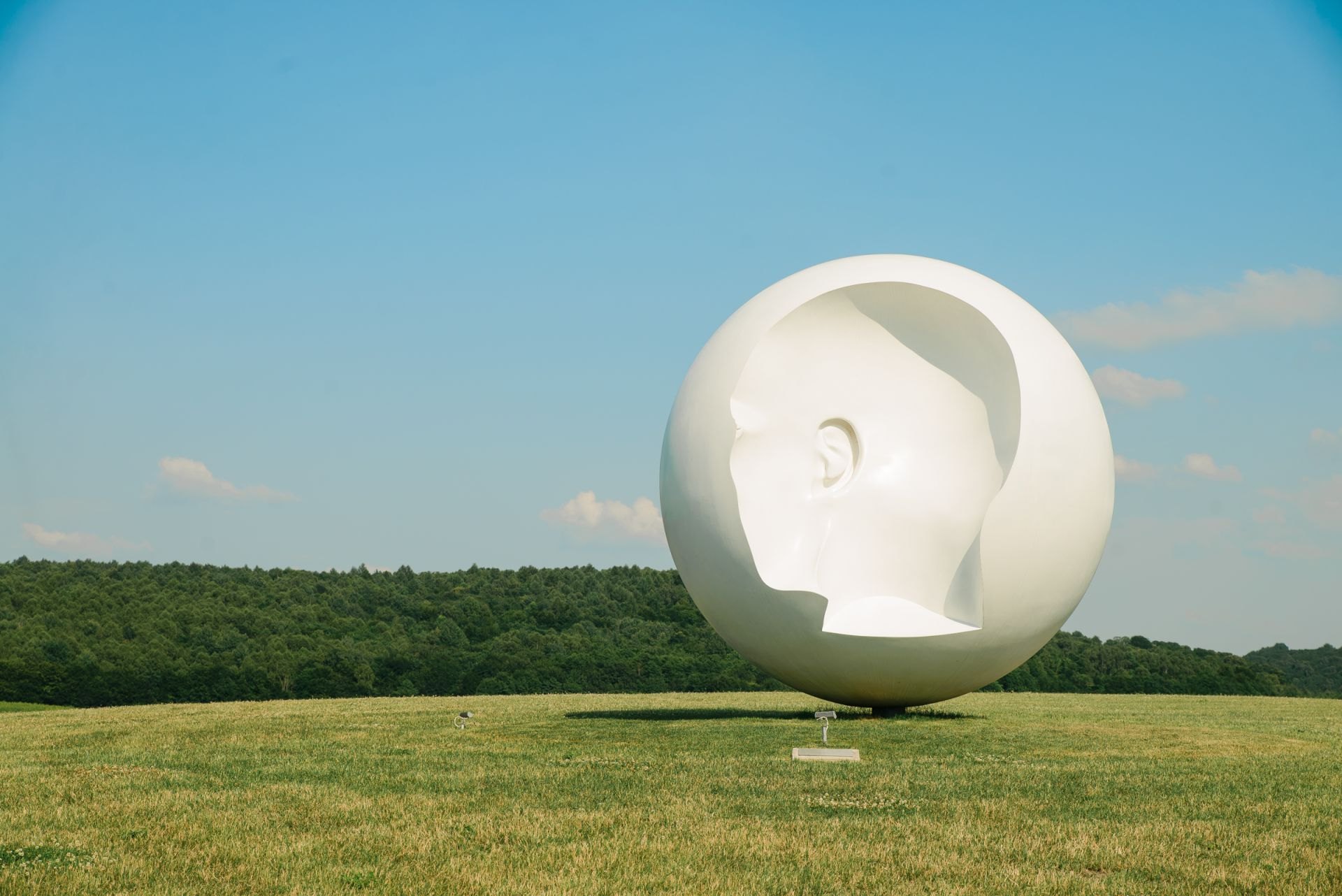
Half an hour's drive from Lviv, past the village of Strilky, the land opens into long, rolling fields. Standing in them, at distances that make you walk, are a white sphere with a human profile cut into it, an eight-metre ear, a brick shell and a grove of red steel trees. This is PARK3020, the first public park of contemporary Ukrainian sculpture.
It was founded in 2020 with a clear brief: to give Ukrainian sculptors, and above all young ones, institutional, financial and educational support, a place to realise large works at home and a platform from which to be seen internationally. Six years on, the park has grown from a handful of commissions into a collection, a programme of exhibitions and an indoor art hall.
A date as a programme
The number in the name is not an address or a founding year. The park calls 3020 a symbolic date of creation and, at the same time, an ambition: a park of the future that is taking the first of a thousand steps into history. It is a useful way to read the place. Nothing here is finished; the collection is meant to be added to, argued with and grown over a very long time.
That long view is built into its structure. PARK3020 began a lasting collaboration with Yorkshire Sculpture Park, Britain's leading institution for public sculpture, to bring in international expertise while the park found its feet and to develop residencies, lectures and studios together. An expert council, with curator Katya Taylor, sculptor Mykhailo Reva and Yorkshire Sculpture Park's Helen Pheby, shapes exhibitions and approves works; a supervisory board of patrons, chaired by Ihor Kryvetskyi, oversees its strategy.
Six commissions, one field
Between March and August 2020 six artists made works for the park on commission: Anna Zviahintseva, Anna Naduda, Anton Logov, Bohdan Tomashevskyi, Nazar Bilyk and Oleksii Zolotar. The brief they shared was the landscape itself, and most of the pieces answer it directly: they are about how a person stands in, looks at and listens to the world around them.
Nazar Bilyk's Space Around is the work that has become the park's image. A human outline dissolves into the perfect form of a sphere, and with it into the space around. Bilyk, who works with the negative form of white plaster, describes these contours as both object and instrument, a way of drawing the space in which a person is present.
Oleksii Zolotar's Ear rises eight metres out of the grass. It began, the park notes, with an unsuccessful selfie, and it addresses a familiar theme, from Bosch to Van Gogh, with an urgent one: the need to listen carefully to a world in the middle of physical war and emotional overload, and to choose what to take in. Anna Zviahintseva took a very different route to scale. Her father used to twist foil into small figures while he was thinking; she enlarged one of them, a pair of legs, to a four-metre object, turning a half-conscious habit into a monument to thought.
Anton Logov's Trees of Life grow straight through the roof of a house. The landscape reminded him of the oaks of his grandparents' region near Odesa, and of the idea that to develop, a person has to cross borders and break standards. Anna Naduda's Biomorph, from the other side of the field, joins the branching form of trees to the idealised canon of ancient Greek sculpture, proposing a single form in which the bodily and the natural are the same thing.
Bohdan Tomashevskyi's Salamander is the most abstract of the six: black metal planes that read at once as a lizard in motion and as the ridge of the Carpathians. In the forests of Rakhiv, where he often met the fire salamander, a large population of the animal is a sign of clean air and water. Set here, it is a quiet warning to a person dazzled by technological progress that civilisation depends on nature.
Later arrivals
The collection has kept growing. Zhanna Kadyrova, who tests the aesthetic potential of ordinary building materials, made a monument to a mollusc, a shell that shuts at any sign of danger, the way a person in a big city learns to. Stepan Ryabchenko's Apparition, a folded yellow column, refers to the legend of a vision said to have appeared on the site of a Kyiv botanical garden in 1862. And the GREVIS group, Volodymyr Levis and Ernest Yemeliantsev, placed a giant button in a birch clearing: a thing lost long ago that grew along with the trees, and now belongs to the landscape as much as they do.
In May 2021 the park added another way of making work: a sculpture symposium, a format that limits artists in time and material. Nine Ukrainian and international sculptors spent the month carving granite on site, and the results joined the collection in the fields.
Indoors: from the forum to Birth
In autumn 2025 the first Global Culture Forum opened a new venue, the Art Hall, with a large exhibition of Ukrainian masters, among them Liubomyr Medvid, Ivan Marchuk and Serhii Savchenko. Alongside it ran Transformation of the Future, a show of young artists, and Ukrainian Ceramics. Continuity of Form, which traced a line from Trypillia clay figures to contemporary ceramics.
The current exhibition, Birth, runs until 4 October 2026. It looks at the moment before a work exists, where an image comes from and how a private experience becomes a shared language, with works by artists of several generations, including Volodymyr Odrekhivskyi, Roman Opalynskyi, Volodymyr Tsisaryk, Mykhailo Demtsiu, Artur Soletskyi and Ihor Palii. It is shown together with a collection of historic Ukrainian dress from different regions and rare twentieth-century books.
Visiting
PARK3020 is open every day from 10:00 to 18:00, next to Edem Resort in Strilky, about 30 minutes by car from Lviv; buses 747, 842 and 843 run from Lviv bus station No. 5, followed by a 30-minute walk. Guided tours, including the exhibition halls, start at 12:00 and 15:00 and last up to two hours, and you can also walk the park on your own. A standard ticket costs 600 hryvnias; children aged 6–12, military personnel, pensioners and art students pay 300, and children under six and combat veterans enter free. Dogs are welcome, and there is parking with charging for electric cars.
The best way to see the park is slowly. The distances between the works are part of the experience: you approach a sculpture from far away, lose it behind a rise in the ground and find it again from another side. For a park that dates itself a thousand years ahead, it is a fitting pace.
Text: Viacheslav Munister for EPRIS Journal. Photographs: PARK3020, park3020.com. Information on visiting as of September 2026; check park3020.com before you go.
Read next
- Five Rooms, One Signature
- The Sacred Spring: A Portrait of the Vienna Secession
- The Heart of EPRIS: Maria Is Now a Bachelor of Architecture
- Nothing Fallow About It: The Harvest Behind France's Novels and Italy's Golden Lion
- Inside the Victoria Museum
- The Doors Are Opening: EPRIS Museum and Architectura, This October