Inside the Victoria Museum
Visual story
Ukraine's first museum of costume, founded in a restored Kyiv mansion in 2017: over 1,500 objects across seven rooms, corseted silk gowns, a gold-braided court coat, cameos cut from shell, and the small objects, lockets, scent bottles, enamel boxes, that a life actually held.
Viacheslav Munister · 2026-09-21
The Victoria Museum sits behind an arched doorway a few steps off Khreshchatyk, in a nineteenth-century apartment building whose stucco cornices and rusticated ground floor give away nothing of what is inside. A small plaque by the entrance reads Victoria Museum — Музей костюма та стилю, the Museum of Costume and Style, open Thursday to Sunday. I went on a whim after a walk through the city centre, and stayed for most of the afternoon.
It's a younger institution than it feels. The collector Victoria Lysenko opened it on 30 May 2017, after nine months of preparation, as the first museum in Ukraine built entirely around historical dress. The building itself is older: a mansion raised in the late nineteenth century, left derelict from around 2000, and extensively restored in 2009, with the original balcony railings on the second and third floors kept rather than replaced. What Lysenko assembled inside now runs to more than 1,500 objects across seven rooms on two floors, over two hundred of them complete garments, alongside what the museum counts as the largest collection of fans in Ukraine, more than eighty of them. In 2022 it was presented at the European Museum of the Year Award; that same spring, on the forty-fifth day of the full-scale invasion, it reopened rather than stay closed.
A wardrobe from another century
Room by room, the museum is built around clothing: dozens of women's gowns from the second half of the nineteenth century into the 1900s, most of them shown on mannequins inside glass cases, lit like the jewellery beside them. A deep purple velvet bodice trimmed with tatted lace stands beside a slate-blue silk skirt; a few steps on, a crinoline gown in a rust-red floral print from the 1860s balloons out under its own weight, the pattern of small roses running unbroken from waist to hem. One label, in Ukrainian and English, catalogues a dark chocolate-coloured dress with floral ornaments and buttons from the 1880s in the plain language of a museum inventory, cotton, velvet, that undersells how much handwork sits inside a single sleeve.
Further in, the colour gets bolder. A cropped coat cut from a brown, orange and cream paisley weave, lined in dark velvet, sits under a framed photograph of the woman it may have been made for, an unusual survival: paisley was for shawls and interiors more often than outerwear, and seeing the whole pattern wrap around a body rather than lie flat changes how you read it. Two cases along, an ivory gown drops its sleeves off the shoulder into a froth of tulle roses and pearl trim, the bodice hand-embroidered with sprays of leaves in a pattern that repeats down the full length of the train, evening dress built for a room with better lighting than daylight.
Some pieces are display-cased tableaux rather than single garments. In one corner, a mourning dress hung with small framed photographs down its bodice stands beneath sepia portraits of the women who might have worn it, next to a folded parasol and a pale silk dress with a deep lace collar, a whole small theatre of a nineteenth-century household, assembled inside a single vitrine.
Silk, braid, and a court coat
The collection isn't only for women's dress. A single red wool coat, cut like a courtier's or a footman's livery, is trimmed the length of both lapels and cuffs in wide gold metallic braid, closed with a column of domed brass buttons, the kind of formal coat that would have been made to a household's own pattern, not bought off a rail. Nearby, a cream silk bodice with a high boned collar carries the same embroidered lyre-and-scroll motif repeated at the shoulders, throat and hem, the sort of detail that only shows itself under a display light.
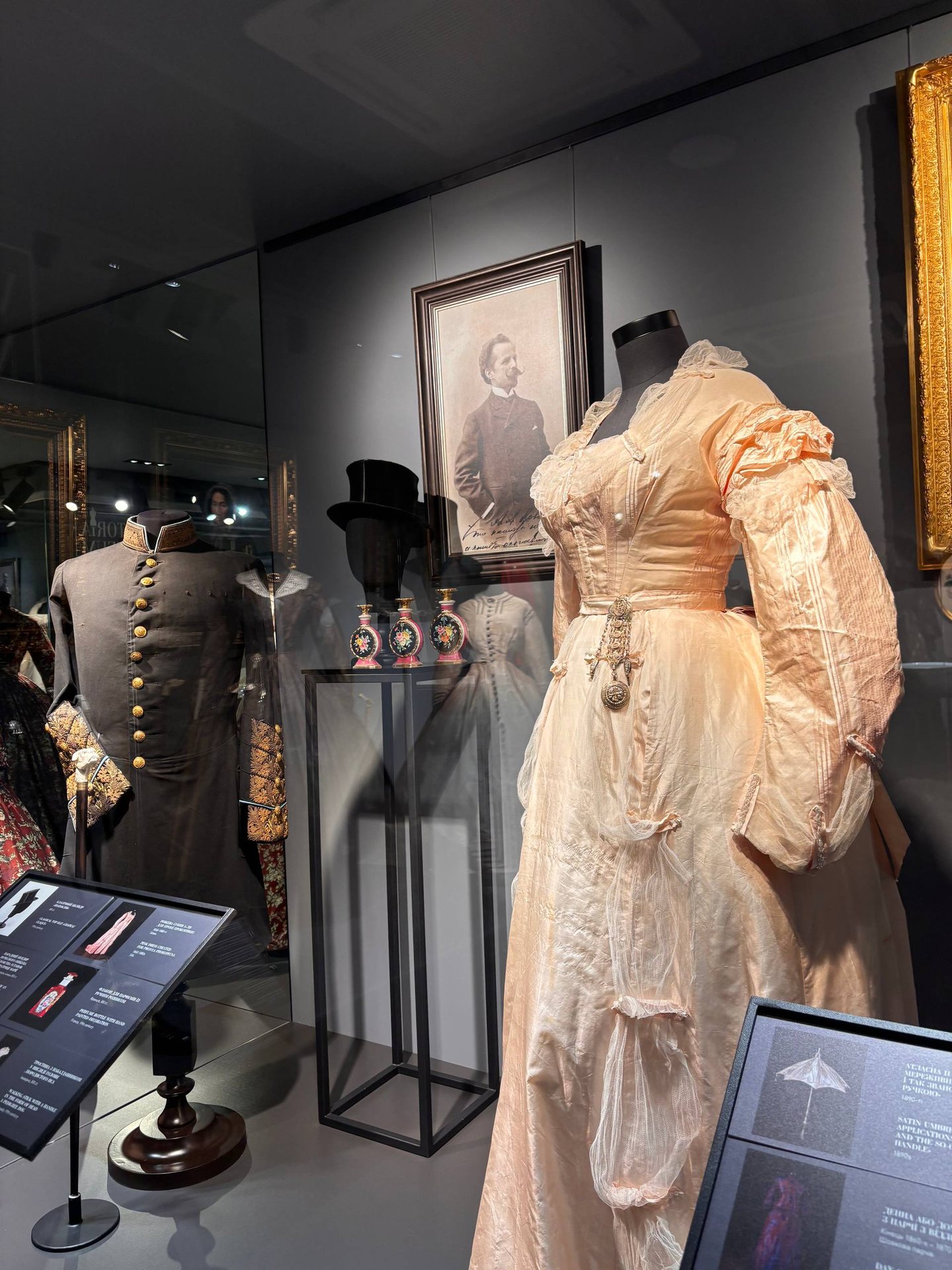
A case of men's accessories does the same close-looking trick from a different angle: a row of walking canes, their handles carved from bone and ivory into a bird's head, a lion, a laughing face, stand beside a white double-breasted summer coat with a black velvet collar, an old leather travelling bag and a single pair of high-buttoned boots, worn enough to have belonged to somebody. Two more gowns, one in dusty pink chiffon with a lace-trimmed train, one in pale cream silk with a beaded high collar, are shown against period portraits of women dressed almost identically, so the wall reads as evidence rather than decoration.
Cameos, lockets, and small boxes
A side room is given over to what would have sat on a dressing table or travelled in a pocket: rings and brooches set with painted miniature portraits, enamelled trinket boxes in cobalt blue and gold, a scent bottle on a chatelaine chain. On one wall, more than a dozen cameos, carved from shell, onyx and sardonyx, English and Italian, mostly nineteenth-century, are mounted in a single gilt frame like a cabinet of miniature paintings: a saint on horseback, a scroll of acanthus leaves, a woman's profile turned three-quarter to the light. The museum's fan collection, the largest in Ukraine by its own count, keeps company with the same cases: a hand-painted court scene on silk, its sticks carved and gilded, folds open beside a stack of enamelled boxes on a single glass shelf.
Paintings and a bronze figure, for context
The clothes are hung against a backdrop of paintings and objects from the same decades: a French Madonna and Child with John the Baptist from the early nineteenth century, gilt-framed portraits of women in the same silhouettes the mannequins wear, a bronze figurine of a woman in a plumed hat holding a fan halfway to her face. None of it is didactic. There's no long wall text explaining the history of the corset or the politics of mourning dress; the museum mostly lets the objects sit close enough together to make their own argument about a period that dressed itself with tremendous, specific care.
The Victoria Museum is open Thursday to Sunday, 11:00–18:00, a short walk from Khreshchatyk. It's a small museum and an easy one to see in an hour, but I'd allow longer, the glass cases reward the kind of slow looking that a phone camera keeps interrupting.
Read next
- Five Rooms, One Signature
- The Sacred Spring: A Portrait of the Vienna Secession
- The Heart of EPRIS: Maria Is Now a Bachelor of Architecture
- Nothing Fallow About It: The Harvest Behind France's Novels and Italy's Golden Lion
- PARK3020: A Sculpture Park Dated a Thousand Years Ahead
- Sandra Kantanen: Beyond the Lens of Traditional Photography