The Art of Being Human, or Why I Came Into This World
Essay
An architect who never became one, a book that never got finished, and a city that changed its composition. Three stories about maps, order, autumn and the art of being human.
Viacheslav Munister · 2026-10-30
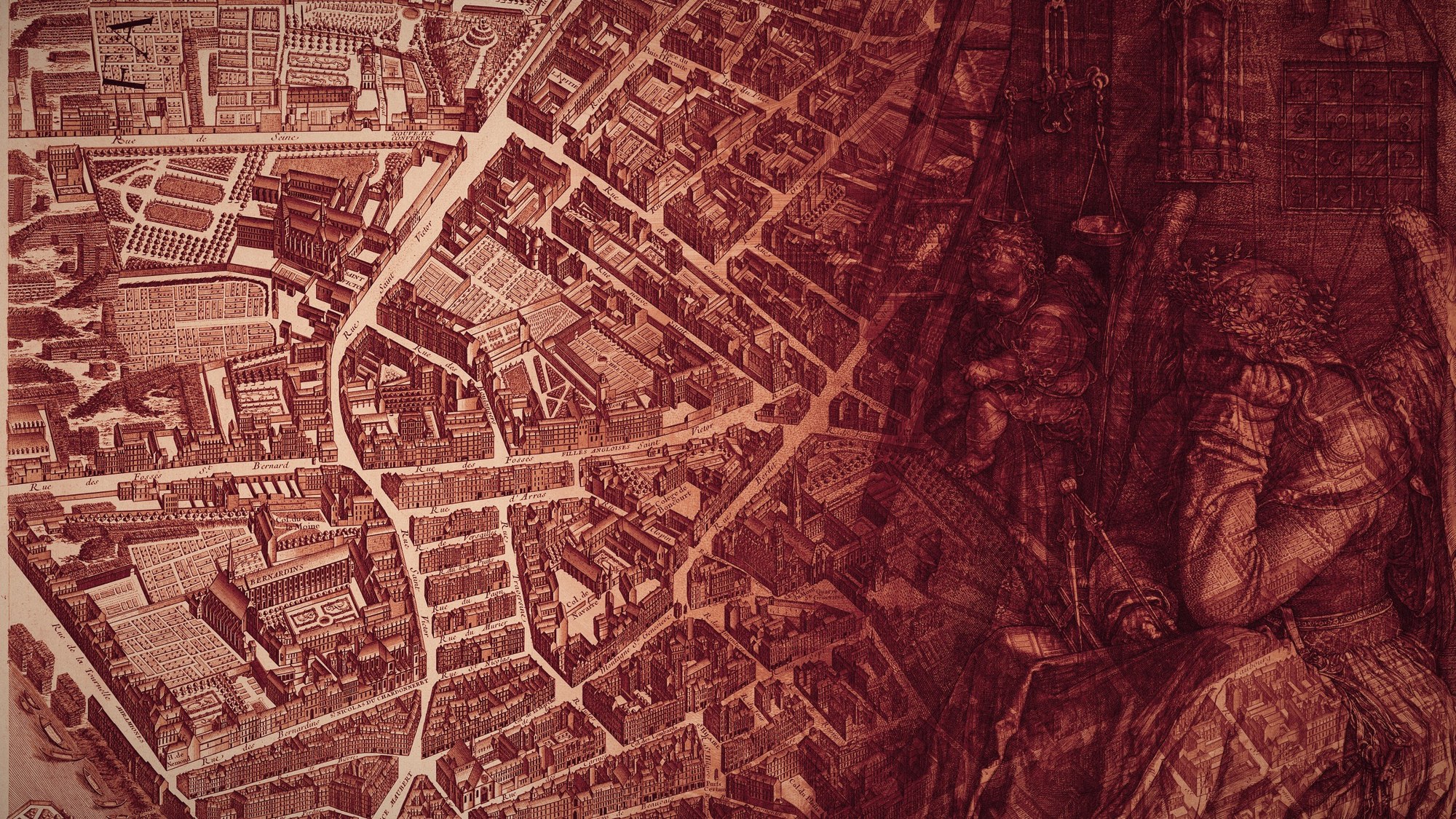
“A map is not the territory.” – Alfred Korzybski
“You take delight not in a city’s seven or seventy wonders, but in the answer it gives to a question of yours.” – Italo Calvino, Invisible Cities
Prologue
My name is Viacheslav, and I am the creative director of EPRIS Journal. A few days ago it was my birthday, and I decided to give myself a present. It is this essay. I was born at the end of October, and I have come to believe that it explains rather a lot. Halloween is the only holiday on which people decorate their houses with the load-bearing parts of the human body. Skeletons in the windows, ribs on the doors, a spine on the porch, and the whole street agrees for one night to show its structure and call it fun. The trees do the same thing, only more discreetly and in better colours. A person born into this exhibition knows one idea well. When the decoration falls, what matters is what remains. The picture at the top of this page was made for the occasion, from two old engravings. One is Dürer’s Melencolia I , from 1514, in which a winged figure sits among every instrument of building (a compass, a plane, a saw, a ladder, a polyhedron, an hourglass) and builds nothing. It is the most accurate portrait of an architect I know, a person with a full toolbox and no site. The other is a plan of Paris, drawn in 1739 so carefully that you can count the courtyards. I laid one over the other. The result is the whole essay in two images: a map, and a man who cannot decide whether to trust it.
Three Stories
Steve Jobs once opened a speech to graduates by saying he would tell them three stories, and that was all. I am going to borrow that form, because it is honest. Three stories, not a treatise. Anyone who means to speak seriously about himself should first learn to speak about himself simply. And a warning in advance. I have no apple and no garage. I have a book that I never finished.
First Story. A Book for Other People’s Parents
It is called Your Child Is an Architect , and I would like you to notice the pronoun. Not my child. Back then, as now, I had no children, no built shed and no signed contract to build a house, and I was explaining to other people’s parents, with great authority, how to raise a person who would build cities. The book was funny. In the foreword I greeted the reader with the news that the little creature had finally opened its eyes, made fun of the “tame hydrocephalic toddler”, of kindergartens and television, and of fathers whose only contribution to their son’s education is iodine on his knees. One chapter was called “Geometric Aperol”. On its first page stood the Parthenon with a golden spiral drawn over it, and next to it a Vitruvian man holding an electric guitar. Le Corbusier in the epigraph said that a person with free will tends toward pure geometry, and Jünger added that every comfort has to be paid for. I understand now who the real reader of that book was. Every adult has a childhood he would like to reissue in a better edition, and a book of advice to parents is the politest way of doing it. I thought I was addressing mothers and fathers. I was addressing a boy who had wanted someone to take his drawings seriously, and who was going to have to learn to do it himself. I had been drawing since before I could read, and not pictures but maps. Streets, courtyards, squares and rivers, laid out on paper so that you could walk through them with your eyes and stay. It was not yet a profession. But “architect” sounded like the right answer to the question “what will you be”, because it promised order, meaning a ruler, a drawing board, a sheet of paper at 1:100 and the light from a window falling exactly where it was calculated. I sincerely believed the world was also drawn at 1:100, and one only had to find the right sheet.
A map is the most optimistic document there is. It describes a place as though the place had already agreed to be what the drawing says. Nobody draws a map of a street that is about to be taken away, and for a child with a pencil the whole world is a street that is not going anywhere. Then, in one of the last chapters, I wrote a practicum called “Calligraphicus”. With a perfectly straight face I told parents that geometry begins with handwriting and not with a compass, and that a child should be taught to make letters rather than to crochet. I even interviewed a scientist, because I wanted some authority. It was a joke, and a well-constructed one. Here is what I understood much later. In that same speech, Jobs tells of a calligraphy course he took with no purpose at all, which came back to him years afterwards in his work. He says you can only connect the dots looking backwards. I look backwards, and I see that my joke about calligraphy was not a joke. It was the one serious thing in the book. A line drawn with intent was what I was left with, and a line drawn with intent is already an order, even if it is the size of a palm.
Second Story. A City That Was Not in the Textbook
My city, which I will call City D, was the best textbook of architecture I ever had. I read it the way one reads a palimpsest, where one era shows through another, where a façade lies about what is behind it, where the courtyard is more honest than the street. The plan was simple. Study, build, be recognised, die a respected old man in a city that was proud of him. Every architecture student learns that a building must have three virtues, which Vitruvius called firmness, commodity and delight. Nobody adds a fourth, because it is invisible, and the fourth is consent. A building stands because a city has agreed that the land is yours, that the client will pay, that the neighbour will not knock the wall down, and that in forty years there will still be people for whom you are drawing the staircase today. Consent is the foundation under the foundation. You only notice it on the day it is gone. In 2014 the composition of my city changed. Not its walls, which were fine, but its people, its rules and its vocabulary. The words “may”, “agreement”, “tomorrow” and “client” quietly took on meanings that appear in no dictionary. I will not explain who was to blame or what happened. Mountains of words have been written about that, and not one of them has returned a single house. I will say only that the city where I had learned to read buildings suddenly required me to learn to read the air. For the air, it turns out, architects hold no licences. That was when the maps betrayed me, in the politest possible way. They were still accurate, and every street stood where I had drawn it. But a map describes a territory that has agreed to be mapped, and mine had stopped agreeing. I was holding a perfectly precise document about a place that no longer existed in the form I had recorded, and I did not know what to do with it. Everyone knows the map is not the territory. Fewer people mention that it is far worse when you have spent your childhood loving the map.
Notice how neatly it turned out. The author of a manual on raising architects did not become an architect. The book stayed unfinished and so did the profession. If I had invented the plot, an editor would have returned the manuscript with the note “too on the nose”. The years that followed I spent in the wrong room. I studied a technical specialty, and the problem was not knowledge. Equations are patient, and they forgive everything except carelessness. The problem was the environment. Technical people, it seemed to me, do not like to reflect or to feel, and at that age seeming is the same as being. I learned to count, and I learned it well. What I could not learn was to pretend that counting is all there is. I should add, in fairness, that the room was not wasted. It taught me what a load is, what a tolerance is and what happens to a beautiful idea when it meets gravity, which turns out to be most of what a magazine editor needs. People often say you must find what you love. Nobody mentions the second option, in which the thing you love finds you later, by a side road, in the form of a random video. Somewhere around the end of 2023 I came across a blog on YouTube that was called, quite literally, Masha Peut . For those who do not read French (I barely do), peut means “can” and also “may”, precisely the little word my city had quietly confiscated ten years earlier.
The blog was run by Maria. She had a journal that came out in Telegram and as a blog, which is to say in a light, quick, almost weightless form, the opposite of a monument. In 2025 I suggested developing the concept of that journal, and it happened. I brought the only thing I had, an architect’s habit of asking what a thing is for, who will walk into it and how it will stand in ten years. That is how EPRIS Journal began. It is the shortest retelling in this essay and the most important, because for years I had been writing about things that did not happen. It turns out that “may” still works, if you say it to the right person.
Third Story. What Carries the Load
Jünger put it more exactly than I could. While the tap runs, the light is on and a phone call brings the fire brigade, a person grows used to counting on someone else’s help, and is helpless on the day it does not arrive. In my book I taught parents to pick a hobby circle and a foreign language for their child, which is to say to prepare him for a life in which everything keeps working. That the building itself might one day stop working, together with the fire station and everyone who is supposed to come when you call, was not in any chapter. It did stop. And then it turned out that order lives in two places. Outside, it is a house, a street, a law, a contract. Inside, it is the habit of drawing a straight line when no one around you is drawing one. The outside order was cancelled for me, quite decisively. The inner one remained, and it carried a great deal more than I had calculated while I was writing about the Parthenon. So “the art of being human” became, for me, an architectural problem at a small scale, with no client, no budget and no right to a second option. You have to work out what in you is load-bearing and what is decoration, and not confuse them when the pressure comes. You have to leave an emptiness in yourself for another person, which is to say a pause, a different opinion, a place at the table. You must not give away what matters in exchange for comfort. Jünger names the price, and it rises without consultation. One more thing about buildings, which I learned late. A building is not finished on the day it opens. It is maintained every day afterwards, by someone who changes the lightbulbs, mends the roof and unblocks the drain, and it stands for exactly as long as that person turns up. People are the same. Being human is not a state you reach but a piece of maintenance you perform, quietly, on the promises you made and the people who rely on them. Nobody photographs it, and it holds everything up.
EPRIS Journal is not compensation for a profession that did not happen (that sounds like an excuse, and I have nothing to excuse). It is the same work by other means, a room for voices, a foundation made of people, windows in the form of questions. When a photographer tells me why he leaves a frame empty, or a designer why he cuts a hole in the middle of a table, I feel that I am finally doing what I promised myself as a child, which is making sure people have somewhere to be. Only without bricks.
Windmills
There is a song I keep coming back to, “Windmills of Your Mind”. I will not quote it, since a song is a house that belongs to someone else, and one should knock before entering. But I can tell you why it fits here. A windmill is the most honest building I know. It does not argue with the air, and it does not demand a licence from it. It stands in the open, lets the wind go through, and turns what passes into bread. A miller cannot choose the wind. He chooses the angle of the sails. I think this is the whole of practical wisdom, and I wish someone had told the boy with the maps. You do not get to decide which weather arrives in your city, your decade or your life. You decide how to set yourself against it, so that what passes through you becomes something other people can eat. I used to think my life ran in a straight line and that the line was broken in 2014. Now I think it was always a circle, and what I took for a break was a turn of the sail. At the end of his speech, Jobs wished the graduates to stay hungry and stay foolish. My wish is more modest and, possibly, more honest. Stay unfinished. An unfinished book is simply a mill that has not met its wind. And the child from Your Child Is an Architect has, by my observation, grown up after all. His house is just not made of brick. It is made of whatever turns.
Thank You
Thank you to everyone who was with me through these years. To those who stayed close when the maps stopped matching the ground, to those who said “may” when the word was in short supply, and to those who simply stayed and asked for no explanation. Whatever I managed to build rests on you. I remember it.