Rooms That Watch You Back
Critical Essay
Glass once promised freedom, honesty and light. Then the walls learned to collect data. An essay on transparent architecture, controlled visibility and the radical luxury of being allowed to disappear.
Viacheslav Munister · 2026-08-15
At night, every glass building changes allegiance. By day it borrows the sky and returns a clean image of the city. After dark the reflection collapses. Desks, lifts, kitchens and bodies appear in stacked rectangles, each room lit like evidence. A person working late becomes part of the elevation. Someone washing a glass becomes a moving detail in an architect’s drawing. The promise was openness. The sensation is exposure.
There is a particular unease in spaces that refuse to keep a secret. You feel it in the lobby where the receptionist can see the lift before the lift can see the receptionist; in the meeting room whose glazed wall has been decorated with a polite stripe of frosting at eye level; in the apartment where the curtain is treated as an aesthetic failure. These interiors are beautiful, controlled and faintly accusatory. They suggest that privacy is something one requests after behaving suspiciously.
The promise of seeing everything
Modern glass arrived carrying a moral argument. Weightless walls would replace the defensive opacity of the old institution. Sunlight would enter the factory, the school and the office. Structure would become legible. Work would be visible, therefore honest. The Bauhaus Building in Dessau gave this faith an unforgettable body in 1926: a workshop wing wrapped in steel and crystal plate glass, its corners apparently dissolved, its rooms offered to the outside world as a continuous field of activity.
The façade was not merely a technical demonstration. It proposed a new social character. Transparency looked hygienic, collective, forward-moving. The wall no longer had to announce authority through stone; it could perform authority through apparent absence. This is the first trick of transparent architecture: the less material the boundary appears to contain, the easier it is to forget that the boundary still decides who may enter, who may look and who must remain visible.
A transparent wall does not abolish power. It edits the direction in which power can look.
A house with nowhere to hide
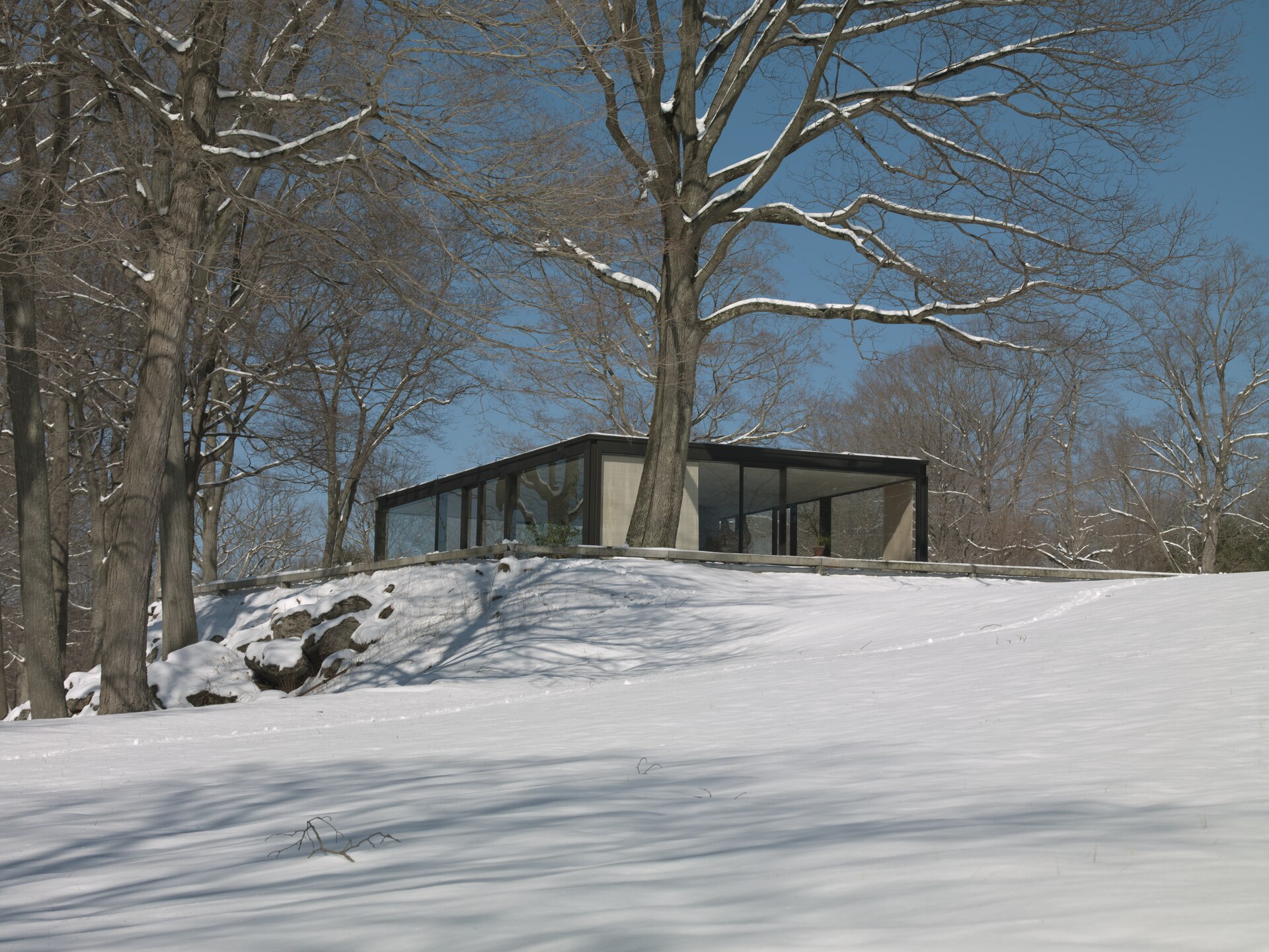
Philip Johnson’s Glass House of 1949 is usually photographed as pure release: a dark steel frame, a brick cylinder and a glass perimeter placed with unnerving precision in the Connecticut landscape. The countryside seems to pass through the room. Furniture floats. Weather becomes wallpaper. Yet the house is less innocent than its photographs. To inhabit it is to accept that every domestic gesture has acquired an audience, even if that audience is only imagined.
The crucial object is not the glass pavilion alone but its companion across the lawn: the Brick House. Opaque, heavy and private, it held bedrooms, services and the mechanical systems that supported the transparent icon. The two buildings operate like a split psyche. One performs clarity; the other absorbs sleep, plumbing, disorder and retreat. The Glass House can look effortless because the Brick House keeps the evidence offstage.
The body in the perfect frame
Mies van der Rohe’s Farnsworth House sharpens the same question. Designed in 1945 and completed in 1951 for the physician Edith Farnsworth, the weekend house is raised above the Fox River floodplain as two white horizontal planes with a single transparent room suspended between them. The image is almost impossibly calm. In winter, bare branches continue through the glazing until the house seems less built than temporarily outlined.
The plan appears universal, but living is specific. Morning arrives from one direction. Clothing has to go somewhere. A person becomes ill, angry, tired or simply unwilling to perform the landscape. Shortly after moving in, Farnsworth added screens around the west porch. Later restoration removed them to recover the canonical 1951 image. The sequence is revealing: the occupant modified the masterpiece to make life more tolerable; preservation modified it again to make the masterpiece more legible.
This is not an argument against the house. It is an argument for reading its beauty without erasing the negotiation required to inhabit it. Architectural photography rewards the uninterrupted plane. Daily life produces interruptions: a curtain half drawn, a chair turned away from the view, condensation at the edge of a pane. Those marks are not visual noise. They are the resident writing back.
This arrangement reveals a truth that contemporary interiors often conceal: transparency is never complete. It is curated. The cable is hidden, the storage wall is closed, the back office has no window, the camera is black and small. What looks like openness is usually a redistribution of opacity. Someone gets the glass view; someone else manages what must not appear in it.
The corporation discovers a face
By the middle of the twentieth century, glass had become corporate grammar. Lever House in New York, completed by Skidmore, Owings & Merrill in 1952, replaced the masonry weight of the commercial block with a blue-green curtain wall and a raised slab hovering above a public plaza. The building looked precise, clean and almost frictionless. It made administration photogenic. The company could be understood as a cool surface rather than a room full of decisions.
The institution as immaculate image
The United Nations Secretariat Building made the symbolism explicit. When its blue-green glazed slab rose beside the East River in 1950, transparency could stand for an institution willing to expose its workings to the world. The façade offered a moral picture before it offered information: international order as a luminous grid, bureaucracy transformed into light.
From the street, however, the grid performs equality by making every bay appear equivalent. Inside, rooms differ in access, security and influence. The curtain wall flattens those distinctions into one consistent skin. That is the political seduction of the glass tower: it can represent openness without surrendering hierarchy. You see the organisation everywhere and its decisions nowhere.
This is where transparency becomes branding. A glazed headquarters says: nothing is hidden here. But the statement is visual, not procedural. You can see people walking behind the façade without seeing how authority moves between them. The transparent building offers access to bodies and withholds access to systems. It is possible to watch an entire floor at work and learn nothing about what the work is doing.
When the building starts taking notes
The smart office completes the transition from window to interface. At The Edge in Amsterdam, employees use an app to locate colleagues, find desks and adjust local lighting or temperature, while sensors monitor occupancy, movement, humidity, carbon dioxide, light and climate. The design is genuinely useful. Rooms can respond to demand; energy is not spent pretending that an empty floor is occupied. Comfort becomes precise.
But precision has a shadow. Once a building knows where a person sits, how long a room is used and which route fills after lunch, space becomes behavioural data. The employee no longer moves through a neutral container. The container records movement, predicts demand and quietly defines what counts as normal. No villain needs to sit behind a wall of monitors. The unease comes from the fact that the system can be efficient, pleasant and invasive at the same time.
The most persuasive surveillance architecture does not look punitive. It looks convenient. It remembers your preferred light level, opens the correct door and suggests the nearest desk. Control arrives dressed as service.
Designing the right to disappear
The answer is not a sentimental return to thick walls and tiny windows. Opacity can protect, but it can also isolate and intimidate. The more interesting task is to design adjustable visibility: spaces that allow a person to decide when to appear, when to blur and when to vanish. Privacy should behave less like a bunker and more like a dimmer.
Transparency without the interrogation
SANAA’s Glass Pavilion at the Toledo Museum of Art offers a more ambiguous model. Its transparent walls do not simply divide interior from exterior. More than 360 large panels, many of them curved, form rooms inside rooms. Reflections overlap with silhouettes; a person appears, disappears behind a bend and returns as a pale double in another surface. Visibility is continuous but never stable.
The difference is subtle but important. A straight glazed partition behaves like a diagram: here, there, observed, observer. Curved glass introduces delay and error. It gives the eye too much information to master at once. The architecture remains open, yet the body is not pinned to a single field of vision. Openness becomes atmospheric rather than disciplinary.
This suggests a richer brief for contemporary design. Do not ask only how much daylight or visual connection a partition can deliver. Ask what kind of relationship the pane produces. Who receives the first view? Can the person inside anticipate an approach? Does reflection protect or expose after dark? Can the surface change state without summoning facilities management? The ethical quality of transparency lives in these small asymmetries.
This changes the status of ordinary elements. A curtain is no longer decoration but a user-controlled façade. Ribbed glass transmits light while refusing a complete image. A deep reveal lets someone stand near a window without becoming a display. A turn in a corridor delays the view by one second, enough to replace surprise with consent. Acoustic absorption prevents transparency of sound even where visual connection is useful. A warm pool of local light can make a desk feel inhabited without illuminating the entire room.
Good spatial privacy is not the absence of contact. It is the ability to modulate contact without asking permission from the building. The best rooms offer several states between exposed and sealed: visible, silhouetted, reflected, screened, withdrawn. They recognise that human attention is not an unlimited public resource.
The radical luxury of the next interior may be simple: a room that notices you without reporting you.
The last lit window
Glass remains irresistible because it turns architecture into weather. It catches clouds, dissolves corners and lets a room borrow a horizon. None of that beauty is false. The mistake is to confuse visual openness with ethical openness, or technical intelligence with care. A building can reveal its structure and still conceal its politics. It can know exactly where you are and understand nothing about what you need.
The city after midnight makes this contradiction visible. Towers become grids of private scenes; transparent homes become lanterns; the office continues to glow for nobody. Somewhere behind one pane, a person reaches for a switch. The room goes dark. For a moment the façade loses a piece of information. That small disappearance feels less like retreat than control.