Neobarocco: Five Buildings That Confess What They Want You to Believe
Essay
No seventeenth-century architect ever had to build a case for absolute power. The power was already absolute, and the architecture only had to make it beautiful. Today's patrons aren't so lucky. A state that isn't sure of its own legitimacy, a brand selling heritage it never had, a city that needs the world to stop laughing at it: each has hired a very different architect to do Bernini's old job. Five buildings, five confessions.
Viacheslav Munister · 2026-09-05
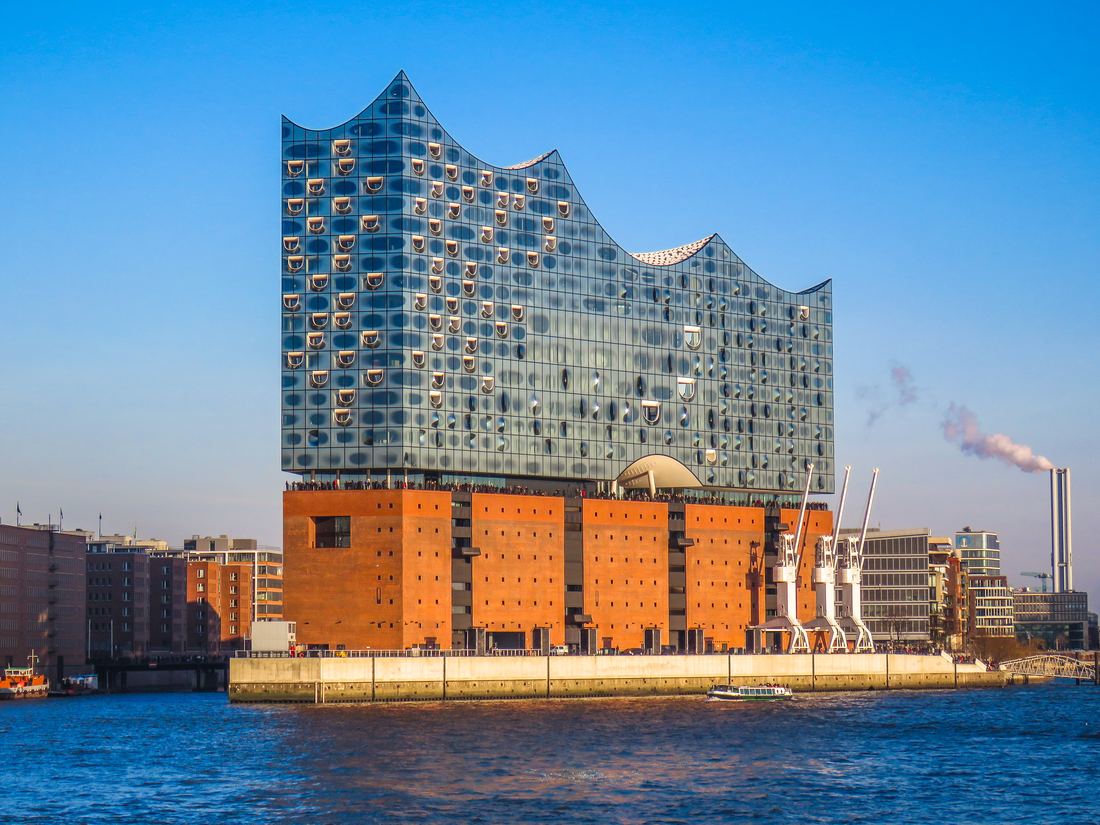
Nobody in Hamburg asked for the Elbphilharmonie to be beautiful. For most of a decade they asked, loudly and in print, for it to stop. A concert hall budgeted in 2001 at €77 million and meant to open in 2010 crept to €114 million by 2005, to €241 million when the schedule slipped again in 2007, past €450 million after the construction contract was renegotiated in 2008, past €500 million by 2012, and finally opened in January 2017 at a confirmed €866 million, on top of a squat 1960s brick warehouse that had spent those same years gutted down to its four outer walls while the number kept climbing. Herzog & de Meuron's answer to a decade of civic fury was not an apology. It was a curved glass crown, faceted like sea ice, that catches the harbor and the sky in whatever light happens to be passing, and does the one thing an over-budget public building is never supposed to manage. It makes the argument about the money evaporate the moment you actually look at it. Within a year, the same city that had wanted somebody fired was posting sunset photographs of the thing.
That is not resilience. That is a very old trick, running on new material, and it worked exactly as designed. A building that makes you feel something is true before you have had time to ask whether it was a good idea: Bernini would have recognized the move on sight, and would not have been remotely surprised that it worked twice.
What the word meant before it became a compliment
“Baroque” gets thrown around now as a synonym for ornate, curved, expensive: an adjective for a feeling, not a claim about how a building actually works. The historical style was a great deal more specific, and a great deal more useful as a lens than the loose modern usage suggests.
Take the single clearest demonstration of it: Bernini's Cornaro Chapel in Santa Maria della Vittoria, finished in 1652. At its center, the marble Ecstasy of Saint Teresa shows the saint mid-vision, an angel about to drive a golden arrow through her, her whole body gone slack with a pain she described as indistinguishable from the love of God. Bernini did not simply carve a sculpture and set it in a niche. He cut a hidden window into the wall above the group and ran gilded bronze rods down through the marble like frozen sunlight, so that real daylight and sculpted light arrive at the same figure at once. On either side, members of the Cornaro family are carved leaning out of what are unmistakably theater boxes, watching the ecstasy the way an audience watches a stage. Architecture, sculpture, hidden engineering and stage lighting are fused into a single continuous event with no seam anywhere between the craft and the persuasion. Art historians have a term for exactly this ambition, bel composto , the beautiful whole, and it describes something considerably more disciplined than “ornate.”
So the useful question about anything called neo-baroque today has nothing to do with curves. It is: who commissioned the disappearing act, and what exactly were they hoping the audience would feel before it had the chance to examine the argument underneath.
Zaha Hadid, Baku: the argument is the country
The Heydar Aliyev Center has no facade, no roofline, no wall in the ordinary sense: plaza and building are one continuous white skin, roughly 39,100 square meters of it plus another 9,000 of plaza, that lifts off the ground, folds through the interior and lies back down on the far side. Werner Sobek's office engineered the whole envelope from around 15,000 individually curved fiber-reinforced panels, no two alike, some as long as seven meters, without a single straight structural line doing the actual work of holding the thing up. Zaha Hadid built it in open opposition to the Soviet concrete still standing across Baku: block after honest, humorless block asserting permanence through mass. The Center asserts the opposite: a young petrostate telling the world, in one unbroken gesture, that it has moved on. The Architectural Review's verdict on first contact was that the building is “a shock to the system,” which is precisely the effect a persuasive building is built to produce.
The Center was originally budgeted at around $250 million for 57,500 square meters, a number that still puts it among the most expensive buildings ever raised per square foot, on a site cleared, according to Human Rights Watch, by force: roughly 250 homes removed to make room for the gesture. Put those two facts beside the white curve in any photograph and the building stops reading as architecture and starts reading as what it actually is: a receipt for how much a country will spend, and who it will move, to make sure the world watches it curve instead of asking why.
Calatrava, Valencia: the skeleton performing innocence
Nothing in the City of Arts and Sciences needs to look the way it looks. A planetarium does not require ribs. A science museum does not need to resemble the picked-clean skeleton of a whale, which is exactly what Calatrava's Museu de les Ciències resembles, on purpose, across two kilometers of Valencia's drained Turia riverbed. This is engineering doing a painted ceiling's job: performing an illusion of structural necessity where there was only choice, the same way Baroque fresco performs a hole in a flat surface opening onto open sky.
It is gorgeous. It is also, in the most literal sense, a magic trick that started coming apart. A complex estimated at roughly €300 million landed near €1.1 billion, with Calatrava's own fees for the project alleged at around €100 million on top, a pattern repeating itself closely enough across his career, from Valencia to Venice to a transit hub built over the ruins of the World Trade Center, that the press settled on calling him “the world's most hated architect.” In 2013, ceramic tiles began detaching from the roof and mosaic facade of the Palau de les Arts opera house at the complex's center; by mid-2014 the regional government had filed suit against Calatrava's firm over the defects. The skeleton, it turned out, was shedding its skin. Someone always pays extra for the sky to look this open: first in the invoice, and later, it seems, in the roof.
Neo-baroque architecture is not a style. It is what a client pays for when the truth alone will not get the reaction they need.
Ma Yansong, Harbin: the one building here that owes Rome nothing
Every essay like this one risks smuggling in an unstated assumption: that the appetite for movement and illusion under discussion is a European inheritance, waiting somewhere to be exported. The Harbin Opera House refuses the premise outright. Ma Yansong has described the building as shaped by wind and water rather than by any Italian precedent: white aluminum panels sweeping across the wetlands beside the Songhua River on the outside, a warm, wind-eroded mass of Manchurian ash inside the main hall, the whole thing closer to a mountain range dissolving into mist in a Song dynasty scroll than to anything Bernini ever touched. MAD won the international competition for the surrounding Harbin Cultural Island in 2010; the opera house itself, roughly 850,000 square feet of it, opened in December 2015 to a city better known internationally, until then, for winter ice sculpture festivals than for architecture.
It belongs in this company anyway, and that is the point worth sitting with. The instinct this essay is tracking, fuse a building into one continuous sensation, argue through the body before the mind gets a vote, is not a Roman export. It surfaces wherever an architect has the tools, a client willing to fund wonder rather than only shelter, and a visual tradition of their own to spend that funding on. Harbin owes the Vatican nothing. It still speaks the same underlying language, fluently, in an accent entirely its own.
Peter Marino: the one who stopped pretending
Hadid, Calatrava and Ma each arrive at a Baroque effect by other means and other materials, translating the seventeenth century's tools of persuasion into fiberglass, structural steel, aluminum. Peter Marino skips the translation and imports the source text directly. Since the early 1980s his flagship stores for Chanel and Dior have set genuine eighteenth-century bronzes and actual Venetian mirrors against blunt, contemporary architectural shells, on purpose, and by his own account with some relish: he has spoken about how rarely anyone dares put something fully modern next to something fully Baroque, and about the collision being the entire exercise, not an accident of taste. The 2004 Chanel tower in Tokyo's Ginza district takes the house's signature black-and-white tweed and detonates it across an entire glazed facade at architectural scale. The reworked Dior flagship on Avenue Montaigne in Paris wraps the boutique itself in a two-thousand-square-meter museum and three private gardens, in case the point somehow wasn't landing already.
This is the case that makes the essay's real question impossible to keep dodging politely. A handbag does not require eighteenth-century provenance to function as a handbag. The bronzes and the mirrors are there to argue, silently and at considerable expense, that the object for sale is heir to a grandeur the brand behind it did not actually inherit: it purchased the props and installed them under gallery lighting, the way a museum installs a period room. Marino is the only architect in this set who is not hiding that this is what he is doing. Whether that honesty is the most respectable thing about his work, or the most cynical, does not seem like a question with room for a third answer.
Where the word stops being useful
Not everything curved and expensive has earned the comparison, and it is worth refusing the lazy version of it on principle. A building deserves “neo-baroque” when its movement and illusion are doing real rhetorical work: arguing for a state's legitimacy, or a brand's inherited weight, or a city's right to stop being laughed at. A building that simply runs parametric software to arrive at an unusual silhouette, with nothing riding on the shape beyond novelty, is not neo-baroque. It is just curved, and calling it baroque performs the same flattening the word already suffers everywhere from real-estate listings to Instagram captions.
What earns these five their place is not a family resemblance of surface. It is that each is trying to make a viewer feel an argument before they have had the chance to interrogate it, in the exact visual grammar the seventeenth century invented for that specific purpose, which three and a half centuries of intervening architecture mostly tried, and largely failed, to argue its way out of.
Bernini never had to build a case for the Pope's authority. The authority was already absolute; the architecture only had to make it beautiful. Nobody commissioning a building today has that luxury, which is exactly why digital fabrication's cheap, borrowed freedom of form keeps ending up in the hands of clients who need an audience feeling something before it starts asking questions: a state without a settled story about itself, a brand selling a history it bought rather than lived, a city that would rather be photographed than interrogated. The style survived the collapse of absolute power by outliving the thing it was built to defend. What is left standing is the technique, and the technique, it turns out, does not need to believe in anything at all in order to work.