Stephen Spartana: My Photographs Are My Paints
Interview
Photographer Stephen Spartana on a road from the baseball field and the steel mill to fine art, water as a living mirror, building a picture from layers, a frozen stream that melted away, and what a photograph of leaves can give someone whose sky is not safe.
Viacheslav Munister & Stephen Spartana · 2026-10-18
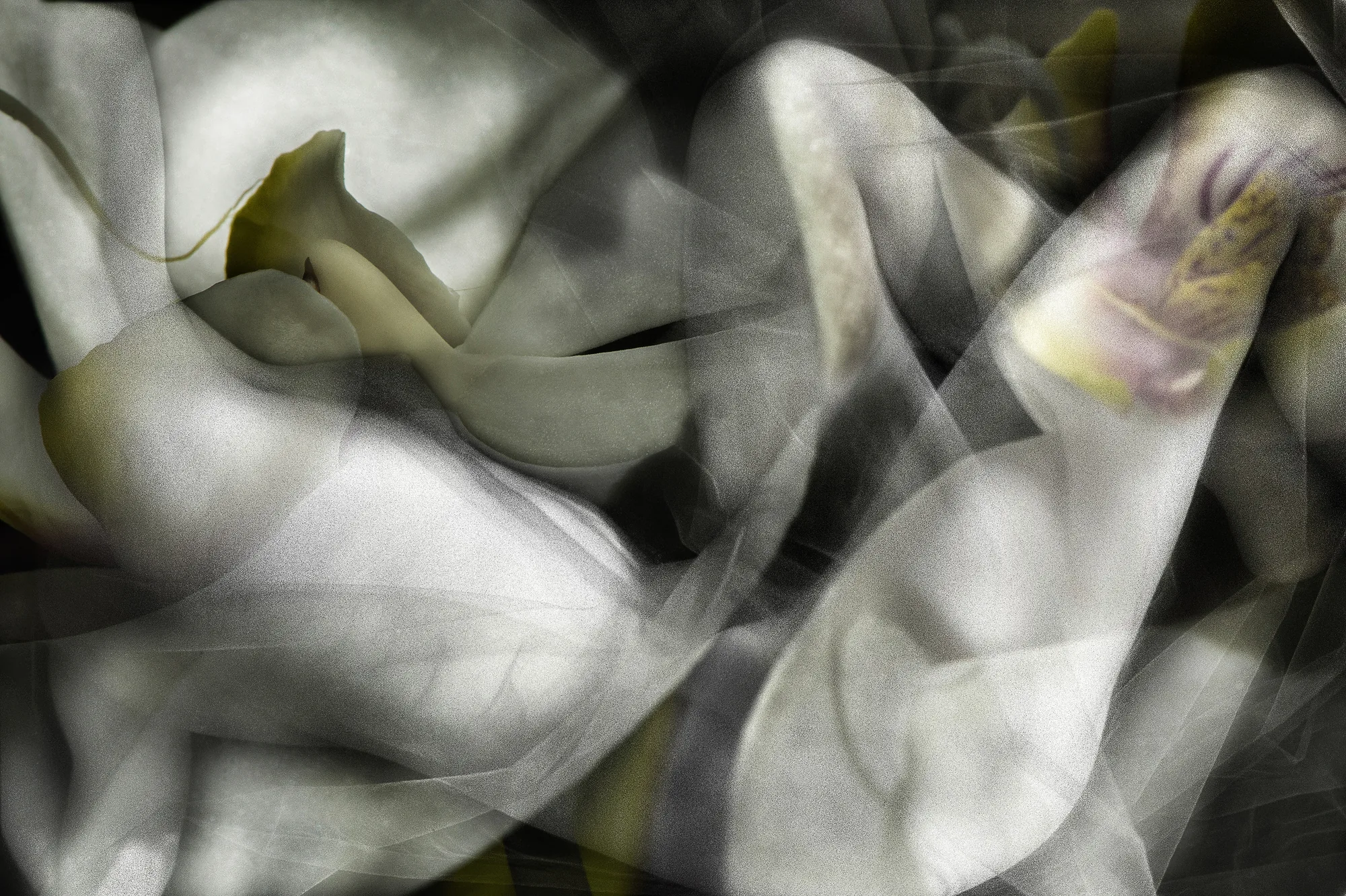
Stephen Spartana’s photographs are built the way memories are: one layer at a time. A figure photographed in a studio against black, a tree from a winter walk, acrylic strokes painted on glass, a river, a frozen stream: they settle into one picture that does not say where it was made. “Where was this person photographed? Is this a real place? Where does reality end and fantasy begin?” he asks of the viewer, and he means the questions as the point of the work.
He came to it by a long road. A boy from a middle-class Baltimore family with no artists in it, he went to college intent only on becoming a baseball player. He took his first photography class as a senior, went to work in a steel mill because he needed money, began art courses at a community college, and then applied to the Maryland Institute College of Art, paying for it with long hours at the mill. After the BFA came some forty years as a commercial photographer. When the pandemic stopped his assignments, he finally had uninterrupted time for his own work. Today it is shown internationally, in Venice in 2021 and at the Florence Biennale in 2025, where he received the Lorenzo il Magnifico Award for Photography.
We wrote Stephen long questions: about the steel mill and a pair of misplaced theatre tickets, about mirrors and water, about the Human-Nature series he began in the early 1990s and picked up again decades later, about forty years of commissions, about how a layered picture is made, about ice, abstraction and Italy, about his book, and about what a photograph can offer people living through war. He answered at his own length and in his own time, and sent sixteen pictures.
Part 01 Where it begins
A baseball field, a steel mill and a theatre seat; the mirrors of a student thesis; a series that waited decades for its second half.
The mill, the mound and the theatre seat
Viacheslav Munister [VM]: You went to college intent only on becoming a baseball player; economics and accounting never felt like a career, and you took your first photography class as a senior. You went to work at a steel mill because you needed money, began taking art courses at a community college, and realised that was what you wanted to do. You applied to MICA, kept working long hours at the mill to pay for it, and often thought how interesting it would be to photograph in the Melt Shop. Years later you started taking ballet classes yourself, and only then began photographing dancers. What did these worlds teach your eye: the pitcher’s mound, the light of liquid metal, the dancer’s body in the air? Is anything of the mill still in your photographs?
Stephen Spartana [SS]: Because I wasn’t raised in an artistic environment, much of my creative inspiration comes from the experiences I’ve accumulated throughout my life. I’ve always been very observant, fascinated by the things happening around me, often seeing beauty and possibilities in places where others might not think to look.
When I first began studying photography, I found myself remembering things I had experienced years earlier and imagining how I might interpret them through a camera. For example, when I worked in a steel mill as a young man, I was fascinated by the molten steel, the enormous machinery, the towering cranes, and the incredible scale and energy of the place. I remember thinking how wonderful it would be to photograph that environment someday. Many years later, after establishing myself as a commercial photographer, I finally had the opportunity to photograph a smaller steel mill. It was an incredibly enjoyable experience, almost like fulfilling a vision I had carried with me for decades.
I remember another experience that influenced the way I see. The first time I attended a dance performance, our tickets had been misplaced, and we were given seats in the very front of the theater. From that position, it was almost impossible to see the entire stage. Instead, I found myself looking through the dancers’ legs, observing fragments of movement, unusual angles, and intimate details that someone sitting farther back might never notice. Those unexpected perspectives stayed with me and eventually found their way into my photography.
I believe everything we experience in life remains somewhere within us. The places we’ve been, the people we’ve encountered, and the things we’ve observed become part of our visual memory. My work is largely conceptual, and I often draw upon those memories, sometimes without even realizing it.
What fascinates me most is the possibility of bringing different worlds together – combining places, experiences, and moments that may be separated by years or even decades. Through layering and composition, I can create relationships between things that would never ordinarily exist together.
In a sense, I’m attempting to move beyond the traditional three dimensions of an image, introducing time as a fourth dimension. My photographs become places where the past and present coexist, where memory and reality overlap, and where experiences from an entire lifetime can come together in a single image.
In a sense, I’m attempting to move beyond the traditional three dimensions of an image, introducing time as a fourth dimension.
From the mirror to the water
VM: Your thesis at MICA used mirrors to bring distant parts of a landscape into a photograph of a figure. Decades later water does the work of the mirrors. Why has one surface holding two worlds stayed with you for forty years? What can water do that a mirror never could, and what did you lose when you let the mirror go?
SS: I’ve always been fascinated by the idea of bringing two worlds together within a single image. That fascination began with mirrors, but over time I discovered that water offers something far more dynamic and unpredictable.
Water has so many extraordinary qualities. It exists as a liquid, a solid, and a gas, constantly changing its form and character. A mirror gives you a relatively precise reflection of what is in front of it, but water has a life of its own. The slightest breeze, a ripple, or a change in light can completely transform what is being reflected. It can distort, soften, fragment, or blend elements in ways that a conventional mirror cannot.
What interests me most is that water doesn’t simply reflect another world; it can reinterpret it. It introduces movement, atmosphere, and an element of unpredictability that opens up so many creative possibilities.
I think the reason this idea has stayed with me for more than forty years is that I’ve always been interested in combining different moments, places, and dimensions within a single photograph. With mirrors, I had greater control over what I was bringing together. With water, I’ve surrendered some of that control, but in return I’ve gained something more organic and expressive. Water allows nature to become part of the creative process, and that has become increasingly important to me as an artist.
With water, I’ve surrendered some of that control, but in return I’ve gained something more organic and expressive.
A series that waited for decades
VM: In the early 1990s, at Gomez Gallery in Baltimore, Human-Nature paired black-and-white nudes with close-ups of flowers. Then the series went quiet for many years before you returned to it. What interrupted it, and what brought you back? And how do you answer the old question that hangs over flowers and bodies placed side by side, about beauty, desire and the way we look?
SS: My artwork was interrupted by life, quite simply. At the time, I was working as a freelance commercial photographer, and my career had really begun to take off. I was incredibly busy, building a business and making a living. My wife and I were also in the process of adopting our two daughters from China, so my priorities naturally shifted toward my career and family. There simply wasn’t enough time to devote to my personal artwork, although I always knew I would return to it.
I never forgot Human Nature . Over the years, I would occasionally revisit the series, incorporating some of the original nudes I had photographed on black-and-white infrared film. Those images always held something special for me, and the relationship between the human figure and the natural world continued to fascinate me.
Georgia O’Keeffe’s flowers were an early inspiration, particularly the way she revealed extraordinary beauty in forms that we often overlook. I think there is a natural connection between the human body and the organic shapes found in nature. Both possess their own sensuality, vulnerability, and beauty. For me, bringing them together was never simply about desire. It was about recognizing that we are part of nature, not separate from it.
It was about recognizing that we are part of nature, not separate from it.
When I returned to the series, my perspective had broadened. Flowers were still important, but I began incorporating other elements of the natural world, exploring relationships between forms, textures, time, and space. The work evolved, just as I had evolved.
I believe that as an artist, you can revisit an idea, but you should never stop moving forward. The original Human Nature planted a seed that has continued to grow throughout my career. What began as an exploration of the relationship between flowers and the human figure has become something much larger: an ongoing exploration of our connection to nature and the many layers of life itself.
Part 02 Two lives, many layers
Forty years of commissions and the work that came after; a picture built layer by layer; the earth as a tattoo; the people who stand in the water.
Forty years of commissions
VM: Since 1983 you have lived as a commercial photographer. How do the two lives, the work that pays and the work that matters, feed and steal from each other? What did forty years of commissions give the artist, and what did they cost him?
SS: I’ve always viewed every assignment as an opportunity to learn. As a commercial photographer, I could have specialized in portraits, architecture, or another subject, but I never wanted to limit myself. I knew I’d eventually become bored doing the same thing repeatedly. I liked that each assignment offered a different perspective and a new way to approach photography. I worked across many areas, often combining people, buildings, objects, landscapes, and other subjects. There was always something new to see, and every assignment presented a challenge and an opportunity to expand my knowledge.
I particularly enjoyed working at colleges and universities. I loved talking with students, hearing their perspectives, and staying connected to a younger generation. I’ve always believed learning is lifelong, and those encounters were as valuable to me as the photographs I made.
I’ve never viewed my commercial career and fine art as separate lives. One continually informed the other. Commercial photography exposed me to people, places, and situations I might never otherwise have encountered. It taught me discipline, adaptability, problem-solving, and how to approach a subject from different perspectives. Those experiences became part of me, both personally and artistically.
Commercial work demanded much of my time, and for years my personal artwork took a back seat. But I don’t see that as something I lost. I was building a career, raising a family, and gathering experiences that would eventually find their way into my art.
When the pandemic halted commercial assignments, it gave me something I hadn’t had in years: uninterrupted time to focus on my own creative vision. For the first time in a long while, I could make photographs entirely for myself, without a client’s expectations or a deadline shaping the outcome.
What changed wasn’t my passion for photography, but where I could direct it. After forty years of fulfilling other people’s visions, I could finally devote myself fully to my own.
After forty years of fulfilling other people’s visions, I could finally devote myself fully to my own.
I don’t feel my commercial career cost me creatively. Quite the opposite. It gave me forty years of knowledge, experience, and visual understanding that I now bring to my artwork. In many ways, I’ve come full circle, returning to where I always wanted to be with a lifetime of experience I didn’t have when I began.
Perhaps that’s the most rewarding part. I’m still learning, experimenting, and discovering new possibilities. An artist never really stops learning; there is always more to explore.
How a picture is built
VM: You call your photographs your paints and your tools a palette. Take one image from Life in Layers and walk us through its making: what was photographed, how many layers there are, in what order they meet, and the moment you knew it was finished. What is decided in the field, and what only appears at the screen?
SS: Heart of the Rose is a good example of how I approach creating an image through layers. The process began with a black-and-white photograph of a nude, followed by a photograph of a rose with a beautiful, muted red color. I then painted acrylic brushstrokes onto glass and photographed those as well, creating another element that I could incorporate into the composition.
The image came together in stages. I began with the nude, introduced the muted red rose, and finally added the photographed acrylic brushstrokes. Each layer brought something different to the composition, and the challenge was finding a balance where the individual elements became something greater than they were on their own.
Much of that exploration now takes place on my computer screen. I rarely create just one version of an image. I experiment with different arrangements, transparencies, contrasts, and relationships between the layers. Sometimes I’ll create numerous variations before finding a direction that feels right. In many ways, it’s similar to painting, except my palette consists of photographs I’ve made throughout my life.
The original photographs provide the foundation, but the final composition often takes me somewhere I hadn’t anticipated when I first captured them. That’s one of the things I love most about the process. I’m not simply recording what I see; I’m discovering what those images can become when brought together.
I’m not simply recording what I see; I’m discovering what those images can become when brought together.
As for knowing when a piece is finished, that’s probably the most difficult question to answer. Sometimes I reach a point where everything feels balanced and the image seems complete. Other times, I’m not entirely convinced. I may put it aside and return months or even years later with a different perspective. I’ve revisited older work many times, discovering possibilities I hadn’t seen before.
For me, creating art is an ongoing process of exploration. There is usually a beginning, but not always a definitive ending. Sometimes an image tells me it’s finished, and sometimes I simply have to walk away from it. I’ve come to accept that uncertainty as part of being an artist. The possibilities are often endless, and that’s what keeps the creative process exciting.
The earth as a tattoo
VM: You describe the Interwoven landscapes as “like the strata of memories”, and the patterns of leaves and rock as tattoos on the skin. When you lay a stone or a leaf over a human body, what are you saying: that we are written by the earth, that we will return to it, that we carry it like ink? Which memory sits in the deepest layer?
SS: I’ve always been fascinated by tattoos and the way people use them to decorate their bodies, often as expressions of identity, personal history, or emotion. In my work, I think of nature as a form of tattoo. Rather than using ink, I use the patterns and textures of leaves, stone, and other natural elements to adorn the human figure. For me, it’s a way of bringing the Earth into the human spirit, suggesting that we are not separate from nature but deeply connected to it. These natural forms become part of the body, almost as though the Earth has left its own impressions upon us. In that sense, the layers in my photographs are not necessarily about one particular memory, but about something more universal: our shared connection to the natural world and the idea that, ultimately, we are of the Earth.
In my work, I think of nature as a form of tattoo.
Who stands in the water
VM: In Caress of Maples a woman stands in flowing water among maple colours that run from chartreuse to crimson, “like a Greek goddess”. Who are the people in your pictures, and how do you work with them? How much is planned, and how much is trust?
SS: In Caress of Maples , the woman is not actually standing in water. All my nudes are photographed in the studio against a black backdrop, often partially draped in a sheer, gauzy fabric. I work with the model to explore a variety of poses, gestures, and movements, photographing possibilities that I may not use until much later. There is a degree of planning, but also a great deal of spontaneity and trust in the process.
The natural elements are photographed entirely separately. Over the years, I’ve built an extensive palette of images drawn from nature, which I return to when creating my compositions. I look for a relationship between the human figure and the natural world, something that feels as though the two were always meant to exist together.
When I find that connection, I begin layering the images, allowing the human form and nature to become part of the same visual experience. My intention is to create something that feels believable yet dreamlike, leaving the viewer wondering: Where was this person photographed? Is this a real place? Where does reality end and fantasy begin?
Ultimately, my purpose is to create an artwork that invites the viewer to spend time exploring and discovering. I want there to be elements immediately visible on the surface, but also subtleties hidden within the layers that may not reveal themselves at first glance. I hope that each time someone returns to the image, they discover something they hadn’t noticed before. For me, the artwork should offer more than a single moment of observation. It should become an experience of discovery, where the viewer moves through the layers, much as I did when creating them.
That sense of mystery and discovery has always fascinated me. I’m not simply placing a figure into a landscape; I’m creating a world where the boundaries between the human body and nature begin to disappear, inviting the viewer to look beyond what is immediately visible.
I’m creating a world where the boundaries between the human body and nature begin to disappear
Part 03 Ice, abstraction, Italy
A stream that froze for two weeks; the point where a forest turns into a feeling; a country that makes the artist feel complete.
A stream that melted away
VM: In 2022 your work turned cold: Cryos-Scapes, Ice Scapes, World Below 0°. At the same time, Elephants of Sri Lanka sits in your portfolio. Is ice, water stopped in time and slowly melting, the most honest image of time you have found? And when you photograph elephants or frozen water, do you feel you are documenting something that may not last?
SS: The elephants of Sri Lanka and my World Below Zero series are really two entirely different subjects, each with its own story and inspiration.
The elephants were photographed in a protected area in Sri Lanka during a project that was originally intended for a book that, unfortunately, never materialized. There was something remarkable about observing these magnificent animals, witnessing their personalities, their interactions, and the gentleness that exists alongside their enormous strength. While I recognize the importance of protecting these animals and their environment, I also understand that a photograph alone cannot ensure their preservation. An image may create awareness or stir an emotional response, but whether that emotion leads someone to take action is ultimately beyond my control.
World Below Zero came about in an entirely different way. During a period of unusually cold temperatures in 2022, I was wandering through the woods when I came upon a partially frozen stream. I was immediately captivated by the intricate shapes, patterns, and textures created as the moving water began to freeze. There was an extraordinary beauty in something so ordinary, something that most people might walk past without noticing.
As the unusually cold weather persisted, I returned to the stream repeatedly over a period of two weeks. Each visit revealed something different. The water continued to flow beneath the ice, creating new formations while transforming others. It was fascinating to watch nature continually reinvent itself, producing intricate designs that seemed almost sculptural in their complexity.
My initial fascination was with the visual possibilities these formations offered. The ice became a collection of natural compositions, each with its own shapes, lines, textures, and delicate structures. I began exploring how these elements could become part of the visual language of the series.
But there was also something fascinating about the temporary nature of what I was photographing. Even during those two weeks of freezing temperatures, the ice was constantly changing. And once the weather warmed, those beautiful formations would simply disappear, carried away by the very water that had helped create them.
In that sense, the photographs do become a record of something that no longer exists. I wasn’t necessarily thinking about environmental loss when I made them. I was responding to the beauty I discovered and the remarkable transformations taking place before my eyes. But looking back, I recognize that the work also speaks to the passage of time and the fragile, fleeting nature of the world around us.
Perhaps that is one of the things I find most compelling about photography. It allows me to preserve a moment that will never happen in quite the same way again. The ice will melt, the water will continue to flow, and those extraordinary patterns will be gone. Yet within the photograph, that moment remains.
The ice will melt, the water will continue to flow, and those extraordinary patterns will be gone. Yet within the photograph, that moment remains.
When a forest becomes a feeling
VM: Your recent prizes are mostly in fine-art abstraction, yet everything begins in a real forest, a real river, real light. Where does a forest stop being a forest and become a feeling? Do you set out to abstract, or does the abstraction reveal itself afterwards? And what do you feel when viewers mistake your photographs for paintings?
SS: After so many years as a commercial photographer, and having had the opportunity to travel extensively, I still find great pleasure in taking photographs simply for the joy of seeing and discovering something beautiful. But at this stage of my life, much of what I photograph is done with the intention of eventually becoming part of a fine art composition or abstraction.
I’ve always been fascinated by the idea of bringing different places together, combining moments in time, and creating something that could never exist in quite the same way in reality. A forest may begin as a forest, a river as a river, but once I start working with those images, they become something more. They become elements of a visual language through which I can express feelings, memories, and imagination.
Sometimes I photograph something with a very specific idea in mind, knowing how I might eventually use it. Other times, the abstraction reveals itself much later. An image I captured years ago may suddenly become the perfect element for something I’m creating today. As I’ve mentioned before, everything becomes part of my palette, a growing collection of colors, textures, shapes, and experiences that I can draw upon.
I don’t necessarily think there is a precise moment when a forest stops being a forest and becomes a feeling. It happens gradually, through the creative process, as I begin to move beyond what the camera originally recorded. I experiment with relationships between images, allowing color, light, texture, and form to guide me. What began as a recognizable landscape may eventually become something entirely different, something that exists somewhere between reality and imagination.
When someone mistakes one of my photographs for a painting, I take that as a wonderful compliment. I’ve always had a deep appreciation for painting and painters, but I’ve never devoted myself to becoming a painter in the traditional sense. Instead, I’ve found my own way of painting through photography.
My camera provides the raw materials, my photographs become my paints, and the computer becomes my canvas. Much like a painter, I build my compositions through layers, making decisions about color, balance, texture, and emotion.
My camera provides the raw materials, my photographs become my paints, and the computer becomes my canvas.
Ultimately, I want people to experience my work as they might experience a painting, not simply as a record of something that existed, but as an expression of something imagined and felt. Photography is my medium, but the freedom to create beyond the literal image is what continues to excite me as an artist.
Italy, and the sense of being complete
VM: In 2021 you took part in the “Time, Space” exhibition in Venice, and in 2025 you received the Lorenzo il Magnifico Award for Photography at the Florence Biennale. What is it about Italy, and Venice above all, that answers something in you? What did you show in Venice, and what did it mean to stand in the city of the Medici holding a prize named after one of them?
SS: At the 2021 Time Space exhibition in Venice, I presented three works: Drifting Through Time , Enema , and Imagine . It was a particularly meaningful experience for me, not only as an artist but also on a very personal level.
I’ve always had a deep affection for Italy. My father’s family came from Italy, so there has always been a sense of connection to the country and its culture. My wife and I spent our honeymoon visiting Florence and Venice, and those memories have stayed with me throughout my life. I’ve also returned to Lake Como on several occasions, each visit reinforcing my love for the country.
There’s something extraordinary about Italy that is difficult to put into words. Everywhere you turn, you’re surrounded by art, history, architecture, and beauty. It’s almost as though creativity is woven into the fabric of everyday life. Venice, in particular, has a magical quality. The reflections in the canals, the constantly changing light, the textures of centuries-old buildings, and the sense that time moves at its own pace make it a remarkable place for someone who sees the world through images.
As an artist whose work often explores time, space, and the relationship between reality and imagination, I find Italy endlessly inspiring. Walking through its cities, I feel surrounded by the accomplishments of artists who came centuries before me. There’s a wonderful sense of continuity, of being connected to something much larger than oneself.
Receiving the Lorenzo il Magnifico Award for Photography at the 2025 Florence Biennale was especially meaningful. To be recognized for my artwork in Florence, a city so deeply connected to the history of art and the Renaissance, was both humbling and gratifying. I couldn’t help but think about my own journey, from a young man who never imagined becoming an artist to standing in a city that has inspired generations of great artists.
I’ve often dreamed of having a studio in Italy, perhaps near Lake Como, where I could immerse myself in that atmosphere of creativity and inspiration.
For me, Italy is more than a beautiful place to visit. There is something about being there that touches me on a deeper level. Perhaps it’s my heritage, my love of art, or simply the way the country seems to celebrate beauty in all its forms. Whatever the reason, when I’m in Italy, I feel an extraordinary sense of belonging. In many ways, I feel complete.
I feel an extraordinary sense of belonging. In many ways, I feel complete.
Part 04 The book, and what beauty is for
The book that gathers forty years, and a question we could not avoid asking from where we write.
A life put in order
VM: Years ago you named three dreams: to work full-time on your own art, to exhibit in cities around the world, and to publish a book of your collected work. What is the book, and what story does it tell? What did you discover about your own work when you had to put it in order, page after page?
SS: The title of my book is Visions of Earth: Fantasy and Reality . It represents a culmination of my life and artistic journey, bringing together images from nine of my established series, along with a small collection of new work. But I never wanted it to be simply a collection of photographs. I wanted it to tell a story, not only about the evolution of my artwork, but about the experiences and unexpected turns in life that brought me to where I am today.
I came from a middle-class family with no real background in art. Growing up, my dream was to become a professional athlete, particularly a baseball player. Looking back, perhaps that wasn’t the most realistic ambition, but it gave me something to work toward. When circumstances changed and that dream was no longer possible, I had to discover another direction for my life. Through a series of experiences, influences, and opportunities, I eventually found my way to art school, earned my BFA, and went on to enjoy a long and successful career in commercial photography.
Throughout those years, I continued to develop my own artistic vision, often drawing upon experiences that, at the time, seemed completely unrelated to art. Eventually, I reached a point where I could devote myself entirely to my personal work, something I had dreamed of doing for decades.
The book follows that journey through the different series I’ve created. Each represents a particular period in my life, a different way of seeing, or an exploration of ideas that have continued to evolve. As the pages progress, I hope the reader will begin to recognize the connections between the earlier work and what I’m creating today. Although my techniques and visual language have changed, my fascination with nature, time, memory, and the human experience has remained remarkably consistent.
Interestingly, perhaps the most difficult part of creating this book had nothing to do with selecting or arranging the photographs. It was the challenge of writing about myself. I’m a very private person by nature, and sharing my personal history, my background, and the experiences that shaped my life was something I wasn’t entirely comfortable with at first. For so many years, I’ve allowed my photographs to speak for me, so putting my own life into words was unfamiliar territory.
But as the story began to take shape and I saw those experiences brought together on paper in a cohesive way, my feelings changed. I began to recognize how important those personal details were to understanding the artwork itself. Things that seemed unrelated at the time suddenly revealed connections I hadn’t fully appreciated. Looking at the finished narrative, I’m genuinely happy that we chose this approach. What initially felt like the most challenging part of the project has become one of its most rewarding aspects.
Putting so many years of work together has also allowed me to look back and recognize how one idea often led to another, sometimes separated by decades. I’ve come to appreciate that the experiences we have in life, even those that seem insignificant at the time, can eventually find their way into our creative expression.
Perhaps most importantly, I hope the book will offer some inspiration to people who haven’t yet discovered their own direction in life. I certainly didn’t begin with a clear vision of becoming an artist. My path was anything but direct, and I think there’s something encouraging in knowing that a life can take unexpected turns and still lead somewhere meaningful. Sometimes what we initially see as a disappointment or failure becomes the very thing that opens the door to something extraordinary.
Sometimes what we initially see as a disappointment or failure becomes the very thing that opens the door to something extraordinary.
Having my work exhibited internationally and now bringing this book into the world are dreams I once hoped might happen. But I don’t see the book as the conclusion of my journey. I see it as another chapter.
I’m still curious, still experimenting, and still learning. There are always new places to explore, new images to create, and new ideas to discover. At this point in my life, I feel fortunate to be doing what I love, and I have no intention of stopping. I simply want to keep moving forward and see where the journey takes me next.
What a photograph of leaves can give
VM: EPRIS is made by people living through a war, in Ukraine. What can a photograph of leaves, water or ice give someone whose sky is not safe? And if you could send one of your images to a reader in Ukraine tonight, which would it be, and what would you wish to happen to them as they look at it?
SS: I’ve always believed that my artwork should be a positive force in people’s lives. I’ve never been drawn to protest photography or to documenting the harsher realities of the world. There are many remarkable photographers who do that work, and I have great respect for them. But my own artistic direction has always been different. I want my photographs to offer a sense of beauty, peace, and perhaps a little escape from the difficulties of everyday life.
My heart goes out to the people of Ukraine. It has been heartbreaking to witness the suffering, destruction, and tremendous loss they have endured. I also find it deeply troubling to watch what is happening in my own country, the United States, and to feel that, in many ways, we have lost our sense of direction and some of the values that once defined us.
I understand that a photograph of leaves, flowing water, or frozen ice cannot change the circumstances of someone living through a war. It cannot make their skies safe or restore what they’ve lost. I would never pretend that art alone could accomplish something so profound. But I do believe that art has the ability to touch us emotionally, to offer a moment of calm, or to carry our thoughts somewhere beyond our immediate surroundings.
That’s really what I hope my work can do. Through the beauty of nature and the imaginary worlds I create, I want to give people an opportunity to step outside their reality, even if only for a few moments. There is so much ugliness, anger, and suffering in the world that I feel it’s equally important to remind people that beauty still exists.
I would find it difficult to choose just one photograph to send to someone in Ukraine, because that sense of hope and escape is something I try to bring to all my work. Whether it’s the delicate structure of a leaf, the movement of water, or a dreamlike landscape that exists only in my imagination, each image is intended to offer something positive.
If someone living through such extraordinary hardship were to look at one of my photographs, my greatest wish would be that, for just a moment, their mind could travel somewhere peaceful. Somewhere they could experience a sense of wonder, beauty, or simply a little relief from the weight of what surrounds them.
I don’t expect my photographs to change the world, but if they can change someone’s state of mind, even briefly, then I feel they’ve accomplished something meaningful. Sometimes a few moments of peace and the reminder that beauty still exists can be a small but valuable gift.
Sometimes a few moments of peace and the reminder that beauty still exists can be a small but valuable gift.
Images © Stephen Spartana; published with the artist’s permission.
Interview by Viacheslav Munister. Answers by Stephen Spartana, lightly edited for clarity and punctuation. Questions have been shortened. All artworks courtesy of the artist.