Rosaria Valenti: The Marks Are Still There
Interview
Somerset painter Rosaria Valenti on her father’s tailoring shop and Frank Sinatra on the radio, on beginning with a feeling and not knowing where the canvas will go, on the marks painted over that are still there, on joy and darkness in one frame, and on Held, the painting she was most afraid to show.
Viacheslav Munister & Rosaria Valenti · 2026-11-10
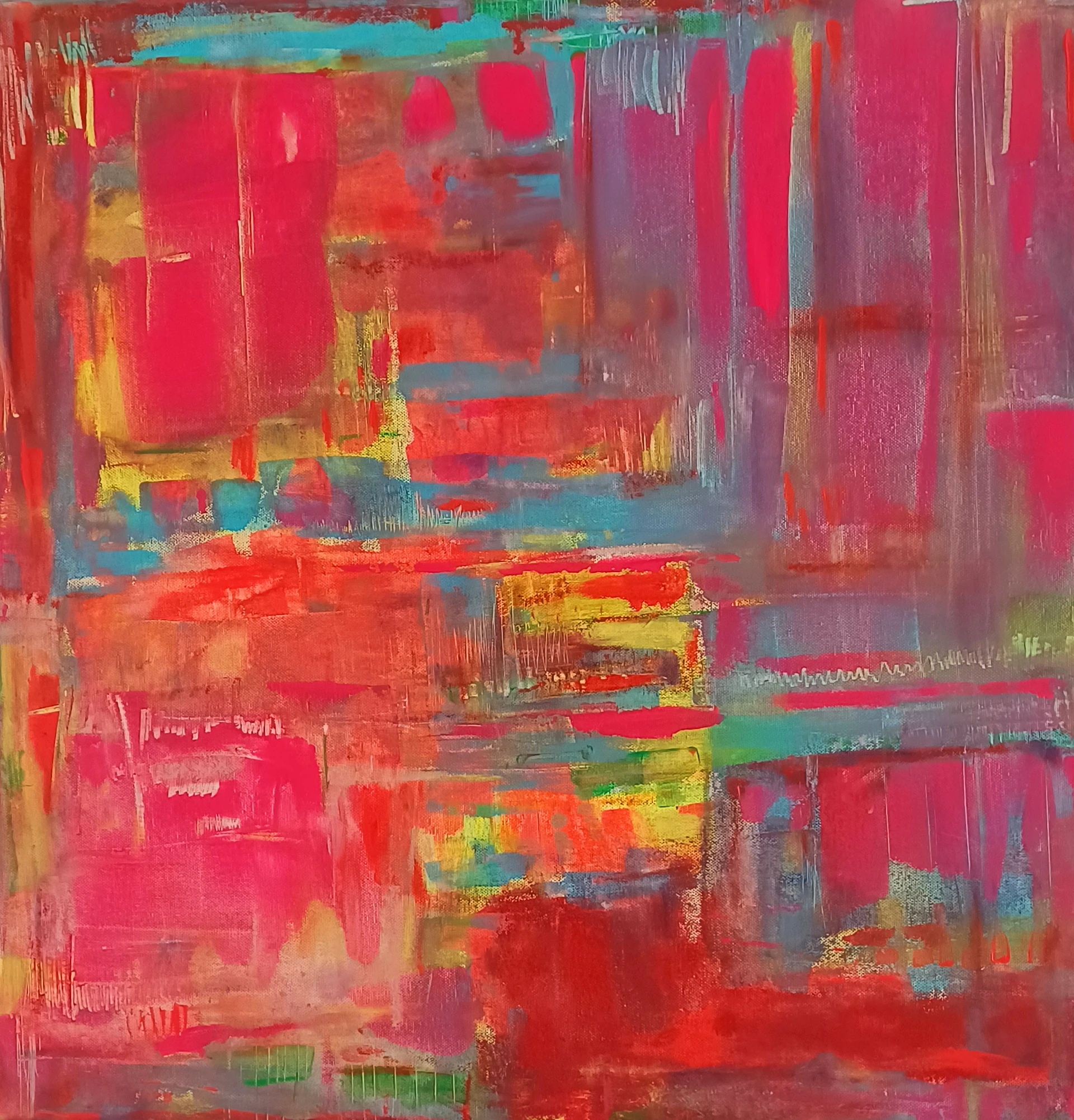
Rosaria Valenti does not plan a painting. She begins with a feeling, reaches for the colour that fits it, makes a first mark, and answers whatever the canvas says back. Things that do not work are painted over, rubbed off or left for another day. “I don’t know where the painting will take me,” she says; for her, painting is a way of letting a feeling go, not of making something specific.
She is a self-taught abstract artist, born in Stoke-on-Trent and now based in Somerset, with Sicilian roots. Her love of art began in her father’s tailoring shop, among offcuts of cloth and the sound of a sewing machine. Her paintings are driven by colour, emotion and experimentation: neon pink and acid yellow beside sprayed black, long drips, layers added and scraped back. Her Instagram bio calls the work “a reflection of what I feel and see, through abstraction.” She has shown in Somerset, at Ilminster Arts Centre and during Somerset Art Weeks, and in 2026 seven of her paintings, the series Within among them, came to EPRIS Museum. The same year Freedom won an Honorable Mention at the TERAVARNA 15th Open International Juried Art Competition.
We wrote Rosaria long questions: about the shop, the first ten minutes in front of a blank canvas, what lies buried under the paint, the month without colour, the black mass that returns in five of the seven paintings, and the one painting she was afraid to show. She answered simply, in her own words and in her own time, wrote a note for every painting, and sent a folder of pictures.
Part 01 Where it begins
A sewing machine and Frank Sinatra; the first ten minutes before a canvas; what stays under the paint.
The sound of the sewing machine
Viacheslav Munister [VM]: You grew up in your family’s tailoring shop, among cloth, thread and the patience of making by hand. What do you remember from that shop that you can still feel in your hands today, and when did you understand that what you wanted to make had no use and no body to dress, only a feeling to hold? Rosaria Valenti [RV]: I remember every morning the sound of my father’s sewing machine, with Frank Sinatra playing because Dad loved his music. There were fabric offcuts everywhere, in different colours and textures. Growing up in that environment, I was surrounded by things being made by hand, and I think those early memories have stayed with me. Today, I make something different, but that love of creating has always been part of me.
The first ten minutes
VM: You do not begin a painting with a fixed outcome; you answer the canvas as it speaks. Take us into the first ten minutes in front of an empty surface: what is the first mark, how do you know what the second one must be, and is fear what you are looking for? RV: I often start painting in the morning, when everything is quiet. I almost always begin with a strong feeling inside me. I reach for a colour that feels right for that moment, and I make the first mark. From there, I respond to what I see on the canvas; one mark leads to another. I don’t know where the painting will take me. When things don’t work, I change them, paint over them, rub them off, or leave it and go back to it later.
I don’t know where the painting will take me.
For me, painting is a way of letting go of a feeling, rather than trying to create something specific.
Like old wounds that have healed
VM: Tell us about something you buried that you loved: a passage of colour, a gesture, a whole painting that lived under another one. What does it mean that the viewer will never see it, and is covering something a way of forgiving it, or of keeping it? RV: I cover the marks; like in life, the painting needs to move on. But the marks are still there, even when you can no longer see them, like old wounds that have healed.
The marks are still there, even when you can no longer see them, like old wounds that have healed.
Part 02 Colour, feeling, abstraction
A month without colour; the painting she will never part with; what the world looks like before it becomes paint.
A month without colour
VM: Your titles shine, and yet your profile keeps a highlight called “art challenge monochrome”. What happened when colour was taken away, did you come back to colour changed, and is there a colour you cannot use yet? RV: The monochrome challenge made me realise how much I love colour, and it’s a big part of my work.
But without it, it made me look differently and focus more on the feelings and marks, to express myself. I think that moment made my work develop more deeply.
But yes I love using vibrant colours, experimenting, and I don’t think there is any colour I wouldn’t use; I think you can use any colour together, but you need to know how to use them.
The painting she would never part with
VM: On your site you write that the work holds feelings that are hard to put into words. Choose the one painting that is hardest for you to look at, or to part with: what lives in it, and how does it feel to know that a stranger may read something entirely different? RV: Without a doubt, it’s the painting Freedom !
After a big traumatic event in our lives, everything changed completely. We had to rebuild our lives in a different way, through pain, fear and uncertainty. I stood in front of that white canvas, and everything I was holding inside came out. It was not weakness, but strength. Freedom became my way of finding my own power again.
It was not weakness, but strength.
I look at this painting and see struggle, strength and the freedom to move forward. It’s a big part of my story and I would never want to part with it. I have taken this painting to many exhibitions, and it connects with people in a powerful way. Everyone sees something different, and I love that. Life can be cruel sometimes, but we can still find strength within ourselves.
I would like a special thank you to everyone who stood by us.
What the world looks like before it becomes paint
VM: Your Instagram bio says that your art is “a reflection of what I feel and see, through abstraction.” We often ask what you feel. Tell us what you see, and what abstraction lets you say that a recognisable image never could. RV: Abstraction gives me total freedom. I may look at the rain, and that sensation stays with me as a memory; I carry it with me. Then I feel the need to express it through movement, colour and marks. Allowing it to become something personal rather than figurative. Abstraction breaks the barrier of figurative art, allowing me to deconstruct the visible world into its core of emotional elements.
Abstraction breaks the barrier of figurative art, allowing me to deconstruct the visible world into its core of emotional elements.
Part 03 The seven works
A dark mass that arrives on its own; a journey seen only from the end; the hardest painting; joy and darkness in one frame; a note for every canvas.
The black
VM: In five of the seven paintings ( Freedom , Unbound , Echo , Unspoken and Held ) there is a dark mass with soft edges and long drips beneath it. What is it, how is it made, and have you ever tried to paint a canvas without it? RV: The black comes naturally into my paintings. I use spray paint and let the paint run and drip down the canvas. I don’t always know what will happen; I respond to what I see and feel as I paint. For me, the black in these paintings is a part of what I have inside, a feeling that comes out through colour. I could paint without it, but something of my energy would be missing.
I could paint without it, but something of my energy would be missing.
Held, Unbound, Echo
VM: On your site, Within is “a journey in three parts”: Held , Unbound , Echo . What is held, what is unbound, and what echoes? Did you plan the journey, or did you only see it once the third canvas was finished? RV: The journey wasn’t planned. I painted each one from what I had inside me at that moment. Only when I finished the third painting, I saw how they belonged together. Held is what we carry inside, Unbound the feeling of breaking free, Echo is what stays with us. Three different expressions of the same inner journey.
The painting that cost the most
VM: Of the seven, which painting cost you the most, and why? Where did you repaint, scrape or cover something over, what almost made you give up, and which decision finally made it stand? RV: Held was the hardest for me because I struggled to get the feeling I had inside onto the canvas. I think there must be 5 layers of paint although if you look at it you don’t see them. I kept painting over and scraping back until I felt I was getting closer to what I wanted to express. It took time but I had to trust myself and keep going. It’s a stage of vulnerability.
Joy and darkness
VM: Neon pink, acid yellow and green sit next to black, and sweetness sits next to dripping. Why do you bring joy and darkness into one frame: is it an argument, a truce, or the way you actually feel? RV: For me, bright colours and darkness can live on the same canvas, just as in life.
We carry both inside us. It’s about being vulnerable, because joy and pain are both part of who we are. So why should I separate them? They are both there, and my paintings reflect that.
We carry both inside us.
A note for every canvas
VM: For each of the seven works, a short note: what it is about, how it was made, and the hardest thing in making it. This is the text visitors will read beside the painting. RV: Freedom , 2025. Acrylic and spray paint. It is about letting go, expressing myself freely. The hardest part was finding the right balance. Luminous Chaos , 2025. Acrylic and oil sticks. The chaos and beauty of feelings coming together. The hardest part was knowing when to stop.
Rebellion Sunset , 2025. Acrylic and spray paint. It is about energy, and keeping it safe from breaking away. The hardest part was keeping the energy without losing control.
Unbound , 2026. Acrylic and spray paint. About breaking free from what we hold back. The hard part was letting go and not controlling everything. Echo , 2026. Acrylic and spray paint, with expressive, deep marks. Memories and feelings that stay with us. The hard part was finding a good balance. Unspoken , 2026. Acrylic and spray paint. What we can’t always put into words. The hardest part was putting the contrasting darker and brighter colours together without making it seem too heavy. Held , 2026. Acrylic layers. Vulnerability: the feelings we carry inside, a heavy weight. The hardest part was the strong marks, putting that feeling on the canvas and hoping it connects with others.
Part 04 Meaning
The most honest thing in the seven paintings; what a stranger might feel after ten silent minutes; and thanks.
The one she was afraid to show
VM: What is the most honest thing in these seven paintings, the one you were afraid to show? And if a stranger stands in front of one of them for ten silent minutes, what would you wish to happen to them? RV: Held was the painting I was most afraid to show. It carries a feeling that was difficult to put onto canvas; I wasn’t sure anyone would understand it.
Held was the painting I was most afraid to show.
I think maybe an older person, with more experience of life, might understand it more. If they stood in front of Held , I wouldn’t want them to see my story. I hope they connect with it in their own way, relate to it and leave feeling a little less alone. I want to thank my family, friends and everyone who supports me on my artistic journey. Your encouragement means a lot to me. A special thank you to Viacheslav for this interview and EPRIS for giving me this opportunity.
Part 05 From the studio
Four more paintings, from Rosaria Valenti’s website.
Images © Rosaria Valenti; published with the artist’s permission.
Interview by Viacheslav Munister. Answers by Rosaria Valenti, lightly edited for spelling, clarity and punctuation. Questions have been shortened. All artworks and photographs courtesy of the artist.