Oksana Dzhuman: A Self-Portrait in 5,500 Sticks
Interview
The Valencia based artist, on turning used tobacco sticks into mosaic portraits, painting every one by hand, and the first time strangers saw the work up close at Russafa Art.
Viacheslav Munister & Oksana Dzhuman · 2026-09-16
Oksana Dzhuman trained as an interior designer, then studied graphic design, then spent several years as a tattoo artist. Today she lives in Valencia and works as an artist, and the material she keeps returning to is one nobody else wanted: used tobacco sticks, disinfected, painted by hand one at a time and set into large mosaic portraits.
The series began at the end of 2024 with a small box on her table. Her largest work so far, a self-portrait, holds 5,500 of them. In 2026 the mosaics were shown publicly for the first time, at Russafa Art in Valencia. EPRIS Journal spoke with her about the long road to this material, the process behind a single portrait, and the painting she calls La Guerra.
You trained as an interior designer, then studied graphic design, and today you work as an artist in Valencia. How did these different stages of study and experience shape the way you see composition, form and space in your work?
To be honest, I don't think it was my education that shaped the way I see composition, form and space today. At university I was a rather unserious student: I realised quite quickly that interior design itself didn't really interest me, and if an assignment didn't grab me, I did it simply because it had to be done.
But some things I genuinely loved. I loved drawing, inventing, working with colour and making things with my hands. One assignment in particular stayed with me: we had to dye paper ourselves in different shades, cut it into small squares and rectangles and assemble an image from them. That process really captivated me. Only now do I realise how close it was to what I do today, just with a completely different material.
Later I went to study graphic design. That was already part of searching for what I wanted to do, but in the end that wasn't mine either. After that I came to tattooing and worked in that field for several years. I think that experience influenced me much more strongly. Tattooing definitely taught me patience, attention to detail and how to work with composition.
Looking back, your path in art reads like several different chapters: drawing, tattoo, and now portraits from recycled materials. How do you connect these chapters into one story for yourself?
For a long time I didn't see it as one story at all. I was constantly trying something new: I could get absorbed in one thing, then switch to something completely different, and after a while come back to something again.
Only when the mosaics appeared did I start looking back and noticing things that repeat. I have always loved details, long manual work, colour, and the process itself, when a whole gradually emerges from separate elements.
And that pull appeared even before university. At school, I remember spending a whole night covering my phone by hand with hundreds of tiny rhinestones, inventing the pattern as I went and not noticing the time at all. Later the phone was, fittingly, stolen. Perhaps all that sparkle did its job after all.
So now I see it all as a rather chaotic path, in which only after years did I begin to listen to myself more and understand what I actually love.
Do you remember the moment you first thought that an ordinary used stick could become something more than rubbish? What caught your attention then?
It all began at the end of 2024, unfortunately, with smoking. I put out a small box where I started collecting used sticks, and that was when I first began to notice how many there were. When it's not one or two sticks you simply throw away, but how many pile up in just a few days, you arrive at a rather unpleasant awareness of the scale of your own habit.
That same evening I began looking at the sticks themselves, and at some point something just clicked: what if I tried to make something out of them? The idea came very suddenly, literally like a light bulb over my head. They are waste, there are a lot of them, they are small, light and the same shape. I immediately wanted to know whether all of this could be turned into a material to work with.
At first your works were made only from your own sticks, but over time other people began to join the project. How did that happen naturally, and what changed for you personally when the material stopped being only yours?
Until 2026 I used only my own sticks, so collecting material took a very long time. The first person to help me was a Spanish friend of mine, and I'm very grateful to her for the support. Then other people gradually joined in, and there was noticeably more material.
Later I posted on social media that I was collecting used sticks for my work, and unexpectedly quite a lot of people responded. People even gave me whole cartons of new sticks. It changed the pace of the work a great deal: before, I had to wait for months until enough material piled up for one piece, and now several thousand sticks can be collected much faster.
And I now see the works themselves a little differently. I look at them and understand that they no longer carry only my “DNA”. In a sense, many people take part in making each of them, and I'm very grateful to everyone who helps me collect material.
If we take our time and describe the whole journey of one work, from the first stick to the finished portrait, which part of the process gives you the most pleasure, and which demands the most patience?
It all starts with collecting. Then comes a rather long preparation: several stages of disinfection and treatment against the smell.
While the sticks are being treated, I prepare the canvas in parallel: I do the layout and a colour map, so I understand which shades I'll need and roughly how the work will look.
Then I dye the sticks in the shades I need. Many people are surprised that I paint every stick by hand, but for me this is the most meditative part of the process. After that, assembling the image on the canvas begins.
The whole work requires patience, but probably the most goes into preparing the material. It takes quite a lot of time.
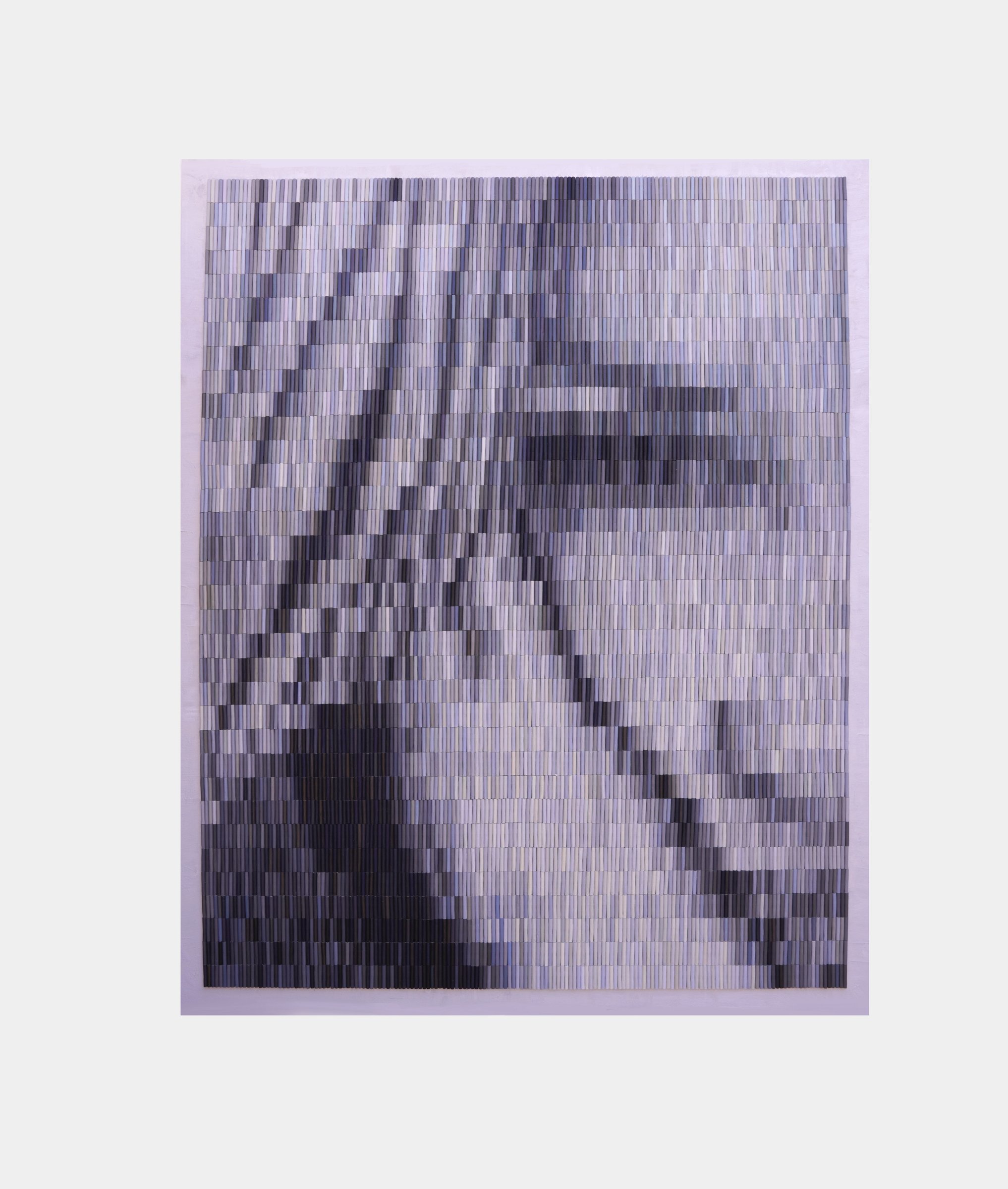
You assembled your self-portrait from 5,500 painted sticks; it is the largest work in the series. If it isn't too personal a question: what did you feel as you gradually recognised your own face in this unusual technique?
While I work, I almost can't see the image. The canvases are large, and you work with them however you can: from the side, from above, sometimes almost lying down. Up close it all looks like a set of separate shades, and the image simply doesn't come together. You can only understand what's emerging by stepping back. With the self-portrait it was even harder, because it is practically black and white.
And when the work was finished, the emotions were very mixed. I was glad I'd finished it, I was proud of myself, and at the same time I wanted to cry and not show it to anyone at all. I think the realisation hit me: this is my face, made of sticks that I smoked myself. It all began with a small box that didn't even hold fifty sticks, and now there were 5,500 of them in front of me.
One of your works refers to Vermeer's Girl with a Pearl Earring, a very recognisable image. What brought you to this portrait in particular, and did your relationship with it change while you were working on it?
I had liked Girl with a Pearl Earring for a long time. Back in Ukraine I painted my own version with a cat, and in Spain the image kept turning up everywhere. At some point I decided that she would be my first portrait made of sticks. A familiar image, familiar colours.
Before her I had made only two works from sticks, both abstract and with a fairly simple palette, so a portrait with so many shades was a big step for me.
When I finished the layout and realised how many shades and thousands of sticks I would have to paint by hand, I thought I had overestimated my strength. I even considered leaving it as elongated coloured pixels. It stayed in that state for quite a long time, until I finally talked myself into finishing what I'd started.
That is probably why I have a special love for this work. It was my first work on such a scale and over such a long time, and in the end it became my favourite.
Besides mosaic, you work in oil painting, graphite studies and the series Elongated Pixels. Do you feel these languages as different voices in the same conversation, or does each one lead you somewhere else entirely?
In general I try not to divide my work into separate directions or tie everything together into one story. I simply like switching between different materials and techniques. I can finish a work in sticks, pick up watercolour or go back to oils, and then return to the sticks again.
Sometimes one thing grows directly out of another. Elongated Pixels, for example, were born while I was working on Girl with a Pearl Earring. At the layout stage I saw that the image looked interesting even without the sticks, and later I made Frida in this technique.
But it's still the sticks that I keep coming back to. Right now this is the material and the process I like most of all.
Among your works there is a canvas called La Guerra. I understand this may be a difficult subject, so I ask carefully: if you feel comfortable talking about it now, what stood behind this work?
For me this work is probably about the pain that stays inside because of the war. Life goes on, you do ordinary things, but it doesn't go anywhere.
At first I wanted to leave hope in this work, the thought that after darkness light always comes. That was meant to be the sun. But in the process, instead of a ray of light, it began to bleed.
Even now I look at this work and feel everything tighten inside. For me, La Guerra is probably that very wound, the one that stays inside even when life around you goes on.
In 2026 your works were shown to the public for the first time at Russafa Art in Valencia. What was it like when people stood next to your mosaics and looked at them in person, rather than on a screen?
At Russafa Art I caught myself feeling a little out of place. There was a lot of painting around, and here I was with my used sticks. I felt awkward, and at the same time I was glad to finally be showing them, and afraid: how would people even take this?
The most interesting part was watching the reactions. Many people didn't understand what the works were made of. Some guessed pastel or chalk, but practically no one guessed used sticks.
The images themselves were also read in different ways. Girl with a Pearl Earring was recognised immediately, because almost everyone knows that image. The self-portrait was harder: people could look at it for a long time without understanding what was in front of them, but as soon as I showed them a photograph, the portrait became visible.
For me it was a very valuable experience. I saw live reactions to my work, received a lot of support and met new people. It's much easier for me to make works than to show them and talk about myself. Even keeping up social media isn't easy for me, so taking part in Russafa Art was quite a big step. And I'm very grateful to everyone who supported me.
Allow me one last, slightly dreamy question: is there an image, a theme or a material you would like to take on one day, but for now lack the courage or the time?
One day I would like to try making a large-scale portrait out of much smaller elements. For now the complexity, the number of elements and the time it would take scare me a little. But once, a few thousand sticks also seemed far too complicated, and now with every new work the process becomes clearer and more precise for me.
In parallel I collect various materials that should have ended up in the rubbish but caught my attention for some reason. I don't know myself yet what they will become, or when. My ideas usually appear quite unexpectedly.
Photographs courtesy of Oksana Dzhuman. Interview conducted in writing for EPRIS Journal, September 2026.