Nicolas Delarre: The Structure Was Already There
Interview
Self-taught Lille photographer Nicolas Delarre on “photographisme”, why the golden ratio matters to him as poetry more than as science, refusing to erase a single passer-by in post, and lying on a library floor for perfect symmetry.
Viacheslav Munister & Nicolas Delarre · 2026-10-16
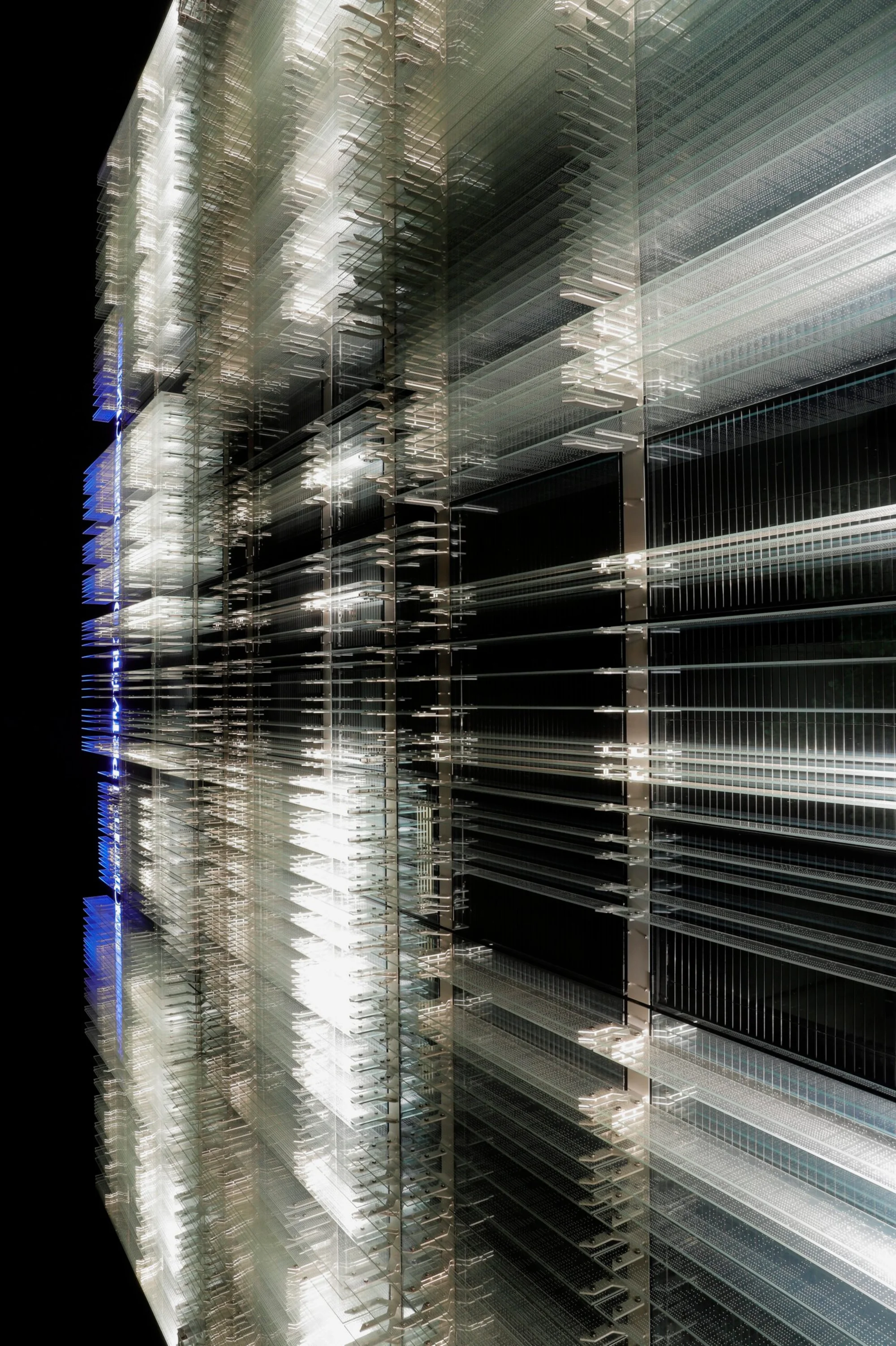
Nicolas Delarre has been photographing since 2018, with no training behind him: the practice was built shot by shot, on trips and through trial and error. What came out of it is a graphic kind of photography, given over mostly to architecture and macro – façades in Amsterdam, Vienna, Prague and Geneva, reflections in water mirrors, the spiral of a dahlia against black.
He calls it “photographisme”: revealing the structure of a subject rather than describing it. In practice that means leaving things out – passers-by, traffic, sometimes the vegetation – until a building stops being a building and becomes a composition. His series “Miroirs” doubles cities through their reflections; the flower work borrows Baudelaire’s “language of flowers and mute things”. He works from Lille, where he keeps returning to the same buildings until the picture he has in mind actually appears.
We spoke with Nicolas about where a photograph of a building ends and an image of its structure begins, the golden ratio as myth and as poetry, the limits of retouching, and how far he will go for perfect symmetry.
01 · Photographisme
Viacheslav Munister [VM]: You call your approach “photographisme”: revealing the underlying structure of a subject rather than representing it faithfully. Where exactly is the line between a photograph that shows a building and an image that reveals its structure?
Nicolas Delarre [ND]: For me the line probably lies in how I select from reality. When I photograph a building I rarely try to render it descriptively, in its surroundings. On the contrary, I try to isolate it from its context so the eye concentrates on its lines, forms, volumes, repetitions or breaks. A lot of that happens through framing: I keep out passers-by, traffic, sometimes vegetation, anything that doesn’t contribute to the graphic construction. In a sense I visually remove the context to bring out its graphic structure.
From there the building gradually stops being only an architectural subject and becomes a composition. A façade can become a set of lines and rhythms, a staircase a sequence of shapes, a structure almost an abstraction.
That’s probably where I would put the line: the moment you no longer look only at what the image represents, but at how its forms are organised inside the frame.
VM: Symmetry, central perspective, perfect geometry – these are also the tools of the architecture of power, of palaces and regimes that want to impress. What separates harmony from imposed order for you? Have you ever turned down a symmetry because it was too perfect?
ND: For me symmetry isn’t necessarily a synonym for imposed order. I see it first of all as a visual language.
A very rigorous symmetry can produce a feeling of harmony and calm or, on the contrary, of monumentality – depending on the architecture itself and what it holds.
So I don’t think I’ve ever given up a composition just because it was “too perfect”, but I may move away from one for reasons of personal taste.
On the other hand, if an off-centre composition or a break in the geometry seems more interesting to me visually, I can choose it – even though that happens rarely.
VM: You look for “an immediate visual impact, open to surprise and contemplation”. Don’t immediacy and contemplation pull in opposite directions? How can an image strike in one second and hold you for an hour?
ND: It’s an interesting question, because immediate impact and contemplation can indeed seem contradictory. But I see them rather as two successive moments: first the impact, then the contemplation.
Our eye is naturally drawn to symmetry and ordered structures. That overall construction works for me as a way into the image. Then comes what I would call “the multitude”: the accumulation of lines, forms, repetitions, contrasts, shadows or graphic details. It’s this richness that lets the eye move around the image, gradually discover new things in it and linger.
The impact draws the eye in; the multitude invites it to stay.
The impact draws the eye in; the multitude invites it to stay.
VM: When you reduce a building to its structure, it loses something: its use, its inhabitants, its noise, its history. Is that a loss you accept, or do you think the structure already contains all of it?
ND: Yes, it’s a loss I fully accept. When I photograph a building I’m not trying to give a complete representation of it, with its use, its inhabitants and all the life around it. I choose instead to isolate its lines and forms.
I don’t think the structure alone contains everything I leave out. It can carry traces of an era, a use or a history, but that isn’t necessarily what I’m trying to tell.
My approach is rather to visually remove part of the context so the building’s graphic structure comes through more strongly. What disappears from the image isn’t unimportant: it’s simply what I choose to leave outside the frame.
02 · Architecture and nature
VM: Your diptych speaks of “a language older than words”: the Fibonacci sequence, radial symmetry, the golden ratio. Many mathematicians consider the golden ratio a largely over-interpreted myth. Does the scientific truth of these patterns matter to you, or only their poetic force?
ND: The scientific truth of these patterns interests me, but it isn’t essential to my practice. The golden ratio is indeed often over-interpreted. In the plant world you find many arrangements linked to the Fibonacci sequence – in the placement of leaves and petals, or in certain spiral structures. But that doesn’t make it a universal law of living things.
What interests me more is that living things organise themselves and sometimes create a visual balance. Whether that balance matches a mathematical rule exactly matters less to me, in the end, than its graphic and poetic force.
In the living world perfect symmetry is very rare. What counts for me is felt symmetry, and that’s often what nature gives back to me when I go out to photograph.
Perhaps that’s exactly where this “language older than words” lies for me: in our capacity to feel an order, a rhythm or a balance before we even try to explain it.
VM: You borrow from Baudelaire “the language of flowers and mute things”, and from Chesterton the idea that the world will perish only for want of wonder. What has a poet or a writer taught you about photography that no photographer has?
ND: Baudelaire’s phrase touches me because it meets what I feel in photography. Some things stay silent until the moment you really decide to look at them. A flower, a façade or a repetition of forms can seem ordinary, then reveal something as soon as you give them attention.
Chesterton’s line about the want of wonder also stayed with me. I don’t hear it only in an aesthetic sense: wonder is also a way of looking at the world other than through usefulness, power or economic interest. It invites humility, reminding us that we are part of a world larger than ourselves.
I don’t think conflicts or political problems can be explained simply by a lack of wonder. But when we stop really looking at human beings, at nature and at what surrounds us, we risk reducing the world to what we can control, own or exploit. I find this idea in Edgar Morin, in the way he thinks about the links between the human, the living, society and the environment.
Some writers and thinkers may have taught me more about looking than photographers themselves: before making an image, you have to keep the capacity to be astonished by what is already there.
VM: You write that you look at architecture with an adult’s eye and at nature with a child’s. What would happen if you swapped them? Is there a building that makes you a child again, and a flower you look at like an engineer?
ND: I actually think these two ways of looking are less opposed than they seem. The Sagrada Família, for example, does that to me. There is something so teeming and unreal about it that I look at it first with astonishment, before I even try to analyse its lines.
Conversely, I can look at a flower very analytically. A simple dandelion interests me almost as a construction: its symmetry, the repetition of its elements, its extremely precise organisation can lead me to observe it with something close to an engineer’s eye.
In the end the two can follow one another quite naturally. First comes wonder, then the wish to understand visually what caused it.
VM: At the Micropia museum in Amsterdam you photograph replicas of Asterionella formosa and Heliosphaera – the image of an image. In “Miroirs” the city is doubled by its reflection. What draws you to these second-degree objects – models, replicas, reflections – rather than the thing itself?
ND: What I like about these second-degree objects isn’t so much their status as replica or reflection as the transformation of looking they allow.
An enlarged replica makes visible a structure that normally escapes us. A reflection doubles or transforms a piece of architecture and brings out a new composition.
In both cases reality is always present, but it becomes something else. It’s interesting to start from the real and draw out of it a more graphic, sometimes more abstract reading.
03 · Cities and mirrors
VM: Lisbon, Geneva, Prague, Vienna, Amsterdam, Annecy: in the “Miroirs” series, is the reflection an extra truth about the city, or a fiction it tells about itself? How many of these images came from chance – a puddle, a window – and how many from a long wait?
ND: In “Miroirs” chance actually plays quite a small part. Many of these images were thought out in advance, including the ones made with water mirrors. I look for these reflective surfaces deliberately, because they let me transform the perception of a place – double it, fragment it or sometimes strengthen its symmetry.
For me the reflection sits precisely between reality and fiction. It always starts from something real, but it offers another reading of it, sometimes almost abstract. So it doesn’t simply show the city as it is: it builds another version of it.
Of course a puddle or a particular light can sometimes trigger an image more spontaneously, but that remains fairly rare. In most cases these photographs are the result of intention and searching rather than chance.
VM: Amsterdam, Vienna, Prague and Geneva keep returning in your work. What does a city need for you to go back with your camera? And Lille – “Convergence”, “Tétris”, Lille-Europe station, the Palais des Beaux-Arts: is it harder to photograph your own city?
ND: I have a particular attraction to the architecture of Central Europe, but what really makes me want to go back to a city is the feeling that I haven’t exhausted its photographic possibilities. Some cities offer such a diversity of architecture that one stay isn’t enough. And the season, or simply a different route, can completely change the way you look at them.
Photographing your own city is different. Familiarity can make the eye less attentive: what you see every day sometimes ends up almost invisible. But that closeness is also an advantage, because you can go back as many times as it takes to find the image you’re looking for.
VM: Many of your urban subjects are contemporary glass-and-metal buildings: the Sluishuis, Geneva’s SPG building with its 2,900 glass louvres, the ÖBB tower. Do you photograph a building as the architect intended it, or against them? Has an architect ever reacted to one of your images?
ND: These are indeed buildings I’m very fond of. I don’t really try to photograph a building “against” its architect, but I don’t try to give a strictly descriptive rendering either. I start from what was designed, then try to offer my own reading of it – often a more abstract one, with a fairly pronounced perspective and a very graphic overall result.
I particularly love the moment when I’m searching for my shot – often without even having a camera with me. It’s clearly my favourite phase.
So far I’ve never had direct feedback from architects, apart from a few positive reactions on social media. I would really like to have their opinion one day and know how they see this interpretation of their own work.
VM: The Palais des Beaux-Arts in Lille lit up for Pink October, Mathias Kiss’s installation, Clarence Guéna’s “Aspersion” at La Manufacture in Roubaix: when light or another artist’s work transforms a place, whom does your image of it belong to?
ND: I think it depends a lot on how I encounter the work or the place. With Clarence Guéna’s Aspersion, everything was already there. The work, presented like a painting, appealed to me immediately. It was love at first sight and I felt no need to add any particular interpretation, so I simply photographed it on a tripod, descriptively.
With Mathias Kiss’s installation, reflections and symmetry were already fully part of the work. My role was mostly to deal with certain technical constraints of shooting inside the museum.
Pink October was different: the pink illumination was planned, but the rain wasn’t. The reflections on the ground brought an element of surprise and let me build a more personal image.
In all three cases the work doesn’t belong to me. That’s exactly why I always make sure to credit the artists. You also have to recognise that in these photographs they have already done a large part of the visual work. What belongs to me more is the way I decide to look at their work and photograph it. These photographs are above all a nod to their work – a way of saluting pieces that marked me.
The work doesn’t belong to me. What belongs to me is the way I decide to look at it.
04 · Black and white, retouching, print
VM: Why black and white for some series and colour for others? What does colour stop you from saying – and what does black and white force you to keep quiet?
ND: For me the choice between colour and black and white depends above all on what the image needs to say.
I use black and white when colour seems secondary, or even distracts from what makes the image strong: the lines, the forms, the contrasts, the shadows. It can also give the subject a kind of timelessness.
Conversely, some images need colour. It can be an integral part of the composition, create a balance or an atmosphere, or simply be what drew me to the scene in the first place. In that case switching to black and white would mean removing essential information.
So I don’t try to decide whether an image is more beautiful in colour or in black and white, but rather what is indispensable to its expression. Colour can sometimes say too much; black and white necessarily makes you give up part of reality. It’s a balance to find for each photograph.
VM: How much of the image is made when you shoot, and how much in development? Where do you draw the line of acceptable retouching in architectural photography – straightening verticals, removing a passer-by, a cable, a sign?
ND: For me the essential part of the image is built at the moment of shooting. I pay a lot of attention to the overall balance of the composition. That is when the image really exists.
Development comes afterwards as a finish. It lets me adjust contrast, highlights, shadows, colours, or sometimes correct the perspective, to get as close as possible to what I perceived on site.
As for retouching, I don’t remove elements from the scene and I don’t add any either. I prefer to work with what is really there at the moment of shooting, even if it means waiting, moving or changing my framing. I also sometimes go back to the same building several times to get the version I want.
The same goes for my flower photographs: as far as possible I try to get the effect I want in camera – for example by isolating the subject against a black background rather than removing its surroundings in post-production.
So my limit lies in the transformation of reality. I can correct or refine the image, but without altering its content. Of course that’s a personal approach that may change over time. Other photographers choose to go much further with retouching, and that can produce artistically very strong work. In the end it all depends on your own approach and the limits you set yourself.
VM: Your prints are limited to thirty copies, signed, on Hahnemühle Photo Rag. At a time when the same image circulates for free and endlessly on Instagram, what does the rarity of a print mean? What does a print say that a screen can’t?
ND: For me the rarity doesn’t lie in the image itself, since it can circulate freely and be seen an almost unlimited number of times, but in the photographic object.
A print is a physical object, with its own format, paper, texture and materiality – a photographic object you choose to let exist in a space. A screen remains an ephemeral luminous representation whose rendering can vary with its quality. A fine-art print on high-quality paper, on the other hand, fixes the final rendering more precisely, especially in the fineness of detail, the nuances and the matter of the image. Large format matters too: it gives the photograph an immersive quality.
For the photographer, the print is also the culmination of an image that has often been prepared for a long time. I always take real pleasure in going to pick up the final print from the lab.
That too is what the rarity of a print means to me: not making the image inaccessible, but giving a photograph a physical, lasting existence.
VM: Tell us about an image the public loves that doesn’t satisfy you, and one you stand by that leaves people indifferent. What does that gap teach you?
ND: A photograph of the Karlskirche in Vienna was very popular, while I remain rather mixed about it. I like the image, but I would have wanted the human presence to be more discreet. An event was running for my whole stay and I had no chance to make another version in calmer conditions.
Conversely, a photograph made in Amsterdam of an avenue of trees in winter got far fewer reactions than I had imagined. I had put a lot into getting that shot, and I think the effort had also created a particular expectation in me. So I was surprised it left the public more indifferent, while I still like it very much.
Above all, this gap teaches me to separate my own eye from the public’s. A photograph’s success doesn’t necessarily mean it fully satisfies me, and the indifference it meets doesn’t necessarily call into question the interest I have in it.
05 · Doubts and horizon
VM: What is the biggest misunderstanding about your work?
ND: Perhaps the idea that my images are largely constructed in post-processing. Their very graphic, geometric or symmetrical look can sometimes give that impression, whereas for me the essential part happens at the moment of shooting: the choice of viewpoint, focal length, distance and framing. Post-processing comes afterwards as a finish, but it doesn’t create the structure of the image. Above all I try to reveal an organisation that is already present in reality.
Another misunderstanding would be to think I pursue graphic perfection for its own sake. Geometry and symmetry are above all ways for me to guide the eye and bring out something I have seen.
VM: What did you have to give up – a way of photographing, a series, a certainty – to get to what you do today?
ND: Above all I had to give up the need to press the shutter. Over time I’ve become more demanding about what really has to go into the image. That had a price: a degree of spontaneity, and the ease of photographing without asking myself questions.
Today I can spend a long time looking for an angle, go back to the same place several times, or simply give up if the conditions don’t match what I imagine. An outing no longer has to produce a successful image: coming home without a photo isn’t a failure, it’s part of the process.
At heart, I photograph less easily than before, but with a much more precise intention.
Coming home without a photo isn’t a failure, it’s part of the process.
VM: If you could photograph only one building for a whole year, which would it be, and why that one?
ND: Probably the Sagrada Família. I’ve been there, but it was at the very beginning of my photographic practice. Today I want to go back with more experience. It’s a building that offers many possibilities, especially with the stained glass and the coloured light that moves through the building over the course of the day. It’s exactly the kind of place you can return to again and again without really taking the same photograph twice.
VM: A project in progress, an upcoming exhibition, a place you dream of photographing?
ND: I don’t have a specific project in preparation right now. Eventually, though, I would like to build an exhibition around the architecture of Central Europe, a region I particularly love to photograph and where I want to keep travelling. It’s only a wish for now, but it’s probably the project I would most like to see take shape in the years to come.
VM: A question we should have asked you – and your answer.
ND: Question: How far are you prepared to go to get perfect symmetry?
Answer: Apparently as far as lying on the floor in the middle of a library. At that point I’d rather not know what the people around me are thinking.
Nicolas Delarre’s photography can be seen at nicolasdelarre-photography.com and on Instagram at @photo.graphizm . Images © Nicolas Delarre; published with permission.