Javier Ordóñez: Iron, Sand and Colour
Interview
The Bilbao painter and sculptor on his great-grandfather in the iron mines of Bizkaia, slag turned into painting, abstraction as jazz, Altamira, tiredness as an engine, and paintings that are never finished: they are abandoned and shared.
Viacheslav Munister & Javier Ordóñez · 2026-11-12
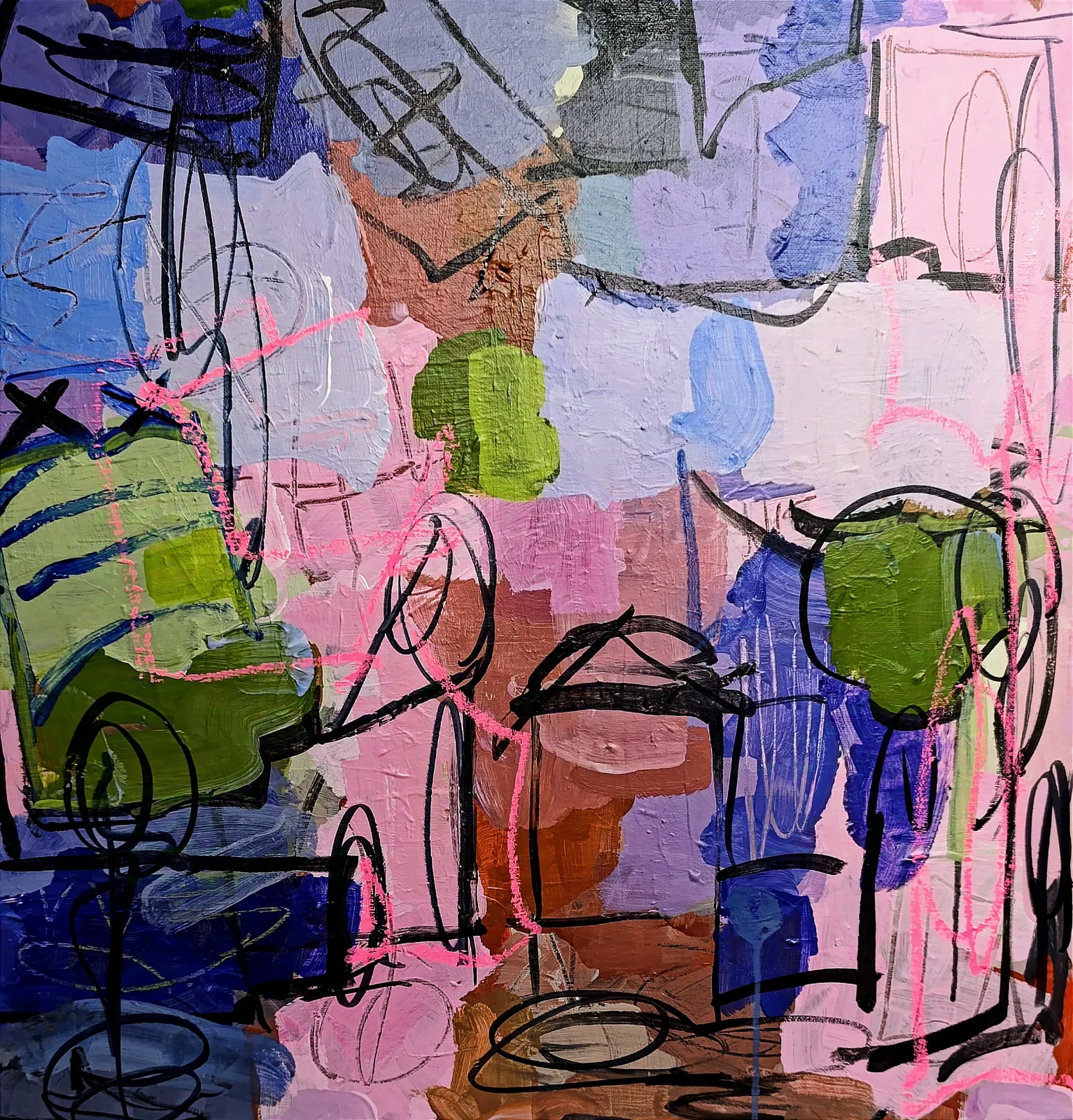
Javier Ordóñez does not paint a landscape: he reduces it. He takes a valley, a volcano or iron slag and brings it down “to its barest expression”, until all that is left are masses of colour, tinted sands, metal powders and Corten steel rust on a handmade wooden stretcher. He was born in Bilbao in 1960 and began studying painting in 1971; from 1976 he went on by himself, through masterclasses, gallery and museum visits and materials demonstrations. Today he has studios in Bilbao and in Cantabria, and sees himself as an artist in continuous training, “researching and innovating”.
He works in two lines that, in his words, share only the artist and a few techniques: Escorias de Hierro (Iron Slag), a tribute to the workers of the mines and foundries of Bizkaia, in paintings and in sculptures he calls Blocks; and Figuraciones Cromáticas (Chromatic Figurations), deconstructed, colourful landscape. In 2025 he brought both together in Migraciones (Migrations) at the La Vidriera Cultural Centre in Camargo, with more than sixty works. He shows at fairs and galleries in Bizkaia, Cantabria, Araba, Madrid and Barcelona, and has been a member of the Asociación Artística Vizcaína since 2002.
Part 01 Bilbao, the great-grandfather and the craft
A boy who drew in Bilbao
Viacheslav Munister [VM]: You were born in Bilbao in 1960, a city of blast furnaces, shipyards and smoke. What was that city like for a boy who drew? Javier Ordóñez [JO]: The city was hard, industrial, with a lot of social and labour conflict. Endless working days. But above all, the people were very involved and helped one another. As a child I was interested in artists and their work. At the Bilbao Fine Arts Museum I used to play at guessing the artist whenever I saw a painting. It was a childhood to remember: there were few cars, and we played in the street with the other children with a lot of freedom.
VM: Who took you to the academy, what did you learn there that you still use, and what are you studying now, more than fifty years later? JO: I sometimes went with my father to the Bilbao Fine Arts Museum to see the great masters of painting. My brother, who knew how interested I was, took me to an academy with students from the Faculty of Fine Arts, and I began to train with them: drawing, colour, painting, making acrylics, the figure, painting outdoors and, most importantly, a free idea of art without academic ties. Those were years of discovering different techniques and theories. As you say, I see myself as an artist in continuous training, researching and innovating. Right now I am studying cyanotype. I would like to fuse it with painting and see whether it can go somewhere with my style.
The great-grandfather and the slag
VM: The Escorias de Hierro series is a tribute to your great-grandfather. Who was he, and what do you remember of him? JO: My great-grandfather worked and lived in the iron mines of La Arboleda and Gallarta in Bizkaia, from the end of the nineteenth century to the beginning of the twentieth. The Escorias de Hierro series is a tribute to the workers of the mines and foundries, who had very gruelling jobs.
Rather than memories, since I never met him, they are conversations I had with my grandfather and my father. Hard years for work.
VM: What does it mean to turn the waste of an industry into a painting: memory, tribute, a settling of accounts? And how do you paint work that no longer exists without falling into nostalgia? JO: In my series it is indeed memory and tribute. Mining and its supporting industry were hugely important in Bizkaia. For me, the way to find the essence of these activities lies in the slag, which is the end of a process, and then to join it with paint and other additives. The ferrous colour, its textures of tinted sands, metal powders, liquids obtained by oxidising Corten steel, all of it mounted on a handmade wooden stretcher, form a whole to be seen, felt, and to take you back in time.
Every time I work on a sculpture or painting in this series there is a sentimental part; I think the way people take to this series comes from memory.
From the figure to abstraction
VM: You started in figuration, and for about twenty years you have focused on abstract expressionism, “where I have found my place”. What did you have to leave behind, and was there a particular day when you knew? JO: Artists are always evolving. What I left behind in figuration is the understanding of a public who looked at my work and did not have to think: they simply liked it or not. Abstract expressionism is total improvisation: you play with the materials, with the paint, you let the materials work on their own, you keep what you like, it is endless. Every time viewers look at the work, new feelings are stirred in them. It is like jazz: improvisation again and again.
There was no particular day when I moved to abstraction; it was more of a need. There came a moment when I decided to paint because I like it, not to be liked.
There came a moment when I decided to paint because I like it, not to be liked.
VM: What remains of the figure inside an abstract painting? JO: The figure in an abstract painting is the essence and the deconstruction of the human figure. It is sensing a neutral character: whether it is a woman or a man, the viewer decides.
VM: What does “finding your place” mean when you also say one has to keep changing? JO: Let me give you an example: I have been working in abstract expressionism for years, and within it you always have to innovate. You cannot stay working with the same materials, sequences or rhythms; you want your work not to be flat. As for finding my place in art, I think I am in the right place. I feel good about what I do, and I feel I am honest with my public.
Part 02 Landscape as abstraction
The barest expression of a valley
VM: You say landscape is itself an abstraction, and yet your titles name real places: Paseando por Cantabria (Walking through Cantabria), Valle del Asón (The Asón Valley), Urdaibai. Why keep the name of the place if the shape can no longer be recognised? JO: I like to give the viewer a clue, so they know the inspiration comes from a real place and can recognise themselves in the colour and in its forms, deconstructed to their barest expression. It helps people understand the work. Many of my works I identify with a number, or they are simply untitled; it is up to the viewer to give them a name if they want.
VM: What is the barest expression of a valley: a colour, a line, a texture, a memory? JO: I reduce it to different masses of colour, with some materials that I add to the work to hint at natural forms. I look for an image that brings on a longing for the land it shows, and lets whoever looks at it give free rein to their imagination and build their own image in their head. Freedom of interpretation.
VM: Do you paint in front of the landscape, from memory, or from within? JO: They are usually studio works, based on photographs from my travels, but it is true that I paint from within, because I want to put my state of mind into the work. It is important to show these states through colour: joy, sadness, excitement, ecstasy and so on.
Timanfaya and the Palaeolithic
VM: In 2014 you began a series on Timanfaya Natural Park in Lanzarote, and in 2019 you painted Viaje al Paleolítico (Journey to the Palaeolithic). What took you to Timanfaya, and where did that painting come from? JO: I had a trip to Lanzarote I had long been meaning to make, to Timanfaya Natural Park specifically, precisely because of those abstract shapes and those very special rocks you can see there, as inspiration for different works I had in mind. I have made a few pieces about Timanfaya, but I need to go back and keep exploring its textures. It is a wonderful park for artists. As for Viaje al Paleolítico, it is inspired by the caves of Altamira in Cantabria, the Sistine Chapel of cave art. They are so impressive that they leave no one indifferent. That is where this work comes from, and it will not be the last.
VM: Is abstraction a modern form, or the oldest one we have? And what does a painter today feel in front of hands painted in a cave thousands of years ago? JO: The more you learn about the different artistic currents, the more you realise that everything has been invented already; what is left to you is to develop and innovate on something known, which gets a more or less eye-catching name. It is presented as something new, but in my opinion abstraction is an ancient evolution. A hand painted in a cave thousands of years ago makes you think that human beings have not evolved that much artistically, that they keep to their roots. I think that is good for our technological society. We have to look back at our history to learn again what we have forgotten.
A hand painted in a cave thousands of years ago makes you think that human beings have not evolved that much artistically, that they keep to their roots.
Between Bizkaia and Cantabria
VM: Your studio sits between Bizkaia and Cantabria. What does it mean to work between two lands: two lights, two landscapes, two ways of being? JO: My heart is split between two wonderful lands: Bizkaia, where I trained, and Cantabria, where I spend long stretches. In Bizkaia I work on small formats and in Cantabria on large ones; pure logistics, really.
My heart is split between two wonderful lands
It is true that in Cantabria I work more with light and with less harsh colours. In Bizkaia the colour is more industrial: greys, reddish tones, less light. The natural surroundings of both lands do have an effect.
VM: The Basque Country has a very strong abstract tradition, from Oteiza and Chillida to Sistiaga. Do you feel part of it, or would you rather stay on the edge? JO: My feeling is that art has no borders, but where you make your work does have an influence. In the Basque Country I have many great artists as references, since I was lucky enough to grow up alongside them. The twentieth century was a great century for Basque artists, who set the standard. A pleasure to have crossed paths with them and to enjoy their work.
VM: In 2013 you wrote a blog post about José Antonio Sistiaga, “With Sistiaga at Galería Kur, Donostia”. What did that meeting mean to you? JO: Sistiaga was a very kind and open person. A great artist with a completely contemporary vision. Meeting him was pure Basque art history. We met at one of his exhibitions at Galería Kur in Donostia, and its director, Juanma Arriaga, took a photo of us. Sistiaga’s death in 2023 was a sad day, because he was the last member of the GAUR group; the artists of that group were Oteiza, Chillida, Basterretxea, Mendiburu, Ruiz Balerdi, Zumeta, Arias and Sistiaga himself – I don’t think I have left anyone out. All of them very important in the art history of the Basque Country.
Part 03 Matter, tiredness and method
Wood, sand and cardboard
VM: Abstract expressionism is usually associated with gesture and poured paint; you build, glue, layer. What does sand do that paint cannot? JO: Sand is the heart of the Escorias de Hierro series: I tint it, look for the right density, and mix it with Corten steel rust until I find the texture for each work. After that the materials speak for themselves. Gesture and thinned paint are very important, but when you work with sand it acts as a filter in the work and softens its effect, which does the final finish a lot of good.
VM: Where does gesture end and construction begin? And if “less is more”, how do you know what to take away, and when a painting is finished? JO: In my work the gesture never ends, although I have to be very careful, because I suffer from a tendency to the baroque. In abstraction, construction comes by itself with experience. I take materials away and add them until the work is adjusted to my taste. Paintings are never finished; they are abandoned and shared. That well-worn phrase was one of the first things I was taught.
Paintings are never finished; they are abandoned and shared.
Migrations and tiredness
VM: Migraciones, you have said, was born of a need to change: “When I get tired, I switch from Figuraciones Cromáticas to Escorias de Hierro.” It is an unusual confession, tiredness as an engine. What migrates from one series to the other, and what stays behind? Are they two languages or two moods? And why is changing, for you, a way of staying honest with the work? JO: I will answer these three questions together, because they are completely bound up with one another. In this exhibition I showed two entirely separate lines of work: Escorias de Hierro and Figuraciones Cromáticas. What migrates from one line to the other is knowledge and some techniques the two have in common; what stays behind is a temporary tiredness, until I come back with more energy. One, as I explained, is more industrial; the other is deconstructed, colourful landscape. The two series have only the artist and a few techniques in common. These series come from my need to switch off completely when I have been working on one of them for a while and feel overwhelmed, low on energy and wanting a change. When you have been working on a series for a long time, exhaustion and block set in, and at that point I move to the other line of work. It is a way to start on another technique and rest from the previous one.
Freshness and new ideas come back again, and it is a way out for me; it is also the way to be honest with my work and with the public who follow me. The title of the exhibition, “Migraciones”, sums the show up.
Untitled
VM: Many of your works are called “Untitled” or carry a number; others, like Solo cine (Only Cinema), tell a story. When does a painting deserve a name, and when is it better left silent? JO: It is strange, but when I give something a title, I do it before I start the work, and its whole process revolves around the title. I don’t know whether other artists do this or wait until they have finished.
When I number them, it is the same as with the untitled ones. But in that case the number stands for a date, because I want to keep firmly in mind when I made it. For example: 139 (September 2013), 148 (August 2014). When a work is untitled, it is because its whole process is not conditioned by anything outside; I look for freshness and for the materials’ own surprise until I get something beautiful. The title is secondary. I leave most of my works silent, untitled. I don’t want to give the work more importance; its value lies in itself.
VM: Does a title help the viewer, or take away their freedom? JO: I have always felt that a title helps the viewer; it is a small guided tour of the work, but it clearly conditions them.
VM: And what is the story behind Solo cine? JO: I am quite a film buff, and I wanted to pay a small tribute to the seventh art through abstraction. I would like to make a small series; what I lack is time. It is on my to-do list.
The third dimension
VM: Your Instagram says “Painting and Sculpture”, and in a highlighted story you appear next to a large blue sculpture, yet there is hardly anything written about your sculpture. When did the third dimension arrive, and what does it give you that painting did not? JO: Let me clear up one detail: in the photo where I appear with a large blue sculpture, the sculpture is a Menina by the great painter and sculptor Manolo Valdés. It belongs to an open-air exhibition the artist held in the city of Santander in 2025. Sculpture is giving me a great deal of satisfaction; with the Escorias de Hierro series I felt the need to carry 2D over into 3D, and it has been a hugely important success. They usually come in pairs, painting + sculpture, made with the same materials to form a 2D+3D diptych. What it gives me within the same series is endless different possibilities, and reaching aesthetically where I could not reach in two dimensions. I call the whole series of sculptures BLOCKS (Escorias de Hierro series), and visitors to my exhibitions respond to them very well.
VM: Are the sculptures paintings that have stood up from the wall, or something else? And what are those “other notions” on your Instagram? JO: The process goes like this: first they were born to hang on the wall, but they have leapt into space. For now they are small-format sculptures, meant for interiors, homes, offices and so on. I don’t rule out making them large. The other notions are studio experiments that mostly never see the light of day: sketches, small sculptures, watercolours, drawings and so on. They are the catch-all drawer most artists have.
Part 04 The others: competitions, association, viewer
Competitions and association
VM: Between 2000 and 2013 you won prizes in competitions, among them first prize in the 6th Bizkaia Provincial Christmas Card Competition (2006) and the “Deusto Bizirik” quick-painting prize (2008). Quick painting means finishing in hours; abstraction seems to ask for time. What did competitions teach you, and what did they take away? JO: I have to say I am no fan of competitions. For a while I wanted to take part to see how my work was received; they were mostly competitions for finished work, and I was interested in how the judges took it. On the whole the result was positive: prizes, honourable mentions, finalist. A sign that I was on the right track. Quick-painting competitions are not for me. I do have a couple of prizes, but I am more of a studio mouse. The truth is that competitions have added little to my career as an artist. I am more about the studio: putting on music, working and exploring.
VM: What does an artists’ association give you that a gallery does not? And is competition good for art? JO: An association makes contact with local authorities easier, lets you into the city’s exhibition circles, trade experiences with other artists, attend masterclasses and get better advice. Working with a gallery is more professional and commercial. Competition between artists is good at the start, if you take it as one more subject: you feel the pressure and try to get as high as you can. It is negative once you have some experience behind you and need to let your work mature calmly.
The painting and the person looking at it
VM: An abstract painting asks the viewer to complete it. What do you hope someone sees in front of Viaje al Paleolítico or an Escoria de Hierro: a place, an emotion, nothing in particular? JO: What I hope is that when they see them, they go back in time and are moved by their own memories. With Viaje al Paleolítico, that they remember the cave they visited as students, when their teacher explained the story of evolution. With Escorias de Hierro, the times they saw industrial ruins, when they studied the Industrial Revolution. Those small things that move us and fill us with nostalgia.
VM: What happens to a painting when it leaves your studio and goes into a home? JO: Personally, it makes me happy. I tell everyone who takes a work home the same thing: “enjoy it”. Don’t choose anything you don’t like, even if they tell you it is a good investment: you will soon tire of it and sell it or push it into a corner.
Don’t choose anything you don’t like, even if they tell you it is a good investment: you will soon tire of it and sell it or push it into a corner.
The people I am close to usually send me photos once they have hung them, and the feeling is mutual: they are happy and I am satisfied, because the work has found its place.
Interview by Viacheslav Munister. Answers by Javier Ordóñez, translated from the Spanish (the original is in the Español version of the site). Questions have been shortened. All works and photographs courtesy of the artist and © Javier Ordóñez.