Gayane Arushanian: Home Is Something You Carry
Interview
A Ukrainian artist of Armenian descent, now between Miami and Kyiv, on balance that is earned rather than given, a series that began as a paper game and turned out to be a factorial, and why she refuses to read her work only through war.
Viacheslav Munister · 2026-10-15
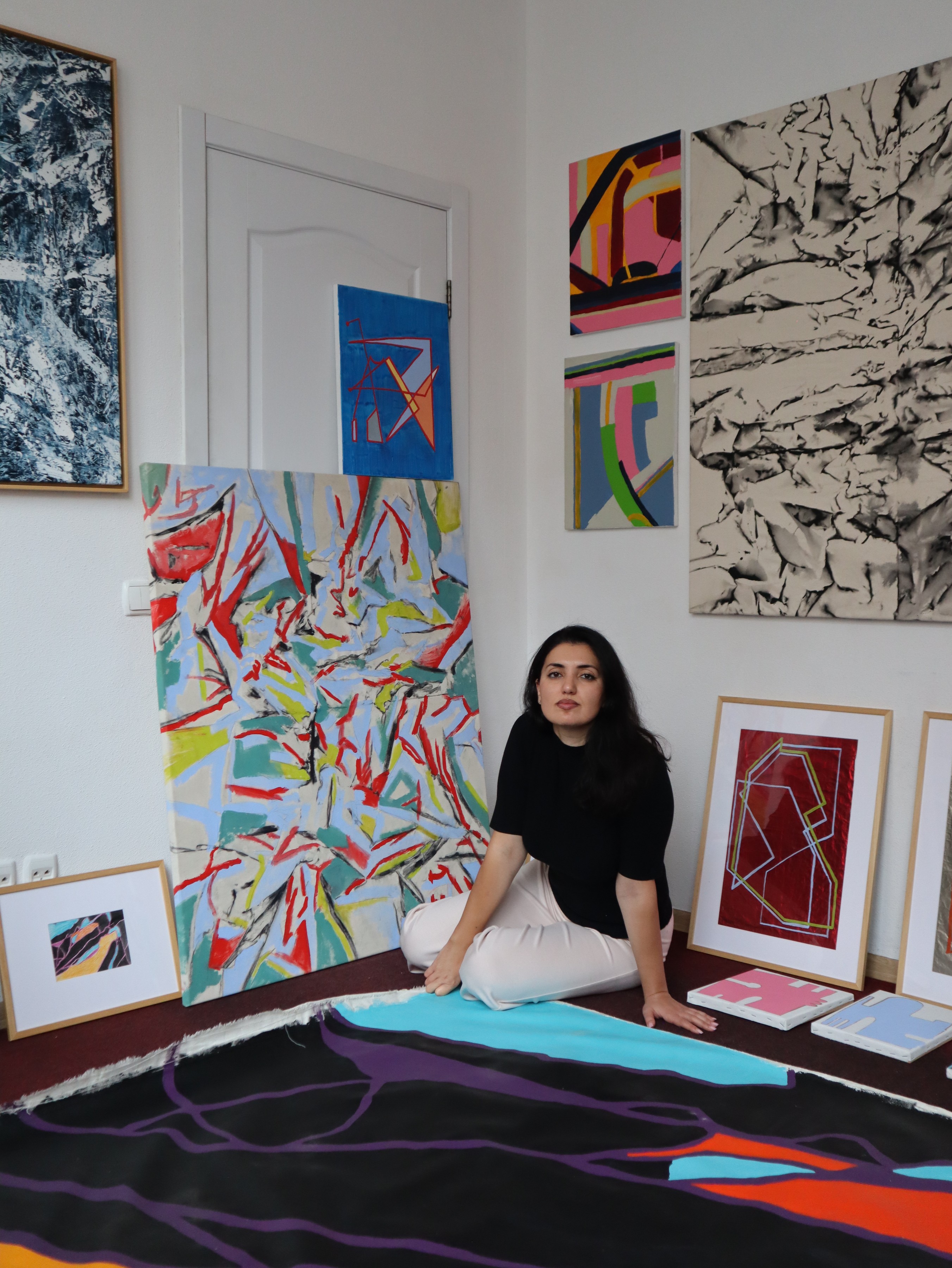
Gayane Arushanian is a Ukrainian multidisciplinary artist of Armenian descent. She was born in Nagorno-Karabakh and came to Ukraine as a child, when war forced her family to flee. She studied at the art school of the Children’s and Youth Creativity Centre in Zaporizhzhia, then took two degrees at once, in industrial architecture and in economic cybernetics. Her main series are IMMERSION. Lapis Lazuli (since 2016), Equilibrium (since 2017) and Abstract Animals (since 2022).
She has had solo exhibitions in Zaporizhzhia and Kyiv, and has shown in group exhibitions across Ukraine (Kyiv, Lviv, Zaporizhzhia, Odesa, Dnipro, Kharkiv), in Germany, Italy, Poland, Spain and the United Kingdom, and in the United States at CONTEXT Art Miami during Miami Art Week. She founded G-ART STUDIO in Zaporizhzhia (2012) and Dnipro (2016), and the School of Experimental Art in Kyiv (2017), which she reopened in 2024 after a pause caused by the full-scale invasion. She now lives and works between Miami and Kyiv.
We asked her about home, hidden order, the body’s sense of balance, and what changes when a painting steps out into space.
01 · Memory and home
You were born in Nagorno-Karabakh. In 1992 war drove your family to Ukraine, and thirty years later another war made you start your life over, this time in Miami. You have said you began drawing at ten as a way of healing. Is your art still an answer to the loss of home, or has it become something else?
Both wars were a litmus test for me. Cruel as it may sound, life is sometimes like that, and the history of art shows how many artists have faced war, and more than once. For me that experience became a push to create even more loudly. It was in the face of destruction that I understood how much I am an artist. That is what war did to me.
Crises, moments of inner crisis, made me express myself through art all the more. On the edge of war and death you feel love and the wish to live even more strongly.
Your 2025 exhibition at Mlyn Design Hub was called Where Home Begins , and your profile says simply HOME. Someone who has lost a home twice has a particular right to ask where it begins. So where? In the body, the language, memory, the studio, other people, or the work you carry from country to country?
When I read this question, tears came to my eyes. I understand how deep it goes, and I remember the whole road behind it.
I would put it this way: only a person’s inner truth gives birth to a place we can call home. Perhaps you could call me a cosmopolitan; that is how my life has turned out. What inspired me, interestingly, was the film Home by the French director Yann Arthus-Bertrand. People divide absolutely everything. Yes, the world we live in doesn’t exist without such divisions either. But I understood, once and for all: home is me, and wherever I am, I carry that meaning with me.
It is my inner truth, from which I create this home and in which meanings are born. They are the patterns I have understood and seen, and that I pass on through the art I make constantly. For me everything is born from the heart, from a pure love for everything that exists.
So I wouldn’t want to divide it into the body, the language, memory, people or the work. All of it is part of my truth. I carry all of it with me.
But of course my home will always be my Armenia, my Nagorno-Karabakh, to which I cannot return. And my Ukraine, the way I lived it, the way I felt it, the way I carry it inside me.
All of it is part of my truth. I carry all of it with me.
Armenian roots, a Ukrainian upbringing, an American present. Which of the three is most present in your work, even when you don’t call on it? And has a viewer in one country ever seen something in a painting that viewers elsewhere didn’t notice at all?
I can’t separate the parts that make up who I am. You can’t throw part of your life out of yourself. My Armenian roots influenced me greatly, and each of these cultures has its share in who I am.
But if we’re talking about which is most present in my work, it is without doubt my Ukrainian formation. More than thirty years of my life were lived in Ukraine. That is where I took shape as a person and as an artist. Ukrainian reality, life in Ukraine, the opportunities I created there and keep developing beyond it – all of that formed me. So I am a Ukrainian artist of Armenian origin. And living abroad, I keep shaping my vision.
As for viewers – yes, some Armenians noticed in my Abstract Animals , especially Abstract Animal II , a resemblance to Armenian khachkars. They saw something Armenian in it. Even in fairly abstract works, a deep or bright red was read as Armenian temperament, emotion, a link to the roots.
What’s interesting is that nobody – at least nobody who said it to me – has ever said, “This is something Ukrainian.” But I don’t create specifically Ukrainian images; there are no direct references to traditional Ukrainian motifs in my work. Ukraine formed me, and that influence shows in how I feel, see and create.
At the same time, I wouldn’t say Ukraine feels very different from Armenia when it comes to colour. Maybe that’s why I found myself in both. To me both peoples are warm and sincere, and both cultures are very rich in colour. So here too it’s hard for me to say where one ends and the other begins in my work.
Many artists who have lived through war say they don’t want their work read only through trauma: it is both true and a trap. How do you feel about curators, journalists and collectors so often starting the conversation with war – us included?
I’m calm about it, including in this interview, because I have accepted the experience of war as part of my path. I don’t separate myself from it. I don’t call it only trauma, because it has become part of my life. It is what shaped me.
02 · Cybernetics and hidden order
You have two degrees – architecture and economic cybernetics, the science of control, feedback and systems. You say you look for “hidden order behind what seems to be chaos”. Yet abstraction, from Kandinsky to Pollock, was often a revolt against order. Are you closer to the engineer who decodes a system, or to the artist who lets it break?
Chaos doesn’t exist without order, just as white doesn’t exist without black, or light without darkness.
Engineering and economic cybernetics are closely tied to physics and higher mathematics. For me they are sciences of the patterns that lie at the root of life. Still, I don’t consider myself an engineer. I don’t build systems by strict rules. And even if I had the chance to build something, I’d be interested in breaking those rules, in making something that goes beyond them.
Your series Factorials was, in your words, a response to rupture, exploring “the inner structures of influence within a system”. A factorial grows explosively: each new element multiplies all the previous ones. Did you think of the mathematical metaphor literally? Which system did you mean – family, country, self, the world – and what broke in it?
Before I started, I didn’t think about a mathematical metaphor. It was pure creation. The very first object was made of paper. I was making the elements of a sculpture, tearing them, opening and closing them in my hands, watching what happened. It was like a game. I opened one element and saw that the whole picture had changed. At some point I thought: “But this is a factorial.” It even reminded me of that school lesson where we were told about factorials.
I never take a mathematical formula and set out to depict it. First something is born in a creative state, and then I recognise in it something that is already part of my world. But it could be named quite differently, too. That’s exactly why I adore abstraction: it has an endless number of names we can give it.
At first it was simply a visual system for me. Only as I went deeper into the series did I understand that it is about any system: a country, a family, oneself, education. And what broke in it? Nothing broke. Every small part affects the system and at the same time creates it.
Chaos doesn’t exist without order, just as white doesn’t exist without black, or light without darkness.
You call your abstractions “visual formulas” that translate emotional and spiritual experience into colour, line and composition. A formula should be reproducible. Can the same painting be painted twice? What in its “formula” cannot be expressed in words?
That is exactly why it is art. My abstraction depicts a system but is not a system itself. It is about those patterns, yet it can’t be reproduced by formula. That is where its artistry lies.
I have never set out to paint the same picture twice. For me, abstraction is an entirely creative process, and repeating it exactly is almost impossible.
What cannot be expressed in words in this visual formula is the meaning and the energy I create with – the force that drives me to do it. The emotional and spiritual experience itself: all the emotions and sensations I put into a work.
I never create just to create. I create because I live it. Everything in my art is something I have lived through. Those experiences are part of who I am.
For you colour is “vibration” and “sensory memory”, not an aesthetic choice. Name one colour in your work and the memory it carries. Is there a colour you refuse to use because it remembers too much?
There is a lot of blue in my work. My connection to that deep, deep blue began in Zaporizhzhia. I used to go down to the Dnipro and could sit for hours looking at the water. Then I saw a slightly different shade of that blue in the sky. And in Kyiv it gained a special depth: very deep, yet bright. All these shades of blue and azure come through in the Lapis Lazuli series. So much in my art is connected with these colours.
As for a colour I refuse to use – there isn’t one. I give myself the freedom to use any colour. What kind of artist would I be if I limited myself? For me art is born from freedom.
03 · Equilibrium
Equilibrium emerged as a meditative exploration of balance in unstable times. How did your understanding of balance change after 24 February 2022? Doesn’t balance now look less like calm and more like the tension between two forces that could tear each other apart at any second?
Editor’s note: our original question dated the series to 2021; the artist corrected this in her answer below, and the question has been adjusted.
Let me clarify first: the Equilibrium series began to take shape in 2016–2017, especially in 2017, when I moved to Kyiv. It didn’t appear in 2021.
Balance has never been absolute calm for me. It is the simultaneous existence of all forces. One doesn’t exist without the other – that is the pattern. It can manifest as tension between two forces or as a state of calm. For me balance is a single whole that can show itself in very different ways.
After 24 February my understanding of balance didn’t change. On the contrary, to some extent it helped me live through the horror. I knew there was another side to that experience – love, an incredible desire to live and create. I’m not saying I knew when the war would end or what would come next. But I already felt that counterweight to destruction. For me that doesn’t contradict balance. And at the same time it doesn’t mean it is calm or easy.
Balance is easy to paint as symmetry, but symmetry quickly goes dead. Where in your compositions is instability deliberately built in? Tell us about a work where you searched a long time for the point where everything holds.
Balance and symmetry are different things for me. If we mean absolute symmetry, complete sameness – in nature I see something else: repeating elements that change every time and together create an overall system. There is the power of nature in that chaos.
In the Equilibrium works I deliberately created disruption – destruction, you could say. But everything holds not on a single line but on the whole pattern, which never repeats exactly.
At first I simply crumpled paper in my hands and watched how the folds appeared and how the form changed. Observation is very important to me in general; I watch everything. Later, on Tenerife, I saw a similar pattern in a rocky mountain, in the way the split stones had settled. All the elements are different, yet together they create something incredible.
Later still, in 2023, when I came to Miami for a few months and saw the extraordinarily beautiful Villa Vizcaya, I was struck by another instance of creation and destruction coexisting. At the time Vizcaya was being built, in another part of the world the Armenian genocide was taking place in the Ottoman Empire. And I myself, in Miami, seemed to be living in another reality while the war went on in Ukraine.
So destruction and creation exist at the same time. I see it in nature, in history and in my own life.
You paint large canvases that are physically hard to move and hang alone. Is balance felt by the body – when you work on a canvas taller than you, on the floor, with tape and a sponge? What does the body know about composition before the head does?
Of course, the body knows and feels its own laws of balance too. Look at yoga or at athletes: our bodies can maintain their balance in very different positions. We’re used to walking on our feet, but we can learn to stand on our hands. It’s a skill we acquire gradually.
Working on a canvas bigger than you is physically harder. But over time the body gets used to it: you develop control over your hand movements and get used to the scale. It’s like learning to shade with hatching: at first your muscles may ache, then the movement becomes natural.
So I’d say the body adapts. It finds its balance as we work with the material and on the surface.
So destruction and creation exist at the same time. I see it in nature, in history and in my own life.
04 · Space: sculpture and transformational objects
Your profile says “Creating transformational spaces”. What has to happen to a space – and to the person in it – for you to call it transformed? How does an object that changes a room differ from an expensive interior accessory? Where is the line between art and design, and does it still exist?
For me a space should coexist with a person’s inner world and transform along with it. If it doesn’t match your inner state, it’s like clothes in which you don’t feel like yourself. Through art a collector fills a space with meanings and with the energy they want to feel in it. I’m convinced that an artist puts their energy into every work.
For me, the distinction between art and design lies in function. Design usually serves a particular function. In art, we can go beyond function: rather than make a work fulfil a practical purpose, we can explore meaning and pursue the questions we seek to answer. At the same time design can also be art. For me the objects made at the Bauhaus are an example: they combine function with artistic vision and reflect the spirit of their time. Art carries the imprint of the time in which it is created.
Art can be decorative, but decoration isn’t its purpose. And decoration isn’t always art – it doesn’t aim to be anything more than decoration.
It seems to me that time often determines what is art and what remains mere decoration.
Your educational background is in architecture and construction. Your sculptures and relief works suggest a return to your architectural roots: a flat shape is cut out and gains thickness, shadow, weight. What does the third dimension give you that canvas doesn’t? And what do you lose when a painting steps out into space?
The third dimension lets me feel form with my hands. Of course, you can paint with your hands too, but I want to go beyond the plane of the canvas and feel space. Through sculpture I create that space myself. I like that feeling, and I want to pass it on.
Do I lose anything? I don’t see it as a loss. For me it is one more way to create and to feel.
The language of your objects – streamlined silhouettes, cut-outs, openings, planes of pastel and saturated colour – recalls an architectural drawing, a child’s stencil and a sign all at once. Where do these forms come from? Do you draw them by hand or construct them geometrically – and has a form ever appeared “by itself” from a mistake or an offcut?
Most often, a form emerges intuitively as my hand moves. I start drawing and it simply takes shape. Sometimes I let chance influence the process, but a form rarely comes from an offcut.
And sometimes an image comes to me. That is exactly how I describe it: “An image came to me.” It’s like an imaginary screen in front of me on which I see something. Some images come in dreams. Sometimes, while I’m drawing, I can already visualise the entire form in three dimensions, including its geometry, rather than just as a flat shape.
I never sit down thinking, “Right, now I need to come up with something.” Everything is born from within. Of course I was influenced by technical drawing, which I loved at school, and by architecture. I love architecture very much, and it is part of my vision too.
Sculpture has a physical presence and weight, and some works can be difficult to move. Someone who has had to rebuild their life several times suddenly makes objects built to last. Is that chance – or a way of finally taking root?
I see it neither as a coincidence nor as an attempt to put down roots. For me it is the desire to work with space, with matter: to feel it and shape it – stone, clay. That feeling can’t be replaced by anything.
Taking root may come as a result, but it isn’t my aim. When I want to make something, I don’t start by thinking, “This will be heavy, it’ll be impossible to move.” Yes, it can be physically hard. But for me, the desire to create comes before concerns about the practical difficulties. That matters a great deal to me.
05 · The market, teaching and honesty
You exhibited at CONTEXT Art Miami in 2025 during Miami Art Week, with tens of thousands of visitors, thousands of works and a few seconds per piece. How does abstract art that invites sustained attention survive there? What did you learn about your works by watching strangers at the stand?
Those who stopped at my works were interested in them. What matters to me is precisely that dialogue between a person and what I create. And the experience showed me once again how important it is to understand your place in the art world.
When you create a work, you look at it as an artist; you live it. But when you enter the art market, you also have to see your work as an object within that system. That isn’t easy. For me these are two different roles: the artist, and the person who wants more opportunities to create. That’s why I go to international art fairs – to widen my possibilities and make something bigger.
Did I learn anything new about the works themselves? My feeling for them hasn’t changed. What changed is my understanding of the place they occupy in the market. I realised it matters to me to be where my works are understood, where my meanings meet the meanings of my collector.
You’ve said abstraction was not understood in Ukraine at first, and that you came to accept that a work “doesn’t have to be understood by everyone”. But between “not for everyone” and “for the narrow circle that can afford to buy it” the line is thin. Who do you work for now – the collector, the viewer, or your ten-year-old self?
At the first exhibitions of the Union of Young Artists of Ukraine in 2012 my works were criticised a lot. At the same time I felt that in that very setting I was doing something new. Today I take it calmly. But even then I knew I wouldn’t change my visual language just because someone didn’t understand it.
I don’t set out to work for anyone in particular. Inwardly I understand who my art might touch: some are close to its themes and meanings, some to its visual language, some are moved by it emotionally. But I don’t make a work in order to touch someone. Where would my freedom as an artist be then?
In recent years I’ve come to see it like this: if I have created something, then somewhere there is my viewer – a person I will meet through these meanings. Perhaps they’ll become my collector, perhaps they’ll remain a viewer.
That feeling lets me create freely. I know that person exists somewhere, and I don’t need to fit my art to them in advance.
You founded the School of Experimental Art in Kyiv and G-ART STUDIO in Zaporizhzhia and combined teaching with your own practice for years. What have your students taught you that no teacher did? And does teaching get in the way of the artist – the habit of explaining when the work should stay silent?
When it comes to children, I adore them. They teach life better than anything. They are pure nature. They teach you to be yourself, to be sincere – and in art, for me, that comes first. At the same time, a good teacher also teaches you to move towards your own nature, your own truth.
Being an artist and being a teacher are different roles, and combining them isn’t easy. A good artist isn’t always a good teacher, and a good teacher isn’t always a good artist. I hope I’m a good teacher, but only my students can say.
I teach the rules and at the same time try to teach a person to follow their inner calling. That is very important. I have seen artists almost lose themselves through the habit of constantly copying, or of just painting when it no longer came from the soul, from their own calling.
So for me teaching isn’t only explaining. I teach feeling – combining the two: understanding and feeling.
“The moment you stop being honest with yourself, it shows in the work,” you said in one interview. Tell us about a time you saw it in your own painting. What gave the dishonesty away – colour, line, speed, a result that was too pretty? And what did you do with that work?
First of all, honesty means knowing yourself. And that is very hard: knowing what you feel, understanding yourself. Then you can sense when you’re being honest with yourself and when you aren’t.
So I don’t have finished works in which I saw it. There were times I started something and it just wouldn’t come. And I didn’t finish it. I could throw something away at the very beginning, so I can’t even call it a work.
What gives it away? It can start with a line, with a colour: you put down a colour and feel something is wrong. Maybe it shows in speed too, but speed alone decides nothing. It’s a feeling.
Everything starts with the state. The artist’s inner state shapes everything: the matter, the painting, the sculpture. If I’m not in that state, what can I create? Hardly anything that would feel meaningful to me.
Inspire Me If You Can (2012–2015) was a portrait project – figurative, about specific people. Today you work almost exclusively in abstraction. What happened to the faces? Do they live somewhere inside your abstract forms?
In recent years I really have worked mostly in abstraction, but I don’t call myself only an abstract painter. Abstraction is a large part of my path right now, but I’ve realised that I am a multidisciplinary artist. I don’t want to limit myself to a style or a technique. There are patterns in everything, in portraiture too – any portraitist can tell you about them.
And the faces haven’t gone anywhere. I think those portraits grew into photography. I often photograph people when they don’t notice. I’ve shown little of it so far, but that is how Inspire Me If You Can continued for me.
People and their faces still inspire me greatly. And I have many more ideas I’d like to realise in the future.
06 · Doubts and the horizon
What is the biggest misunderstanding about your work?
I probably don’t see anything as a misunderstanding of my work. I’ve never even thought about it that way.
At the start of my path I was very sensitive to how my abstraction was received. It’s my creation, after all. Incomprehension, and sometimes hate, did hurt me. That’s probably the only thing I could call a misunderstanding.
But over the years I’ve become much calmer about it. It no longer matters so much that everyone understands what I create. If someone didn’t understand – then they didn’t. Maybe they simply aren’t my viewer. That’s all.
What did you have to give up – a manner, a series, a city, a certainty – to arrive at what you do today?
I wouldn’t say I had to give anything up. I consciously chose to leave something behind and move on, because I wanted to grow.
For example, I left portraits. It was very important to me that they were alive, especially the eyes. But at some point I wanted something else, and those studies remained as I finished them. I experimented a lot, and I still love experimenting. Pure creativity is born in it; there is chance and mystery in it. It keeps inspiring me. And everything I made was in my own manner, even when it was a search.
The same with cities. I left Zaporizhzhia because I wanted to move to Kyiv. Going to Miami was my conscious choice as well. I didn’t leave Kyiv because of the full-scale war – I very much wanted to stay there. But I always felt a pull towards something larger. The places I leave stay in my heart for ever.
What I gave up inwardly was the fear of growing – because it really is frightening to be alone in a huge city, or a huge country, or a completely new and enormous art world. Yet on the international art scene I feel confident. I have the sense that I’m where I’m meant to be. This is my world. I chose this path consciously. Where it leads next – we’ll see.
If you could create just one space – a room, a pavilion, a square – for one city in the world, which city would you choose, and what should a person feel as they leave?
I dream of creating a huge garden with incredible flowers, trees and sculptures. Most likely I would choose Armenia and Ukraine for it. I really love Kyiv.
I’d want a person leaving the garden to feel what we feel when we listen to classical music: a sense of spring, a sense of beginning, a sense of eternity. I would call that feeling very close to God.
What are you working on now?
I’m working on a series for an exhibition. I know what I’d like to show, but for now I’ll keep it secret. In parallel I’m working on the series Equilibrium.Net .
The question we should have asked – and your answer.
Not that you should have asked exactly this, but taking it creatively, I’d be interested to answer: “If you could meet a person from the past, who would it be?”
For me it’s Leonardo da Vinci. Simply a brilliant artist, the genius of his time. I would love to live near him for at least a while and see with my own eyes how he lives, how he creates, what inspires him. Not just to meet and talk, but to observe his life. That would be incredibly interesting to me. I love watching wise, intelligent older people – there is so much life in them. Or Einstein, if da Vinci is too busy.
Gayane Arushanian lives and works between Miami and Kyiv. gayanearushanian.com · Instagram: @gaya.arushanian.art