Francis Bacon: Life and Legacy
Feature
To mark the recent anniversary of Francis Bacon’s birth, we look back at the life and legacy of one of the most influential painters of the 20th century. Through key moments from his biography, the people and experiences that shaped his artistic vision, and a selection of seven paintings, we explore the world of an artist whose work continues to fascinate and challenge audiences today.
Maria Ivanova · 2026-10-28
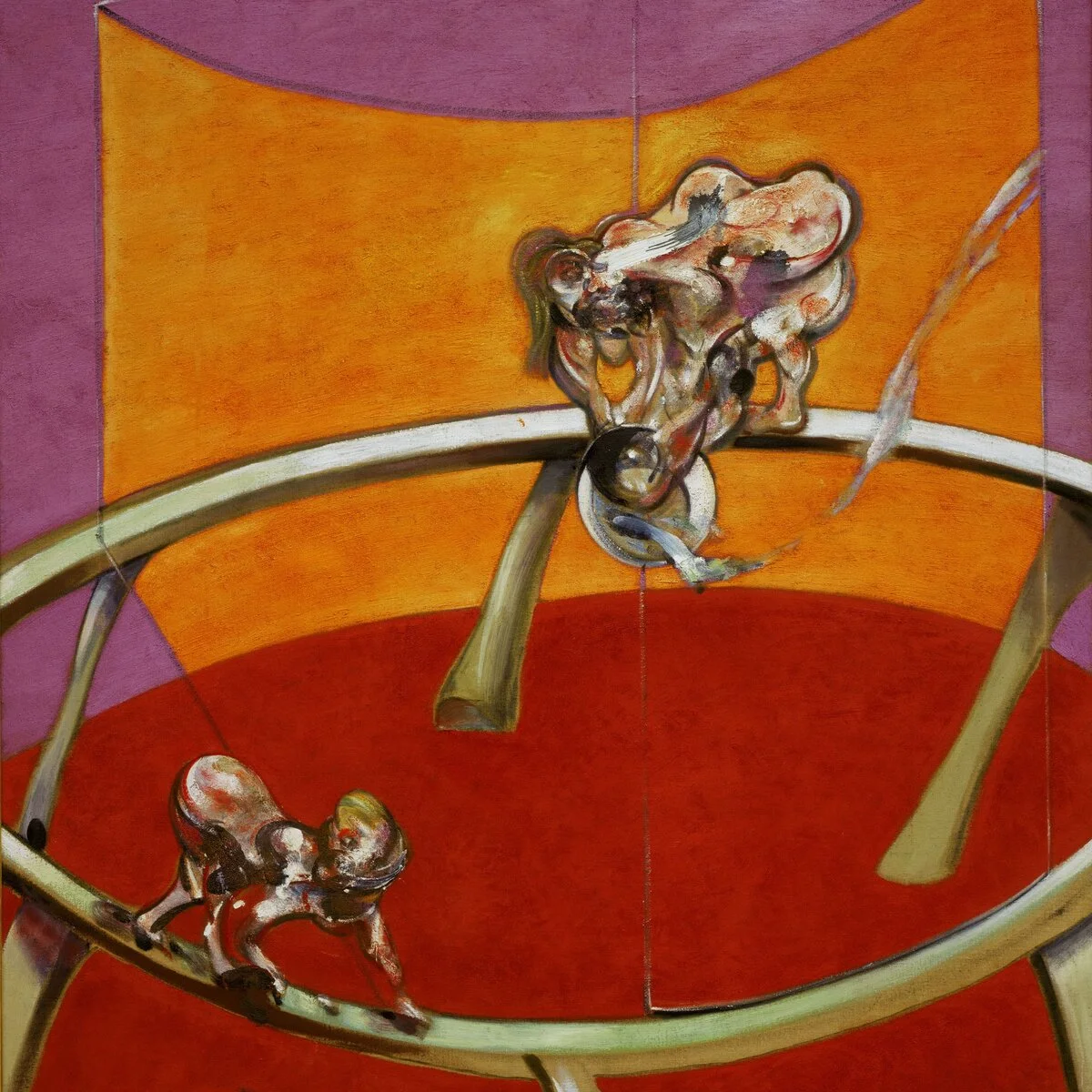
Francis Bacon was an Irish-born British painter and one of the most influential figures in twentieth-century art. Best known for his distorted human bodies, screaming faces, and psychologically charged compositions, he developed a distinctive visual language that existed on the boundary between figuration and abstraction.
Although his paintings often approach abstraction, Bacon never entirely abandoned the human figure. Instead, he pushed it beyond conventional representation, using distortion, violent brushwork, and unexpected combinations of colour to express the intensity of human experience. His work explored themes of mortality, desire, isolation, violence, and the vulnerability of the body, challenging traditional ideas of beauty and representation.
Francis Bacon's paintings reveal the beauty hidden within the terrifying duality of existence. Everything that carries meaning has two sides. In other words, there is beauty and there is a beast in everything that truly matters.
The undeniable temporality of life is frightening, even terrifying, yet at the same time, it is perhaps the greatest blessing we have. It is precisely what pushes us forward, making us love, desire, create, and search for meaning. This impermanence runs like a red thread through everything we touch: our loved ones, our relationships, our achievements, and even our memories. Everything will eventually come to an end, no matter how solid or permanent it may seem today.
And yet, beauty exists precisely in this fragility, in the vulnerability we never asked for and cannot escape. If you can understand this contradiction, you can begin to understand the paintings of Francis Bacon.
His works do not demand that you find beauty or glory in them. They simply exist. But for art to mean something, it must be understood in a particular, individual way. Bacon's paintings are far from the most pleasant images one could encounter, yet they are among the most celebrated and expensive works of modern art. In 2013, his "Three Studies of Lucian Freud" sold for an astonishing $142.4 million, setting a world auction record at the time.
Why someopne is willing to pay such extraordinary amounts for paintings that can be so difficult, disturbing, and even repulsive to look at?
Perhaps because beauty is not always something we see. Sometimes it is something we recognise without being able to explain it, a feeling that reaches us before we have the chance to understand it. Bacon's paintings seem to communicate on precisely this level, where the instinctive experience of one human being becomes recognisable to another.
Below you can find ten facts about Francis Bacon that may help you understand his art and the personality behind it.
Childhood and Early Years
1. Childhood Trauma and an Atmosphere of Constant Threat
Francis Bacon grew up in Ireland during the Irish War of Independence (1919–1921) and the subsequent Civil War (1922–1923). His family belonged to the wealthy Anglo-Irish Protestant community, which found itself increasingly vulnerable amid revolutionary violence. Bacon’s father, a former British Army officer, feared attacks by Irish republicans. The artist later recalled: “I was made aware of danger at a very young age.”
His grandmother’s house, whose husband held a senior position in the County Kildare police force, was fortified with sandbags. Camouflaged trenches were dug across roads, where snipers might lie in wait. Bacon described his childhood surroundings: “We lived in a sandbagged house.”
His father constantly warned the children about the possibility of an attack during the night. Bacon remembered his words: “If they come tonight, say nothing.”
Yet the sense of threat did not come solely from the outside world. Within his own family, Bacon also felt like an outsider. Severe asthma, loneliness, a strained relationship with his authoritarian father, and an early awareness of his own sexuality made his childhood deeply unhappy. In one of his final interviews, the artist admitted: “I didn't feel good about myself. People frightened me.”
Speaking about his relationship with his father, he was even more direct: “My father didn't love me, that's for sure.”
These experiences may have shaped the way Bacon later depicted human existence: isolated figures, enclosed spaces, distorted bodies, and a pervasive sense of danger lurking even within the most ordinary interiors. Bacon himself connected the violence in his paintings to growing up and living through an age of continuous upheaval: “I have been accustomed to always living through forms of violence.”
In his paintings, horror does not so much invade ordinary life from the outside as reveal itself beneath its seemingly respectable surface. Spaces intended to protect the individual become traps, while the human body emerges as the ultimate expression of vulnerability.
2. Francis Bacon had no higher education or formal art training
Francis Bacon received neither formal artistic training nor a particularly consistent school education. Due to his family's frequent moves, his early education was rather fragmented. For a brief period, he was taught by a local parish priest in Ireland, while his time at Dean Close School in Cheltenham came to an abrupt end when he simply ran away. Bacon himself later recalled that, as a child, he barely read and was hardly even aware of the existence of painting.
3. Bacon began his career as a furniture and interior designer
At the age of sixteen, Francis Bacon left for London, later spending time in Berlin and Paris. His creative journey began not as a painter, but as a designer of furniture and interiors influenced by modernism. His work from this period was characterised by strict geometry, clean lines and simplicity, and was even featured in an article published in The Studio magazine in 1930. The few surviving paintings from his early years also reflected this aesthetic, with their sharp edges and clearly defined contours.
Artistic Influences and Relationships
3. Picasso’s work sparked Francis Bacon’s interest in painting
A turning point that led Bacon to consider pursuing a career as a painter was his visit to an exhibition of Pablo Picasso's works at Paul Rosenberg's gallery in Paris in the late 1920s. From a formal perspective, the biomorphic distortions and anatomical deformations found in Bacon's paintings of the 1930s were directly influenced by Picasso's experiments with form.
“It was after staying in Paris, where I saw an exhibition of Picasso, that I said to myself that I was going to paint.” (Francis Bacon : in conversation with Michel Archimbaud)
4. Roy de Maistre helped shape Francis Bacon’s artistic vision
An Australian painter who converted to Catholicism and became one of Bacon’s earliest mentors and closest friends. They are believed to have met in London in 1930, when Bacon was still working as a furniture and rug designer. De Maistre not only helped him master oil painting but also played a significant role in shaping his visual language. De Maistre’s experiments with colour can be traced in Bacon’s early Crucifixion (1933), while his semi-abstract, distorted figures may have inspired the monstrous creatures in Three Studies for Figures at the Base of a Crucifixion (1944).
De Maistre’s engagement with Christian iconography was equally important. Bacon adopted the motif of the Crucifixion but stripped it of religious consolation, transforming it into an image of bodily suffering and human vulnerability. De Maistre also introduced him to Surrealism, the magazine Minotaure, the work of Piero della Francesca, and the practice of using photographs as source material for painting – an approach that would later become fundamental to Bacon’s artistic practice.
De Maistre himself believed that one should be gentle and forbearing in life, but that in art it was sometimes necessary to give the spectator “an ugly left uppercut.” Bacon, it seems, turned this principle into an entire artistic language.
5. The patron who encouraged Francis Bacon to keep painting
Eric Hall - British businessman, art collector, one of Francis Bacon’s earliest patrons, and his lover for nearly seventeen years. They met around 1932, possibly at London’s Bath Club. Hall not only provided Bacon with financial stability but also played a crucial role in the development of his artistic career. In 1937, he organised the Young British Painters exhibition at Agnew’s Gallery, where Bacon exhibited alongside Graham Sutherland and Roy de Maistre.
During the Second World War, Hall provided Bacon with a place to work at a country house near Petersfield and encouraged him to return to painting after several years of artistic uncertainty. His influence extended well beyond financial support: Hall broadened Bacon’s literary and cultural interests, introducing him to the world of Greek tragedy, which would later become one of the most important sources of imagery in the artist’s work.
Hall also acquired Bacon’s groundbreaking triptych Three Studies for Figures at the Base of a Crucifixion (1944), which he later donated to Tate, securing its place in a major public collection. Bacon remembered him with a rare warmth: “He never let me down.”
Working Methods and Sources
6. Bacon preffered working from photographs than from the sitter
“Even in the case of friends who will come and pose,” he said, “I’ve had photographs taken for portraits because I very much prefer working from the photographs than from them” .
7. The Rejection of preliminary sketches and the role of chance
Francis Bacon preferred to paint directly onto the canvas, without a fully developed composition prepared in advance. He believed that a preliminary drawing could capture only the general idea, but not what mattered most: the unpredictable movement of paint, the collision of colours, and the accidental distortions that emerged during the painting process. In an interview with the art critic David Sylvester, Bacon admitted: “I often think I should, but I don’t.”
For Bacon, painting was a constant confrontation between intention and chance. He would begin with a particular image in mind but allow the paint to transform it beyond recognition. Working with large brushes, rubbing, scraping, smearing, or throwing paint onto the canvas, he produced unexpected forms that could prove more expressive than his original conception. Sometimes an accidental brushstroke would destroy an already painted face, yet it was precisely through this destruction that he could discover an entirely new image. Bacon explained: “I want a very ordered image, but I want it to have come about by chance.”
Chance, however, did not mean a complete surrender of control. Bacon carefully assessed the forms that emerged, developed successful accidents, and rejected anything that seemed too predictable or illustrative. He was interested in bypassing rational perception and acting directly upon the viewer’s nervous system. The distorted faces and bodies in his paintings were therefore not merely representations of suffering, but attempts to convey the sensation of physical and psychological tension itself.
A revealing example is one of his paintings featuring carcasses of meat, which Bacon had originally conceived as an image of a bird landing in a field. As he worked, the lines unexpectedly suggested an entirely different form, and the artist followed this new direction. Chance thus became not an obstacle but a source of artistic discovery.
This method was accompanied by an almost ruthless attitude towards his own work. If a painting failed to achieve the necessary intensity, Bacon might slash the canvas and destroy it. After his death, more than a hundred damaged and cut-up canvases were discovered in his studio. For him, an unsuccessful painting had no value simply because months of work had gone into it.
Yet the image of an artist who had completely abandoned preliminary drawings turned out to be, at least in part, a myth cultivated by Bacon himself. After his death, numerous sketches, photographs marked with annotations, and other preparatory materials were discovered in his studio. This discovery revealed that behind the apparent spontaneity of his paintings lay a complex process of visual research. Bacon did not so much reject preparation as seek to preserve the possibility of the unexpected during the act of painting – the moment when an image ceased to obey its original conception and began to take on a life of its own.
8. Art of accident
For Francis Bacon, painting was an unpredictable process in which the most powerful images often emerged from unexpected accidents. He preferred to work in solitude, usually during the morning hours, when daylight illuminated his studio. Rather than constructing a detailed plan before beginning, he allowed the image to develop through direct interaction with the paint.
Bacon generally began with the human figure, building its form through energetic gestures before turning to the surrounding space. He believed that excessive planning could diminish the vitality of a painting. Yet spontaneity did not guarantee success: he was notoriously demanding of his own work and frequently destroyed canvases that failed to achieve the intensity he sought.
His method was therefore neither entirely spontaneous nor carefully predetermined. It depended on a continuous negotiation between artistic intention and the unpredictable behaviour of paint.
9. Painting beyond the brush
Bacon's distinctive surfaces were the result of an unusually experimental approach to materials. He was willing to use almost anything that could leave an interesting mark, from pieces of fabric and sponges to everyday objects found around his studio. These improvised tools allowed him to smear, scrape, press, and disrupt the paint in ways that conventional brushes could not.
One of his most significant technical decisions came in the late 1940s, when he began working on the untreated reverse of his canvases. Unlike a smooth, prepared surface, the exposed fabric absorbed pigment unevenly and retained the texture of its woven threads. This gave Bacon greater freedom to produce the rough, irregular effects that became characteristic of his paintings.
He also explored contrasts between different types of paint application. Thick, heavily worked passages could appear beside delicate veils of colour, while materials such as dust, sand, and pastel introduced additional physical complexity. These effects were not merely decorative: they helped transform the painted body into something that seemed simultaneously solid, vulnerable, and unstable.
10. Francis Bacon and the human scale
Despite the dramatic distortions of his figures, Francis Bacon frequently worked at a scale that preserved a direct physical relationship between the painting and its viewer. His works ranged from intimate portraits of heads to monumental canvases featuring bodies approaching life-size.
This choice of scale was particularly significant in his larger compositions. Even when the human body was twisted, fragmented, or rendered almost unrecognisable, its proportions could remain close to those of a real person. As a result, Bacon's figures were not simply images to be observed from a distance; they could feel like physical presences occupying the same space as the viewer.
The contrast between recognisable human proportions and radical anatomical distortion intensified the unsettling effect of his paintings, making even his most abstracted figures feel disturbingly real.
Selection of artworks
Selecting works from Francis Bacon’s vast and extraordinary body of art is no easy task. Throughout his career, Bacon created paintings that continue to challenge, disturb, and fascinate viewers, each offering a different perspective on his distinctive artistic vision. Any selection inevitably leaves out works of great significance. Nevertheless, we have chosen seven paintings that we believe offer a compelling introduction to his artistic world, revealing some of the recurring themes, visual experiments, and emotional intensity that define his work.
Crucifixion (1933)
In 1933, at the age of 23, Francis Bacon was still at the beginning of his career as a painter. Until then, he had primarily worked as a designer of furniture, rugs, and interiors, developing his painting skills largely on his own, with the guidance and support of Roy de Maistre.
His *Crucifixion* (1933) became one of the earliest works in which Bacon’s distinctive visual language began to emerge. Instead of a traditional representation of the crucified Christ, he depicted an almost ghostly, translucent figure resembling a human skeleton, a butchered carcass, and the biomorphic creatures of Picasso all at once.
Three lines radiating from the figure suggest a spatial setting without establishing a fully defined interior. The human body appears isolated in an almost absolute void. This composition already anticipates one of the defining features of Bacon’s later work: the solitary figure enclosed within a schematically constructed space, a visual device he would continue to develop for decades.
The painting was reproduced in Herbert Read’s influential book *Art Now* (1933), alongside a work by Picasso. This marked an important moment of early recognition for the young artist. Soon afterwards, the painting was acquired by Sir Michael Sadler, one of Britain’s most prominent collectors of modern art, for approximately £20.
Crucifixion with a skull (1933)
After purchasing Bacon’s first "Crucifixion", Sir Michael Sadler commissioned a self-portrait. However, instead of sending a conventional photograph, Sadler provided Bacon with an X-ray of his own skull.
This unusual proposal was particularly suited to Bacon’s emerging artistic interests. Even at this early stage, he was fascinated by medical imagery, anatomical structures, and the possibility of revealing the human body beneath the surface of the skin.
Rather than using the X-ray to produce a conventional portrait, Bacon incorporated the skull into a new composition centred on the Crucifixion. In *Crucifixion with Skull* (1933), the skull appears alongside a taut, elongated, crucified figure. Painted in sensuous, fleshy pink tones, the bone structure creates a disturbing contrast with the emaciated body.
The composition also carries a deeper symbolic resonance. Golgotha, the site of Christ’s crucifixion, traditionally means “the place of the skull.” In Christian iconography, a skull at the foot of the cross often symbolises death and is associated with the tradition that Adam was buried beneath the site of the Crucifixion. The skull in Bacon’s painting can therefore be interpreted both as the result of Sadler’s unusual commission and as a reinterpretation of a centuries-old religious motif.
What makes this episode particularly revealing is the way Bacon transformed a medical image into something entirely different from its original purpose. The X-ray ceased to function as a tool of anatomical observation and instead became part of a disturbing visual language in which religious imagery, bodily vulnerability, and the physical reality of death converged.
Study after Velázquez’s Portrait of Pope Innocent X (1953)
One of Francis Bacon’s most iconic paintings was inspired by Diego Velázquez’s seventeenth-century portrait of Pope Innocent X. Remarkably, Bacon worked primarily from reproductions and famously avoided seeing the original painting, even when he visited Rome. Rather than reproducing Velázquez’s image of papal authority, Bacon transformed it into a disturbing vision of human vulnerability. The Pope appears trapped within a transparent, cage-like structure, his mouth wide open in a seemingly endless scream.
The origins of this image reveal Bacon’s fascination with cinema, particularly Sergei Eisenstein’s silent film "Battleship Potemkin" (1925). Bacon was deeply affected by the famous Odessa Steps sequence, especially the close-up of a screaming nurse wearing shattered pince-nez glasses. The image became one of his most important visual references, contributing to his recurring fascination with the open mouth as an expression of extreme physical and psychological intensity.
Art critic David Sylvester, who knew Bacon personally and conducted extensive interviews with him, described the connection as:
“the inspired conflation between the Velázquez portrait of Pope Innocent X and the close-up of the nanny shrieking from Eisenstein’s Battleship Potemkin.”
This combination of two radically different visual sources, a XVIIth century portrait representing religious authority and a twentieth-century cinematic image of terror, became central to Bacon’s reinterpretation of the papal figure.
The influence of Eisenstein was not merely a resemblance identified by later art historians. Bacon himself discussed his fascination with the screaming woman in his interviews with Sylvester, while the catalogue of his 1959 exhibition at the Museum of Modern Art noted that the image had made a lasting impression on him even before he began painting seriously.
By combining Velázquez’s composition with Eisenstein’s cinematic scream, Bacon stripped the Pope of his traditional dignity and authority, transforming him into an isolated, almost helpless human figure. The transparent cage surrounding him reinforces the sense of psychological confinement, while the blurred vertical strokes make his body appear to dissolve into the surrounding darkness.
The result is not simply an image of a man screaming, but a confrontation between power and vulnerability, religious authority and physical suffering. Bacon transformed one of the most commanding portraits in Western art into an image of existential terror, demonstrating his ability to bring together historical painting, cinema, and the visceral reality of the human body.
Three Studies for Figures at the Base of a Crucifixion (1944)
During the late 1930s and early 1940s, Bacon painted relatively little and destroyed many of his early works, dissatisfied with their results. An important moment in his artistic development was the International Surrealist Exhibition held in London in 1936, to which Bacon submitted work but was rejected as insufficiently surrealist. Nevertheless, Surrealism, particularly its distorted bodies and biomorphic forms, had a significant influence on his emerging visual language. These influences would become especially apparent in "Three Studies for Figures at the Base of a Crucifixion" (1944), which marked his artistic breakthrough.
Despite its title, the triptych depicts neither Christ nor the Crucifixion itself. Instead, Bacon presents three disturbing, almost inhuman creatures against a striking orange background.
Bacon associated these figures with the Furies, or Erinyes, the ancient Greek goddesses of vengeance who pursue Orestes for the murder of his mother in Aeschylus’s "Oresteia".
The painting was first exhibited publicly in April 1945, when London was still living with the devastation of German bombing raids. For an audience that had endured years of war, these monstrous figures carried a particularly unsettling force.
The creatures appear trapped in an ambiguous space, their bodies twisted and distorted beyond recognition. Their elongated necks, gaping mouths, and fragmented anatomy blur the boundaries between human and animal forms. Rather than illustrating a specific mythological scene, Bacon transforms the Furies into manifestations of violence, suffering, and psychological torment.
The vivid orange background intensifies their disturbing presence. Unlike the dark, atmospheric settings traditionally associated with horror, Bacon places his figures against a flat, almost aggressively bright surface, leaving the viewer nowhere to escape their physical intensity.
Bacon later regarded this triptych as the true beginning of his mature artistic career, effectively rejecting much of his earlier work. It marked a decisive shift towards the visual language that would define his paintings for decades: distorted bodies, isolated figures, open mouths, and the transformation of human suffering into something immediate and visceral.
Created during the final stages of World War II, "Three Studies for Figures at the Base of a Crucifixion" is often interpreted as an expression of the collective anxiety and violence of its time. Yet its power lies in the fact that it does not depict war directly. Instead, Bacon transforms the experience of terror into a disturbing vision of the human condition itself.
Painted Screen (c. 1929)
One of the most fascinating surviving examples of this early period is *Painted Screen* (c. 1929), a three-panel folding screen that already reveals some of the ideas that would later define his paintings.
In 1927, the young Bacon travelled to Paris, where he encountered the work of modern European artists, particularly Pablo Picasso, Fernand Léger, and Giorgio de Chirico. Their influence is strikingly visible in the screen. The distorted, fragmented figures recall Picasso, while the geometric forms and monumental shapes suggest Léger. Perhaps most intriguingly, the classical columns and mysterious architectural setting evoke de Chirico's metaphysical paintings of the 1910s, with their deserted Italian squares, unsettling perspectives, and dreamlike atmosphere.
Although conceived as a decorative object, the screen already demonstrates Bacon's fascination with the relationship between the human figure and its surrounding space. The bodies appear caught among architectural structures, anticipating the geometric enclosures and cage-like spaces that would become characteristic of his later paintings. Even its three-panel format seems to foreshadow the triptychs for which Bacon would eventually become famous.
The screen also has a connection to Roy de Maistre, one of Bacon's earliest artistic mentors. It later belonged to de Maistre and appears in his painting "Francis Bacon's Studio in Queensberry Mews West" (1930), offering a rare glimpse into Bacon's early artistic environment.
Another intriguing detail emerged during technical examination: beneath the painted surface, researchers discovered preliminary pencil drawing. This complicates Bacon's later insistence that he worked without preparatory sketches, suggesting that drawing played a role in his early creative process.
"Painted Screen" is particularly revealing because it captures Bacon at a moment when he was still absorbing the visual language of European modernism. Long before the screaming popes and distorted bodies of his mature paintings, he was already experimenting with fragmented figures, ambiguous spaces, and the unsettling relationship between architecture and the human body.
Study for Portrait X (1957)
It is precisely this extraordinary consistency that makes "Study for Portrait X" so striking. In a body of work where the human face is almost invariably subjected to distortion, the unexpected clarity and delicacy of this portrait seem to challenge Bacon's own pictorial conventions. Here, the familiar violence of his brushwork appears momentarily restrained. The eyes, lips, and contours of the man's face are rendered with unusual precision and care, allowing something close to an individual likeness to emerge.
The man sits on a simple wooden chair, dressed in a brown suit, his body turned away from us while his head looks back over his shoulder. His pale face stands out against the deep green darkness of the room. Thin, almost invisible lines outline the walls, floor, and ceiling, enclosing him within one of Bacon's characteristic geometric cages. The space is empty, with no windows, doors, or objects to distract from the solitary figure.
The painting belongs to a period dominated by one of the most passionate and destructive relationships of Bacon's life: his love affair with Peter Lacy, a former RAF pilot whom he met in the early 1950s. Bacon later described Lacy as the first man with whom he had truly fallen in love. Their relationship was intense, obsessive, and frequently violent. Lacy could be both tender and cruel, and their repeated separations did little to weaken Bacon's attachment to him.
In 1956, Lacy moved to Tangier, Morocco, where Bacon visited him repeatedly. During these years, Lacy became a recurring presence in Bacon's paintings, sometimes portrayed directly and sometimes evoked through isolated male figures.
Their relationship ended in tragedy when Lacy died in Tangier in 1962, reportedly from complications related to alcoholism. Bacon received the news around the time of his major retrospective at Tate in London. The loss deeply affected him, and Lacy's presence continued to haunt his artistic imagination.
Read next
- Sandra Kantanen: Beyond the Lens of Traditional Photography
- Art that makes you smile
- Where We Meet Ourselves - interview with Keisuke Azuma
- Where the Warmth Lives: How Two Traditions Measured the Turn from Summer to Autumn
- Where Wisdom Takes Form: Inside the New CCA Tashkent
- Who Needs a Museum? The Urban Design of Invitation