Federica Gioffredi: First the Heart, Then the Mind, Finally the Eye
Interview
The Neapolitan photographer Federica Gioffredi on an Olympus and a father who was an offshore racing champion, on the black and white that hides a universe of colors, on laundry waiting for the wind, on Sanfelice seen from below, on the home gallery in Parco Margherita and on a project born during Covid.
Viacheslav Munister & Federica Gioffredi · 2026-10-29
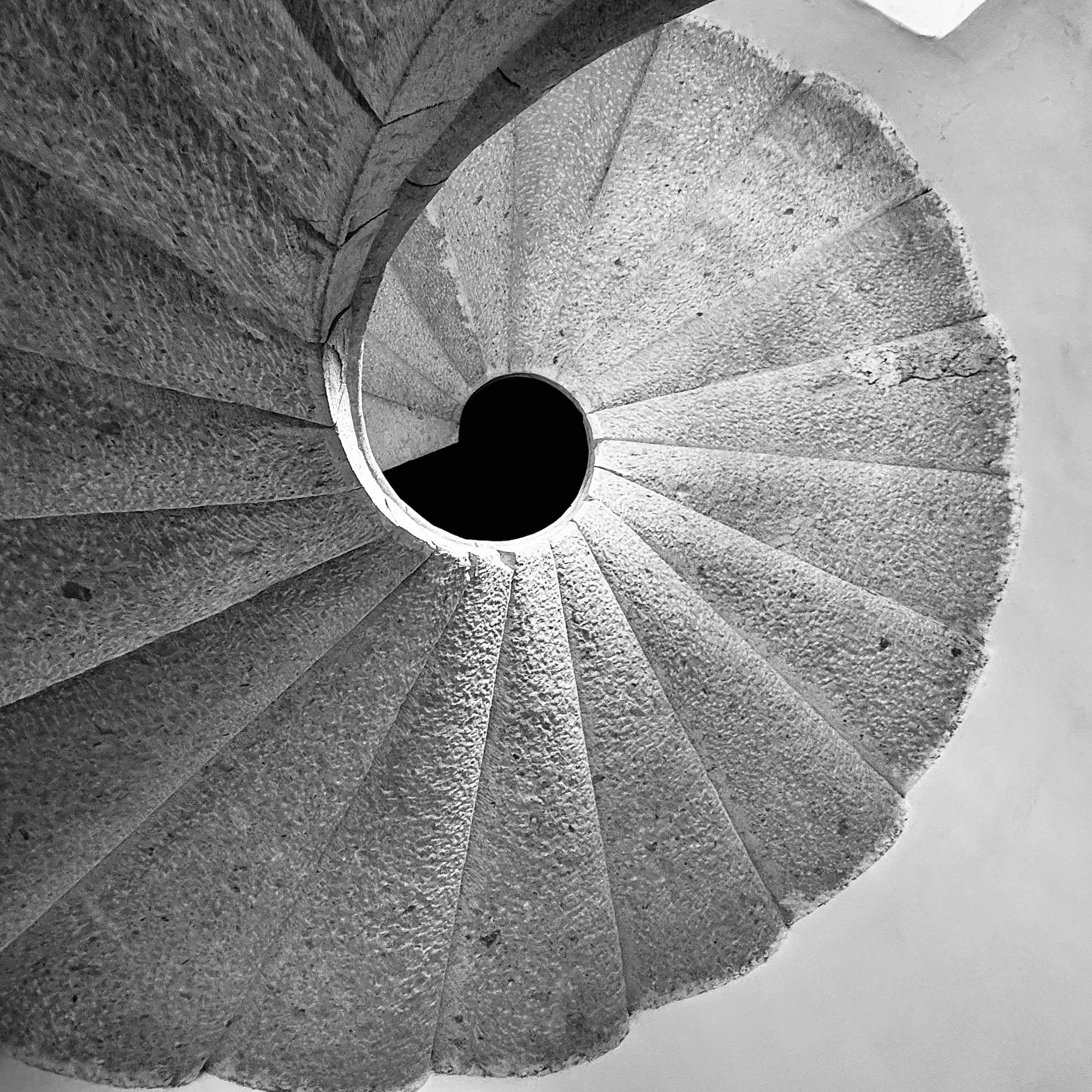
Federica Gioffredi stops the moment that seemed like any other: a sheet billowing in the wind in an alley, a white hood lifted during a procession, a spiral staircase seen from below, the colonnade of a Paris building reflected in spheres of polished metal. She was born in Naples in 1972. For about ten years she worked in Milan as a stock market trader; then she left for Bali on holiday and, as she has told it, stayed four years. Today photography is her profession.
Her work moves through black and white, travel and memory, and lately opens up to color as well: from Kosmo to Sinestesie d’acqua , from the five volumes of Documento > Monumento for the Fondazione Banco di Napoli to Ardite invenzioni , FRIENDS and Il Giappone. Equilibrio nel tempo . She has turned her home in Parco Margherita into a home gallery, the FG Home Gallery.
We wrote her long questions, and she answered in her own way: simply, in a few lines, without explaining too much. One sentence stayed with us more than the others: “If I had to choose between heart, mind and eye, I would definitely put the heart first.” Here is the conversation, with the photographs she sent us and others taken from her series online.
Part I The gaze behind the camera
An Olympus, the speed of the sea and the stillness of a photograph; what a lens conceals; from the Milan stock exchange to Bali and back.
Speed and the moment
Viacheslav Munister [VM]: You were born in Naples in 1972, the daughter of Antonio Gioffredi, offshore powerboat racing world champion, and it was your father who gave you your first camera, an Olympus. A father who lives on speed and a daughter who writes “my power to stop time”: are speed and stillness opposites, or two ways of looking at the same wave?
Federica Gioffredi [FG]: Actually, I think speed and photography are two very different worlds, almost opposed. Speed is movement, something that slips away, while photography is precisely the desire to stop a moment, to take it out of time. Perhaps the only point where they meet is precisely this: the moment.
What these two dimensions certainly share is a particular way of looking at life, a perspective different from other people’s. After all, I think that in both speed and photography there is the ability to perceive something that not everyone manages to grasp. And perhaps that is the most authentic bond: not so much speed or stillness, as the way in which we choose to look at the world.
Perhaps the only point where they meet is precisely this: the moment.
Behind the camera
VM: In your Instagram bio you write about “hiding my gaze behind the camera,” a gesture that gives you “peace and tranquility”; on your website you add: “I observe my inner world in order to then transpose it into photography.” What does one hide from, behind the camera? Is photographing for you a way of being more present in the world or of disappearing from it for a moment? And what of the outside world is left once the image is finished?
FG: When I talk about hiding my gaze behind the camera, I don’t mean hiding from the world, but simply putting myself behind a lens. It is that very gesture that gives me a tremendous sense of peace.
Looking at the world, at life, at the people who pass through that small rectangle is something deeply intimate. It is as if, in that very narrow space, everything took on a different meaning. I choose a moment, I stop it in time and I try to turn it into an emotion.
So it is not a way of disappearing from the world, but perhaps of entering it even more deeply, through my gaze and my sensibility. The outside world stays there, in the image, but inevitably it becomes intertwined with what I feel inside.
It is as if, in that very narrow space, everything took on a different meaning.
From the stock exchange to Bali
VM: For about ten years you worked in Milan as a stock market trader; then, as you have told it, “I left for Bali on holiday and stayed a full four years.” The stock exchange and photography have something in common: the instant, the decision, the risk of arriving one second too late. What did Bali give you that Milan could not, and why did you then return to Naples?
FG: I think the stock exchange and photography are two worlds that seem very far apart, but they have something in common: numbers, time and above all the importance of the moment. On the stock market every second can make a difference, just as in photography, where everything is decided in a fraction of a second.
Bali, instead, gave me a completely different dimension from the one I had lived in Milan. Then I came back to Naples, because I think Naples has something unique: it is a city you can move away from, even for many years, but which somehow keeps belonging to you. It stays inside you, in your heart, in your memories, in your emotions.
On the stock market every second can make a difference, just as in photography, where everything is decided in a fraction of a second.
Part II Black and white, and color
The heart before the mind and the eye; a universe of colors inside the gray; an old man in black and white and a maiko who had to be red.
Heart, mind, eye
VM: “I have always expressed myself in black and white because I love that kind of photography,” you have said. Your biography mentions Cartier-Bresson: putting “the heart, the mind and the eye on the same line of sight.” Of the three, which comes first when you shoot? And what does black and white take away from a colorful city like Naples, and what does it give back?
FG: If I had to choose between heart, mind and eye, I would definitely put the heart first, then the mind and finally the eye. It may seem a paradox, because in photography the eye should be the protagonist, but for me it is not so. It is the heart that feels, the mind that interprets, and only afterwards the eye that translates all of this into an image.
As for black and white, I have never considered it a photograph without colors. On the contrary, I think that in the infinite shades of gray a universe of colors and emotions is hidden. Every tone tells something.
It is the heart that feels, the mind that interprets, and only afterwards the eye that translates all of this into an image.
When color is needed
VM: With Il Giappone. Equilibrio nel tempo, color enters for the first time alongside black and white, and red, you have said, is the color you associate with that country. Among your favorite photographs you named a maiko seen from behind, in color, and an old man sitting on a flight of steps, in black and white. How do you decide, faced with a scene, whether it is in color or in black and white?
FG: I prefer black and white because it is the one in which I recognize myself most, the one I feel closest to my sensibility. For me black and white is not at all devoid of colors: in the infinite shades of gray I find a particular depth and emotional intensity, as if through those tones I could enter into the image, almost touch it.
There are, however, photographs that need color, because it is color itself that tells their essence.
In my exhibition on Japan, for example, there is the photograph of an elderly man sitting on a flight of steps, with a face deeply marked by time. That image, for me, could only be in black and white. Every wrinkle, every line of his face takes on an extraordinary strength, almost tactile. It is as if I could brush that skin and feel the story it tells.
By contrast, the photograph of Maiko absolutely had to be in color. Taking the color away would have meant losing a fundamental part of Japan: that red, so intense, so alive, almost a fire, which holds all the strength and energy of that culture.
Part III Travel and memory
Twelve hundred shots for a journey from Naples to Martina Franca; the four elements; the laundry, the procession and the gust of wind; two lakes.
“Tourist in the city”
VM: “Travel is the true substance of my work,” you write, introducing Kosmo. Due secoli dopo… Da Napoli a Martina Franca is a journey “in the footsteps of the Grand Tour”: five stages, 331.6 kilometers, 1,234 shots. How do you choose, among so many shots, what tells the story of a place? And can one be a traveler in one’s own land?
FG: The twelve hundred shots are the result of the different stages of my journey, of the places I passed through and the moments I wanted to capture. Often I lingered on the same subject, photographing it several times, from different angles and perspectives, looking each time for something different.
The hardest part was definitely the selection, because I had to manage to hold the story and the essence of a place in very few images. So I had to make a first choice of the photographs I felt were most representative and then keep selecting, until I arrived at the ones that best managed to tell what I had seen and lived.
As for photographing my own city, I always like to call myself a “tourist in the city.” I love wandering around Naples, discovering new corners, getting to know places I hadn’t yet explored and looking at them each time with different eyes.
Naples is a city that has so much to tell and to show, and I think you never really finish discovering it. It is a habit I care about a great deal and to which I devote time at least once or twice a week. I like getting lost in its streets, observing, letting myself be surprised and, of course, photographing.
After all, for me traveling doesn’t necessarily mean going far away. Sometimes it is enough to step out of your front door and look at your own city with the curiosity of someone seeing it for the first time.
Naples is a city that has so much to tell and to show, and I think you never really finish discovering it.
The four elements
VM: Kosmo, curated by Bianca Stranieri, is dedicated to the four elements: Fire, Water, Air and Earth, twenty-eight photographs in four series of seven. How do you photograph air, which is invisible? And which of the four elements feels most your own?
FG: Water is definitely the element I feel most connected to, the one in which I recognize myself most, followed right after by fire.
To represent air, instead, I chose mostly photographs of trees, because I liked the idea of telling something we cannot see directly, but whose presence we can perceive. I thought of the wind passing through the leaves, of their movement, and it seemed to me the most natural way to give shape, through photography, to an invisible element.
One exception is a photograph taken at Rocca Calascio, in Abruzzo, where the sky is the protagonist.
The white of hanging laundry
VM: In your photographs a white fabric often returns: sheets hung between the alleys of Naples and the tunics of the Biancovestiti of Lauro. Laundry and penance, the everyday and the sacred, in the same white: is it chance or choice? How long do you wait for a gust of wind?
FG: I have always been fascinated by laundry hanging out to dry. I even devoted a photographic project to it, titled Mollette e panni. I photographed it not only in Naples but in many other cities too, such as Barletta, Martina Franca, Rome and Venice. It is a subject that attracts me particularly, perhaps because it manages to tell the everyday life of people through something so simple.
How long am I willing to wait for a gust of wind? Quite a while! I remember a photograph taken in Naples, in the Rione Sanità. I was standing under a building, looking up, and watching all that laundry swell and deflate as the wind passed. In the end it happened, and the photograph I had imagined was born.
I have always been fascinated by laundry hanging out to dry.
Two lakes
VM: Sinestesie d’acqua. Tra cielo e terra, curated by Bianca Stranieri, puts Lake Avernus and Lake Annecy side by side to speak of the duality of man: good and evil, life and death. Why these two lakes in particular?
FG: Lake Annecy, in Haute-Savoie, gives me a feeling of absolute peace. It is a place I know very well, because I often go back thanks to a friend who hosts me. The landscape looks almost like a painting, with its soft colors, the calm lake, the people strolling and an atmosphere of great serenity. Every time I am there I feel such a deep tranquility that it comes naturally to me to associate it with the image of paradise.
Lake Avernus, instead, gives me completely different feelings. It is a place that, despite its modest size, has an extraordinary, almost mysterious energy. An energy that I also find in the verses of the many authors who have written about it and that, in my opinion, you can really perceive when you are there. It is no coincidence that Virgil describes it as the gateway to the Underworld. It is an intense place, full of suggestion, which naturally led me to associate it with hell.
From there came the idea of setting these two lakes against each other, using water itself, the element I feel most connected to, to tell of two completely opposite worlds.
It is no coincidence that Virgil describes it as the gateway to the Underworld.
Part IV Naples: archive, architecture, friendship
From Caravaggio to the empty stadium; a palace found by chance in the Rione Sanità; forty-four photographs for forty-four friends; a home that is a gallery.
From Caravaggio to Maradona
VM: Documento > Monumento, an idea of Bianca Stranieri for the Fondazione Banco di Napoli, has reached its fifth volume: from C’arte in fotografia and Intorno a Caravaggio to Il Patrimonio UNESCO in Campania, I 2500 anni di Napoli and Napoli 100. What was it like to move from art to football, and how do you photograph a huge, empty stadium?
FG: Documento > Monumento was an extraordinary experience, above all because each volume tackled a different theme and gave me the chance to explore worlds that were very far from one another. We went from Caravaggio, who for me represents pure art, to the UNESCO heritage, which took me to visit and photograph several places in Campania, all the way to football, a world I knew relatively little about. I follow football, but I have never been a great fan.
Precisely for that reason, one of the experiences that struck me most was photographing the Stadio Diego Armando Maradona completely empty. At first I wondered how I could tell, through an image, a place so large but without the people and the emotions that normally animate it.
And instead it was an incredible surprise. I felt a tremendous force, an energy that seemed to be present even in the silence, even without the fans. It was as if all the love Naples feels for football had stayed right there, among the empty stands.
I found the same intensity in the murals dedicated to Maradona, which in Naples have become true icons, part of the identity and culture of the city.
It was as if all the love Naples feels for football had stayed right there, among the empty stands.
“Ferdinando, lievete ’a sotto”
VM: Ardite invenzioni, in 2025, pays homage to Ferdinando Sanfelice on the 350th anniversary of his birth. What does architecture teach a photographer about light and about looking? And after this project, does Naples seem more vertical to you?
FG: Ardite invenzioni comes precisely from my being, as I always say, a “tourist in the city.” One day I was walking through the Rione Sanità, in Naples, and I found myself in front of two extraordinary buildings: Palazzo dello Spagnolo and Palazzo Sanfelice. The first, for a long time attributed to Ferdinando Sanfelice, was later discovered, through historical documents, not to be his work, even though it strongly recalls his architectural style.
From that chance encounter a real passion for this architect was born, a figure I found absolutely extraordinary, so much so that he was nicknamed “Ferdinando, lievete ’a sotto,” for the fear that his daring constructions might collapse.
I looked deeper into his story and began to study his palaces, his works, the staircases and the gates, discovering architectural details that fascinated me deeply. Among the photographs born from this research there is one, titled Gelosia, which portrays a gate and is one of my favorites. Dedicated to my Czechoslovakian wolfdog.
Since then my way of looking at the city has changed. I look at it much more vertically. Absolutely yes!
Friends, not portraits
VM: FRIENDS, “…call them emotions, if you like!”, at the FG Home Gallery since April 2026 in support of the pet therapy program at the Santobono Hospital: 44 black-and-white photographs of places and not of faces, each titled with the name of a friend. How did you choose the photographs, if they are not portraits?
FG: I love this exhibition so much, because friendship is a fundamental part of my life and I believe deeply in this feeling. I wanted to dedicate the photographs to all those people who, one way or another, have been important to me: some were part of my life for a while, others are still great friends today.
I also dedicated a photograph to my Czechoslovakian wolfdog. As I said earlier, it is Gelosia, the photograph of a gate by Ferdinando Sanfelice.
Friendship is a fundamental part of my life and I believe deeply in this feeling.
How did I choose the photographs, given that they are not portraits? Some I took while I was with the person to whom I then dedicated them, others I chose because there was something in the image that made me think of that person.
It is an exhibition I really love, because behind every photograph there is a memory, a person, a bond. I made it with all my heart.
Matter and spheres
VM: In Materia Materica you write: “I photograph to make our emotions tangible through matter.” With The Balls, the metal spheres of Paris that reflect the sky, you came second in the Coinè Prize for Art at the 2021 Vernice Art Fair. A surface that contains the world and a matter that represents nothing: are they the two extremes of your work?
FG: Balls is perhaps one of my favorite photos of all. I took it in Paris and it shows some large metal spheres. In a way I also connect it to Materia Materica, a work made of details and surfaces, often in color, because I find that color manages to render matter better. The chiaroscuro creates shapes that look like volcanic stones or the insides of trees. I really like this feeling of making matter almost tangible, as if through photography you could actually touch it.
I really like this feeling of making matter almost tangible, as if through photography you could actually touch it.
A house full of photographs
VM: In Parco Margherita you opened the FG Home Gallery, a home of about 160 square meters full of photographs. What changes when a photograph lives in a home and not in a museum? And what must it have to deserve being hung?
FG: They are two completely different things. A museum is a place open to the public, while my home is a more intimate space, where I welcome friends and people with whom I am happy to share what I do.
My apartment has become a home gallery and by now I live completely immersed in my photographs. I have them everywhere, large, small, memories of trips, images of Japan, of Morocco, of Venice, the Boules of Paris in enormous format… One day maybe I’ll start counting them!
I like opening my home, organizing dinners, being with friends, putting on exhibitions and inviting other artists. I really like the idea of sharing a part of my private life through photography.
Exhibiting in a museum is certainly something else, it has enormous value for the public and for an artist, but they are two completely different experiences. At my home the photographs are part of my daily life, and I like them to enter the lives of the people who come to visit me.
The criterion by which I choose a photo to hang at home is very simple: either it is tied to a happy memory or it stirs a great emotion in me. I follow no other rules, it has to be something I like having around me and that makes me feel good.
At my home the photographs are part of my daily life, and I like them to enter the lives of the people who come to visit me.
Part V To close
A work we did not talk about.
Nemico invisibile
VM: Is there a question we should have asked you, or a person you would like to thank?
FG: No, on the contrary, you did very well, you gave space and value to almost all of my work. There is one, though, that we haven’t talked about, called Nemico invisibile. It is a photographic project born during Covid, which I care about enormously because I made it in a period of great suffering, this one too in the company of my Czechoslovakian wolfdog. It is a work that has not yet been published. As for people, certainly my parents, who sadly are no longer with us.
Photographs © Federica Gioffredi, published with the author’s consent.
Interview by Viacheslav Munister. Answers by Federica Gioffredi, lightly edited for punctuation and clarity. The questions have been shortened. The photographs come from the author’s archive and from her website federicagioffredi.it; each caption refers to the series of origin. Titles and years are those she gave.