Burnt Sienna, Pink Marble and a Garden of Umbrellas: Copenhagen’s Museums, Room by Room
Feature
Thorvaldsens painted galleries, a Roman emperor in hot pink at the Glyptotek, Henrik Vibskov’s spiral of umbrellas, Thomas Dambo’s trolls at ARKEN and Remedios Varo at Louisiana: a colour-led tour of Copenhagen’s museums and what is on until when.
Viacheslav Munister · 2026-10-27
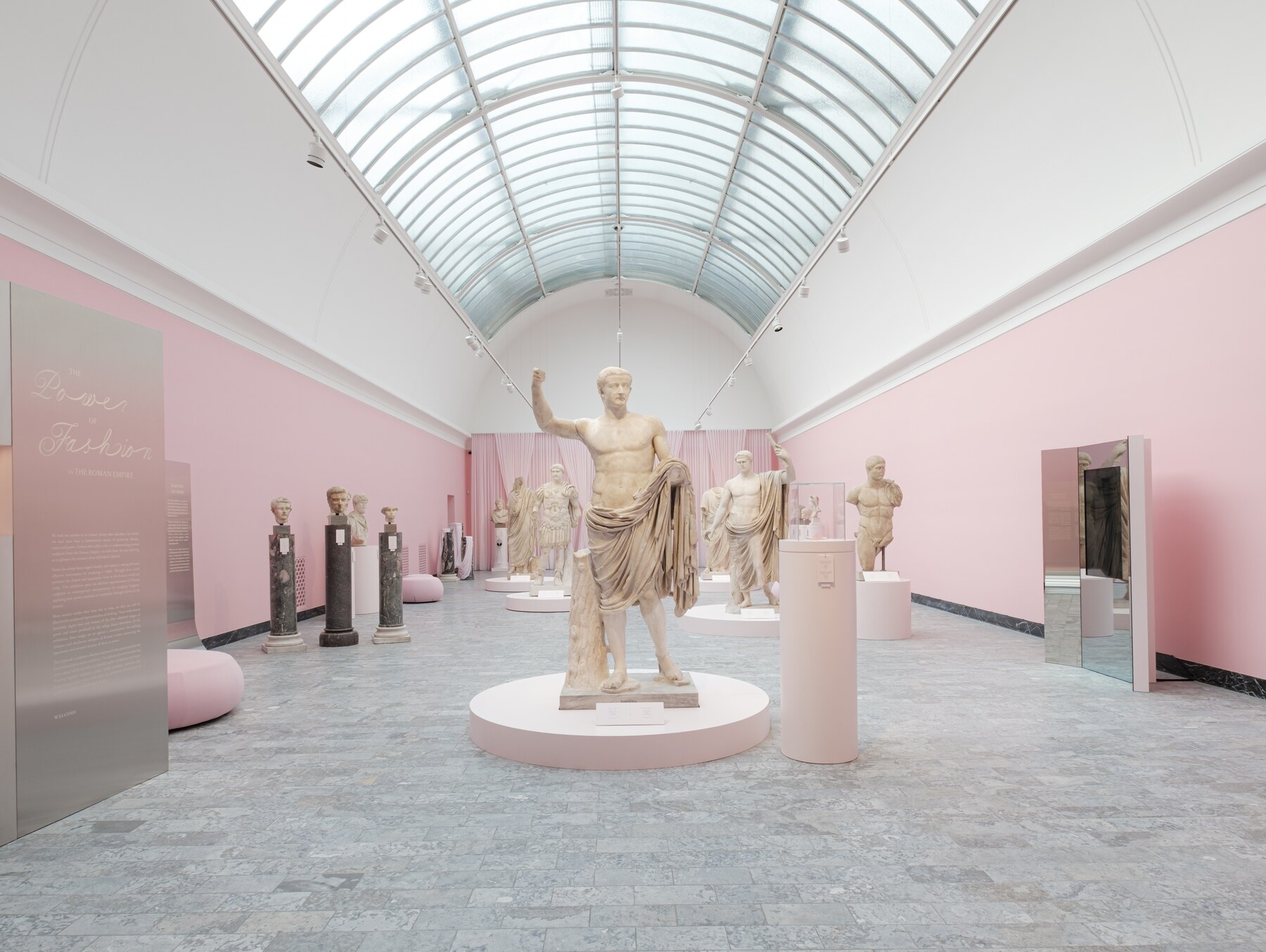
There is a Copenhagen that you can only see indoors, and it is a warm one. Walls the colour of burnt sienna and chrome yellow. A ceiling painted blue and gold. A glasshouse of palm trees in the middle of a sculpture museum, in a city where it is dark by four o’clock in the winter. A garden with an almost nine-metre spiral of red and white umbrellas turning in the wind. And, this autumn, a hall painted pink for an emperor in a hot-pink toga.
Copenhagen’s museums are not neutral white boxes. Many of them are buildings with a strong colour and a strong personality, and what is on show inside is often in conversation with the walls around it. So here is a guide to six of them, as they are right now, in the final stretch of 2026: what the rooms look like, who made them, and what is on until when. Between them you will find the ochre streets that connect it all.
I · Thorvaldsens Museum: the building that was never white
Start with the one that surprises people most. Thorvaldsens Museum sits on Slotsholmen, beside the palace of Christiansborg, and it was designed by the architect Gottlieb Bindesbøll to hold the works that the sculptor Bertel Thorvaldsen left to his native city. It opened in 1848. You expect a temple of white marble, and the statues are indeed white. But the rooms around them are painted, in saturated colour, and walking in feels like stepping into a jewel box.
The idea behind that colour has a history. According to sources on the museum, Bindesbøll followed the debate of his time about how brightly the ancient Greeks had painted their temples and sculptures, and brought strong colour into a neoclassical building in Copenhagen, which met with resistance at first. Modern descriptions of the galleries talk of a palette of earth tones: alternating shades of umber, burnt sienna, ochre and chrome. The building was restored several times, among others between 1921 and 1942 by the architect Kaare Klint, so what you see is the result of many hands, not a perfectly frozen 1848. I could not find a room-by-room paint analysis, so I will not pretend to know exactly which wall was which colour on opening day.
Look at the floors, too. They are tiled in geometric patterns, ochre, grey and black, a different design for different rooms, so that the ground itself is a kind of fabric. The ceilings are the real surprise. In some galleries they are decorated with pale, finely worked ornament that you only notice when you tilt your head back.
The courtyard completes it. Thorvaldsen is buried in the middle of the museum he never saw, in a courtyard whose walls carry painted friezes of plants. A museum designed so that visitors would remember it as a place, not only a collection. If you do one thing in Copenhagen on a grey day, make it this: the colour is its own exhibition.
II · The Glyptotek: palms in winter, and a hall painted pink
The Ny Carlsberg Glyptotek is the museum of the brewery’s heir, Carl Jacobsen, and it is a collection of ancient sculpture that happens to live in a building with a garden inside it. Under a glass roof is a winter garden of palms and tropical plants, with a fountain, benches, and a mosaic path. In the Danish winter, people sit there with coffee and take off their coats.
And this autumn the building has an exhibition that is entirely about colour. The Power of Fashion in the Roman Empire opened on 1 October 2026 and, by the museum’s own listing, runs until 27 March 2027 (a few news outlets give 29 March, so check before you plan a trip around the final weekend). It has 171 objects, drawn from the Glyptotek’s own Roman collection and from international loans, and it is the largest special exhibition on antiquity in the museum’s history.
The centrepiece is a statue of the emperor Tiberius, carved in the first century. Today it is white marble. But polychromatic analysis shows that the cloth draped over him was originally hot pink, a colour associated in his day with wealth and conviction, and the exhibition digitally reconstructs how the statue may have looked. It is a good reminder that the white marble we think of as “classical” is mostly what time left behind: the colour was washed, burned and worn away, and now scientists are painting it back. “Today, a half-naked ruler wearing pink might come as a surprise,” the Glyptotek’s Brøns says in the museum’s statement, “but for the Romans, it was a clear visual statement of power, luxury and divine authority.”
The pink is the point. In antiquity, the status of a colour was largely a question of how hard it was to make: pinks and purples came from shellfish, and ancient Romans boiled snails in lead vats for days at a time to get the dye. Fashion, in other words, was not a frivolity but a legible code, in which the right colour, the right hairstyle and the right scent told a room who you were. The show makes that code something you can smell: four “scent stations”, developed with a Danish skincare company, let visitors sniff floral notes worn by Roman men and the stronger perfumes popular among women, and twelve listening posts let you eavesdrop on Roman writers gossiping about what their powerful contemporaries wore. There are also loans, including three tunics that have never before left the British Museum.
III · Designmuseum Danmark: a rococo courtyard, and a spiral of umbrellas
Designmuseum Danmark is housed in an eighteenth-century building, a former hospital, and the first thing it teaches is how calm a Copenhagen facade can be: a long pale-grey front with white windows, a central pediment, and a dark door, around a gravelled courtyard with a line of stones set into the ground. It is the opposite of a museum trying to impress you. And inside it is a different story.
From 18 September 2026 to 21 February 2027 the museum belongs to the Danish designer and artist Henrik Vibskov. He has spent more than 25 years building a universe in which music, scenography, costumes, installations and fashion feed one another. A graduate of Central Saint Martins (2001), he has made more than 50 fashion collections and shown at MoMA in New York and at the Palais de Tokyo in Paris, and he plays drums with the band Trentemøller and others. Alongside the studio he is a professor at Design School Kolding, and his prizes include the Thorvald Bindesbøll Medal and the Crown Prince Couple’s Culture Prize; in 2025 he received a lifelong honorary grant from the Danish Arts Foundation. The exhibition is immersive, with miniature models of installations, 44 display cases of objects and prototypes from his studio, and walk-through works, and its stated spirit is that mistakes are gold and beauty can emerge from chaos.
You can see part of the show before you step inside. The outdoor piece The Umbrico Spiral, almost nine metres tall, with red and white double spirals that turn in the wind, stands in the museum garden. Against grey plaster and green summer leaves, the red and white is the loudest colour in the neighbourhood, and the most cheerful.
IV · ARKEN: a ship made of concrete, and a troll made of trash
Out on the coast at Ishøj, south-west of the city, ARKEN is the museum that looks like it is about to sail. Its architecture is deliberately nautical: a long white form with a sharp angular prow, set among water and reeds at the edge of the sea. (The architect is Søren Robert Lund and it opened in 1996; I am quoting this from general knowledge rather than a source I checked this week.) It is worth the trip in itself, and this year it is worth the trip for one exhibition in particular, with only a few weeks left.
Thomas Dambo – The Garbage Man runs from 24 May to 29 November 2026. It is the first museum exhibition by the Danish artist who has become famous for monumental troll sculptures made from recycled materials: more than a hundred of them, placed around the world. Dambo came to it by an unusual route: a youth shaped by hip-hop, graffiti and street art, then large-scale installations from salvaged material, and a conviction that upcycling and public participation are the point. His breakthrough was The Six Forgotten Giants of 2016, giant trolls hidden in the green areas around Copenhagen’s western suburbs, and the American version of his Troll Hunt drew more than 1.24 million visitors in its first year, according to the museum. ARKEN says it aims to be the first museum in the world to bring Dambo indoors, and the exhibition tries to say that recycling is gold.
The colour here is of a different kind: not paint, but the stuff of a thousand wardrobes. The halls are filled with mountains of discarded clothing, cardboard and plastic, which the trolls rise from, climb over and sleep in. ARKEN thanks the waste companies and the charity Folkekirkens Nødhjælp for collecting the waste that went into it. At the end, there is a troll workshop where visitors build their own trolls from the museum’s own former shop and foyer flooring, which had just been taken out. The museum’s building is, in a small way, part of the art.
V · Louisiana: the museum that lets the garden in
Further north, in Humlebæk, the Louisiana Museum of Modern Art starts in a nineteenth-century villa and then keeps going. Its founder Knud W. Jensen bought the villa to turn it into Denmark’s first contemporary art gallery, and the architects Jørgen Bo and Vilhelm Wohlert extended it over decades, in six buildings between 1956 and 1991, that link together in a continuous circuit around the park. The principle, repeated in every description, is balance: nature, architecture and art. The villa is not hidden or replaced. It is just the beginning of a walk.
Look at the details here: the low roofs, the dark window frames, the pale concrete steps, and the way every pavilion frames a different piece of the Øresund. The museum’s colour is the colour of its surroundings: the ivy-green of the villa, the blue of the water, the grey-white of the concrete, the dark green of the trees.
The current headline show is a retrospective of Remedios Varo (1908–1963), the Spanish-Mexican artist who made precise, dreamlike paintings at the meeting point of Surrealism, mysticism and science. It has more than 70 works, including paintings, drawings, notebooks and archival material, arranged in roughly chronological order, and it is on until 10 January 2027. Varo’s technique is meticulous, and much of her imagery draws on Italian painting of the late Middle Ages and the Renaissance. The exhibition is organised around questions of creativity, knowledge and perception, and around how Varo moved between dream and reality in a single canvas. For a museum so tied to its park, there is something fitting about a painter who made entire interior worlds.
VI · Between the museums: the ochre streets
It would be a mistake to end indoors. Everything above is connected by streets, and the streets have their own palette, a warm ochre that you could call the city’s house colour. Its purest form is in Nyboder, the low terraced rows King Christian IV began in 1631 to house the sailors of the Royal Danish Navy; ‘Nyboder yellow’ is an accepted colour name in Danish. Whether the original paint was ochre-wash on pale brick or something else is disputed, but the way a lime-and-earth-pigment wall holds the evening light is not.
Then there is Nyhavn, dug between 1670 and 1675, whose coloured houses and old wooden ships look best at the end of a long day, and the black-and-gold spire of the Church of Our Saviour, whose external staircase winds around the outside of the spire, 400 steps in all. They are not museums, and they are free.
A museum day, planned by colour
If you have a long weekend, you could do worse than plan it by colour. Begin with Thorvaldsens Museum, because it will recalibrate your eye; the Glyptotek’s palm garden and its pink Roman hall for lunch; Designmuseum Danmark and Vibskov’s garden in the afternoon, with the grey rococo courtyard as the rest. Give ARKEN or Louisiana a whole day each, because both are better as a destination than as a stop. ARKEN’s trolls leave on 29 November, so that is the one with a deadline; Varo stays until 10 January and Vibskov until 21 February.
Fact-check note: dates and show details come from the museums’ own pages and from Smithsonian Magazine, Euronews and other press coverage of the shows; the Glyptotek’s closing date differs between sources (27 vs 29 March 2027). Thorvaldsens Museum’s colour scheme is from published descriptions; I found no room-by-room paint analysis. The 1848 opening date, Thorvaldsen’s burial in the courtyard, the Glyptotek’s founder Carl Jacobsen, ARKEN’s architect and 1996 opening, and Designmuseum Danmark’s origins as a hospital are from general knowledge. Please double-check opening hours and any ticket rules before you go. Photographs from Wikimedia Commons are credited in each caption with author and licence; exhibition photographs are used with credit to the photographers and the museums.