All Intensive Purposes: Misha Kahn and the Design of Getting There
Review
An onyx table that pretends to be junk, a dining table cast from the mess after the aperitivo, a wall of sugar-glossy mirrors: Misha Kahn’s new show at Friedman Benda in New York is a portrait of how contemporary design is really made.
Viacheslav Munister · 2026-11-05
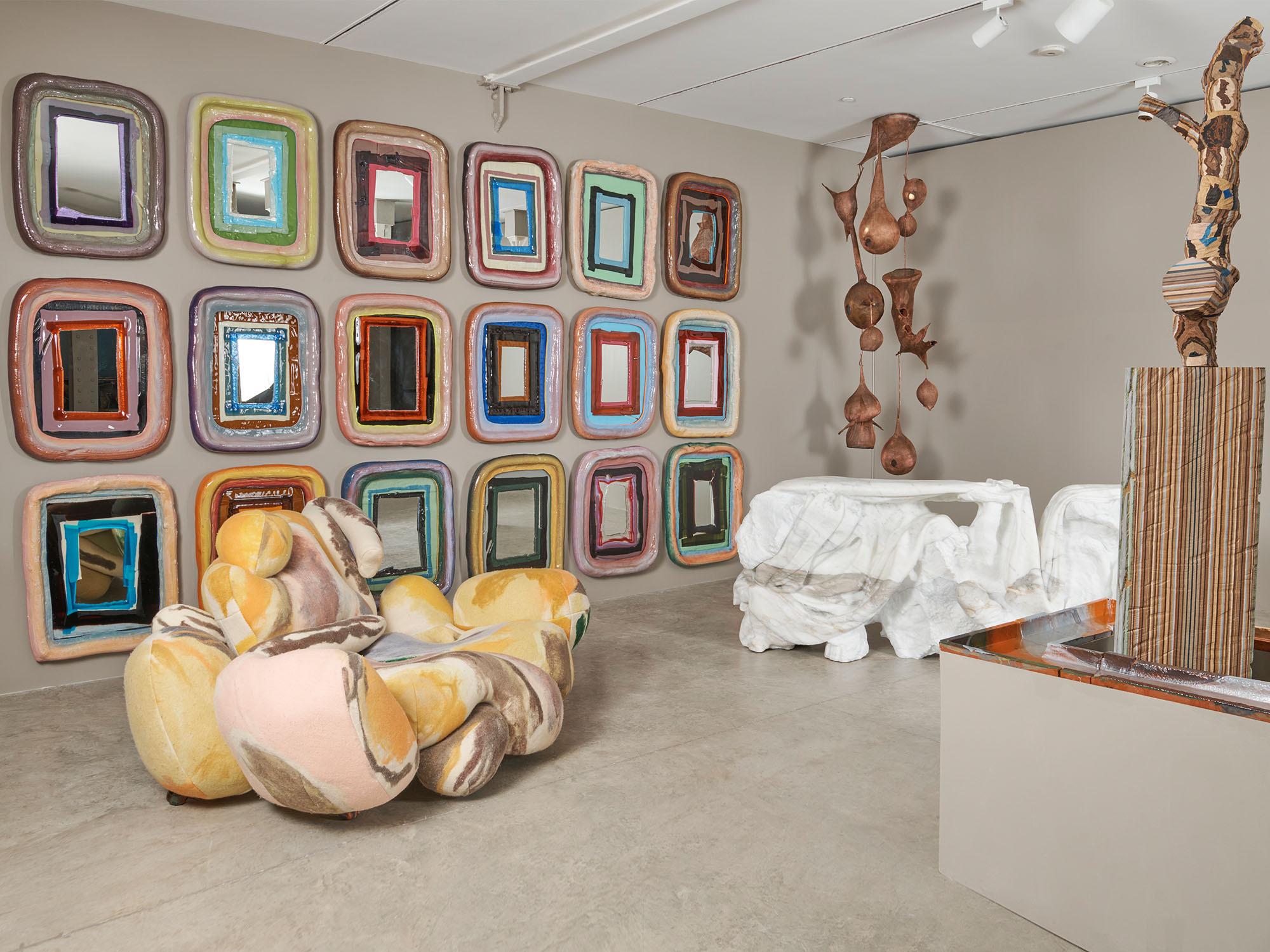
Most furniture is designed backwards. You start with the purpose – sit, eat, store, look – and work back to the object. Misha Kahn starts at the other end. He follows a material, a technique or a half-formed joke as far as it will go, and only at the end asks whether the thing that came out is a chair. The answer is usually yes. It is also usually something nobody has seen before.
His new exhibition at Friedman Benda in Chelsea, which opened on 29 October and runs until 12 December, is called All Intensive Purposes – a deliberate mishearing of “all intents and purposes”. The gallery’s text puts it neatly: the title shifts the focus from a predetermined end to the intensity of getting there. The show marks ten years of Kahn’s collaboration with the gallery, and it is the clearest statement yet of what makes him one of the most interesting designers working in America.
I · Furniture as a process you can see
Kahn was born in Duluth, Minnesota, in 1989 and studied furniture design at the Rhode Island School of Design, graduating in 2011. Three years later he was in the Museum of Arts and Design’s Biennial. His first institutional solo show, Wobble Moon, was at Museum Villa Stuck in Munich in 2022, and his work is now in the Brooklyn Museum, the Corning Museum of Glass, LACMA, the Dallas Museum of Art and the Museum of Fine Arts, Houston.
What sets him apart is range. He works in metal, glass, wood, textiles, ceramics, resin, fibreglass, cement and stone, and moves between the crudest and the most advanced techniques without embarrassment: improvised moulds and collage on one side, virtual reality modelling and industrial casting on the other. He also seeks out masters – the women weavers of Gone Rural in Eswatini for his woven Scrappy series, Stephens Tapestry Studio in South Africa, the glass sculptor Deborah Czeresko in Brooklyn, the late Italian jeweller GianCarlo Montebello. The result is design made the way contemporary industry actually works: global, hybrid, digital and handmade at once.
Look first at the upholstery. In a new series, Kahn builds sofas and seats as heaps of soft forms, then covers them with bold painted marks, so that the whole object looks, in the gallery’s phrase, as if it had been sculpted from paint. They are absurd and inviting at the same time: you want to laugh, and then you want to lie down.
II · Stone that pretends, metal that remembers
The centrepiece is a dining table called Post Apertivi Detritus. Its base is a sprawl of cast metal; one element is a sculpted torn napkin, complete with a gristly bit of food, impaled with toothpicks. The top, rendered in cast glass and stone, has the staccato rhythm of a graphic print. The title tells the story: this is the table after the aperitivo, the moment when order has already collapsed. Kahn casts the mess and makes it permanent.
The same reversal drives a low table carved entirely from onyx. Onyx is one of the most precious decorative stones there is; Kahn forces it to impersonate something cheap and roughly assembled, all broken edges and makeshift joints. Elsewhere he carves wispy drapery into Calacatta marble and knits chandeliers out of copper. Every time, the most skilled work possible is spent on making a thing look accidental. It is a joke about craft that only a very good craftsman could make.
The most skilled work possible is spent on making a thing look accidental.
III · A wall of mirrors
The most immediately seductive work in the show is a wall of mirrors. Eighteen frames, each soft, thick and glossy like poured sugar, each a different chord of colours – lilac around green, pink around cobalt, honey around brown. Seen together they look like a colour chart for a world that does not exist yet. Seen one at a time, they do what a mirror should: put you in the picture, slightly distorted, slightly happier.
Here and there the exhibition also traces material back to its origin. A discarded scrap of paper is folded, twisted and torqued into a new form; works in Alpi plywood – a colourful multilaminar veneer – return to tree-forms, only to be “butchered back into objects”, as the gallery puts it. The show is quietly about where things come from, and how much transformation an object can absorb before it forgets.
IV · Why it matters
For most of the twentieth century, industrial design meant reduction: the best object was the one with nothing left to remove. Kahn’s work belongs to a generation that grew up with digital modelling, global supply chains and endless images, and it draws a different conclusion. If almost any form can now be made, the interesting question is no longer how little, but how far. His answer is an object that keeps the traces of every decision, accident and collaboration that went into it.
The gallery ends its text with a line that describes the show better than any review could: with its gluttonous array of materials and processes, the exhibition begins to resemble the absurd collage outside. That is the point. These are not escapes from the contemporary world. They are portraits of it – and you can sit on several of them.
See it
Misha Kahn: All Intensive Purposes is at Friedman Benda, 515 West 26th Street, New York, until 12 December 2026.
Facts, titles and descriptions of the works are from Friedman Benda’s exhibition text and the gallery’s biography of the artist. Images are the gallery’s exhibition photographs, reproduced with credit.