Ádám Dóra: The Discipline of Being an Artist
Interview
Adam Dora on the intersection of abstraction and everyday life, the role of discipline in creative freedom, and the importance of staying true to one's artistic vision.
Maria Ivanova & Ádám Dóra · 2026-11-17
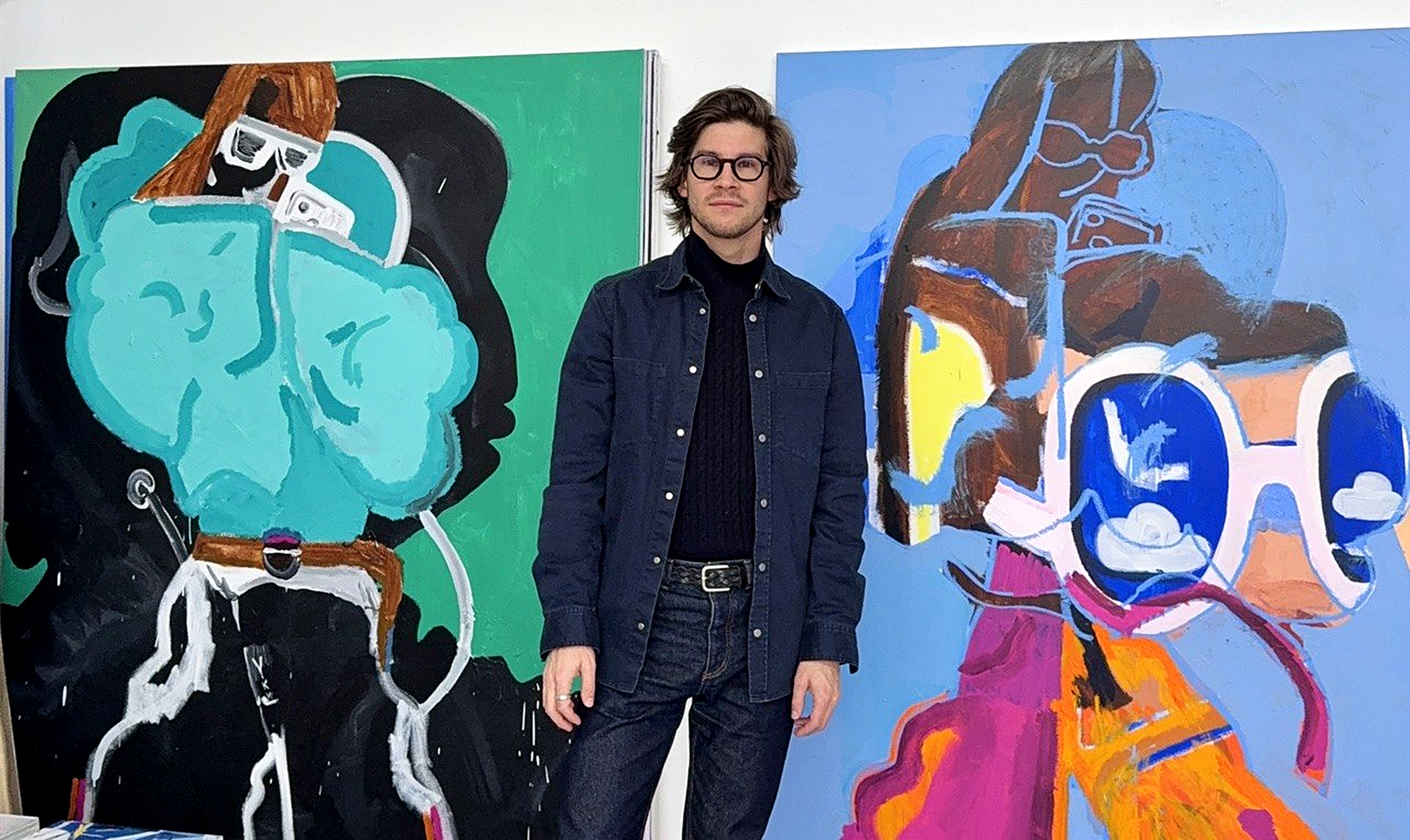
Adam Dora’s paintings occupy a space between abstraction and representation. What initially appears to be an arrangement of colours, textures and gestures gradually reveals familiar objects drawn from everyday life. From food and fitness equipment to contemporary technology, these elements become part of a visual language in which observation and painterly experimentation are closely intertwined.
We talked with Adam Dora about his artistic practice, the role of discipline in creative freedom, the importance of staying true to one’s artistic vision, and his favourite places across European cities.
Becoming an Artist
Maria Ivanova [MI]: How did you come into art?
Adam Dora [AD]: From childhood. When I was a kid, I was always interested in pictures of all kinds. I collected pictures, stickers, postcards, everything around me, and I was always drawing, like any kid.
At a certain point, I realised that if you want to be connected to this all the time, if it’s the main practice you enjoy and you take making pictures seriously, then that’s what being an artist means. But I didn’t know that before. It was always a part of my life when I was growing up.
Then my parents started taking me to an artist, a classical portrait painter, so my education was very classical, focused on the study of painting. I started attending classes, and that’s how my professional journey began. Then I realised I wanted to study art, and I went to university.
Education and style
MI: Is it essential for an artist to have a degree?
AD: I come from a classical education, so I have that background, but I know a lot of artists who have no formal education. I think being a good artist isn’t something you can teach. You can learn skills, techniques, art history and aesthetics. It’s nice to be educated, to know your culture, art history and world history. But to make good art, it isn’t necessary. It’s a plus.
MI: And what is necessary?
AD: I think tension, and deepening your sensitivity in your own way. It could be anything, and it’s very personal. In my work, one part comes from the themes, from inspiration, from the collective memory that I put into my work. But another part is sensitivity. It’s very personal: you were born, you came into this world, and everyone has their own personality.
How you touch a material and transform it into a picture, a sculpture or a three-dimensional object – that’s magic, because it’s just a material, and then it becomes a creature.
MI: How did you develop your style? At first glance your paintings are abstract, but then you go deeper and understand that they’re not abstract at all. It’s fabulous.
AD: Thank you so much. It’s very hard to describe. I was really into abstraction as a kid. I could play with anything: sticks I found, leaves, splashing water. That’s an abstract approach: sensory experience, when you see shapes and colours, and your brain connects them.
It has always been with me, and it’s really hard to put into words. You see, hear, and study things around you, and even if you don’t go to art school, everything in your environment definitely affects your memory.
That’s why I can’t be totally abstract: I really like seeing things, analysing what I see and having a connection to them. And the same with abstraction - my brain starts to turn it into a context. It’s like architecture: you have to construct something. Even on a canvas, you construct a composition through colours, materials, textures, and so on.
MI: What are you working on right now? [interview conducted in early October 2026]
AD: You’ve probably seen the series with lenses. That’s my latest work. I showed three pieces at the Budapest Contemporary Art Fair with my Hungarian gallery, and I also have a series with my Barcelona gallery.
They're figures and faces where you can’t tell the sex. They reminds me of figures from fashion advertising, things I’ve seen on Instagram or social media. That affects me a lot, not directly, but somehow it goes into my brain, and I’m really interested in how it influences paintings.
There’s another recurring theme in my work: lenses, phones and eyewear. I’m particularly interested in how these objects shape the way we see. There’s a lot of meaning in that, but they also serve as compositional elements in my new paintings.
MI: Whenever I look at your paintings, I get the feeling that you enjoy the creative process just as much as the final result. There’s something very sincere and unforced about every gesture, as though the pleasure of painting itself is visible in your work. I find that particularly fascinating. Would you say that’s true?
AD: You’re totally right. That’s really important, perhaps the most important core of my work. Painting has a very powerful energy, and sometimes its not so much about what is in the picture or the strength of the concept (of course, those things matter), but about the energy that comes through and how the work starts to speak for itself.
But on the other hand, if you look at my projects and exhibitions, all of them deal seriously with contemporary themes. The two balance each other.
MI: How do you think AI impacts art practice?
AD: A lot. Many artists use it, and I use it for research. If I have a question about a topic or want to look something up in art history, I use Google or whatever else is available. Everything is becoming integrated.
I’m not against it, because it helps and saves a lot of time. But I don’t use it to generate pictures. I don't like it, although maybe it will get better in the future.
But what I’m searching for in pictures is impossible to replicate with AI. If it were possible, my practice would be over, but I truly believe it isn’t.
Where it comes from, what it’s for, what the goal of the work is - that’s not something an algorithm can achieve. It isn’t human, and it lacks the randomness of the human brain. I’m not an expert in this field, but that’s what I believe.
Personal Belongings: the fitness-club series
AD: This was my latest solo exhibition at a Hungarian gallery [Heart&Cherry], Personal Belongings. The exhibition explores the environment of a fitness club through abstraction.
Before this, I had been working with food elements, landscapes and still-life elements with small objects. Then I started noticing similar scenarios in the gym and became fascinated by them.
A fitness club is a special place, with an atmosphere that exists only there: the furniture, the colours, the lights, the iron objects, the plastic objects. It’s an abstraction. I imagined some of these places, but also incorporated things I had seen, and my brain turned them into pictures.
I really liked how the exhibition space matched the interior and how the colours worked together.
The show was about the imaginary story of a man alone, working out, which is reflected in the paintings. There are no figures, no other people in the pictures, just scenarios made up of objects.
It’s also about playing with the proportions of small and big things. I’m really interested in how you can experience space and translate it into something flat. That’s always part of painting.
I Paint What I Don’t Want to See
MI: Can we talk about your exhibition I Paint What I Don’t Want to See?
AD: Yes, this was in Piramidón Centre d'art Contemporani in Barcelona. I had a summer residency programme, and I developed this series of works for the exhibition. This was before the gym series; it’s where it all started.
The concept came from a book about Philip Guston, I Paint What I Want to See. That was the main concept and the title of the book. After the abstract period of his life, he started making figurative works, imaginary scenes centred around an artist, the studio and so on.
This series is much more about the experience of being in the kitchen. For example, this painting came from mixing colours on the palette while I was also preparing food. I’m always making sauces, cutting things into sticks, making fries or something like that, constantly mixing things and colours. I realised that it’s all connected. The cloud here is a playful element, fluffy, like dough in the kitchen.
MI: And again, we see the AirPods here. I really like it. Not everyone can understand abstraction, but when they find an element they can relate to, they become fascinated by the whole artwork. It’s kind of a hook for them.
AD: Absolutely. And I put it there because it’s not about including an exact product in the work. Some older people, or even young people, might not recognise this product. It’s purely compositional.
When I started painting it, I had seen this object on my table and thought: that’s nice, because I need something round like this - four circles, two white and two black. It’s abstract thinking within a picture.
Then your brain connects it to another product. So it also reflects how I think when creating an abstract painterly language, while a mind conditioned by advertising tends to go in a commercial direction.
It was the same with the hamburgers. I was building a tower of colours and shapes. It’s an abstract painting, but seen from another perspective, it’s a giant hamburger. When you get close, it feels very powerful and intense.
One of them is still with me. It hangs at the entrance to my house, where there’s a narrow hallway leading into a larger area with a big table. It covers the whole wall – about two metres by 180 centimetres.
It changes how you approach the space: when you walk through, you see just gastro-abstraction, but when you sit at the table, you can see a burger. Two opposites.
Discipline
MI: Do you ever have periods when you lack inspiration or don’t feel like working?
AD: Of course, everyone does. I travel, but inspiration is something you cannot expect. I think it comes when you work.
If you work as a professional artist, you work continuously, and I like to work this way. If I’m in the studio and I find my rhythm, it works. Sometimes there are ups and downs, of course. I don’t have the same energy level all the time, but you can train it.
It’s very similar to being a professional athlete. Sport and art are very different, but the discipline of training yourself to work in any mood is the same.
Someone preparing for the Olympic Games has to focus on many things, and not every training day is the same: sometimes you have more energy, sometimes you’re more exhausted. But if you know your goal and keep following that path, then in the long term, you’re moving upwards.
That’s my vision of life, not only of art.
Favourite places
Budapest
MI: What’s your favourite place in Budapest, your hometown? It doesn’t have to be related to art, anything that comes to mind.
AD: I’ll start with a special place that isn’t really connected to art, perhaps only architecturally. It’s called Rudas, a Turkish bath on the Buda side. I used to go there almost every week, or every two weeks when I’m in Hungary.
It’s a historic bath, built when the Turks were in Hungary, and it still has some of its original walls and roof. I love it because it’s beautiful, and the mineral water comes up from beneath the hills.
I also like the Museum of Fine Arts, which everyone connected to art should visit.
Barcelona
MI: What about Barcelona?
AD: Well, in Barcelona, I always stay at Piramidón, a huge building with four floors of artists’ studios and one floor of gallery space. It’s a hybrid between a studio house and a gallery.
They organise exhibitions featuring the artists who live there, and they also have a huge collection. They started collecting works by artists back in the eighties and nineties. It’s amazing to be part of that community.What I would really recommend in Barcelona is the Picasso Museum and the Miró Foundation on Montjuïc.
For design lovers, I would recommend Side Gallery. It’s a very extraordinary space, focused on collectible design and unique experiences.Among contemporary art galleries, the one I work with, Escat Gallery, is of course my number one. It’s a growing gallery with two spaces, one on Trafalgar Street and the other in L’Hospitalet de Llobregat. It’s really cool.
France
MI: What’s your favourite museum in France?
AD: I really like the Centre Pompidou. I’ve been there many times. In Paris, I also like the Rodin Museum. It’s amazing, and the sculpture garden is beautiful.
If I can name somewhere outside the capital, it’s the Picasso Museum in Antibes. It’s fantastic. And there’s also a Fondation Hartung Bergmann in Antibes. I went there about ten years ago, when it wasn’t open to the public as it is now and visits were by appointment only. Now it’s open once or twice a week, so it’s easier to visit. It’s very nice.
In addition, Matisse museum in Nice is worth visiting.
In Closing
MI: What advice would you give to everyone in this world?
AD: Maybe it’s too simple, but follow your own path. Many people say this, but many of them don’t take it seriously.
Interview by Maria Ivanova, edited for publication. Cover photo by Victor Marosi.