A Cow Made of Broken Tile
Interview
A family workshop on turning mosaic, a material invented never to move, into furniture that ships across oceans, and why a table with a cow on it is, they insist, mostly about the glass of milk you got after a day outside.
Viacheslav Munister & DIHLUST · 2026-09-18
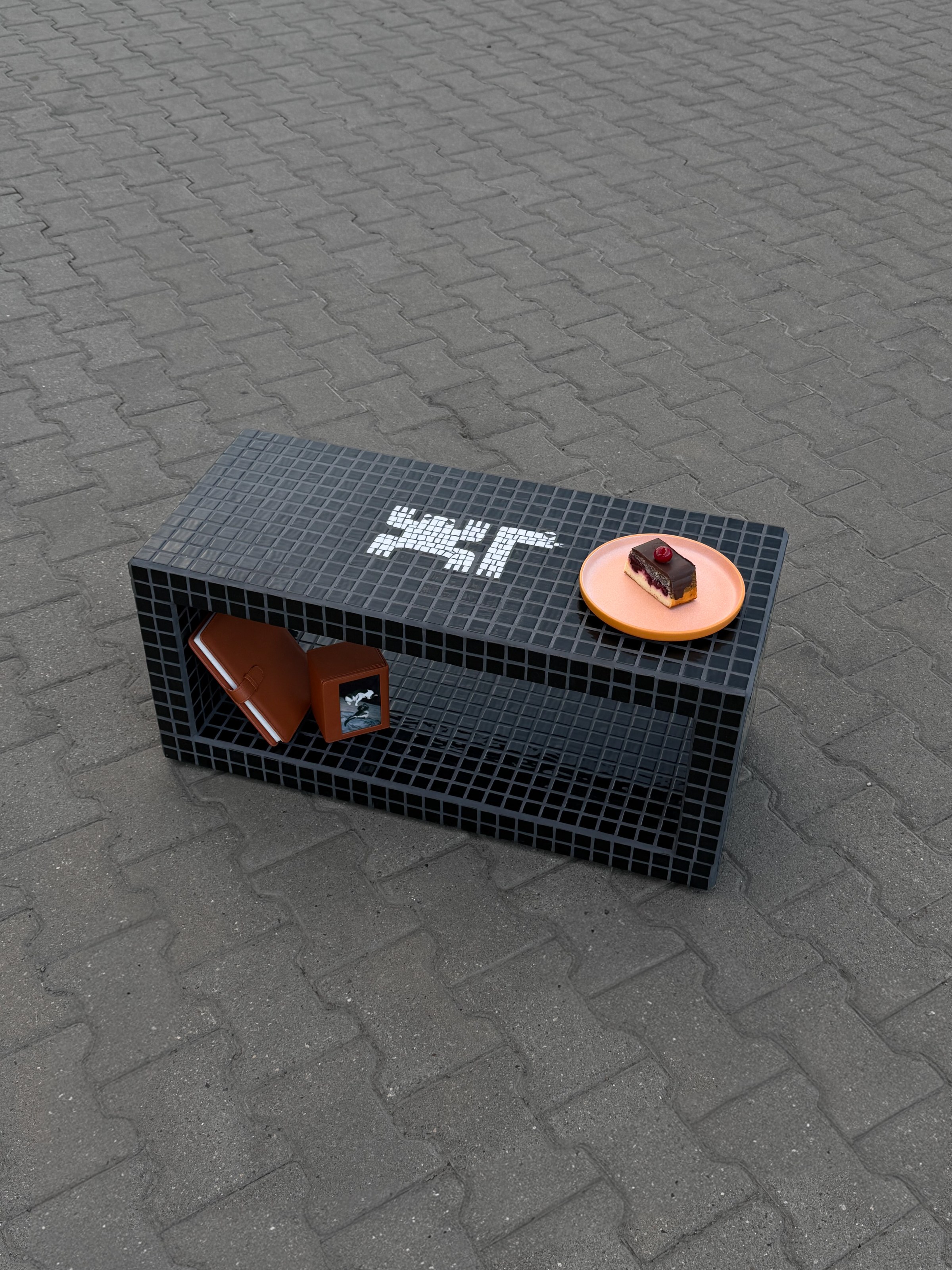
DIHLUST is a family workshop in Ukraine, run by a brother and sister who build small, cube shaped side tables entirely out of glazed mosaic tile. Every piece begins as a sketch reduced to a grid, most often a pixellated cow, their signature image, though a client's logo or a pet's portrait works just as well, then gets laid, tile by tile, onto a wooden frame built to carry the weight.
Their online listings read less like a shop and more like a missing-pet notice reworked for furniture: a promise that MILK-cube is “looking for a loving family.” Mosaic has meant permanence for two thousand years; DIHLUST packs it for international courier instead. EPRIS wrote to them with nine questions built around exactly that contradiction. They answered in their own words, translated here from Ukrainian and condensed for length.
William Morris argued, a century and a half ago, that everyday objects deserve as much attention as painting, the idea the Arts and Crafts movement was built on. Tell us how DIHLUST began: why did a cube clad in mosaic, rather than a painting or a sculpture, become the object you chose to speak through?
The first reason is function. A side table is not a silent object, it is something we interact with every day: you set a coffee cup on it, put down a book or your keys. That means it can belong to any space, and it lives alongside our life. Marks get left on it, it gets used. It is a functional art object that erases the line between a certain high aesthetic and the everyday.
In Japanese folklore there is tsukumogami, the belief that an object, used long and carefully enough, eventually grows a soul of its own. Your listing “MILK-cube is looking for a loving family” says almost exactly that about furniture: factory objects are usually silent, yours seem to be looking for a home. Where does that impulse to humanise, or animalise, your own pieces come from? Do you genuinely feel each cube is a little alive, or is this mostly the language of marketing?
Of course there is a large part marketing in it, we like playing with concepts and metaphors. But every table really is unique, which makes it very easy to grow attached to it, almost like it is family.
The “loving family” listing is actually an old street form: a handwritten notice on a lamppost about a lost pet, with tear-off phone number strips along the bottom. You took that form almost literally and filled it with commercial content. What matters more to you in that gesture: irony about advertising, or a sincere attempt to make selling furniture feel as emotional as finding a home for an animal?
We carried that format over to furniture because every table of ours is unique. When you make something with your own hands, putting in tens of hours of work, it stops being just a product and takes on a character of its own, so we thought it would be great to build that into the piece in this style.
A cow and a glass of milk are a recurring motif in your work. Is that more a personal story from childhood or rural life, or a deliberate engagement with a pastoral, almost kolkhoz adjacent iconography that a lot of people in Ukraine right now either feel awkward about, or, on the contrary, are reclaiming with tenderness?
It is mainly about nostalgia. When we were thinking about which set to release first, as a family business, me and my brother, we wanted, for no particular reason, to start from where life itself starts: from childhood, from its warmest memories.
The image of a glass of milk is tied to something simple: how we would spend a whole summer day outside, running around, getting tired, and then that cold glass of milk felt like the tastiest thing in the world. Those are pure emotions and memories we wanted to put into our work. It seems like exactly the kind of nostalgic feeling that connects most people.
Mosaic has meant permanence for millennia: the floors of Byzantine churches, Gaudí's façades, things built to outlast generations in one place. You turn it into an object that can be lifted, embraced, sold and shipped across an ocean. What breaks in the idea of mosaic itself once it stops being part of a fixed space and becomes a thing that travels?
Nothing breaks. If anything, mosaic takes on an entirely new life here. We are not destroying its permanence, we are making it mobile. We are simply rethinking it.
Your profile has a “MEET OUR TEAM” family collage. Historically, a workshop where the whole family works is closer to a medieval guild, or to the early Eames Office, than to a contemporary design studio with hired staff. Was staying a family workshop a conscious choice, or did it simply happen that way because of scale?
It was a conscious choice, even though the whole thing was born spontaneously. We came up with the business itself in literally one day. Then we checked the market, realised nothing quite like this existed yet, and started acting right away.
Our family has always made things with our own hands: my brother paints and does plaster relief work on walls, our father can do a full renovation from scratch himself, so there was never really any doubt we could learn this too and build the picture we had in our heads. It is also a rare chance to do creative work that feeds the whole family at once, about as close to an ideal life scenario as it gets, because everything our family has ever had came through hard physical labour and a constant search for work.
Fragile tile on a wooden base, and yet worldwide shipping across oceans and customs: a material invented never to move again now has to survive a courier service. What did you actually have to change in your technique for the sake of the journey, rather than for the sake of beauty?
We had to make peace with the fact that packaging for each table ends up fairly expensive, around twenty to twenty-five percent of the table’s cost. That is a sacrifice we cannot show our work to the world without, so we just accepted it as a fact. We also had to reinforce the tables from the inside, which adds weight but is about durability. They weigh sixteen to thirty-one kilograms.
Your bio has the phrase “possible realisation of your own…”, meaning you are open to someone else’s idea. In a traditional craft guild the master usually carried out the patron's vision and kept his own voice hidden in the execution. Is it the same for you, or does the final word always stay with you while the client only sets the theme?
We are always interpreting someone else’s idea, but through the lens of our own style. All our tables stay pixellated and minimalist, but the image itself can be almost anything: a logo, a portrait of someone’s pet. The final word on style and form is always ours, because that is our artistic language, but the client sets the theme and the story. We get enormous pleasure from that process, watching a shared idea turn into a recognisable pixel art table.
The Arts and Crafts movement never quite survived its own contradiction: handwork, loved for being unrepeatable, scales badly without losing exactly what made it worth loving. Have you already thought about that trap for DIHLUST, or are you prepared to stay a small workshop for as long as it takes?
We are fully aware of that trap of handwork, but in our view it is always better to raise quality and value than to chase volume of sales. Of course, if it turns out to be necessary for growth, we do plan to eventually bring in extra hands for the basic processes, to make the work more efficient.
Photographs courtesy of DIHLUST. Interview conducted in writing for EPRIS Journal, September 2026, and translated from Ukrainian.